$MAXI: The Next Crypto to 1000X? How Political Scandal is Driving Eyes to New Defi Projects

bitcoinistPublished on 2026-02-03Last updated on 2026-02-03

Abstract

U.S. political scandals, like Senator Chris Murphy’s allegations of "potentially criminal conduct" in crypto deals, are shifting investor attention from institutional projects to decentralized finance (DeFi). This distrust is driving capital toward community-driven, politically independent assets. Maxi Doge ($MAXI), a meme token emphasizing transparency, leverage, and high-risk growth, is positioned to benefit. With over $4.5M raised in its presale and a focus on active community participation, it appeals to traders seeking alternatives to politically influenced cryptocurrencies. However, such investments carry significant risk.

When U.S. Senators start tossing around terms like ‘potentially criminal conduct’ to describe high-profile crypto deals, the market listens.

But perhaps not in the way regulators intend. Senator Chris Murphy’s recent grilling of potential UAE investments, citing ‘brazen, open corruption’, has dominated headlines. Yet, this geopolitical friction highlights a growing fracture. It’s the widening gap between ‘corporate’ crypto and the wild, permissionless world of DeFi.
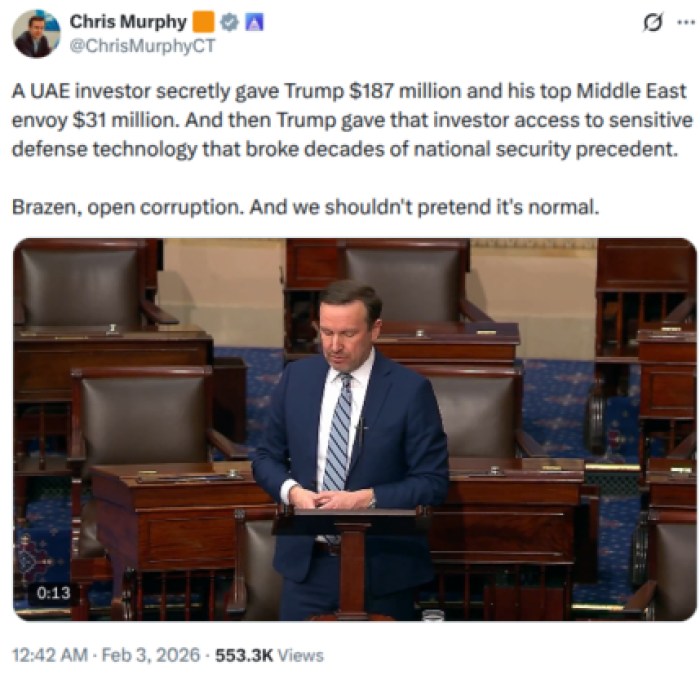
Source: X

The fear? Foreign entities are buying influence through blockchain projects tied to political figures. For the average retail trader, that signals a familiar danger: becoming exit liquidity for backroom deals. Trust is the only real currency here.

When that erodes at the institutional level, bogged down by regulatory scrutiny and conflicts of interest, capital historically flees toward the ‘wild west’ of the market.

We’re already seeing this migration on-chain. While institutional projects stall under the weight of Senate hearings, traders are rotating liquidity into assets that prioritize raw community strength. The narrative is shifting from ‘who do you know in Washington?’ to ‘how strong is your community?’

In this trust vacuum, high-leverage meme tokens are emerging as vehicles for retail conviction. So, who is leading this charge? Maxi Doge ($MAXI) , a project capitalizing on the market’s appetite for assets that operate far outside the sphere of political influence. It could be the next crypto to 1000x.

Escaping The Political Theater Through High-Leverage DeFi

The allure of DeFi during political scandals is simple: transparency. There are no backroom deals in a smart contract; there is only code. This environment has paved the way for Maxi Doge ($MAXI), a project that strips away the pretense of ‘institutional adoption’ to focus on what you actually want: volatility, leverage, and aggressive growth.

Traders familiar with previous cycles know that during periods of regulatory FUD (Fear, Uncertainty, and Doubt), meme coins often outperform utility tokens precisely because they’re uncorrelated with government policy. Maxi Doge leans into this.

Branding itself as a ‘240-lb canine juggernaut’ with a ‘lift, trade, repeat’ mentality, it creates a distinct psychological separation from the suit-and-tie narrative of Washington-linked crypto. The selling point isn’t a treaty; it’s a ‘Leverage King Culture,’ something wildly different from other kawaii dog-themed coins.
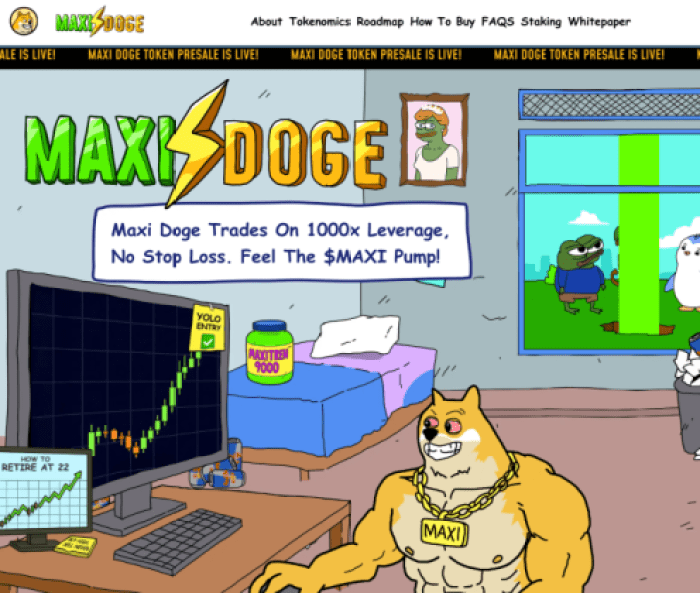
Source: Maxi Doge

Through planned holder-only trading competitions and a gamified ‘Maxi Fund’ treasury, the project plans to incentivize active participation rather than passive speculation. It hopes to solve a critical problem for retail traders lacking whale-tier capital: offering a playground where conviction pays better than connections.

Plus, the plan to integrate futures platform partnerships suggests a roadmap designed to capture the high-risk, high-reward segment alienated by current political discourse.

Learn ‘how to buy maxi doge’ in our guide.

Retail Hype Signals Shift Toward Retail-First Assets

While headlines focus on Senators and foreign treaties, social media and project engagement show where investors are looking. Political scandal appears to be driving investors toward fresh presales offering better risk-to-reward ratios than established, politically sensitive coins.

Maxi Doge has already secured over $4.5M in its ongoing presale, suggesting significant liquidity is rotating into this new sector. Even more telling is the social media following it’s managed to garner. Boasting over 6K followers on X, and over 3.3K subscribers on Telegram, $MAXI clearly has its fans.

Don’t get us wrong, these aren’t numbers to break a bank, but it’s still something to note for a hype project still in presale, that’s mainly thriving on vibes alone.

Beyond the socials, the protocol’s staking mechanics offer shelter for its capital. With dynamic APY fueled by daily automatic smart contract distribution, investors can compound holdings while waiting for the broader market to stabilize.

It fits the project’s ‘Never skip leg-day’ ethos: steady accumulation regardless of external conditions. If you’re exhausted by the volatility of political news cycles, the straightforward mechanics of a meme-driven ecosystem offer a refreshing (if high-risk) alternative.

CHECK OUT THE MAXI DOGE ($MAXI) PRESALE.

The information provided in this article is for educational purposes only and does not constitute financial advice. Cryptocurrency investments, particularly in meme tokens and presales, carry high risks, including the potential for significant loss. Always perform independent due diligence.


Related Questions

QWhat is the main reason the article suggests that DeFi projects like Maxi Doge ($MAXI) are gaining attention during political scandals?

AThe article suggests that DeFi projects gain attention during political scandals because they offer transparency through smart contracts, operating outside the sphere of political influence and backroom deals, which attracts capital fleeing institutional crypto due to eroding trust, regulatory scrutiny, and conflicts of interest.

QAccording to the article, what specific feature of Maxi Doge ($MAXI) is designed to incentivize active participation rather than passive speculation?

AMaxi Doge plans to incentivize active participation through holder-only trading competitions and a gamified 'Maxi Fund' treasury, creating a playground where conviction is rewarded more than connections.

QHow does the article describe the performance of meme coins compared to utility tokens during periods of regulatory FUD (Fear, Uncertainty, and Doubt)?

AThe article states that during periods of regulatory FUD, meme coins often outperform utility tokens because they are uncorrelated with government policy, making them a more attractive option for traders seeking assets detached from political influence.

QWhat evidence does the article provide to show that Maxi Doge ($MAXI) is attracting significant interest from retail investors?

AThe article cites that Maxi Doge has secured over $4.5M in its ongoing presale and has garnered a social media following of over 6K followers on X and 3.3K subscribers on Telegram, indicating significant retail investor interest and liquidity rotation.

QWhat is the core ethos or mentality that the Maxi Doge ($MAXI) project brands itself with, according to the article?

AMaxi Doge brands itself with a 'Leverage King Culture' and a 'lift, trade, repeat' mentality, creating a psychological separation from traditional finance and emphasizing steady accumulation and high-risk, high-reward dynamics, encapsulated in its 'Never skip leg-day' ethos.

Related Reads

From Gold to Bitcoin: Fixed Supply + Institutional Frenzy, Might It Repeat the 'Explosive' Price Trend?

"From Gold to Bitcoin: Fixed Supply and Institutional Frenzy May Lead to 'Explosive' Price Rally Analysts suggest Bitcoin's price action could mirror gold's over the past two decades, following the launch of spot Bitcoin ETFs. Gold ETFs, introduced in 2004, drove gold's price surge to a current market cap near $28 trillion. Both gold and Bitcoin are non-yielding stores of value, with prices driven purely by investor sentiment rather than cash flows or credit. Gold ETFs experienced dramatic cycles: explosive growth, painful drawdowns, and slow recoveries, with each cycle reaching higher peaks. Bitcoin ETFs, approved in early 2024, saw rapid institutional adoption but are now facing similar volatility. Recent warnings highlight the risk of significant ETF outflows disrupting the current rebound. BlackRock's IBIT, a leading Bitcoin ETF, has sold nearly 100,000 BTC to meet redemptions while still holding over 733,000. The core parallel is fixed supply: when demand surges, prices explode, but demand is often volatile and wave-like, not steady. Institutional interest, through ETFs and corporate adoption, remains a key support pillar, helping to cushion sell-offs. If Bitcoin captures even a fraction of gold's role as a store of value, its upside potential is immense, though the path will be marked by high volatility. For investors, focusing on long-term trends and managing risk is crucial as this 'price explosion' narrative unfolds."

Foresight News32m ago

From Gold to Bitcoin: Fixed Supply + Institutional Frenzy, Might It Repeat the 'Explosive' Price Trend?

Foresight News32m ago

Why Is AI Agent Shopping Hard to Popularize?

The article argues that the popular narrative of "AI agent shopping" – equipping AI with a wallet to autonomously handle purchases – is fundamentally flawed and oversimplifies the complexity of shopping. It deconstructs shopping into two core actions: **information retrieval** (standardized, easily automated) and **value judgment** (deeply subjective and human-centric). The narrative mistakenly assumes AI can fully handle both. Value judgment itself has two layers: **evaluation** (assessing options against criteria) and **demand definition** (setting the criteria, weights, and values). The latter is inherently human and dynamic, as preferences are not fixed but constructed during the decision-making process ("constructive preferences"). The real dividing line for automation is not product standardization, but whether the **act of choosing** itself holds experiential value. For mundane purchases (e.g., printer paper), full AI delegation works. For experiential goods (e.g., wine, furniture), the joy of selection is core to consumption, so AI should act as an assistant that narrows options, leaving the final choice to humans. The "AI wallet" concept confuses three separate elements: decision-making, execution, and fund custody. Current payment industry solutions (e.g., from Stripe, Mastercard, Google, Visa) show that limited, scoped payment authorization tokens are sufficient for most consumer scenarios, not full fund custody. The true use case for autonomous AI wallets is in **B2B procurement** and **machine-to-machine (M2M) settlements** for standardized, high-frequency, low-value transactions. The real bottlenecks for AI shopping are not payment technology, but **1) the lack of trusted data sources** (e.g., fake reviews, counterfeit goods) and **2) the impossibility of automating human demand definition**. The conclusion is that the focus should be on safely automating the assessment and filtering process while reserving for humans the rights to define their criteria and enjoy the final act of choice. For experiential goods, the platform's competitive advantage shifts to providing a superior selection experience.

Foresight News1h ago

Why Is AI Agent Shopping Hard to Popularize?

Foresight News1h ago

After Nine Months of Shorting, a Full Turn to Long: Renowned Trader Opens Bitcoin Positions Around 64K, Crypto Market Long-Short Divergence Intensifies

After nine months of being short, prominent crypto trader Doctor Profit has closed all his bearish positions and started buying Bitcoin near $64,000, signaling a complete bullish reversal. He argues that structural market changes—such as impending U.S. regulation (CLARITY Act) and institutional adoption via securities tokenization—are rewriting the traditional four-year cycle script, potentially bringing the market bottom forward from the widely expected September/October timeframe. This view finds some technical support from on-chain analyst gumsays, who notes a bullish divergence on Bitcoin's weekly chart has persisted for 147 days, nearing the 161-day duration seen before the 2022 cycle low. However, cycle researcher Jake Pahor presents a counter-argument based on historical data. Analyzing patterns since 2014, he identifies three common features of past bear market bottoms: a ~12-month duration from peak to trough, a sustained period of extreme fear (with a proprietary risk score below 20), and the price falling below Bitcoin's realized price (~$53,000 currently). The current cycle, only nine months from its October 2025 peak, meets none of these conditions. The debate highlights a market torn between "front-running" a potential early bottom driven by new fundamentals and waiting for confirmation through traditional on-chain and sentiment metrics. While Doctor Profit opts for aggressive buying, Pahor maintains a disciplined, tiered accumulation strategy, continuing weekly buys at current risk levels but reserving larger orders for if more extreme fear emerges.

marsbit1h ago

After Nine Months of Shorting, a Full Turn to Long: Renowned Trader Opens Bitcoin Positions Around 64K, Crypto Market Long-Short Divergence Intensifies

marsbit1h ago

Trading

Spot
活动图片