Market Plunge, But These Crypto OGs Are Still 'Topping Up Their Faith'

marsbitPublished on 2026-02-06Last updated on 2026-02-06

Abstract

Summary: On February 6, Bitcoin plunged 15.48% to $60,000, marking its largest single-day drop since the FTX collapse. The Crypto Fear & Greed Index hit 9, indicating "extreme fear" and a new low since the 2022 bear market. Despite widespread panic, several crypto veterans reaffirmed their conviction. Michael Saylor encouraged buying Bitcoin as a form of support. The founder of Base emphasized long-term commitment to building. Lily Liu, President of the Solana Foundation, argued that blockchain's core purpose is financialization, stressing the importance of protecting liquidity unity. She criticized the "Web3 narrative" as overly simplistic and called for creating new markets rather than relying on speculative narratives. Balaji expressed strong bullishness, stating that "code-based order" is rising as "rules-based order" collapses, making short-term prices irrelevant. He emphasized the need for on-chain companies and internet-native systems. The founder of Helius shared similar optimism, advocating for filtering out "tourists" to improve signal-to-noise ratio in the space. Linda Xie shared her experience of a 75% drawdown in 2018, advising against emotionally-driven decisions and emphasizing holding assets with strong fundamental belief. Crypto influencer神鱼 (Shenyu) succinctly stated: "1 BTC = 1 BTC." Overall, these leaders urge perseverance, focus on fundamentals, and long-term belief in crypto's transformative potential despite market volatility.

Editor's Note: On February 6th, Bitcoin fell to a low of $60,000, plummeting 15.48% in a single day, marking its largest single-day drop since the FTX collapse. At the same time, the Crypto Fear & Greed Index dropped to 9, indicating a state of 'Extreme Fear' in the market, hitting a new low since the 2022 bear market.

However, as pessimism spreads, many veteran Builders and thought leaders in the crypto world are voicing a different perspective. This 'Crypto Faith Topping-Up List' compiles their thoughts and perseverance amidst the storm. Perhaps it can offer you a sliver of solace and direction to move forward during this market winter.

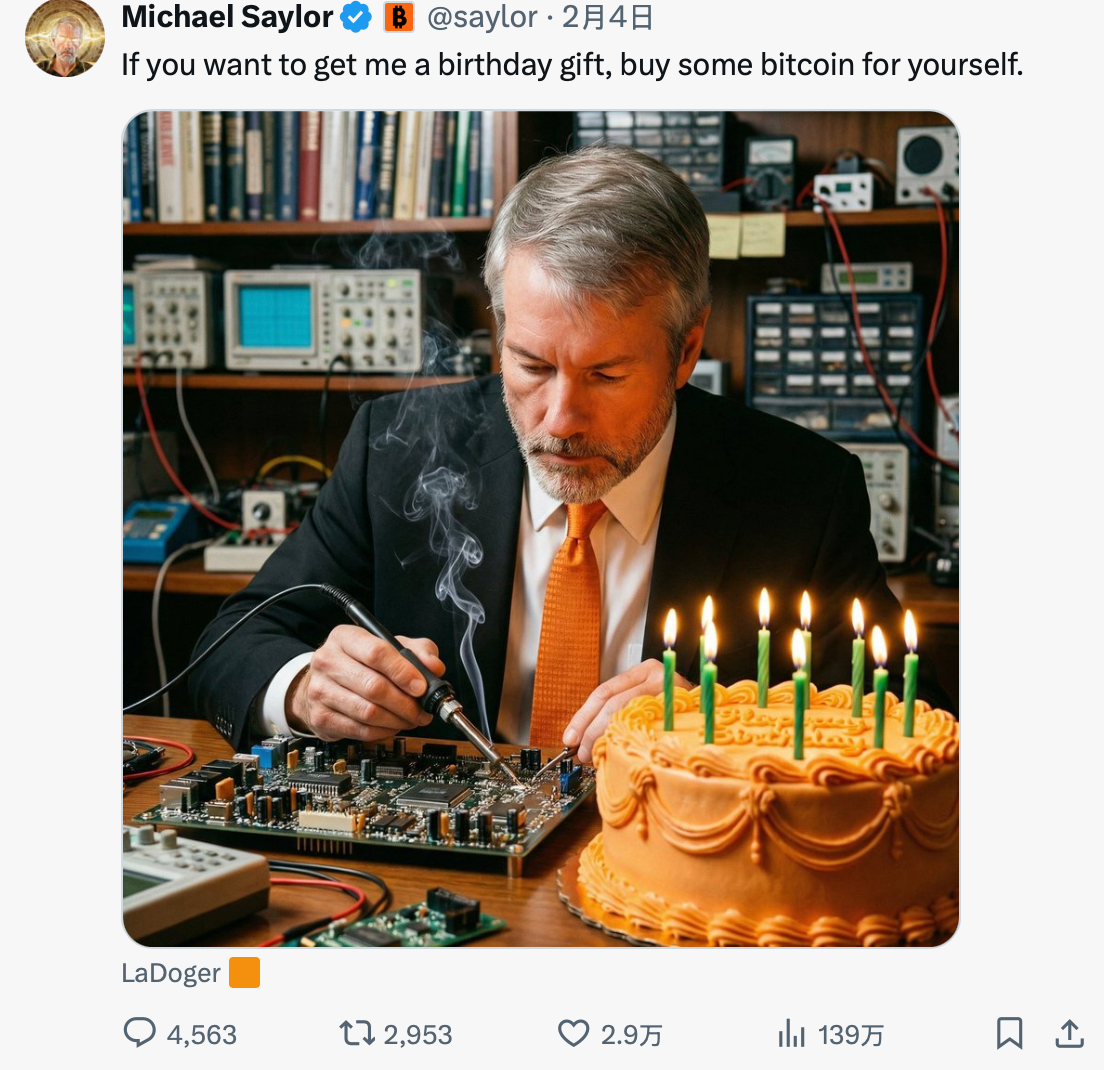
Michael Saylor:

If you want to give me a birthday present, buy yourself some Bitcoin!
Base Founder:

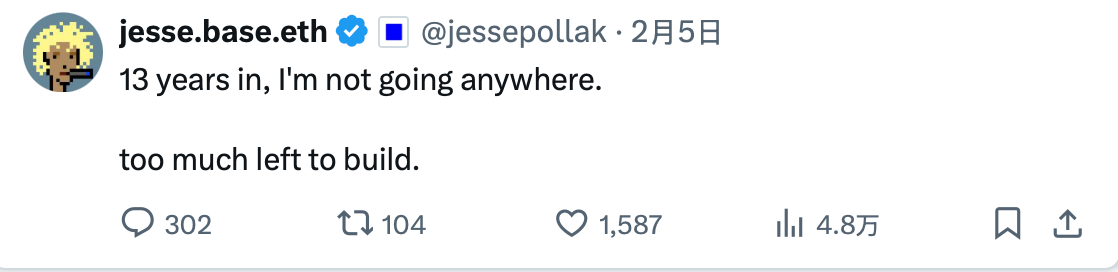
13 years have passed, and I'm not going anywhere.

There's still so much to build.
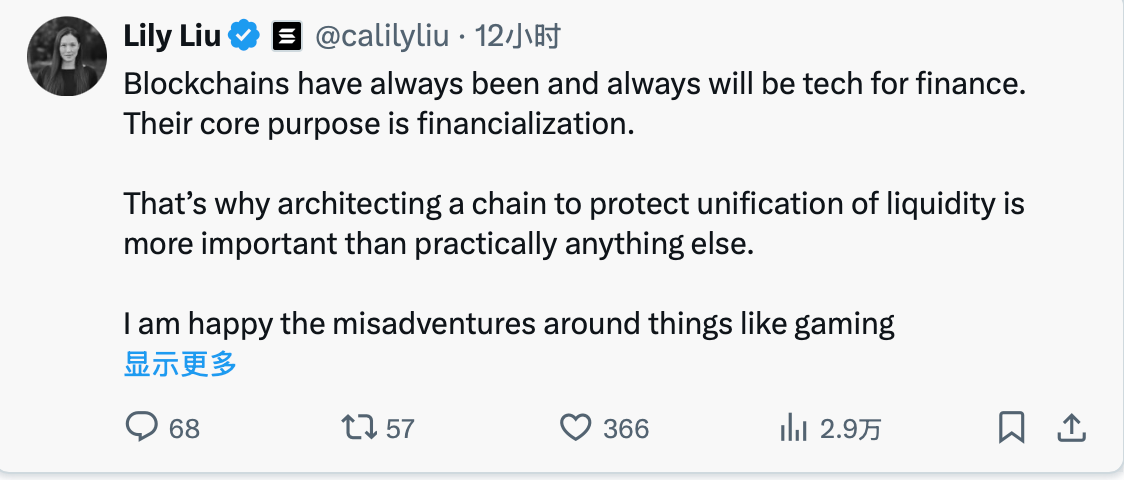
Solana Foundation President LilyLiu:

Blockchain was, is, and always will be financial technology. Their core purpose is financialization.

This is also why, when designing a chain, protecting the unity of liquidity is more important than almost anything else.

I'm glad the misguided focus on things like 'chain games' is finally over.

More broadly, the 'read write own' / 'Web3 narrative' is essentially too skeuomorphic and, to be honest, a bit intellectually lazy. New technology is never as simple as 'put something on-chain, and voilà—everything changes'; you must truly create new markets.

The old narrative was more of a fig leaf, used to justify VCs pouring money into various unnecessary infrastructures, hoping to create a private asset that could become 'magic internet money.'

The more projects try to attract prices through narrative packaging and take a share of the liquidity from the 'wild west' of the internet, the harder the 'narrative justification machine' has to work, shaping everything into the 'great third wave of applications'—'everything you do today can now earn you money.'

The reality is, the opportunities are indeed huge, far beyond what even our most creative minds can imagine, but not in the way they've been described over the past few years.

The blockchain journey has always been about finance: providing open financial infrastructure for anyone and everyone on the internet.

This enables capital formation and internet innovation to happen anywhere in the world, allowing the resulting innovation and progress to truly take root. Open finance brings greater economic freedom, and economic freedom brings individual sovereignty and autonomy.
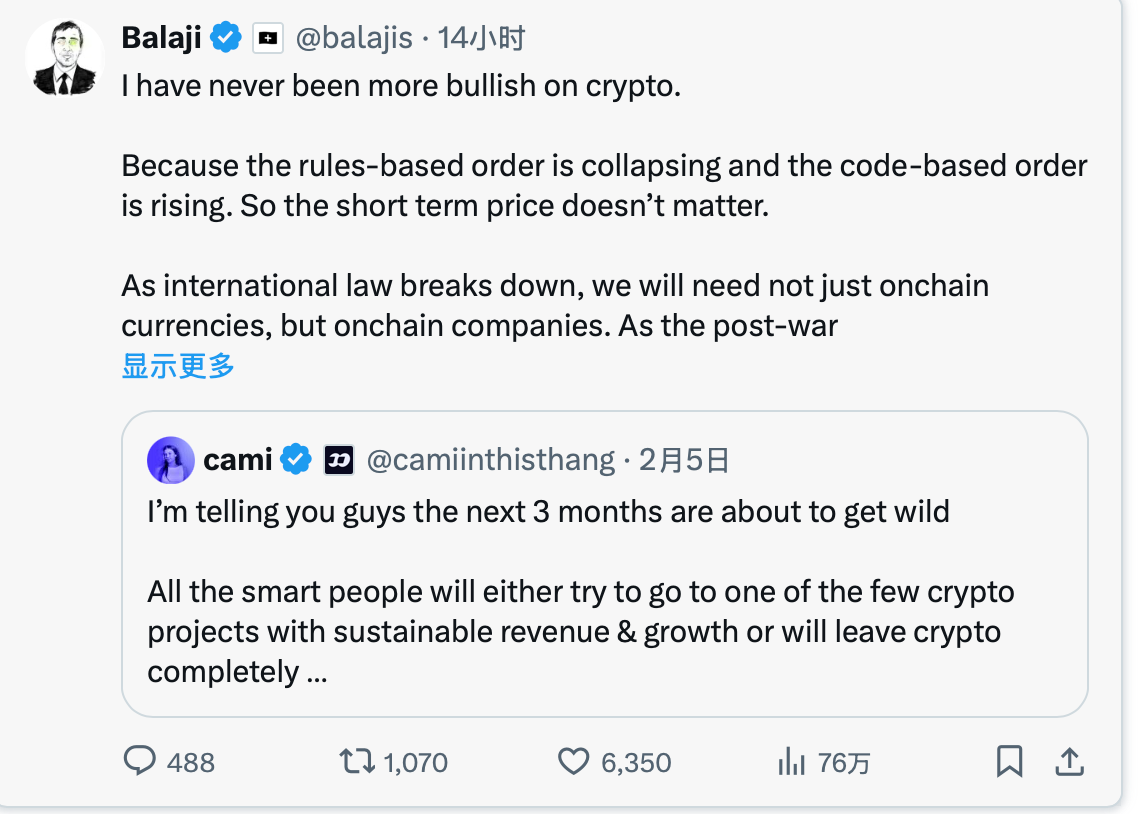
Balaji:

I have never been more bullish on cryptocurrency than I am now.

Because the 'rules-based order' is collapsing, and the 'code-based order' is rising. So short-term prices simply don't matter.

As the international legal system disintegrates, we need not only on-chain money but also on-chain companies. As the post-war order unravels, we similarly need a 'post-internet order.' Nations will fail, and networks will replace them.

We need internet capitalism, we need internet democracy, we need internet privacy.

So we need cryptocurrency.
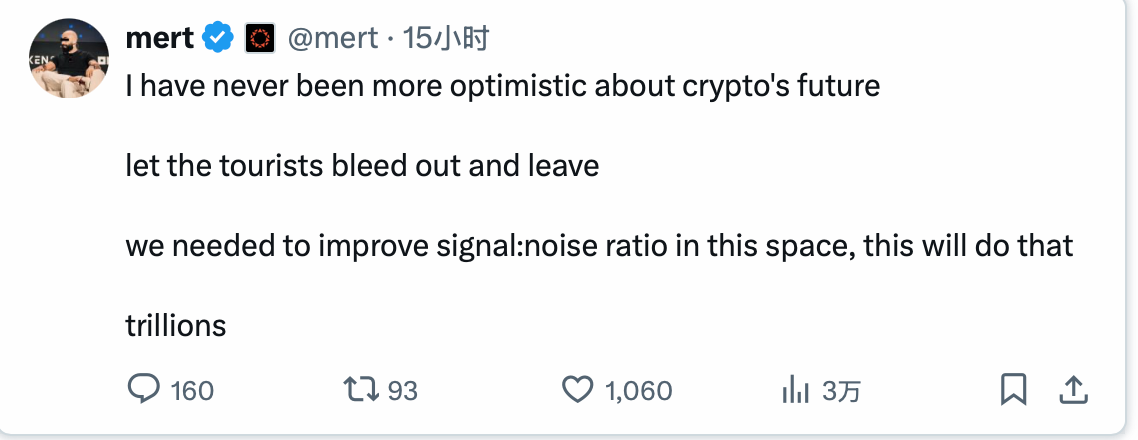
Helius Founder:

I have never been more confident about the future of cryptocurrency than I am now.

Let the tourists bleed out and leave.

We need to increase the signal-to-noise ratio in this space, and this will achieve that goal.

Trillion
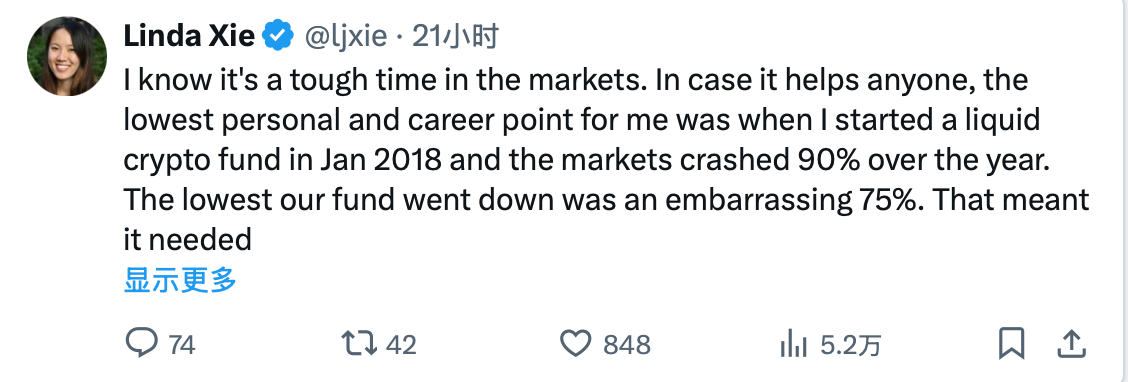
Linda Xie:

I know the current market environment is tough. I hope these experiences can be helpful to some. For me, the personal and professional low point was in January 2018, after launching a crypto liquidity fund, when the market fell 90% that year. Our fund experienced a maximum drawdown of a humiliating 75%, meaning the fund needed to quadruple just to break even.

At the time, many investors chose to trust us (this was after about 1,000 fundraising meetings), some of whom I deeply respected, and I felt I had let them down; some investors even yelled at me over the phone. I was extremely worried about what I had gotten everyone into, including employees. I had also invested almost all of my personal savings.

But we stuck to the direction we truly believed in, and it eventually paid off years later (currently delivering about 4x DPI for investors). Hold onto assets you genuinely believe in fundamentally, and don't make any extreme decisions driven by emotion.
Shenyu:

1btc = 1btc

Related Questions

QWhat was the significance of Bitcoin's price drop to $60,000 on February 6th?

AIt marked a 15.48% single-day drop, the largest since the FTX crash, and pushed the Crypto Fear & Greed Index to 9, indicating 'extreme fear' and a new low since the 2022 bear market.

QAccording to Solana Foundation's Lily Liu, what is the core purpose of blockchains?

ABlockchains are, and always will be, financial technology. Their core purpose is financialization, providing open financial infrastructure to anyone on the internet to enable capital formation and innovation globally.

QWhat is Balaji's main argument for being extremely bullish on cryptocurrency despite short-term price movements?

AHe believes the 'rules-based order' is collapsing and a 'code-based order' is rising. As international law and the post-war order disintegrate, there is a need for on-chain money, companies, and new systems like internet capitalism and democracy, which cryptocurrency enables.

QWhat personal experience did Linda Xie share to help others during the difficult market?

AShe shared that her crypto liquidity fund launched in Jan 2018 experienced a 90% market drop and a 75% drawdown, requiring a 4x return just to break even. By sticking to their convictions and not making emotional decisions, they eventually delivered about 4x DPI (Distributed to Paid-In Capital) to investors.

QWhat common sentiment is expressed by multiple figures like Michael Saylor, the Base founder, and the Helius founder?

AThey express unwavering confidence and a long-term commitment to cryptocurrency. Saylor encourages buying Bitcoin, the Base founder states he's 'not going anywhere,' and the Helius founder says he's 'never been more confident,' suggesting that weak hands (tourists) leaving will improve the space.

Related Reads

BitMart Research Institute Weekly Highlights: A Comprehensive Review of Macro Environment, Crude Oil, AI Tech Stocks, and Crypto Market

**Weekly Market Review: Macro, Oil, AI Tech Stocks & Crypto Market** **Macroeconomic & Traditional Finance** The April U.S. Non-Farm Payrolls report of 115K new jobs exceeded expectations, but the data's quality was questioned. Growth was heavily concentrated in healthcare, while other sectors contracted, and manufacturing employment turned negative. A statistical model accounted for a large portion of the gains, conflicting with household survey data showing a loss of 226K jobs. Meanwhile, AI's impact on jobs is emerging, with information sector roles declining, though overall unemployment remains at ~4.3%. Oil prices hovered near $100 per barrel. Global oil buffer inventories have drawn down significantly, supporting prices, but high costs are suppressing demand. China's recent reduction in crude imports acted as a market stabilizer. Geopolitically, the U.S. and Iran are likely to reach a tentative agreement to keep the Strait of Hormuz open and avoid price spikes. For AI tech stocks, short-term prospects are mixed. A potential SpaceX IPO in June could pressure current index heavyweights like Nvidia, while smaller components might benefit. The mid-term focus shifts to Q2 earnings, emphasizing AI's return on investment. Long-term risks include potential election policy shifts and massive IPOs from companies like OpenAI, which could test the sector's sustainability. **Crypto Market & Ecosystem** Crypto markets rose moderately, with BTC climbing from ~$77K to ~$82K, driven by improved risk sentiment. Spot trading volumes remain low, but buying pressure is evident. ETF inflows continued (~$791M last week). However, institutional purchases of BTC and ETH were more modest than expected. The derivatives market shows lingering bearish bets, particularly on alts and ETH. A key trend is the "dual-track" model where projects pursue public listings for traditional funding while also building their own blockchains/tokens to capture crypto liquidity, as seen with Circle's ARC chain. Stablecoins and institutional chains present significant future opportunities. *Disclaimer: This is market analysis, not investment advice.*

marsbit9m ago

BitMart Research Institute Weekly Highlights: A Comprehensive Review of Macro Environment, Crude Oil, AI Tech Stocks, and Crypto Market

marsbit9m ago

While Everyone Says NFTs Are 'Dead', the Art World is Quietly Completing an 'On-Chain Renaissance'

While many declare NFTs "dead" and dismiss them as overhyped JPEGs, a significant institutional shift is quietly underway within the art world, signaling a "on-chain renaissance." Traditional art, a ~$60B market, is stagnant, aging, and highly concentrated, facing a massive $80 trillion generational wealth transfer to digital-native heirs. Contrary to the narrative, leading institutions have been building infrastructure for digital and on-chain art. Major museums like MoMA, the Centre Pompidou, LACMA, and the Guggenheim have acquired seminal NFT works into their permanent collections. Top galleries like Pace, Gagosian, and Hauser & Wirth have launched NFT platforms or accepted crypto, with Pace giving a solo show to generative artist Tyler Hobbs. Auction houses Sotheby's and Christie's operate dedicated on-chain sales platforms. This follows a historical pattern where every major art movement—from Impressionism to Pop Art—was initially mocked before institutional acceptance. NFT art, only 7-12 years old, is progressing faster. Auction data shows resilience, with works by Beeple ($69.3M), Pak (~$91M), and Dmitri Cherniak ($6.2M in a bear market) achieving high prices. A new cohort of collectors (e.g., FlamingoDAO, PleasrDAO) and "Medici" figures like Cozomo de' Medici are accumulating foundational works. The core argument is that NFTs represent not a speculative asset class but a new ownership system for digital culture, solving provenance issues through immutable, timestamped blockchain records. The medium has survived the speculative crash and is being institutionalized. The bet isn't on short-term price rallies but on the long-term cultural significance of on-chain art as the defining medium for the next generation of collectors.

marsbit47m ago

While Everyone Says NFTs Are 'Dead', the Art World is Quietly Completing an 'On-Chain Renaissance'

marsbit47m ago

Jensen Huang's Message to Graduates: AI Won't Replace You, But Those Who Excel at Using AI Will

NVIDIA CEO Jensen Huang, addressing 2026 graduates at Carnegie Mellon University, emphasized that AI will not replace people, but those who leverage AI effectively will have an advantage. He delivered this message during a commencement speech where he also received an honorary doctorate, his seventh. Huang reflected on his personal journey as an immigrant, starting from humble beginnings as a dishwasher to co-founding NVIDIA. He shared early struggles, including a near-bankruptcy moment saved by honesty with Sega, highlighting resilience and learning from failure. He positioned the current era as the dawn of the AI revolution, a shift as significant as past computing waves. Huang explained that AI is redefining computing from human-written software to machine learning, creating a new industry focused on manufacturing intelligence. While acknowledging fears about job displacement, he argued that AI amplifies human capabilities rather than replaces human purpose. Tasks may be automated, but the core meaning of professions remains. Huang urged graduates to embrace this transformative time with responsibility and optimism. He stated that AI should democratize technology, bridging gaps and enabling broader participation in creation and problem-solving. His final advice was to actively engage with the opportunity: "So run, don’t walk," and to put their hearts into their work.

marsbit54m ago

Jensen Huang's Message to Graduates: AI Won't Replace You, But Those Who Excel at Using AI Will

marsbit54m ago

Trading

Spot
Futures
活动图片