Mapping RIVER’s path to $22 and beyond as volume surges 45%

ambcryptoPublished on 2026-03-31Last updated on 2026-03-31

Abstract

RIVER's price surged 22.48% to $17.12, supported by a 45.24% increase in trading volume, indicating strong buyer participation. Despite the rally, the price remains within a broader range-bound structure, with key resistance levels at $22.68 and $32.83. The RSI has recovered to 47.43 but remains below the bullish threshold of 50-60, suggesting the uptrend is not yet fully confirmed. Negative exchange netflows of -$111.44K indicate accumulation and reduced selling pressure, while a 26.45% rise in Open Interest reflects growing leveraged positions, adding potential volatility. The move shows strength but requires sustained demand to break above resistance and confirm a continued upward trend.

River’s [RIVER] rally accelerated as the price jumped 22.48% to $17.12 at press time, while market cap reached $335.65 million, supported by a 45.24% surge in trading volume. This sharp expansion reflects strong participation entering the market as buyers step in with conviction.

Volume also climbed to $48.19 million, which strengthens the credibility of the move rather than suggesting a weak spike. However, this surge is unfolding within a broader range structure, which keeps the breakout narrative incomplete.

As participation rises and the RIVER price pushes higher, the focus now shifts toward whether this expansion can sustain itself beyond short-term demand.

Can RIVER reclaim higher resistance levels now?

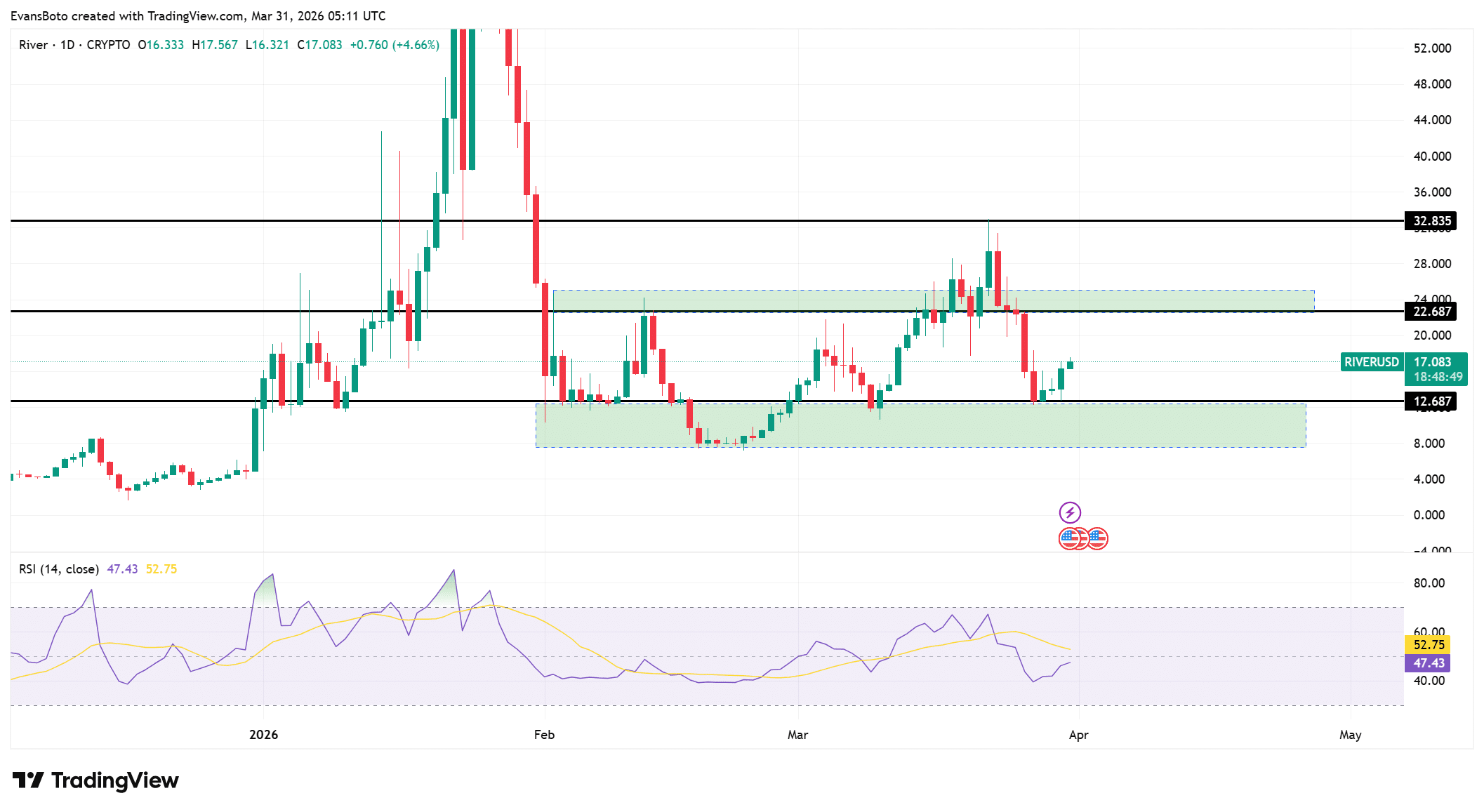
RIVER has rebounded from the $12.68 demand zone and is now pushing toward the $22.68 mid-range resistance. This recovery reflects renewed buying interest after the previous decline. However, the structure remains range-bound, with $32.83 acting as the next major resistance above.

The current move shows strength, yet it still sits within the established range rather than confirming a breakout. As price approaches this mid-range level, sellers could begin to re-enter the market. However, sustained pressure from buyers would be required to absorb this supply and extend the move higher.

At the time of writing, the RSI climbed to 47.43 after rebounding from lower levels, which reflects easing bearish pressure. This recovery suggests that selling intensity has weakened as buyers regain some influence over price direction. However, RSI remains below the key 50–60 zone, which typically signals stronger bullish control.

Such positioning shows that buyers have not fully taken over the trend. As a result, the current recovery appears constructive but incomplete. If RSI continues rising toward higher thresholds, it would reinforce the case for a stronger push toward resistance levels.
Source: TradingView

Exchange outflows support tightening supply narrative

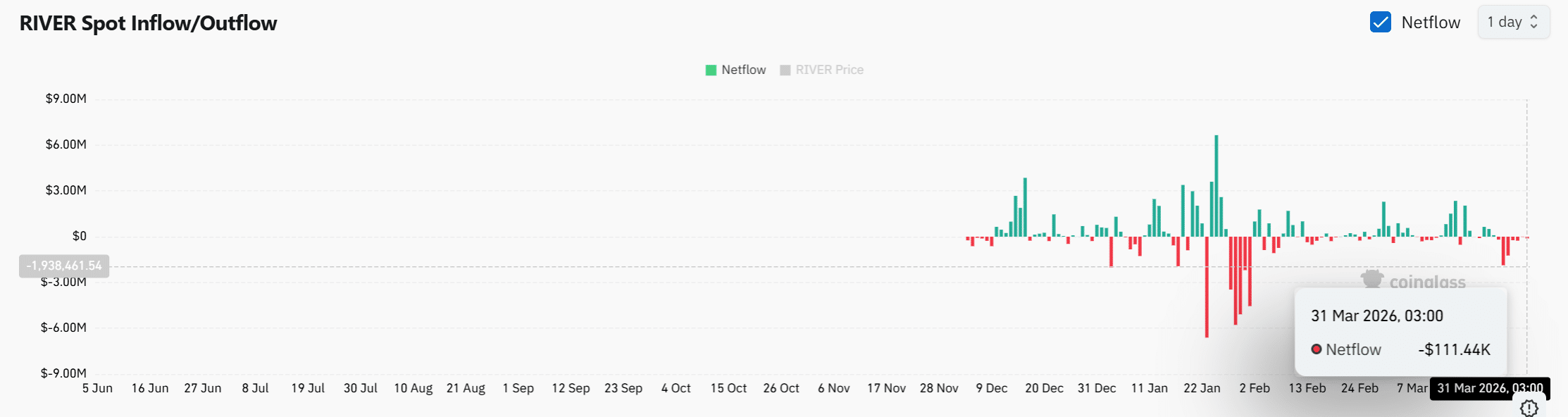
Negative spot netflows printed at -$111.44K as of writing, confirming that tokens are leaving exchanges rather than entering them. This behavior reflects ongoing withdrawals into private wallets, which reduces immediate sell-side availability.

Such outflows often align with accumulation, especially when they occur during a price recovery phase. As supply on exchanges tightens, buyers face less overhead pressure from sellers.

However, the sustainability of this trend remains critical, as continued outflows would support further upside, while any reversal could quickly shift market dynamics.
Source: CoinGlass

Leverage builds as RIVER open interest expands sharply

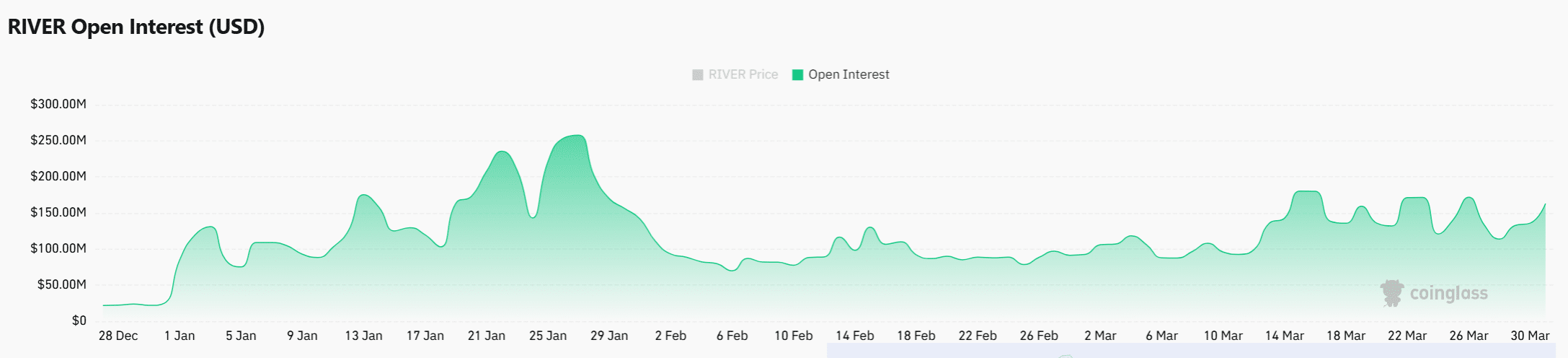
At press time, Open Interest (OI) has risen 26.45% to $173.07 million, which signals that traders are actively increasing their positions during the rally. This expansion shows that market participants are not exiting but instead committing more capital to the move.

Rising OI alongside price growth often reflects strong conviction, yet it also introduces additional risk. If positions become overcrowded, even small price fluctuations could trigger volatility through liquidations.

As leveraged exposure continues to build, price stability will depend on whether spot demand can support this growing speculative positioning.
Source: CoinGlass

RIVER’s rally reflects real demand supported by tightening supply and rising participation. However, price still trades within a range, which limits confirmation of a breakout. RSI has not yet confirmed full bullish control, while rising OI introduces risk.

The current structure suggests strength, yet it requires sustained demand to push beyond resistance and validate continuation.


Final Summary

  • RIVER’s recovery shows strengthening demand, yet resistance ahead could still limit upside without sustained buyer pressure.
  • Rising leverage alongside price growth introduces instability, which could quickly shift direction if conviction weakens unexpectedly.


Related Questions

QWhat was the percentage increase in RIVER's price and its trading volume as mentioned in the article?

ARIVER's price increased by 22.48% and its trading volume surged by 45.24%.

QWhat are the key resistance levels that RIVER is approaching according to the analysis?

ARIVER is pushing toward the $22.68 mid-range resistance, with $32.83 acting as the next major resistance above.

QWhat does the RSI level of 47.43 indicate about the market sentiment for RIVER?

AAn RSI of 47.43 reflects easing bearish pressure and suggests that selling intensity has weakened, but it remains below the key 50-60 zone which signals stronger bullish control, indicating the recovery is constructive but incomplete.

QHow do the exchange netflows and open interest data support the current market narrative for RIVER?

ANegative spot netflows of -$111.44K indicate tokens are leaving exchanges, reducing sell-side availability and supporting the accumulation narrative. Meanwhile, a 26.45% rise in Open Interest to $173.07 million shows traders are increasing positions, reflecting conviction but also introducing leverage risk.

QWhat are the main factors that could limit or jeopardize RIVER's continued price rally?

AThe price is still within a range-bound structure, lacking a confirmed breakout. Rising leverage introduces instability and potential volatility from liquidations. Sustained buyer pressure is required to overcome resistance levels, and a reversal in exchange outflows or weakening conviction could quickly shift market dynamics.

Related Reads

How Many Tokens Away Is Yang Zhilin from the 'Moon Chasing the Light'?

The article explores the intense competition between two leading Chinese AI companies, DeepSeek and Kimi (Moon Dark Side), and the mounting pressure on Yang Zhilin, the founder of Kimi. While DeepSeek re-emerged after 15 months of silence with its powerful V4 model—boasting 1.6 trillion parameters and low-cost, long-context capabilities—Kimi has been focusing on long-context processing and multi-agent systems with its K2.6 model. Yang faces a threefold challenge: technological rivalry, commercialization pressure, and investor expectations. Despite Kimi’s high valuation (reaching $18 billion), its revenue heavily relies on a single product with low paid conversion rates, while DeepSeek’s strategic silence and open-source influence have strengthened its market position and valuation prospects, now targeting over $20 billion. Both companies reflect broader trends in China’s AI ecosystem: Kimi aims for global influence through open-source contributions and agent-based advancements, while DeepSeek prioritizes foundational innovation and hardware independence, notably shifting to Huawei’s chips. Their competition is seen as vital for China’s AI progress, with the gap between top Chinese and U.S. models narrowing to just 2.7% on the Elo rating scale. Ultimately, the article argues that this rivalry, though anxiety-inducing for leaders like Zhilin, is essential for driving innovation and solidifying China’s role in the global AI landscape.

marsbit6h ago

How Many Tokens Away Is Yang Zhilin from the 'Moon Chasing the Light'?

marsbit6h ago

TechFlow Intelligence Bureau: ChatGPT Helps Amateur Mathematician Crack 60-Year-Old Problem, CFTC Sues New York Regulator Over Coinbase and Gemini

An amateur mathematician, with the assistance of ChatGPT, has solved a combinatorial mathematics puzzle originally proposed by Hungarian mathematician Paul Erdős in the 1960s. This marks another milestone in AI-aided mathematical research, demonstrating the evolving capabilities of large language models in formal reasoning. In other AI developments, OpenAI introduced a new privacy filter tool for enterprise API usage, automatically screening sensitive data. Meanwhile, the Qwen3.6-27B model achieved 100 tokens per second on a single RTX 5090 GPU using quantization, significantly lowering the cost barrier for local AI deployment. In crypto and Web3, the U.S. CFTC sued New York’s financial regulator, challenging its oversight of Coinbase and Gemini—a first-of-its-kind federal-state regulatory clash. Following a vulnerability, KelpDAO and major DeFi protocols established a recovery fund. Tether froze $344 million in assets linked to Iran’s central bank upon U.S. Treasury request, highlighting the centralized control risks in stablecoins. Separately, Litecoin underwent a 3-hour chain reorganization to undo a privacy-layer exploit. In the U.S., former President Trump invoked the Defense Production Act to address power grid bottlenecks affecting AI data centers and dismissed the entire National Science Board, raising concerns over research independence. A retail trader gained 250% on a $600k Intel options bet amid AI-related speculation. Xiaomi announced its first performance electric vehicle, targeting rivals like Tesla. Meanwhile, iPhone users reported devices automatically reinstalling a hidden app daily, suspected to be MDM-related. A Chinese securities report noted that A-share institutional crowding has reached its second-longest streak since 2007, signaling high valuations and potential style rotation. The day’s developments reflect a dual narrative: AI is enabling unprecedented individual breakthroughs, while centralized power structures—whether governmental or corporate—are becoming more assertive, underscoring that decentralization is as much a political-economic challenge as a technical one.

marsbit6h ago

TechFlow Intelligence Bureau: ChatGPT Helps Amateur Mathematician Crack 60-Year-Old Problem, CFTC Sues New York Regulator Over Coinbase and Gemini

marsbit6h ago

Trading

Spot
Futures

Hot Articles

How to Buy RIVER

Welcome to HTX.com! We've made purchasing River (RIVER) simple and convenient. Follow our step-by-step guide to embark on your crypto journey.Step 1: Create Your HTX AccountUse your email or phone number to sign up for a free account on HTX. Experience a hassle-free registration journey and unlock all features.Get My AccountStep 2: Go to Buy Crypto and Choose Your Payment MethodCredit/Debit Card: Use your Visa or Mastercard to buy River (RIVER) instantly.Balance: Use funds from your HTX account balance to trade seamlessly.Third Parties: We've added popular payment methods such as Google Pay and Apple Pay to enhance convenience.P2P: Trade directly with other users on HTX.Over-the-Counter (OTC): We offer tailor-made services and competitive exchange rates for traders.Step 3: Store Your River (RIVER)After purchasing your River (RIVER), store it in your HTX account. Alternatively, you can send it elsewhere via blockchain transfer or use it to trade other cryptocurrencies.Step 4: Trade River (RIVER)Easily trade River (RIVER) on HTX's spot market. Simply access your account, select your trading pair, execute your trades, and monitor in real-time. We offer a user-friendly experience for both beginners and seasoned traders.

4.8k Total ViewsPublished 2026.01.16Updated 2026.01.16

How to Buy RIVER

Discussions

Welcome to the HTX Community. Here, you can stay informed about the latest platform developments and gain access to professional market insights. Users' opinions on the price of RIVER (RIVER) are presented below.

活动图片