Law Firm Behind FTX Legal Work Now Facing $525M Suit

bitcoinistPublished on 2026-05-15Last updated on 2026-05-15

Abstract

A federal lawsuit seeks $525 million from Silicon Valley law firm Fenwick & West for its alleged central role in facilitating FTX's fraud. A bankruptcy examiner found the firm "deeply intertwined" in FTX's wrongdoing, creating shell companies like North Dimension to funnel over $3 billion, drafting backdated agreements, and implementing FTX's auto-delete messaging policy on Signal. The suit, filed by 20 international victims, claims Fenwick's involvement lent FTX false legitimacy, preventing investors from withdrawing savings. It cites former FTX engineer Nishad Singh, who testified he directly told Fenwick attorneys about misuse of customer funds, after which the firm allegedly advised on concealment. The complaint includes claims of malpractice and fraud, targeting both the firm and two individual partners. This follows the recent rejection of Sam Bankman-Fried's bid for a new trial.

A court-appointed bankruptcy examiner found that Fenwick & West was “deeply intertwined in nearly every aspect of FTX Group’s wrongdoing” — and now that finding sits at the heart of a $525 million federal lawsuit filed against the Silicon Valley law firm.

Shell Companies And Deleted Messages

Twenty victims of the FTX collapse, coming from five countries, filed the complaint Wednesday in the US District Court for the District of Columbia.

They say they lost their life savings when the exchange went under in November 2022, and that Fenwick’s involvement gave FTX a false sense of legitimacy that kept them from pulling their money out in time. Six individual defendants are named alongside the firm.

The examiner’s conclusions came after a review of more than 200,000 documents in the federal bankruptcy proceedings.

According to the lawsuit, the examiner found that Fenwick created corporate structures for both FTX and its sister trading firm Alameda Research, formed shell entities to hide money movements, and drafted backdated agreements to cover up illicit transfers.
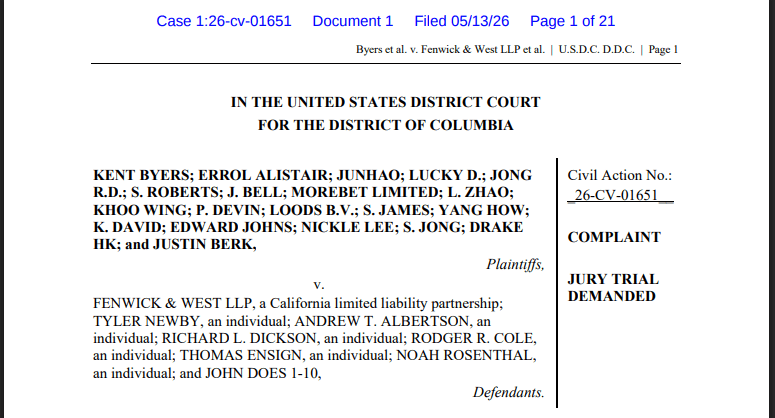
Source: Court Listener

Two specific acts are described in detail. Reports indicate Fenwick attorneys set up North Dimension Inc., a Delaware shell company that posed as an electronics retailer while allegedly funneling over $3 billion in stolen customer funds.

The firm also reportedly put in place FTX’s auto-delete messaging policy on the Signal app — the same system federal prosecutors say helped the fraud go undetected.

A Witness From Inside FTX

Nishad Singh, FTX’s former Director of Engineering, adds another layer to the case. Singh pleaded guilty to fraud charges and testified against Sam Bankman-Fried at his criminal trial.

According to the lawsuit, Singh told Fenwick attorneys directly that customer funds were being misused. Rather than walking away, the firm allegedly advised on how to conceal it.

BTCUSD now trading at $79,806. Chart: TradingView

After FTX filed for bankruptcy, Fenwick quietly scrubbed all references to the exchange from its website. The firm also retained defense lawyers from Gibson Dunn before any civil lawsuit had been filed against it.

Damages And Individual Defendants

The plaintiffs are bringing seven claims, including malpractice, fraud, and gross negligence. They are seeking compensatory damages above $525 million, a return of all legal fees Fenwick collected from FTX, and punitive damages against two named partners — Tyler Newby and Daniel Friedberg — for what the complaint calls deliberate and reckless individual professional conduct.

Meanwhile, Bankman-Fried’s own legal efforts have stalled. A federal judge last month rejected his bid for a new trial, dismissing his claims of new evidence as baseless.

Judge Lewis Kaplan, who sentenced Bankman-Fried to 25 years in prison in 2024, said his arguments were “wildly conspiratorial and entirely contradicted by the record.”

Featured image from WealthBuilders, chart from TradingView

Related Questions

QAccording to the lawsuit, what specific actions did the court-appointed bankruptcy examiner find Fenwick & West to be involved in with FTX?

AThe examiner found that Fenwick & West was 'deeply intertwined in nearly every aspect of FTX Group’s wrongdoing,' including creating corporate structures for FTX and Alameda Research, forming shell entities to hide money movements, and drafting backdated agreements to cover up illicit transfers.

QWho is named as a key witness from inside FTX in the lawsuit against Fenwick & West, and what is the significance of his testimony?

ANishad Singh, FTX's former Director of Engineering, is named. He pleaded guilty to fraud and testified that he directly told Fenwick attorneys customer funds were being misused. The lawsuit alleges the firm then advised on how to conceal it rather than withdrawing.

QWhat are the plaintiffs in the lawsuit seeking from Fenwick & West and the named individual partners?

AThe plaintiffs are seeking compensatory damages above $525 million, a return of all legal fees Fenwick collected from FTX, and punitive damages against two named partners, Tyler Newby and Daniel Friedberg, for alleged deliberate and reckless professional conduct.

QWhat were two specific acts allegedly performed by Fenwick attorneys detailed in the complaint?

AFirst, they set up the Delaware shell company North Dimension Inc., which allegedly funneled over $3 billion in stolen customer funds while posing as an electronics retailer. Second, they reportedly implemented FTX’s auto-delete messaging policy on Signal, which helped conceal the fraud.

QWhat recent development is mentioned regarding Sam Bankman-Fried's legal situation?

AA federal judge, Lewis Kaplan, last month rejected Sam Bankman-Fried's bid for a new trial, dismissing his claims of new evidence as 'wildly conspiratorial and entirely contradicted by the record.' Judge Kaplan had sentenced him to 25 years in prison in 2024.

Related Reads

Breaking: OpenAI Undergoes Major Reorganization, President Brockman Assumes Command

OpenAI has announced a major internal reorganization just months before its anticipated IPO. The company is merging its three flagship product lines—ChatGPT, Codex, and the API platform—into a single, unified product organization. The most significant leadership change involves co-founder and President Greg Brockman moving from a background technical role to take full, permanent control over all product strategy. This follows the indefinite medical leave of AGI Deployment CEO Fidji Simo. Additionally, ChatGPT's longtime lead, Nick Turley, has been reassigned to enterprise products, with former Instagram executive Ashley Alexander taking over consumer offerings. The consolidation, internally framed as a strategic move towards an "Agentic Future," aims to break down internal silos and create a cohesive "Super App." This planned desktop application would integrate ChatGPT's conversational abilities, Codex's coding power, and a rumored internal web browser named "Atlas" to autonomously perform complex user tasks. The reorganization occurs amid significant internal and external pressures. OpenAI has recently seen a wave of high-profile departures, including Sora co-lead Bill Peebles and other senior technical leaders, leading to concerns about a thinning executive bench. Externally, rival Anthropic recently secured funding at a staggering $900 billion valuation, surpassing OpenAI's own. Google's upcoming I/O developer conference also poses a competitive threat. Analysts suggest the dramatic restructure is a pre-IPO move to present a clearer, more focused narrative to Wall Street—streamlining operations and demonstrating decisive leadership under Brockman to counter internal turbulence and intense market competition.

marsbit55m ago

Breaking: OpenAI Undergoes Major Reorganization, President Brockman Assumes Command

marsbit55m ago

Two Survival Structures of Market Makers and Arbitrageurs

Market makers and arbitrageurs represent two distinct survival structures in high-frequency trading. Market makers primarily use limit orders (makers) to profit from the bid-ask spread, enjoying high capital efficiency (nominally 100%) but bearing inventory risk. This "inventory risk" arises from passive, fragmented, and discontinuous order fills in the limit order book (LOB). This risk, while a potential cost, can also contribute to excess profit if managed within control boundaries, allowing for mean reversion. Market makers essentially sell "time" (uncertainty over execution timing) to the market for price control and low fees. In contrast, cross-exchange arbitrageurs typically use market orders (takers) to exploit price differences or funding rates, resulting in lower nominal capital efficiency (requiring capital on both exchanges) and higher transaction costs. Their risk exposure stems from asymmetries in exchange rules (e.g., minimum order sizes), execution latency, and infrastructure risks (e.g., ADL, oracle drift). These exposures are active, exogenous gaps that primarily erode profits rather than contribute to them. Arbitrageurs essentially sell "space" (capital sunk across venues) for localized, immediate certainty. Both strategies engage in a trade-off between execution friction and residual risk. Optimal systems allow for temporary, controlled risk exposure rather than enforcing zero exposure at all costs. Their evolution converges towards hybrid models: arbitrageurs may use maker orders to reduce costs, while market makers may use taker orders or hedges for risk management. Ultimately, both use different forms of risk exposure—market makers exposing inventory, arbitrageurs immobilizing capital—to extract marginal, hard-won certainty from the market.

链捕手55m ago

Two Survival Structures of Market Makers and Arbitrageurs

链捕手55m ago

Who Will Define the Rules of the AI Era? Anthropic Discusses the 2028 US-China AI Landscape

This article, based on Anthropic's analysis, outlines the intensifying systemic competition between the U.S./allies and China for AI leadership by 2028. It argues that access to advanced computing power ("compute") is the critical bottleneck, where the U.S. currently holds a significant advantage through chip export controls and allied innovation. However, China's AI labs remain competitive by exploiting policy loopholes—via chip smuggling, overseas data center access, and "model distillation" attacks to copy U.S. model capabilities—keeping them close to the frontier. The piece presents two contrasting scenarios for 2028. In the first, decisive U.S. action to tighten compute controls and curb distillation locks in a 12-24 month AI capability lead, cementing democratic influence over global AI norms, security, and economic infrastructure. In the second, policy inaction allows China to achieve near-parity through continued access to U.S. technology, enabling Beijing to promote its AI stack globally and integrate advanced AI into its military and governance systems, altering the strategic balance. Anthropic contends that maintaining a decisive U.S. lead is essential for shaping safe AI development and governance. The core recommendation is for U.S. policymakers to urgently close compute and model access loopholes while promoting global adoption of the U.S. AI technology stack to secure a lasting strategic advantage.

marsbit2h ago

Who Will Define the Rules of the AI Era? Anthropic Discusses the 2028 US-China AI Landscape

marsbit2h ago

Trading

Spot
Futures
活动图片