Lagarde Says ECB Needs Tokenised Money, Not Crypto Stablecoins

bitcoinistPublished on 2026-05-08Last updated on 2026-05-08

Abstract

ECB President Christine Lagarde argues Europe should not respond to dominant US dollar stablecoins by creating its own euro-denominated versions. Instead, she advocates for building tokenised financial infrastructure based on central bank money. Lagarde acknowledges stablecoins' growth and role in crypto settlement and cross-border payments, but identifies key risks: financial stability vulnerabilities, as shown by USDC's depegging during the Silicon Valley Bank collapse, and potential disruption to monetary policy transmission in the euro area. She contends that promoting private euro stablecoins under MiCAR would offer limited benefits for the euro's international role while introducing material trade-offs. A more effective path to strengthening the euro involves deeper capital market integration and developing a safe asset base. Lagarde is constructive on the transformative potential of DLT-based market infrastructure for Europe's fragmented financial system. The ECB's strategy focuses on public solutions like the Pontes project for wholesale settlement in central bank money and the Appia roadmap for an interoperable tokenised ecosystem by 2028. The goal is to harness innovation's benefits without replicating fragile instruments from elsewhere.

ECB President Christine Lagarde has pushed back against the idea that Europe should answer dollar crypto stablecoin dominance by promoting euro-denominated stablecoins of its own, arguing instead that the region should build tokenised financial infrastructure anchored in central bank money.

In a speech at the Banco de España LatAm Economic Forum in Roda de Bará, Spain, Lagarde framed stablecoins as one of the fastest-moving policy questions in global finance. The market, she said, has grown from less than $10 billion six years ago to more than $300 billion today, with close to 98% of stablecoins denominated in US dollars and nearly 90% controlled by Tether and Circle.

Lagarde: ECB Must Not Copy US Crypto Stablecoin Model

That concentration has turned crypto stablecoins into more than a crypto-market instrument. In Lagarde’s view, they now sit at the intersection of monetary power, financial stability and tokenised-market infrastructure.

“The growing argument is that to remain relevant, Europe must respond by promoting euro-denominated stablecoins of its own,” Lagarde said. “Otherwise, it faces a future of digital dollaritation and a loss of monetary sovereignty.”

But she argued that this framing misses the central issue. Stablecoins, according to Lagarde, perform two separate functions that are often conflated: a monetary function, by extending the reach of a currency, and a technological function, by acting as the cash leg for settlement on distributed ledger infrastructure.

“The argument I want to develop today is that once we disentangle those two functions, the case for promoting euro-denominated stablecoins is far weaker than it appears,” she said. “And a more fundamental question comes into view: do we actually need stablecoins to obtain the benefits they are said to provide? Or are we mistaking the instrument for the outcome?”

Lagarde acknowledged that stablecoins have become central to crypto settlement and increasingly relevant for cross-border payments, particularly in regions where access to stable currencies is limited. She also noted that dollar-backed stablecoins can reinforce demand for US Treasuries, especially if they become yield-bearing instruments.

That dynamic is now openly part of US policy. Lagarde pointed to the GENIUS Act, which the US administration has described not only as a consumer protection and financial stability measure, but also as a tool to support “the continued global dominance of the U.S. dollar” and strengthen demand for Treasuries.

For Europe, however, Lagarde said the monetary case for euro stablecoins is weak once risks are included. Under MiCAR, euro-denominated stablecoins could create additional demand for euro-area safe assets and marginally extend the euro’s international reach. Yet she argued that the trade-offs would be material.

The first is financial stability. Lagarde cited Circle’s USDC depeg during the Silicon Valley Bank collapse in March 2023, when Circle disclosed that $3.3 billion of USDC reserves were held at the failed bank and the token briefly fell to $0.877.
“The promise of par redemption depends on the very market confidence that can vanish when financial stability deteriorates,” she said. “And a mass redemption can accelerate that deterioration.”

The second risk is monetary policy transmission. If retail deposits migrate into non-bank stablecoins and return to banks as wholesale funding, the ECB’s rate decisions may transmit less effectively through the banking system. Lagarde said this matters particularly in the euro area, where banks remain the dominant source of credit to the real economy.

Her conclusion was blunt: stablecoins are not an efficient way to strengthen the euro’s international role. The better route, she said, is deeper capital-market integration through Europe’s savings and investments union, alongside a safe asset base that matches the euro’s global ambitions.

Where Lagarde was more constructive was on tokenisation itself. She described DLT-based market infrastructure as genuinely transformative, especially for Europe’s fragmented financial system. In 2023, the EU had 295 trading venues, 14 central clearing counterparties and 32 central securities depositories, compared with two clearing houses and one central securities depository in the US.

Stablecoins currently fill the settlement gap in tokenized markets because they provide an on-chain unit of value for atomic settlement. But Lagarde argued that private stablecoins are fragile and fragmented foundations for that role.

The ECB’s answer is public infrastructure. From September, the Eurosystem plans to offer wholesale settlement through the Pontes project, linking DLT platforms to TARGET so transactions can settle in central bank money. Lagarde also pointed to the Appia roadmap, published in March, which aims to support a fully interoperable European tokenised financial ecosystem by 2028.

“Europe knows which port it is sailing to,” Lagarde concluded. “Our task is not to replicate instruments developed elsewhere, but to build the foundations and the infrastructure that serve our own objectives, so that we can harness the benefits of innovation without importing the fragilities.”

At press time, the total crypto market cap stood at $2.64 trillion.
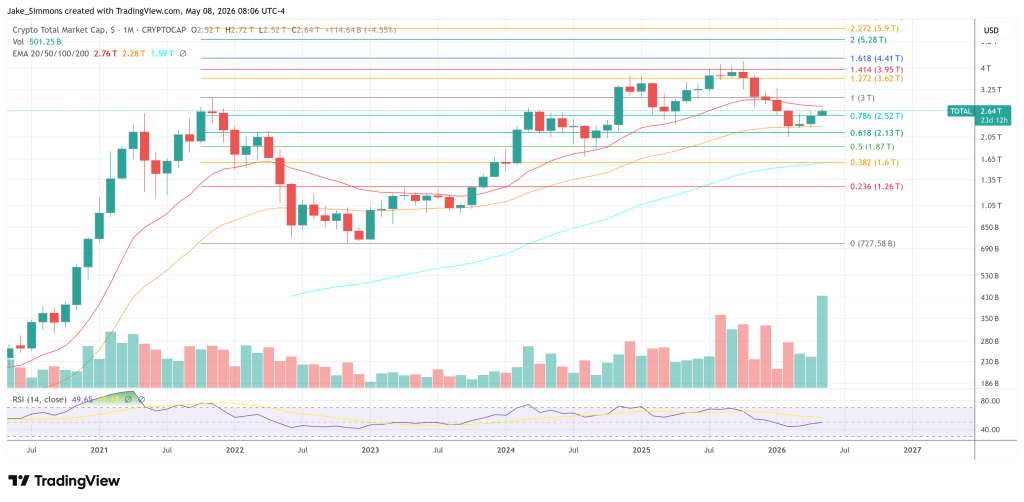
Total crypto market cap faces the 20-month EMA, 1-week chart | Source: TOTAL on TradingView.com

Related Questions

QWhat is Christine Lagarde's main argument against promoting euro-denominated stablecoins?

AShe argues that the monetary case for euro stablecoins is weak once financial stability and monetary policy transmission risks are considered, and that Europe should instead build tokenized financial infrastructure anchored in central bank money.

QAccording to Lagarde, what two functions do stablecoins perform that are often conflated?

AStablecoins perform a monetary function, by extending the reach of a currency, and a technological function, by acting as the cash leg for settlement on distributed ledger infrastructure.

QWhat are the two main risks Lagarde associates with private stablecoins?

AThe two main risks are financial stability (as demonstrated by the USDC depeg during the Silicon Valley Bank collapse) and the impairment of monetary policy transmission if retail deposits migrate into stablecoins.

QWhat European public infrastructure projects does Lagarde mention as alternatives to stablecoins for tokenized markets?

AShe mentions the Pontes project (starting in September) to offer wholesale settlement in central bank money, and the Appia roadmap, which aims to support a fully interoperable European tokenized financial ecosystem by 2028.

QHow does Lagarde describe the current dominance of US dollar stablecoins in the market?

AShe states that close to 98% of stablecoins are denominated in US dollars, with nearly 90% of the market controlled by Tether and Circle.

Related Reads

Ten-Thousand-Word Analysis: From $10 to $290, MRVL Wins the Entire AI Era by 'Not Making GPUs'

Marvell Technology's stock price surged from under $10 in 2016 to a record $290 in June 2026, fueled not by making GPUs, but by dominating AI infrastructure connectivity. This analysis argues the market misvalues MRVL as merely a smaller Broadcom in custom AI chips, overlooking its true, unique position. Marvell's core strength lies in enabling high-speed data flow for AI clusters through three interconnected businesses. First, it holds a commanding ~70% market share in high-speed optical DSPs (essential for data center light modules), a deep-moat business with accelerating growth. Second, its custom AI chip design business serves hyperscalers like AWS, Microsoft, and Google, with a significant revenue pipeline despite lower margins. Third, stable cash flows come from Ethernet switch chips and enterprise storage controllers. Together, they form a full-stack "AI data movement" platform. CEO Matt Murphy's transformative leadership since 2016, involving strategic divestments, key acquisitions (like Inphi for optical DSPs), and securing long-term agreements with major cloud providers, repositioned the company. A pivotal $2 billion strategic investment from NVIDIA in 2026 underscored Marvell's critical role in the AI ecosystem, particularly through collaborations like NVLink Fusion. While Marvell faces risks—including client concentration (losing the Amazon Trainium3 design), lower-margin business mix, competitive threats, insider selling, and complex supply chains—its fundamentals remain strong. The optical interconnect moat is widening with the acquisition of Celestial AI (photonics fabric), and financial metrics show accelerating revenue growth and operating leverage. With a PEG ratio suggesting undervaluation relative to its growth, the thesis is that the market undervalues Marvell's monopolistic position in AI "plumbing" while overemphasizing its competitive custom chip segment. The story transcends investing, symbolizing how in any complex system—from the internet to AI—the value of "connection" ultimately surpasses that of individual "nodes."

marsbit24m ago

Ten-Thousand-Word Analysis: From $10 to $290, MRVL Wins the Entire AI Era by 'Not Making GPUs'

marsbit24m ago

AI Relay Stations Spark Heated Debate on Zhihu: Behind Cheap Tokens, What Are Users Really Worried About?

A discussion on Zhihu about "AI relay stations" shifted the niche developer topic of "cheap tokens" into broader user awareness. Users moved beyond simply questioning the legitimacy of these services to focus on practical concerns: Where do cheap tokens truly come from? Is the model being accessed the real one? Can relay stations see prompts, code, and API keys? For occasional users, are the risks worth it? The core debate centered less on price and more on trust. A primary worry is model authenticity—the risk of "model swapping," where users paying for a premium model might be routed to a cheaper one, creating an information asymmetry. Others argued that cost comparisons matter; while cheaper than official pay-as-you-go APIs, relay stations may not be the lowest-cost option versus subscriptions, domestic models, or free tiers, making user needs assessment crucial. Speculation about token sources ranged from legitimate bulk discounts to gray-area methods like account sharing or exploiting regional pricing. This opacity makes risk assessment difficult for users. Data security emerged as a critical concern, especially for enterprise use. When processing sensitive information like code, contracts, or client data, the inability to verify a relay station's data handling, retention, or access policies poses significant compliance and confidentiality risks. The evolving consensus suggests relay stations can be used cautiously for low-sensitivity, disposable tasks (e.g., summarizing public info, simple translation). However, they should not be the default for sensitive, professional, or production workflows involving proprietary data, Agents, or automated systems. Recommendations include avoiding large prepayments, not relying on a single service, using test prompts to monitor quality, anonymizing data where possible, and keeping official channels as backups. Ultimately, the discussion framed tokens not just as a billing unit but as a measure of real cost encompassing price, model integrity, data security, and service stability. The popularity of relay stations highlights user demand for affordable access, but the debate underscores a key trade-off: the savings from cheap tokens may come at the price of trust, transparency, and control over one's data and AI experience.

marsbit54m ago

AI Relay Stations Spark Heated Debate on Zhihu: Behind Cheap Tokens, What Are Users Really Worried About?

marsbit54m ago

In-Depth Research Report on TradFi: The Convergence Wave of Crypto and Traditional Finance

In 2026, the crypto industry is undergoing a profound infrastructure-level transformation—TradFi assets are migrating on-chain at an unprecedented pace. According to CoinGecko's Q1 2026 report, the total value locked (TVL) of tokenized real-world assets (RWA) has surpassed $31 billion, a nearly 4x increase from $7.8 billion at the beginning of 2025, with the sector’s aggregate market capitalization reaching $19.3 billion. Among these, the market cap of tokenized stocks surged from $2 million to $486 million, with Q1 spot trading volume reaching $15.1 billion—a single quarter already surpassing the entire second half of 2025. RWA perpetual contract Q1 trading volume reached a staggering $524.8 billion, far exceeding the $313 billion for all of 2025. Meanwhile, BlackRock's BUIDL fund has reached $2.3 billion in scale and has filed for two new tokenized funds, signaling that the world's largest asset manager's tokenization strategy is evolving from pilot to product suite expansion. HTX, as a core participant in the crypto exchange sector, officially launched TradFi perpetual futures products including NVDA, AAPL, MSFT, META, and SPY in 2026, enabling crypto users to gain 24/7 trading access to core U.S. equities. Boston Consulting Group predicts that global tokenized asset scale could reach $16 trillion by 2030, while McKinsey offers a conservative estimate of approximately $2 trillion. The on-chain migration of TradFi assets is no longer a "future narrative" but a structural transformation unfolding in real time, as crypto exchanges evolve from single crypto asset trading platforms toward "multi-asset-class trading infrastructure."

HTX Learn56m ago

In-Depth Research Report on TradFi: The Convergence Wave of Crypto and Traditional Finance

HTX Learn56m ago

Trading

Spot
Futures
活动图片





