Krypto News: Coinbase and Crypto.com Launch Prediction Markets

bitcoinistPublished on 2026-02-04Last updated on 2026-02-04

Abstract

Major cryptocurrency exchanges Coinbase and Crypto.com have recently launched prediction market platforms, expanding their offerings beyond traditional crypto trading. Coinbase activated its "Coinbase Predict" feature across all 50 U.S. states in partnership with regulated provider Kalshi. This allows users to trade binary event contracts on real-world outcomes in sports, politics, and economics, settled in USD or USDC. The platform operates under CFTC oversight, creating a regulatory distinction from gambling. Simultaneously, Crypto.com introduced its standalone prediction market app, "OG," operated by its CFTC-registered derivatives division. A key differentiator is its planned offering of margined, leveraged positions on prediction contracts, alongside social features and user incentives. The article highlights the growing interest in event-based trading and questions which infrastructure can best support it. It points to Bitcoin Layer-2 solutions, like the project "Bitcoin Hyper," as a potential foundation for building scalable, decentralized prediction markets. The project's ongoing presale, having raised over $31 million, is cited as evidence of significant market interest in expanding Bitcoin's use cases beyond a store of value.

Since the beginning of the year, major crypto exchanges have been diving deep into the prediction and event trading market. In quick succession, both Coinbase and Crypto.com have announced and launched new platform offerings that allow private users to bet on the outcome of real-world events—from sports events to politics and cultural developments. This development is part of a broader trend where established trading platforms are expanding their product portfolios far beyond classic crypto trading.

Coinbase Expands Nationwide Prediction Markets

At the end of January, the US exchange Coinbase activated its prediction market offering across all 50 US states. The feature was introduced in collaboration with the regulated US provider Kalshi and enables customers to trade so-called event contracts directly via the Coinbase app. These are binary markets where the contract settles based on a yes/no outcome of an event, such as "Will Team X win the game?" or "Will US GDP exceed expectations?".

Pricing is determined by supply and demand in the market, not by odds set by the platform.

The full national release follows an earlier, limited availability in select regions. Coinbase itself describes the product as an opportunity to "hedge" on real-world events and convert predictions into tradable market prices, similar to established prediction markets like Polymarket or Kalshi itself. Wagers can be placed in US dollars or via stablecoin balances in USDC, which is already familiar to Coinbase customers.

Regulatorily, the offering is significant in the US as it falls under the supervision of the Commodity Futures Trading Commission (CFTC), which allows for a different classification than classic sports betting or gambling. This regulatory classification is not without controversy: in several states, there have already been disputes over whether prediction markets should instead fall under state gambling laws.

Crypto.com Launches Standalone Platform "OG"

Simultaneously, Crypto.com has launched its own prediction market platform called OG, which initially focuses on the US market and went live just before one of the biggest sporting events of the year. OG is operated by Crypto.com | Derivatives North America (CDNA), a registered CFTC clearing and trading venue, and also offers users the ability to trade event contracts on topics such as sports, politics, finance, and entertainment.

A key distinguishing feature of OG is the planned offering of margin or leveraged positions on prediction contracts, which is intended to set it apart from previous platform formats—an approach that, however, also implies higher risks for users. Additionally, OG integrates social elements such as leaderboards and rewards, including up to $500 for the first million registered users.

The launch as a standalone app rather than an integrated feature signals that Crypto.com views the prediction market as its own growth area that generates strong user interest. According to the company, demand for such contract types has increased significantly in recent months, which favored the decision to spin off a dedicated product.

Are Decentralized Prediction Markets Coming to Bitcoin?

The recent moves by major exchanges into regulated prediction markets highlight how much interest in event-based trading has grown. At the same time, this brings a fundamental question into focus: On which infrastructure can such applications be mapped in a scalable, transparent, and as neutral as possible manner in the long term?

While many of the platforms used today are built on existing smart contract networks, there is a parallel growing interest in solutions that enable these concepts on a Bitcoin basis as well. A prerequisite for this is powerful Layer-2 structures that open up new use cases beyond pure value storage.

Against this backdrop, one project is currently coming more into view that aims to address exactly this gap.

Bitcoin Hyper positions itself as a Layer-2 solution for the Bitcoin ecosystem, with the goal of enabling more complex applications directly at Bitcoin's security level. These explicitly include decentralized prediction markets, which have so far been implemented primarily on Ethereum- or Solana-based networks. The project pursues the approach of combining Bitcoin's liquidity and trust base with a high-performance execution layer to enable applications that were previously considered technically unfeasible.
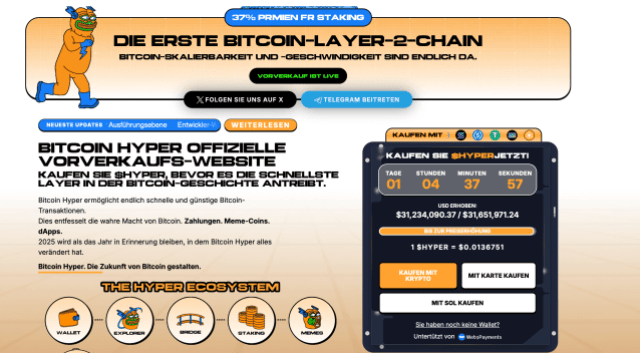
The current market interest is reflected primarily in the ongoing presale. According to project reports, over $31 million has already been raised, indicating unusually high attention in a phase where many investors are acting more selectively. Observers attribute this in part to the overarching narrative: Bitcoin not just as a passive store of value, but as a foundation for new financial and information markets. Prediction markets are considered a particularly sensitive use case, as they require both scalability and security.

Bitcoin Hyper attempts to differentiate itself in this environment through a clear focus on Bitcoin Layer-2 infrastructure. If the adoption of such Layer-2 networks continues to accelerate, applications like decentralized prediction markets on Bitcoin could also become realistic.

The presale is divided into several price tiers, allowing early participants to achieve book gains. Acquisition is done via the project website by connecting a compatible wallet and executing the token swap.

Go to the Bitcoin Hyper Presale

Related Questions

QWhat new type of trading platforms have Coinbase and Crypto.com recently launched?

ACoinbase and Crypto.com have launched prediction market platforms, allowing users to trade on the outcome of real-world events such as sports, politics, and cultural developments.

QHow does Coinbase's prediction market, Coinbase Predict, function and what is it regulated under?

ACoinbase Predict functions as a binary market where contracts settle based on a yes/no outcome of an event. It is regulated under the oversight of the U.S. Commodity Futures Trading Commission (CFTC).

QWhat is the name of Crypto.com's new prediction market platform and what is one of its key differentiating features?

ACrypto.com's new platform is called OG. A key differentiating feature is its planned offering of margin or leveraged positions on prediction contracts.

QAccording to the article, which blockchain is being positioned as a potential new base for decentralized prediction markets through Layer-2 solutions?

ABitcoin is being positioned as a potential new base for decentralized prediction markets through Layer-2 solutions like Bitcoin Hyper, which aims to enable more complex applications on Bitcoin's security level.

QHow much funding has the Bitcoin Hyper project reportedly raised in its ongoing presale, according to the article?

AThe Bitcoin Hyper project has reportedly raised more than $31 million in its ongoing presale.

Related Reads

Only a 50% Chance of Passing This Year, Can the CLARITY Bill Succeed Before the Midterm Elections?

The CLARITY Act, which passed the House in July 2025 with strong bipartisan support (294-134), faces a critical juncture in the Senate. The Senate Banking Committee is expected to hold a markup soon, but key issues remain unresolved, including stablecoin yield provisions, DeFi regulations, and securing full Republican committee support. Other contentious points involve the Blockchain Regulatory Certainty Act (BRCA), ethics amendments for government officials, and SEC-related matters. The legislative calendar is tight, with limited time before the midterm elections. If the committee markup is delayed beyond mid-May, the chances of passage in 2026 drop significantly. Senator Cynthia Lummis has warned that failure this year could delay comprehensive crypto market structure legislation until 2030 or later. Galaxy estimates the probability of the CLARITY Act becoming law in 2026 is only about 50%. The bill provides crucial regulatory clarity by defining jurisdictional boundaries between the SEC and CFTC, establishing a path for decentralization, and bringing digital commodity intermediaries under federal regulation. Its passage is seen as vital before potential power shifts in the next Congress, which could bring less favorable leadership to key committees. The timeline is compressed, and the bill must compete for floor time with other priorities like Iran authorization and DHS appropriations. Key hurdles include finalizing the stablecoin yield compromise text, addressing law enforcement concerns about BRCA, and navigating political dynamics around SEC nominations. The outcome of the Banking Committee markup and the level of bipartisan support will be critical indicators of its future success.

marsbit34m ago

Only a 50% Chance of Passing This Year, Can the CLARITY Bill Succeed Before the Midterm Elections?

marsbit34m ago

Only a 50% Chance of Passing This Year, Can the CLARITY Bill Succeed Before the Midterm Elections?

The CLARITY Act, which passed the U.S. House in July 2025 with strong bipartisan support (294-134), faces a critical juncture in the Senate. The Senate Banking Committee is expected to hold a markup soon, but key issues remain unresolved, including stablecoin yield provisions, DeFi regulations, and securing full Republican committee support. Additional challenges involve the Blockchain Regulatory Certainty Act (BRCA), ethics amendments for government officials, and SEC-related concerns. Galaxy estimates only a 50% chance of the bill becoming law in 2026. The tight legislative calendar, competing priorities like Iran military authorization and DHS appropriations, and the impending midterm elections create significant time pressure. If the bill is not passed before the new Congress convenes in 2027, comprehensive crypto market structure legislation could be delayed until 2030 or later, especially if leadership changes result in less favorable committee chairs. The act provides crucial regulatory clarity by defining the jurisdictional boundaries between the SEC and CFTC, establishing a path for decentralized networks to be classified as non-securities, and bringing digital commodity intermediaries under federal regulation. The outcome of ongoing Senate negotiations, particularly the release of revised text on stablecoin yields, will be a key indicator of its future prospects.

Odaily星球日报44m ago

Only a 50% Chance of Passing This Year, Can the CLARITY Bill Succeed Before the Midterm Elections?

Odaily星球日报44m ago

Four-Dimensional Resonance: Hong Kong Web3 Carnival Sub-Forum Co-Creates Blueprint for Global Financial New Infrastructure

The "Four-Dimensional Resonance: 2026 Global Financial New Infrastructure" forum, a core event of the Hong Kong Web3 Festival, was successfully held at the Hong Kong Convention and Exhibition Centre. Co-hosted by Web3Labs and DeShang Singularity Tech, with joint support from Bitroot, Injective, Microsoft, and Z Oracle, the event gathered policymakers, industry leaders, and investors to explore the integration and innovation of global financial infrastructure, focusing on RWA, AI, DeFi, and compliant payments. Policy speakers, including Hong Kong Legislative Council Member Mr. Wu Jiezhuang, South Korean National Assembly Member Mr. Min Byung-duk, and ACED Chairman Mr. Yun Seok-hun, emphasized the importance of cross-border regulatory collaboration and an open policy environment for fintech innovation. Web3Labs CEO Caspar and DeShang Singularity Tech CEO Chang Shuai highlighted Hong Kong’s role as a financial innovation center and the approaching "singularity moment" for global financial infrastructure. Technical insights were shared by MagnetX, Bitroot, Microsoft, and Injective on topics including AI Agent economies, the evolution of public blockchains, and AI’s transformative role in finance. Key partnerships and initiatives were launched: - GWDC 2026 Korea collaboration between Hong Kong and South Korea. - A strategic agreement between Web3Labs and Microsoft. - The launch of a public anti-fraud alliance by Z Oracle and partners. - The "Injective Rising Star" program to support AI and Web3 projects. Panel discussions delved into AI-driven smart payments, compliant cross-border transactions, and the fusion of RWA and DeFi. Participants agreed that integrating RWA with DeFi is crucial for the next stage of financial infrastructure, enabling a shift from physical to digital finance. The forum underscored Hong Kong’s pivotal role in advancing a globalized and sustainable Asian fintech ecosystem.

marsbit52m ago

Four-Dimensional Resonance: Hong Kong Web3 Carnival Sub-Forum Co-Creates Blueprint for Global Financial New Infrastructure

marsbit52m ago

Trading

Spot
Futures
活动图片