KITE under pressure: 1.8B supply meets falling demand and rising shorts

ambcryptoPublished on 2026-03-27Last updated on 2026-03-27

Abstract

KITE remains in a bearish phase with weakening fundamentals and negative market sentiment. The number of holders has declined from 105,420 to 104,780 since March 24, while market capitalization dropped by $57 million. Despite a high circulating supply of 1.8 billion tokens, demand is shrinking. The price fell 11% in 24 hours, with rising volume indicating strong bearish momentum. Perpetual traders are increasing short exposure, pushing the funding rate to a deeply negative -1.2420%, similar to levels preceding a previous sharp decline. Liquidity analysis suggests a potential drop toward $0.175, with further downside risk likely due to persistent selling pressure and dominant short positioning.

Kite [KITE] remains in a bearish phase as market sentiment continues to weaken. The recent decline reflects underlying structural shifts that could push prices lower in the near term.

Perpetual traders are capitalizing on this trend, increasing short exposure in ways that may exert additional downward pressure in upcoming trading sessions.

KITE fundamentals weaken as holder count drops

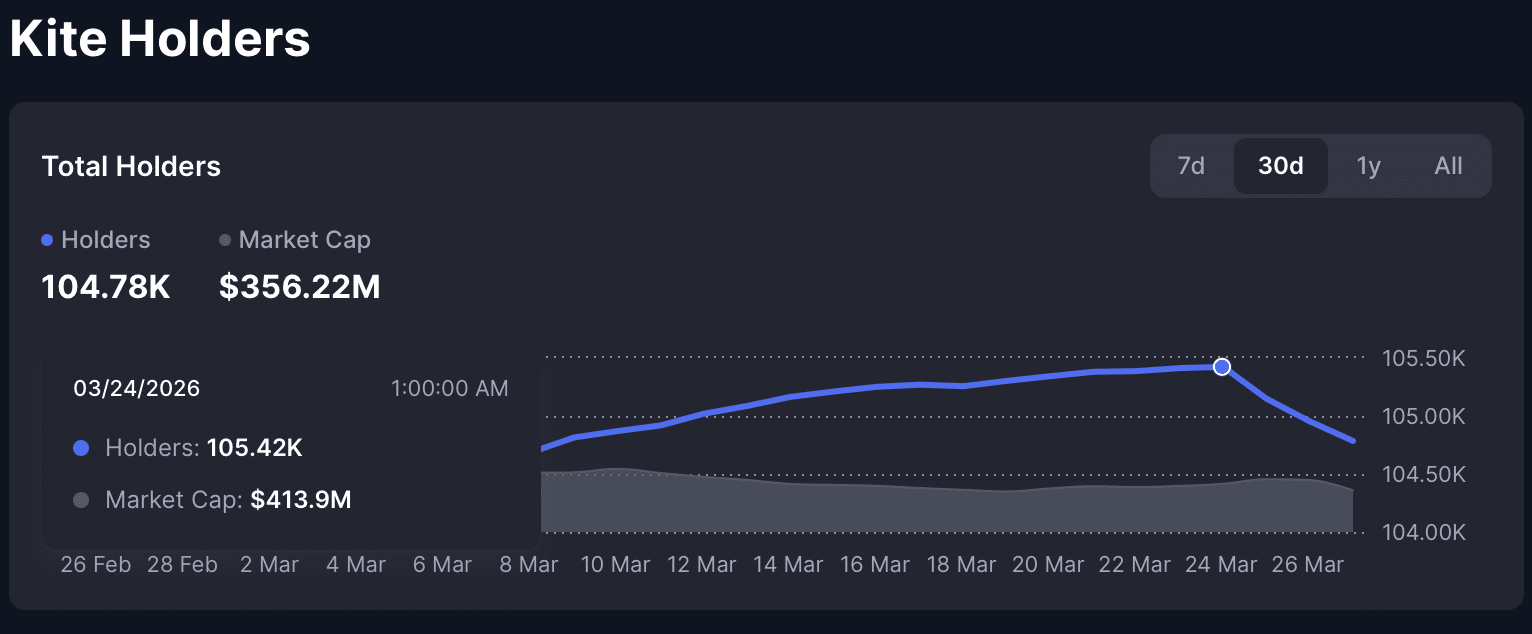
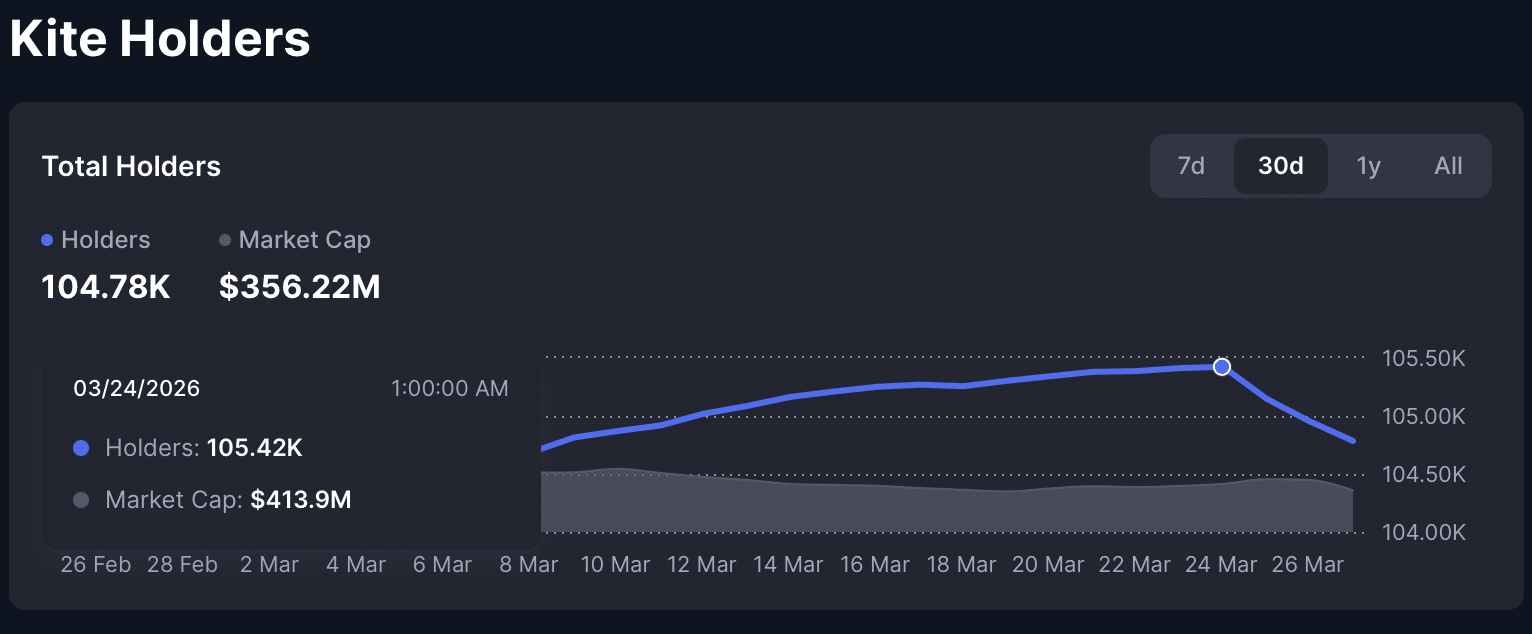
A key driver behind KITE’s recent decline lies in deteriorating fundamentals. The number of holders has dropped sharply after peaking at 105,420 on the 24th of March, when market capitalization reached $413.9 million.

At press time, the holder count has fallen to 104,780, while market capitalization has declined by $57 million, according to CoinMarketCap.
Source: CoinMarketCap

Despite the drop in participation, KITE’s circulating supply remains elevated at 1.8 billion tokens. This imbalance between supply and shrinking holder demand continues to weigh on sentiment.

At the same time, price action has weakened, with KITE posting a double-digit loss of 11% over the past 24 hours as of writing. Trading volume, however, has increased. Historically, rising volume alongside falling prices signals strong bearish momentum, suggesting the downtrend may extend.

Perpetual market signals growing short dominance

The perpetual futures market adds further downside risk.

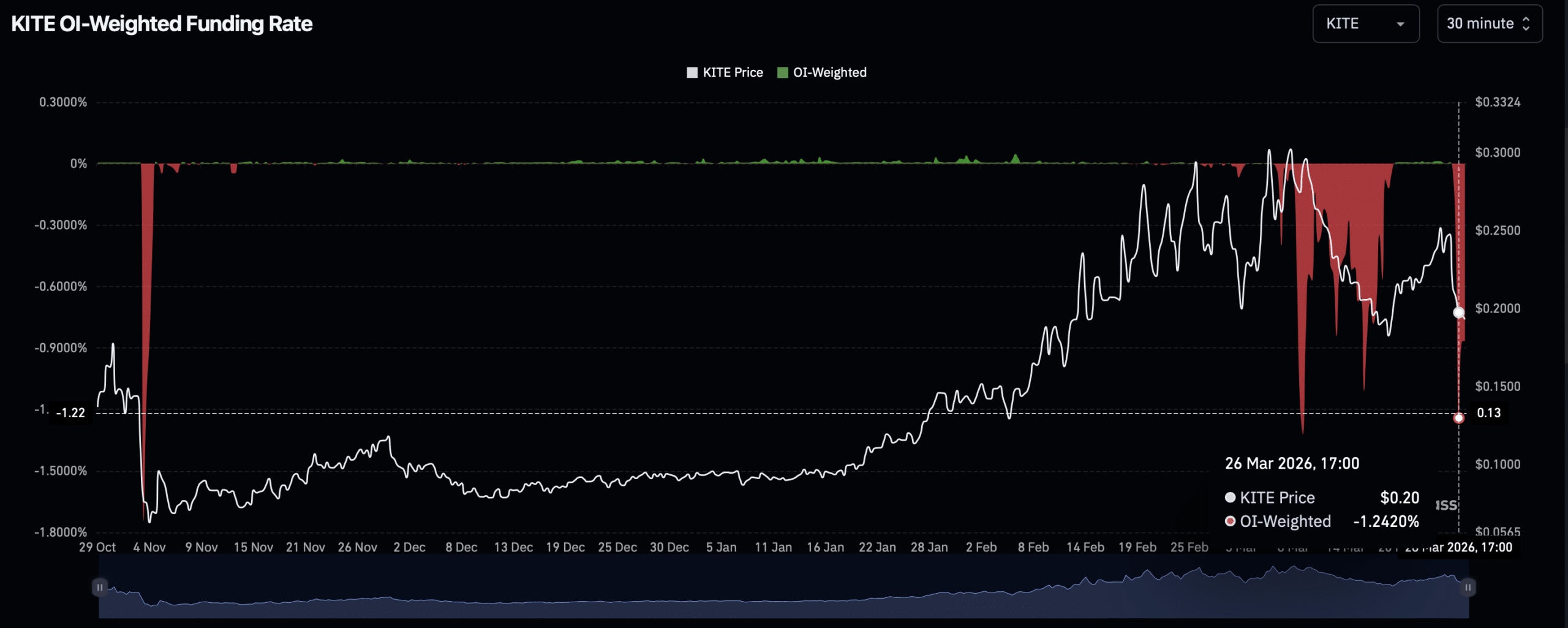
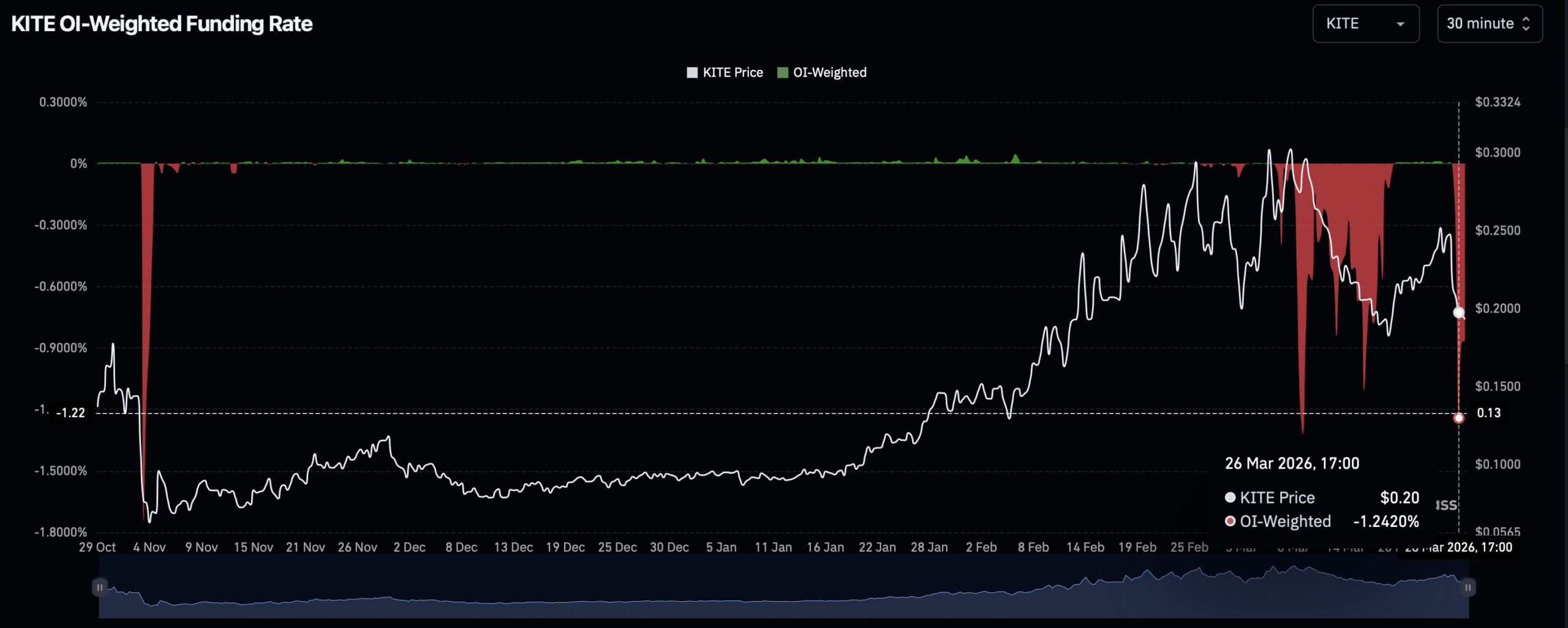
Short traders have increased their dominance across KITE contracts. Over the past 24 hours, the Open Interest Weighted Funding Rate, which measures whether longs or shorts control the market, has turned sharply negative, at press time, reinforcing bearish sentiment.

The Funding Rate dropped to -1.2420%, the steepest drop since the 9th of March. On the 19th of March, a similar decline occurred, resulting in a sharp price drop from $0.29 to $0.18, indicating potential downside pressure.
Source: CoinGlass

Notably, capital inflows into the perpetual market have risen even as short positioning intensifies. Open Interest has increased by nearly 1% to $50.54 million, suggesting that traders are adding liquidity primarily to build short exposure.

Liquidity points to further downside risk

Liquidity data indicates that KITE may still have room to decline.

Current liquidity clusters indicate a potential move toward $0.175, where a concentration of unfilled orders exists. With minimal liquidity below this level, price may gravitate toward this zone in the short term.
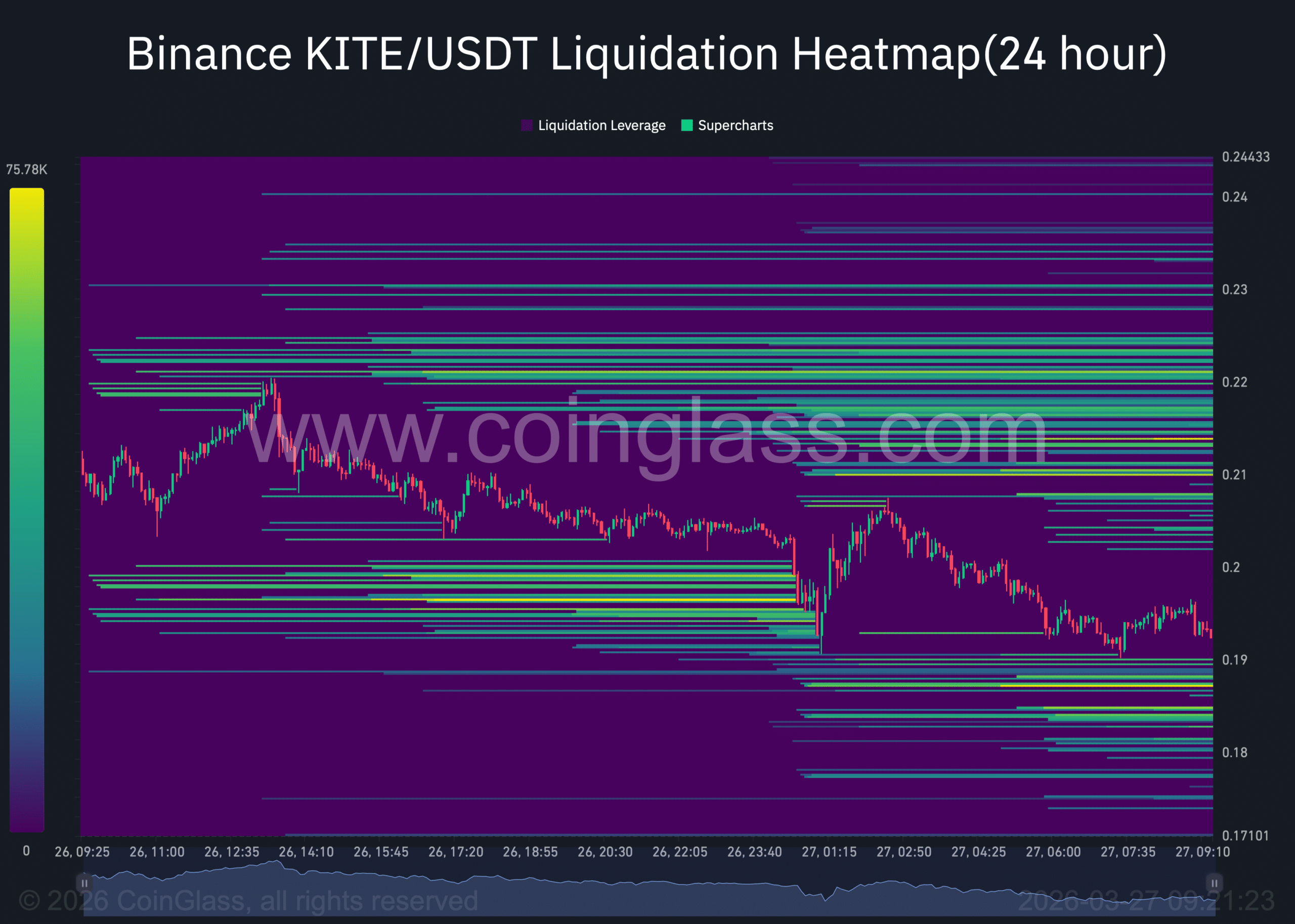
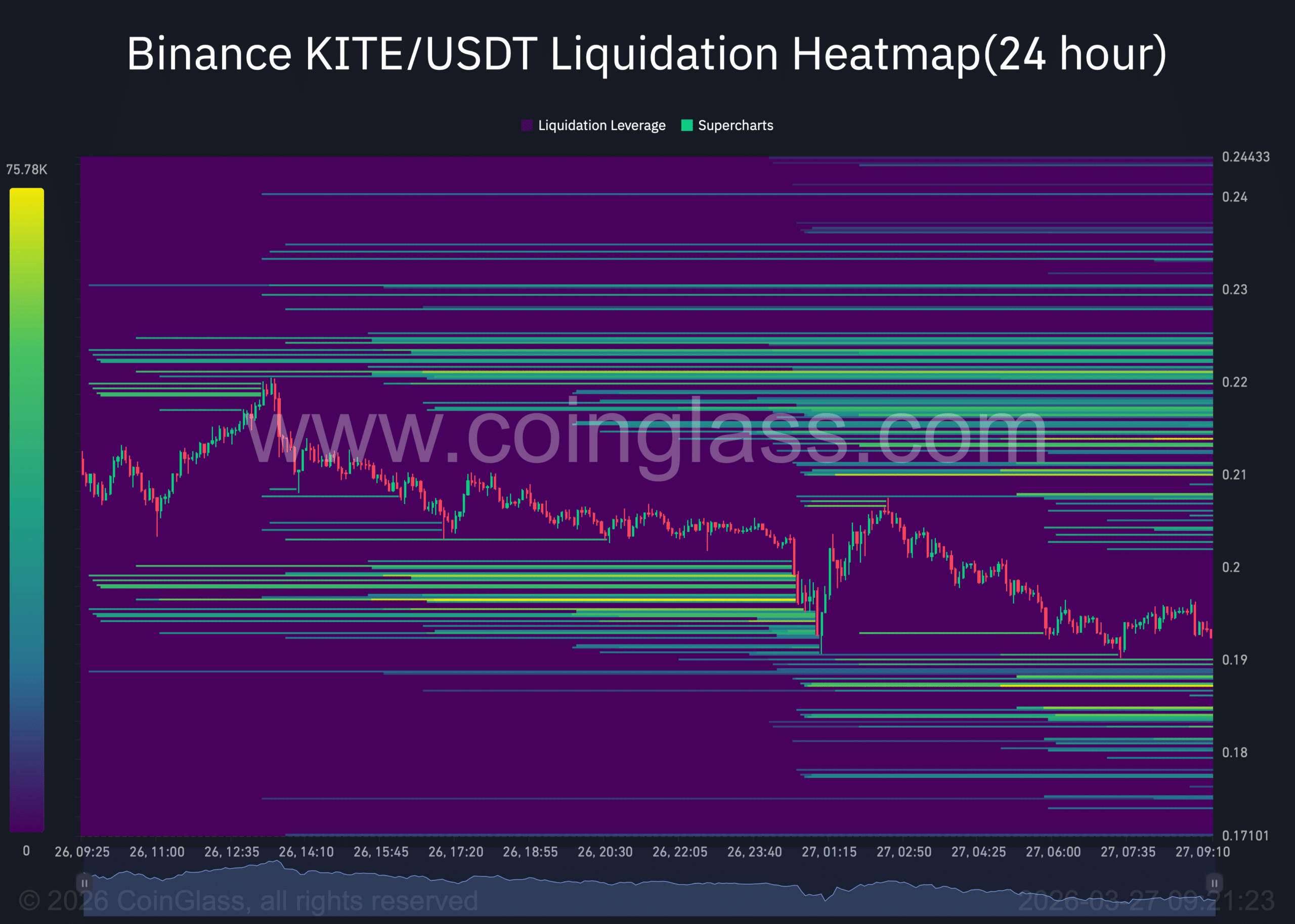
Source: CoinGlass

If KITE stabilizes and rebounds from this region, it could target a recovery toward the $0.23–$0.24 range. However, given the prevailing bearish momentum and increasing short pressure, the probability of further downside remains higher for now.


Final Summary

  • KITE’s holder count continues to decline after reaching an all-time high on March 24, coinciding with a $57 million drop in market capitalization.
  • Perpetual traders are reinforcing the downtrend, with short contracts rising to levels last seen weeks ago.


Related Questions

QWhat is the main reason behind KITE's recent price decline according to the article?

AThe main reason is deteriorating fundamentals, including a sharp drop in holder count and an imbalance between the elevated circulating supply of 1.8 billion tokens and shrinking holder demand.

QHow has the number of KITE holders changed since its peak on March 24th?

AThe holder count has dropped from a peak of 105,420 on March 24th to 104,780 at the time of writing.

QWhat does the negative Open Interest Weighted Funding Rate indicate for the perpetual futures market?

AA sharply negative funding rate of -1.2420% indicates that short traders are dominant and paying long traders, reinforcing bearish sentiment in the market.

QWhat price level does liquidity data suggest KITE gravitate towards in the short term?

ALiquidity data suggests a potential move toward $0.175, where a concentration of unfilled orders exists.

QWhat was the percentage loss in KITE's price over the 24 hours preceding the article?

AKITE posted a double-digit loss of 11% over the past 24 hours as of writing.

Related Reads

How Many Tokens Away Is Yang Zhilin from the 'Moon Chasing the Light'?

The article explores the intense competition between two leading Chinese AI companies, DeepSeek and Kimi (Moon Dark Side), and the mounting pressure on Yang Zhilin, the founder of Kimi. While DeepSeek re-emerged after 15 months of silence with its powerful V4 model—boasting 1.6 trillion parameters and low-cost, long-context capabilities—Kimi has been focusing on long-context processing and multi-agent systems with its K2.6 model. Yang faces a threefold challenge: technological rivalry, commercialization pressure, and investor expectations. Despite Kimi’s high valuation (reaching $18 billion), its revenue heavily relies on a single product with low paid conversion rates, while DeepSeek’s strategic silence and open-source influence have strengthened its market position and valuation prospects, now targeting over $20 billion. Both companies reflect broader trends in China’s AI ecosystem: Kimi aims for global influence through open-source contributions and agent-based advancements, while DeepSeek prioritizes foundational innovation and hardware independence, notably shifting to Huawei’s chips. Their competition is seen as vital for China’s AI progress, with the gap between top Chinese and U.S. models narrowing to just 2.7% on the Elo rating scale. Ultimately, the article argues that this rivalry, though anxiety-inducing for leaders like Zhilin, is essential for driving innovation and solidifying China’s role in the global AI landscape.

marsbit6h ago

How Many Tokens Away Is Yang Zhilin from the 'Moon Chasing the Light'?

marsbit6h ago

TechFlow Intelligence Bureau: ChatGPT Helps Amateur Mathematician Crack 60-Year-Old Problem, CFTC Sues New York Regulator Over Coinbase and Gemini

An amateur mathematician, with the assistance of ChatGPT, has solved a combinatorial mathematics puzzle originally proposed by Hungarian mathematician Paul Erdős in the 1960s. This marks another milestone in AI-aided mathematical research, demonstrating the evolving capabilities of large language models in formal reasoning. In other AI developments, OpenAI introduced a new privacy filter tool for enterprise API usage, automatically screening sensitive data. Meanwhile, the Qwen3.6-27B model achieved 100 tokens per second on a single RTX 5090 GPU using quantization, significantly lowering the cost barrier for local AI deployment. In crypto and Web3, the U.S. CFTC sued New York’s financial regulator, challenging its oversight of Coinbase and Gemini—a first-of-its-kind federal-state regulatory clash. Following a vulnerability, KelpDAO and major DeFi protocols established a recovery fund. Tether froze $344 million in assets linked to Iran’s central bank upon U.S. Treasury request, highlighting the centralized control risks in stablecoins. Separately, Litecoin underwent a 3-hour chain reorganization to undo a privacy-layer exploit. In the U.S., former President Trump invoked the Defense Production Act to address power grid bottlenecks affecting AI data centers and dismissed the entire National Science Board, raising concerns over research independence. A retail trader gained 250% on a $600k Intel options bet amid AI-related speculation. Xiaomi announced its first performance electric vehicle, targeting rivals like Tesla. Meanwhile, iPhone users reported devices automatically reinstalling a hidden app daily, suspected to be MDM-related. A Chinese securities report noted that A-share institutional crowding has reached its second-longest streak since 2007, signaling high valuations and potential style rotation. The day’s developments reflect a dual narrative: AI is enabling unprecedented individual breakthroughs, while centralized power structures—whether governmental or corporate—are becoming more assertive, underscoring that decentralization is as much a political-economic challenge as a technical one.

marsbit6h ago

TechFlow Intelligence Bureau: ChatGPT Helps Amateur Mathematician Crack 60-Year-Old Problem, CFTC Sues New York Regulator Over Coinbase and Gemini

marsbit6h ago

Trading

Spot
Futures
活动图片




