"King of Shilling" Hayes Strikes Again, This Time Setting His Sights on Deribit

Foresight NewsPublished on 2026-06-29Last updated on 2026-06-29

Abstract

On June 29, BitMEX co-founder Arthur Hayes acquired approximately 6.16 million SYN tokens via OTC platform Flowdesk, valued at around $2.2 million. Subsequently, Hayes publicly endorsed SYN on X, calling it one of the most asymmetric investments he's seen since HYPE and declaring it time for an on-chain options DEX to challenge industry leader Deribit, naming Hypercall as that challenger. The article details the evolution of the Synapse Protocol, originally launched in 2021 as a cross-chain messaging and liquidity network. While its TVL peaked above $1 billion during the last bull market, it has since declined. The protocol's team has since built Hypercall, an on-chain options trading platform on Hyperliquid's HyperEVM, which supports trading options on "any asset" with features like 24/7 trading and defined risk limited to the premium paid. Deribit, founded in 2016, is highlighted as the dominant centralized crypto options exchange, commanding roughly 85% market share in BTC and ETH options. Its strengths include deep liquidity and professional tools, though it faces critiques over custody risk, KYC requirements, and regulatory uncertainty. The analysis suggests Hypercall's potential lies in decentralization, permissionless access, and transparency, potentially carving a niche in DeFi-native and emerging asset options. However, it faces significant challenges competing with Deribit's established network effect and liquidity depth. The piece concludes by noting Hayes's re...


Author: Ma He, Foresight News


On June 29, an address associated with BitMEX co-founder Arthur Hayes purchased approximately 6.16 million SYN tokens via the OTC platform Flowdesk, with a transaction value of about $2.2 million at an average buy price of around $0.3573 per token.
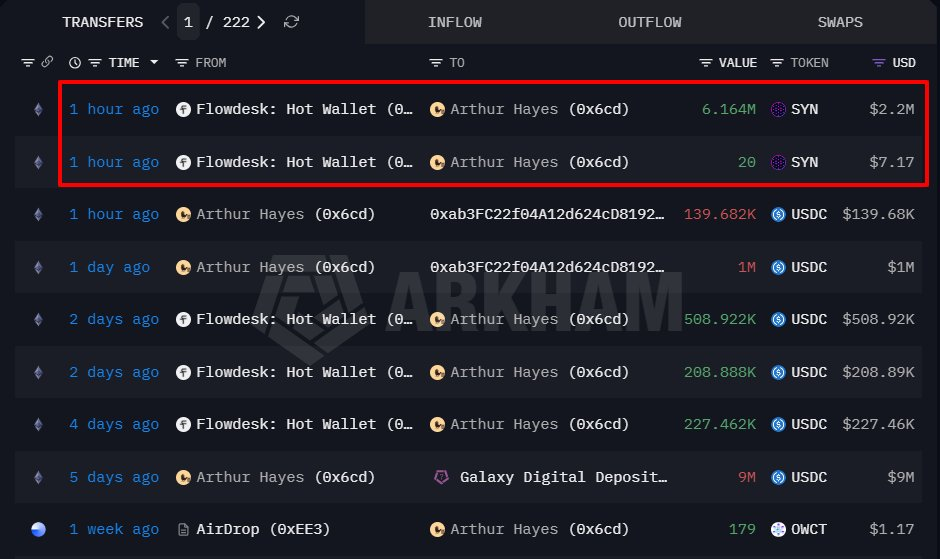


Subsequently, Arthur Hayes posted on the X platform stating that SYN is one of the most asymmetric investments he has seen since HYPE and explicitly declared, "Now is the time for options DEX to officially challenge Deribit, and Hypercall is that challenger."


Currently, SYN is trading at $0.436, up over 40% in 24 hours. Since June 2026, the price of SYN has experienced explosive growth, increasing more than 10x in a single month, with an FDV of approximately $110 million.


Synapse: From Cross-Chain Infrastructure to On-Chain Options


Synapse Protocol was established in 2021, initially positioning itself as a universal cross-chain messaging and liquidity network. It allows developers to transmit arbitrary data between different blockchains, including smart contract calls and NFTs, going beyond simple asset bridging.


Early on, Synapse gained a foothold in the multi-chain ecosystem with its cross-chain AMM liquidity pools and low-slippage stablecoin swaps. During the 2021-2022 bull market, its TVL once exceeded $1 billion, making it a major player in the cross-chain bridge sector alongside projects like Wormhole, LayerZero, and Axelar. However, the competition in cross-chain connectivity is fierce, and compounded by the bear market impact, the protocol's TVL declined significantly.
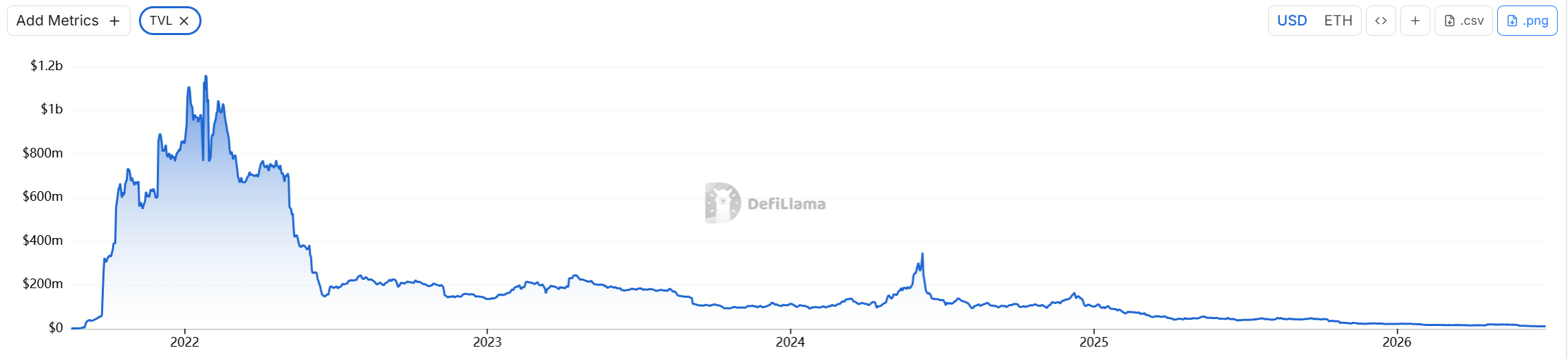


According to the latest data from DefiLlama, as of June 2026, Synapse TVL is approximately $11.1 million, primarily concentrated on chains like Ethereum and Canto.


The SYN token, serving as the governance token, reached a high of around $5 in October 2021 but has remained subdued for a long time since.


Hypercall is an on-chain options trading protocol built by the Synapse team, deployed on HyperEVM within the Hyperliquid ecosystem. Its core proposition is to create "an options exchange that can trade any asset."


Unlike traditional centralized options platforms or early on-chain options protocols, Hypercall's official documentation states it supports trading at any scale, with contracts divisible down to the dollar or up to million-dollar levels. Additionally, the maximum loss on an option is limited to the premium paid, with no liquidation or cascading liquidation risks. It also supports 24/7 trading.


Currently, Hypercall's Mainnet Alpha is live, allowing users to connect their wallets to trade SpaceX (SPCX) options. BTC puts and NVDA spreads have also appeared as available underlyings. The team previously claimed its product has processed over $55 billion in cumulative trading volume.


Deribit: The Centralized Options Dominator


Founded in 2016, Deribit has long held an absolute dominant position in the crypto options market. According to industry data, its market share in BTC and ETH options is around 85%, making it the preferred platform for institutional traders, market makers, and quantitative funds.


Currently, data from DeFiLlama shows its total asset value is $3.588 billion.
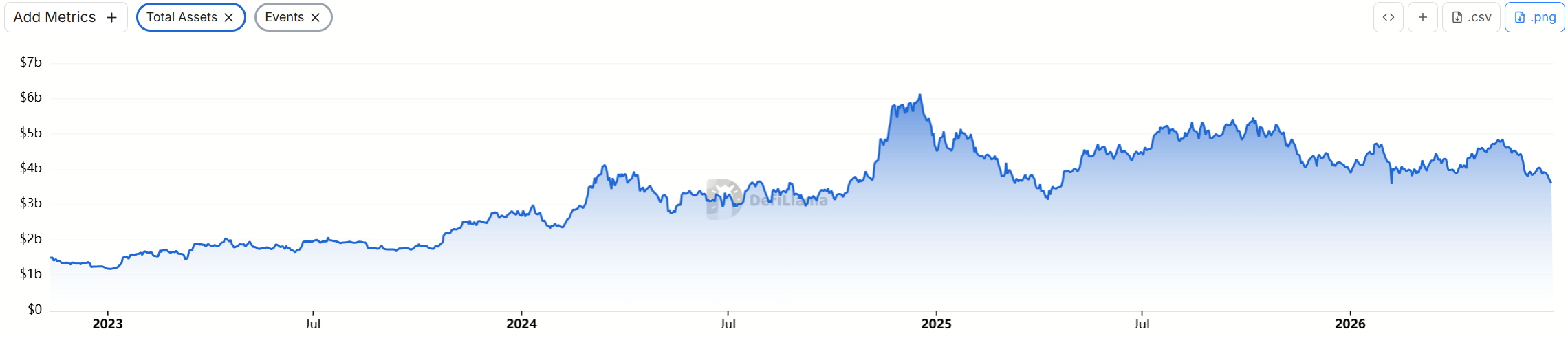


Deribit's advantages lie in its deep liquidity and professional tools: support for portfolio margin, block trading, and low-latency multicast data feeds. Furthermore, it has a long track record of stable operation. However, centralization brings inherent limitations: custodial risks, KYC barriers, regulatory uncertainty, and relative unfriendliness towards small retail users and DeFi natives. The complexity of options trading and the margin mechanism further amplify these pain points.


Arthur Hayes's call taps into the industry's core logic—as on-chain perpetual DEXs like Hyperliquid have demonstrated high performance, composability, and capital efficiency, the demand for on-chain options, as "precise tools for expressing volatility and direction," is accumulating.


Hypercall's potential advantages include: decentralization, permissionlessness, no KYC, and transparency. Moreover, deep integration with the Hyperliquid settlement layer promises a trading experience close to centralized platforms while retaining on-chain transparency. However, the protocol is still in its early Mainnet Alpha stage, with liquidity depth far inferior to Deribit. Initial underlying assets include SpaceX for testing; coverage of mainstream crypto options will take time. Historically, on-chain options protocols (like early versions of Hegic, Opyn) have made many attempts but often struggled to scale due to insufficient liquidity.


Deribit's network effects are difficult to replace in the short term. Hypercall is more likely to act as a "complement and differentiated competitor" rather than a direct replacement—especially in the DeFi-native and emerging asset (e.g., RWA, AI-related) options space.


What Game is the King of Shilling Playing?


Arthur Hayes's recent "shilling" track record shows significant divergence.


Previously, he was highly bullish on HYPE, predicting a price target as high as $150, but chose to liquidate all his HYPE holdings in early June. He also liquidated his holdings in previously shilled NEAR and WLD. On June 16 and 23, on-chain tracking data showed he repurchased a total of 91,000 HYPE tokens via an exchange.


On June 24, the release of a CARDS (Collector Crypt) in-depth research report by Arthur Hayes's family office, Maelstrom, also sparked controversy. The report set a price target of $4 by the end of summer.


Just 4 days later, CARDS's market cap had fallen approximately 22% since Maelstrom set the target price.


Currently, its price is $0.2437, with a market cap of $100 million and an FDV of $487 million.
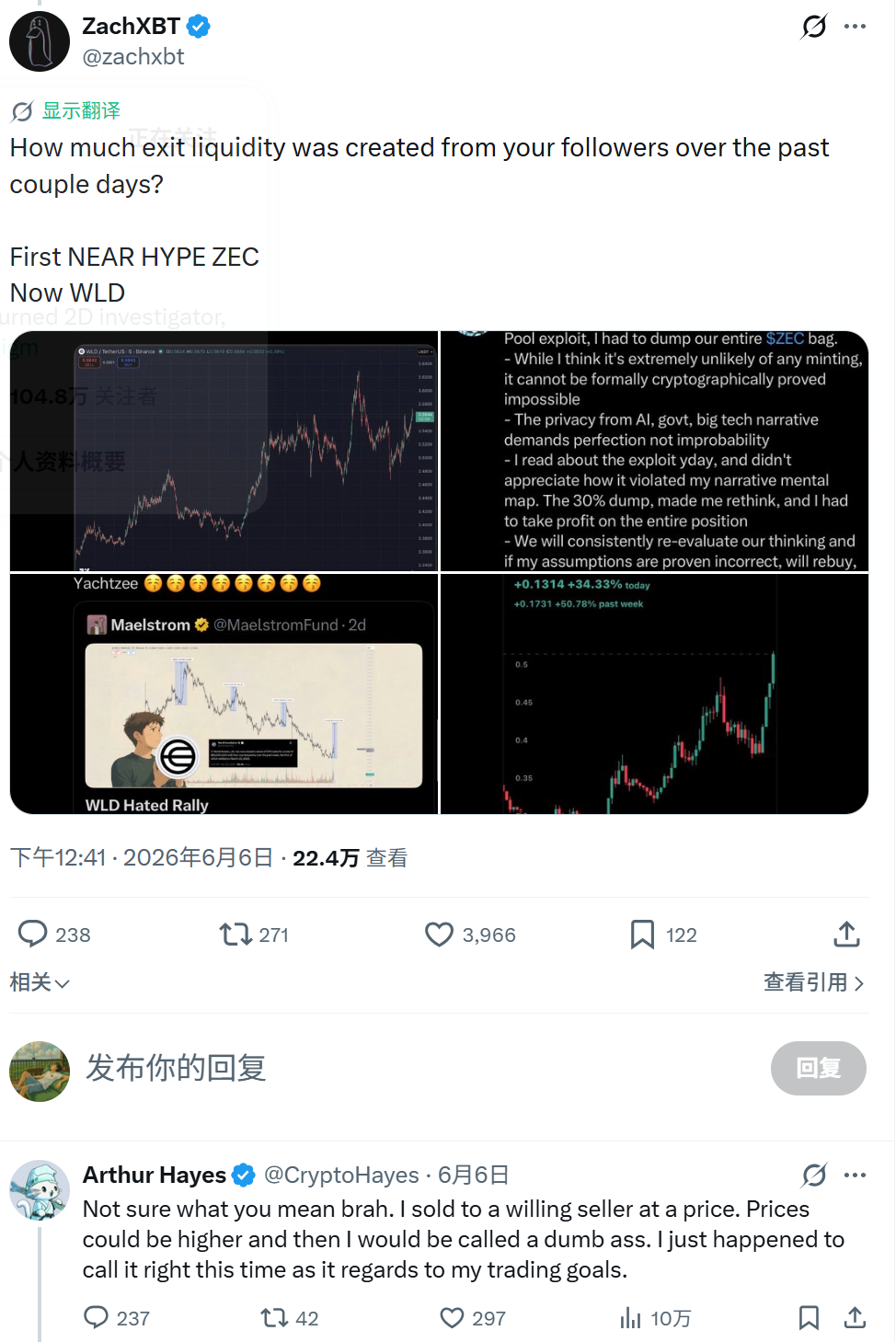


On-chain detective ZachXBT previously criticized Arthur Hayes on X, tweeting, "How much exit liquidity has your fanbase created for you over the last few days?" Arthur Hayes responded that he was just trading normally, prices can go up or down, and stated, "Happened to get this one right."


Related Questions

QAccording to the article, what action did Arthur Hayes's associated address take on June 29th, and what was the reason given for this investment?

AArthur Hayes's associated address purchased approximately 6.16 million SYN tokens worth about $2.2 million via the OTC platform Flowdesk on June 29th. Hayes later stated on X that SYN was one of the most asymmetric investments he had seen since HYPE, explicitly saying it was time for an on-chain options DEX to challenge Deribit and that Hypercall was that challenger.

QWhat is the core historical business of the Synapse Protocol, and what new venture is the team currently focusing on with Hypercall?

ASynapse Protocol was originally founded in 2021 as a universal cross-chain messaging and liquidity network, allowing arbitrary data transfer between blockchains. The team is now focusing on Hypercall, an on-chain options trading protocol built on Hyperliquid's HyperEVM, which aims to be an exchange for trading options on any asset.

QWhat are the main advantages and current limitations of the Hypercall protocol compared to the established leader Deribit?

AHypercall's main advantages are its decentralization, permissionless and KYC-free nature, transparency, integration with the Hyperliquid settlement layer, and features like no forced liquidation. Its primary current limitations are its early Mainnet Alpha stage, significantly lower liquidity depth than Deribit, and initial coverage focused on test assets like SpaceX, with mainstream crypto options still needing time to develop.

QWhat recent criticism did Arthur Hayes face from the on-chain investigator ZachXBT, and how did Hayes respond?

AZachXBT criticized Arthur Hayes on X, asking how much exit liquidity his followers had created for him over the past few days due to his public calls. Hayes responded that he was just trading normally, that prices can go up or down, and that he 'just happened to be right this time.'

QWhat was the performance of the CARDS token after Arthur Hayes's Maelstrom family office published a research report with a price target?

AFour days after Maelstrom published a research report on June 24th setting a price target of $4 for CARDS by the end of summer, the token's market cap had fallen by approximately 22%.

Related Reads

In Conversation with Ray Dalio: We Are Currently in an AI Bubble, with 1% of My Portfolio in Bitcoin

Ray Dalio, founder of Bridgewater Associates, warns in an interview that the current AI boom shows classic bubble characteristics, which could lead to significant economic downturns as seen in past cycles like 1929 or 2000. He explains that speculative enthusiasm, fueled by debt and overvaluation, often precedes a crash when rising rates or taxation force asset sales, causing widespread losses and recession. Dalio also outlines his "Big Cycle" theory, describing an approximate 80-year pattern where widening wealth gaps, massive government deficits, and shifting geopolitical power (like China's rise) create internal conflict and global instability. He emphasizes that we are in a late-cycle, transitional phase where traditional powers like the US and UK face decline. For personal wealth protection, Dalio advises diversification beyond cash into assets like stocks, bonds, real estate, and particularly gold, which he prefers over Bitcoin. While he holds about 1% of his portfolio in Bitcoin as a non-printable hard asset, he views gold as more secure from technological or governmental threats. Regarding AI's impact, Dalio believes it will disproportionately benefit capital owners, worsening inequality by replacing both physical and cognitive labor. He suggests that human intuition and emotional intelligence, combined with AI, will be key for future workers. On taxation, Dalio argues that wealth taxes are impractical and risk triggering asset sell-offs, reducing productive investment. He points to the UK as a cautionary example of debt, low productivity, and political strife. Geopolitically, Dalio foresees a more regionalized world, with the US showing weakness in prolonged conflicts like with Iran, akin to past imperial declines. The ideal outcome, he suggests, is coexisting powerful blocs (e.g., Americas, China-Asia Pacific) without major war.

marsbit3h ago

In Conversation with Ray Dalio: We Are Currently in an AI Bubble, with 1% of My Portfolio in Bitcoin

marsbit3h ago

Daily 7.2 Trillion KRW: Foreign Capital's Record Net Buying on Friday! Wall Street Says Headwinds for Korean Stock Fund Flows Have Subsided

South Korean stock market sees a dramatic shift in fund flows. On July 31, foreign investors made a record net purchase of approximately KRW 7.2 trillion in KOSPI stocks, marking a fundamental reversal from the persistent large-scale net outflows seen in previous months. This contributed to a significant narrowing of foreign net selling in July to KRW 9.8 trillion, down sharply from KRW 48.4 trillion in June and KRW 44.5 trillion in May. Simultaneously, domestic institutional pressure eased. South Korean pension funds and asset managers turned to a net buying position in July, purchasing KRW 1.0 trillion worth of KOSPI shares, contrasting with net sales in May and June. Market volatility is expected to be dampened by new financial regulations. Effective July 31, the Financial Services Commission tightened access for retail investors to single-stock leveraged ETFs by raising the minimum cash deposit requirement. Trading volumes for these products subsequently dropped to about 50% of their monthly average. Citigroup Research maintains its year-end KOSPI target of 10,000 points. The firm cites several supportive factors: the substantial easing of headwinds from capital outflows, a robust fundamental outlook for the semiconductor sector, historically low market valuations, strong economic fundamentals, and the potential for policy support from financial authorities if needed.

marsbit3h ago

Daily 7.2 Trillion KRW: Foreign Capital's Record Net Buying on Friday! Wall Street Says Headwinds for Korean Stock Fund Flows Have Subsided

marsbit3h ago

Thanks to Dice Rolls, Bitcoin Keys Are Stored Offline, But Not Everyone Will Do It

The article discusses using dice rolls to generate secure Bitcoin wallet seeds, providing entropy independent of potentially flawed hardware random number generators. It explains that each fair dice roll offers about 2.585 bits of entropy, with around 50 rolls needed for a standard 12-word seed phrase and 99+ recommended for higher security. This method gained attention after a vulnerability was revealed in some Coldcard hardware wallets, where a faulty firmware RNG (dating back to 2021) compromised generated keys. The analysis notes that while a dice-generated main seed was safe from this specific flaw, other Coldcard functions (like creating paper wallets, backup keys, or passwords) could still be vulnerable if they used the defective RNG. The piece argues that while dice-based entropy is technically robust, the manual process is error-prone, tedious, and unrealistic for most new users, who might make mistakes in recording or inputting rolls. It concludes that while manual entropy generation should remain an option for advanced users, the long-term goal is to develop reliable, user-friendly hardware and software that securely generates randomness without requiring specialized knowledge. Coldcard users are advised to check their firmware version and replace any secondary secrets (like paper wallet keys) created with vulnerable devices, while also considering multi-signature setups with devices from different manufacturers for added security.

cryptonews.ru8h ago

Thanks to Dice Rolls, Bitcoin Keys Are Stored Offline, But Not Everyone Will Do It

cryptonews.ru8h ago

Trading

Spot
活动图片




