Kalshi Teams Up with Coinbase, Robinhood, and Others to Form Prediction Market Alliance, Aiming to End the 'Casino' Argument

Odaily星球日报Published on 2025-12-12Last updated on 2025-12-12

Abstract

Kalshi, a leading prediction market platform, has formed the Coalition for Prediction Markets (CPM) alongside major platforms including Coinbase, Robinhood, Crypto.com, and Underdog. This move is a strategic response to increasing regulatory pressure and opposition from traditional gambling lobbyists, particularly following legal challenges in states like Connecticut and Nevada. The coalition aims to advocate for the prediction market industry, counter misinformation, and push for federal-level regulation, arguing that prediction markets are distinct from gambling. They emphasize that prediction markets generate valuable public information, outperform traditional polls by approximately 30%, and are used by nearly half of Americans under 45. With the industry valued at $28 billion as of October and platforms like Kalshi and Polymarket each exceeding $10 billion in valuation, the sector is expanding rapidly. Kalshi’s CEO, Tarek Mansour, asserts that attacks from gambling interests are motivated by profit protection rather than consumer safety. The CPM will focus on promoting transparency, market integrity, and customer protection while leveraging federal jurisdiction to overcome state-level regulatory obstacles. This development signals the maturation of prediction markets as a significant new internet-driven sector, potentially surpassing traditional gambling in relevance and utility.

Original / Odaily Planet Daily (@OdailyChina)

Author / Wenser(@wenser2010)

New Changes in the Prediction Market Sector!

Just yesterday, Kalshi, one of the duopoly players in the prediction market, joined forces with platforms like Crypto.com, Robinhood, Coinbase, and Underdog to establish the Coalition for Prediction Markets (CPM). This is also the first joint external action taken by Kalshi in response to regulatory pressure after being deeply embroiled in the "market-making" crisis. Following the federal judge Victor Bolden's order for Connecticut to suspend enforcement against Kalshi, this move by Kalshi is undoubtedly a new attempt at "indirect salvation"—as Kalshi CEO Tarek Mansour stated: "CPM aims to speak for the prediction markets and resist negative traditional lobbying groups." To some extent, the establishment of the Prediction Market Alliance also marks a footnote for the prediction market sector's expansion from the cryptocurrency industry to a broader stage. Odaily Planet Daily will provide a brief analysis of this event and its potential impact in this article.

The Underlying Battle Between Prediction Markets and Traditional Gambling: Using Industry Associations to Counter Traditional Lobbying

Regarding prediction markets, we have previously provided detailed introductions and analyses in multiple articles (recommended reading: "The Future of Prediction Markets: Left is the Casino, Right is News" and "Why Prediction Markets Are Truly Not Gambling Platforms"). The reason Kalshi had to unite with Coinbase, Robinhood, and other "major players" to establish the CPM prediction market alliance is relatively simple—either there are common interests or common enemies.

Currently, the biggest enemy facing Kalshi and other prediction market platforms is not regulatory agencies but the traditional gambling industry.

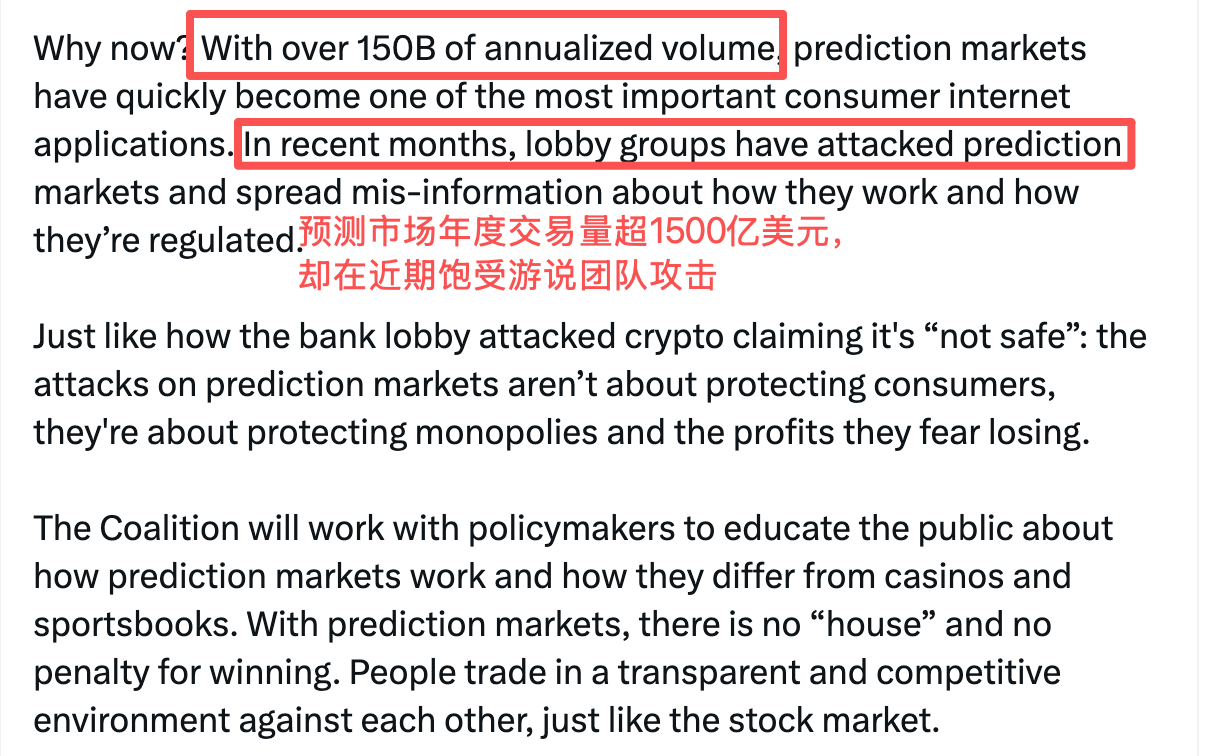
According to Kalshi CEO Tarek Mansour, "In recent months, many lobbying groups have attacked prediction markets, spreading misinformation about how they operate and how they should be regulated." The crux of the issue is that the "cake" of prediction markets has already encroached on someone else's "rice bowl"—traditional gambling platforms in the United States.

After all, this is an emerging sector with an annual trading volume exceeding $150 billion. Last month, the combined trading volume of Kalshi and Polymarket approached $10 billion, and both have valuations exceeding $10 billion. The former raised $1 billion in its latest Series E round, valuing it at $11 billion; the latter previously completed a $2 billion financing round led by NYSE's parent company ICE and is seeking a new round of financing at a valuation of $12–15 billion.
Based on current information, Kalshi and the numerous exchanges and trading platforms entering the prediction market are adopting a strategy similar to industry associations and "lobbying counterattacks" to address their regulatory crisis—traditional gambling platforms cannot tolerate their user base being taken away by prediction markets and lobby local governments to exert pressure? Then I will "return the favor" by uniting all forces that can be团结ed through an industry association to争取 the broadest possible unified alliance阵营.

Behind the investigations and user lawsuits initiated by local regulatory agencies in Connecticut, Nevada, and other states against Kalshi are the employment opportunities and high tax revenues provided by the gambling industry, which supports local finances.

On this point, Kalshi CEO Tarek Mansour sees it very clearly, as he said—just as banking lobbying groups attack cryptocurrencies as 'unsafe,' the attacks on prediction markets are not to protect consumers but to protect monopolies and the profits they fear losing.

All the hustle and bustle in the world is for profit; all the coming and going is for gain.

Faced with a "new emerging industry" and platforms like prediction markets that are developing rapidly and can see their valuations multiply tenfold in a few months, traditional gambling industry monopolies are naturally unwilling to be quietly swept into the dustbin of history.

And the reality is that, as an industry distinct from traditional gambling, the real demand for prediction markets is far stronger than it appears, and the information value they reflect is far more important than commonly believed.

Prediction Markets Rapidly Penetrate the U.S. Market: Nearly 50% of Americans Under 45 Are Users

According to the official introduction of the Coalition for Prediction Markets (CPM),

  • Prediction markets have become one of the most accurate and user-friendly tools for the public to understand evolving economic, cultural, and political trends; nearly half of U.S. citizens under 45 have already used prediction markets, and market expansion continues to accelerate;
  • In October this year, the prediction market industry valuation reached $28 billion;
  • Prediction markets' forecasting performance is approximately 30% higher than traditional polls.
  • Over 70% of Americans believe prediction markets should not be treated as gambling.
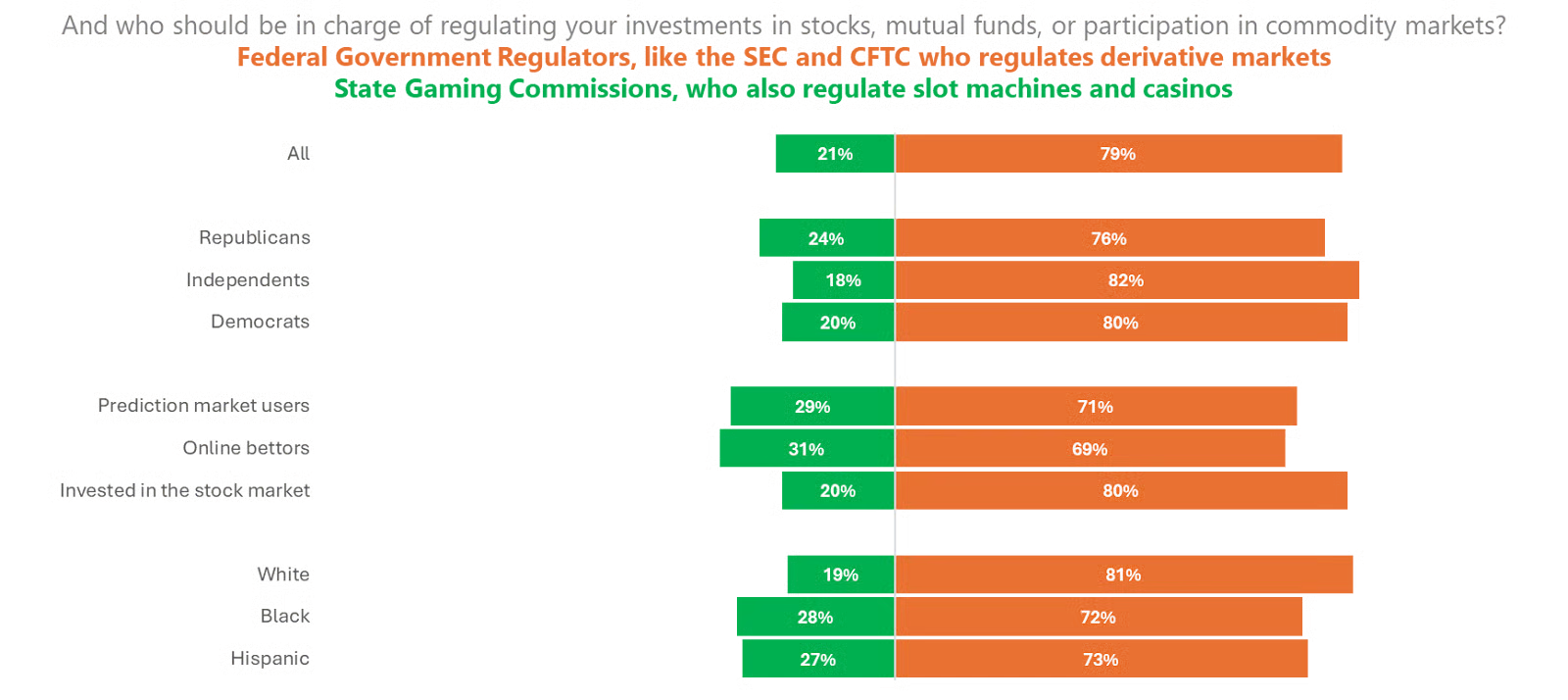
In addition, prediction markets differ from the traditional gambling industry in the following three aspects:

First, prediction markets have no "house" and no penalty for winning (as in casinos). Prediction markets aggregate information from thousands of people to generate real-time probabilities of outcomes and should be considered more analytical than gambling; participating in prediction markets requires knowledge and analysis similar to financial investment, rather than purely probability-based gambling; prediction markets create public information value by generating predictions useful to media, alliances, and owners (such as辅助 policy decisions, public opinion screening, event trend prediction, etc.).

Second, as a CFTC-designated contract market, Kalshi enjoys exclusive federal jurisdiction. In short, local laws have no right to adjudicate the business legality of prediction market platforms like Kalshi. "Prediction markets deserve the same rigor as modern financial markets—clear rules and federal regulation. The best way to protect consumers is to have these markets federally regulated with consistent user protection measures."

Third, prediction markets cover a wider and more diverse range of fields, capable of generating public information value. "Millions of Americans have become active users of prediction markets, which have become the most powerful way to leverage collective wisdom and often outperform traditional polls. Economists, news networks (CNN, CNBC), journalists, policymakers, and readers now rely on prediction markets to obtain quality information in the noisy舆论 field."

Kalshi's Strategy of Alliances: Combining Top-Down and Grassroots Approaches

It is evident that in the face of tightening "regulatory chains" from local agencies, Kalshi's solution is to break through in a different direction—

On the one hand, by establishing the Coalition for Prediction Markets (CPM), Kalshi emphasizes that it will subsequently protect industry transparency, market integrity, and customer protection standards;

On the other hand, Kalshi CEO Tarek Mansour reiterated the jurisdiction scope, defining prediction markets as a new industry distinct from local gambling, and may subsequently leverage forces at the federal government level to escape the quagmire of lawsuits and the regulatory traps of local protectionism.

Unlike Polymarket, which focuses more on providing content for on-chain prediction events and重返 the U.S. market through the acquisition of the derivatives exchange QCX, Kalshi, which has always emphasized "compliance," places greater importance on the long-term stable operation of its business. After completing financing with a valuation of $11 billion, it cannot and will not allow itself to face endless regulatory obstacles on its path to commercial success.

Perhaps this is also why Kalshi chose to join forces with industry players like Coinbase, Robinhood, Crypto.com, and Underdog to launch the Prediction Market Alliance—it needs both同行利益 binding and a united front against external pressures; it also needs to "make a big deal out of it" and "take the top-down route" to involve federal-level regulatory agencies, highlighting its identity and status as an "industry innovation pioneer."

Conclusion: Prediction Markets Will Surpass the Gambling Industry to Grow into a "New Internet Sector"

At the end of the article, I would like to conclude with two interesting recent incidents involving Kalshi and Polymarket, the two "prediction market oligopolies"—

One is the recent criticism by Paradigm co-founder Matt Huang, a lead investor in Kalshi, of a "bug in Polymarket's duplicate calculation of trading data." Subsequently, this was clarified by deployer, co-founder of the AI agent platform Bankr: "Polymarket's trading data is correct; Paradigm is smearing competitors due to its investment in Kalshi." One can't help but感叹, real-world business competition is always so朴实无华; even capital新星 with billion-dollar valuations cannot avoid the cliché剧情 of "spreading black material and engaging in verbal sparring on the internet";

The other is Kalshi CEO Tarek Mansour's recent statement on the 20VC podcast that the rivalry between Kalshi and Polymarket is more like a showdown between sports legends, similar to NFL quarterback stars "Tom Brady vs. Eli Manning," or in soccer, "Messi vs. Ronaldo." "The prediction market industry is maturing faster due to competition."

As event betting in prediction markets extends far beyond sports events and the加密 field, this new species combining news products, trading标的, and博弈 competition is gradually emerging from the cryptocurrency领域 to become the next "new internet sector," much like how Uber, Didi, and Meituan开创ed the sharing economy.

As for the inefficient, zero-sum, and non-incremental traditional gambling industry, it may eventually be crushed, replaced, and ground into a pile of碎泥 on the "golden road" of the industry.


Related Questions

QWhat is the Coalition for Prediction Markets (CPM) and which companies are involved in its formation?

AThe Coalition for Prediction Markets (CPM) is an alliance formed by Kalshi in collaboration with Crypto.com, Robinhood, Coinbase, and Underdog. Its purpose is to advocate for the prediction markets industry, counter negative lobbying from traditional gambling groups, and promote the sector's growth and federal regulation.

QAccording to the article, what is the primary adversary that the newly formed CPM aims to combat?

AThe primary adversary is the traditional gambling industry. The article states that traditional gambling platforms, feeling threatened by the rapid growth of prediction markets, have been lobbying against them, spreading misinformation, and pressuring local regulators to take action.

QWhat are some key statistics mentioned about the adoption and valuation of prediction markets in the US?

AKey statistics include: nearly 50% of Americans under 45 have used prediction markets; the industry was valued at $28 billion in October; prediction markets are about 30% more accurate than traditional polls; and over 70% of Americans believe prediction markets should not be treated as gambling.

QHow does the article differentiate prediction markets from traditional gambling?

AThe article differentiates them on three main points: 1) Prediction markets have no 'house' and do not penalize winning; they aggregate information from many users to generate real-time probabilities. 2) They are federally regulated (e.g., Kalshi is a CFTC-designated contract market), giving them exclusive federal jurisdiction. 3) They cover a wider range of topics and generate public information value for policymakers and media, unlike the zero-sum nature of traditional gambling.

QWhat two contrasting anecdotes does the article use to illustrate the relationship between the 'duopoly' of Kalshi and Polymarket?

AThe first anecdote describes a conflict where Paradigm (a Kalshi investor) accused Polymarket of double-counting trading data, which was later clarified as a misunderstanding, suggesting competitive mudslinging. The second anecdote quotes Kalshi's CEO comparing their rivalry to legendary sports competitions like Tom Brady vs. Eli Manning or Messi vs. Ronaldo, suggesting that the competition is driving the industry's maturation.

Related Reads

Those Pre-Bitcoin PoW Protocols Have Recently Been Reimplemented

This article details a recent surge in replicating pre-Bitcoin Proof-of-Work (PoW) protocols, specifically focusing on Hal Finney's 2004 RPOW (Reusable Proofs of Work). Within five days in May 2026, multiple independent builders in the Bitcoin/cypherpunk community launched projects inspired by this early electronic cash proposal. The initiative began with Fred Krueger's `rpow2.com`, a centralized but auditable system that replaced RPOW's original IBM 4758 hardware with Ed25519 signatures. Initially a faithful replica, it later adopted Bitcoin-like features (21M supply cap, difficulty adjustment) and a controversial 5.24% founder allocation. This sparked rapid forks, including `rpow4.com` which incorporated full Bitcoin parameters, a prediction market (`rpowmarket.com`), and a DEX (`rpow2swap.com`). Concurrently, Mike In Space created a prototype of Wei Dai's 1998 b-money proposal (`b-money.replit.app`), pushing the historical exploration even further back. The article contrasts these centralized, server-dependent experiments with Bitcoin's core innovation of decentralized, trustless consensus. It also highlights a parallel development: the `HASH` project on Ethereum, which uses smart contract hooks to enable a purely fair-launch, browser-mineable PoW token with 0% allocations to team or VCs. The collective activity is framed as a meme-driven, educational exploration of cypherpunk history rather than a serious financial movement, with all projects heavily disclaiming any investment value.

marsbit6m ago

Those Pre-Bitcoin PoW Protocols Have Recently Been Reimplemented

marsbit6m ago

South Korean Exchanges 'Battle' Regulators, Challenging the Boundaries of Enforcement and Legislation

South Korea's cryptocurrency industry is engaged in a rare, direct confrontation with regulators. The Financial Intelligence Unit (FIU), the primary anti-money laundering (AML) watchdog, has recently imposed heavy penalties on major exchanges like Upbit and Bithumb for alleged violations involving unregistered overseas VASPs and AML procedures. However, exchanges are now actively challenging these actions in court and through industry associations. In a significant shift, the Seoul Administrative Court ruled in favor of Upbit's operator, Dunamu, overturning part of an FIU-ordered business suspension. The court found the FIU's penalty criteria and justification insufficiently clear. Similarly, the court suspended the enforcement of a six-month business suspension against Bithumb pending a final ruling, citing potential irreversible harm to the exchange. Beyond legal battles, the industry is contesting proposed legislative amendments. The Digital Asset eXchange Alliance (DAXA) strongly opposes a draft rule that would mandate Suspicious Transaction Reports (STRs) for all crypto transfers over 10 million KRW (~$6,800). DAXA argues this "poison pill" clause violates legal principles and would overwhelm the STR system, increasing reports from 63,000 to an estimated 5.45 million annually for major exchanges, thereby crippling effective AML monitoring. This conflict highlights a structural tension in South Korea's crypto governance: comprehensive digital asset laws are still developing, while regulators rely heavily on AML enforcement. The industry's move from passive compliance to active legal and legislative challenges signifies a new phase, pressing for clearer rules and more proportionate enforcement. While short-term disputes may intensify, this clash could ultimately lead to a more mature and sustainable regulatory framework for South Korea's vibrant crypto market.

marsbit58m ago

South Korean Exchanges 'Battle' Regulators, Challenging the Boundaries of Enforcement and Legislation

marsbit58m ago

After 50x Storage Surge, Justin Sun Always Looks to the Next Decade

Sun Yuchen, known for his controversial stunts like a $30 million lunch with Warren Buffett (canceled due to a kidney stone) and eating a $6.2 million duct-taped banana, is often overshadowed by a significant fact: his decade-long track record of spotting major investment trends. In 2016, he famously advised young people to invest in Bitcoin, Nvidia, Tesla, and Tencent instead of buying property. A hypothetical $20,000 investment in Nvidia and Tesla from that list would now be worth over 50 million RMB. His latest major call was on November 6, 2025, predicting a "50x storage opportunity" tied to the AI boom, which materialized with Sandisk's stock surging nearly 50-fold by 2026. Looking ahead, Sun now focuses on the next frontier: Physical AI. He identifies four key areas: 1. **Embodied AI/Robotics**: He sees this reaching its "iPhone moment," with companies like UBTech and Galaxy General leading in commercialization. 2. **Drones**: Viewed as the first commercially viable form of Physical AI, revolutionizing sectors from warfare (e.g., AeroVironment's Switchblade) to logistics. 3. **Spatial Computing**: Beyond VR, it's about AI understanding physical space, a foundational technology for robotics and autonomous systems, exemplified by Apple's Vision Pro. 4. **Space Exploration**: After a 2025 suborbital flight with Blue Origin, Sun advocates for space as the ultimate frontier, discussing blockchain's potential role in space asset management and data transactions. His investment philosophy involves betting on entire, inevitable trends rather than single companies. For robotics, he sees Tesla (the body/manufacturer) and Nvidia (the brain/AI platform) as complementary plays. In defense drones, he highlights companies making tanks obsolete (AeroVironment) and those augmenting fighter jets (Kratos). For space, he participated in Blue Origin's flight and anticipates SpaceX's potential IPO to redefine the sector's valuation. Sun Yuchen's vision frames the next two decades not as a revolution in information flow (like the internet), but in the fundamental operation of the physical world through AI-powered robots, autonomous systems, and spatial intelligence, ultimately extending human and AI activity into space. While many still focus on conventional assets, he continues to look toward the next technological horizon.

marsbit1h ago

After 50x Storage Surge, Justin Sun Always Looks to the Next Decade

marsbit1h ago

The Billionaires Behind the Most Expensive Midterm Election in History

"The Most Expensive Midterm Elections and Their Billionaire Backers" This analysis details the unprecedented scale of spending in the 2026 midterm elections, highlighting the key billionaire donors shaping the political landscape. Jeff Yass, founder of Susquehanna International Group, has contributed over $81 million, ranking third among individual donors behind George Soros ($102.6M) and Elon Musk ($84.8M). Yass is a major donor to Trump's MAGA Inc. and supports school choice and various candidates. Overall, federal committees have raised over $4.7 billion this cycle, with political ad spending projected to reach $10.8 billion. Republican-aligned groups are significantly out-raising their Democratic counterparts. "Dark money" from undisclosed sources continues to grow. The core stakes involve control of Congress and policy direction for Trump's final term. Donors are also motivated by specific issues: Sergey Brin and Chris Larsen are funding opposition to a proposed California wealth tax and supporting crypto-friendly policies. Other top donors include OpenAI's Greg Brockman and his wife Anna ($50M total to MAGA Inc. and an AI-focused PAC), Richard Uihlein ($45.3M to conservative causes), venture capitalists Marc Andreessen and Ben Horowitz (each over $44M to crypto/AI PACs and MAGA Inc.), Miriam Adelson ($42.6M to GOP leadership PACs), Paul Singer ($33.9M), and Diane Hendricks ($25.8M to MAGA Inc.). The article notes that the peak fundraising period is still ahead, with major primaries approaching.

marsbit1h ago

The Billionaires Behind the Most Expensive Midterm Election in History

marsbit1h ago

Trading

Spot
Futures
活动图片




