Finally, the open-source version of the same series as the IMO perfect score gold medal model from Little Red Book is here!
Last month, Little Red Book's self-developed large model 'dots-note-3.0' set a historic record: an AI achieving the officially certified full 42 points in the International Mathematical Olympiad for the first time. Since then, the most pressing question from the community has been when the model would be open-sourced.
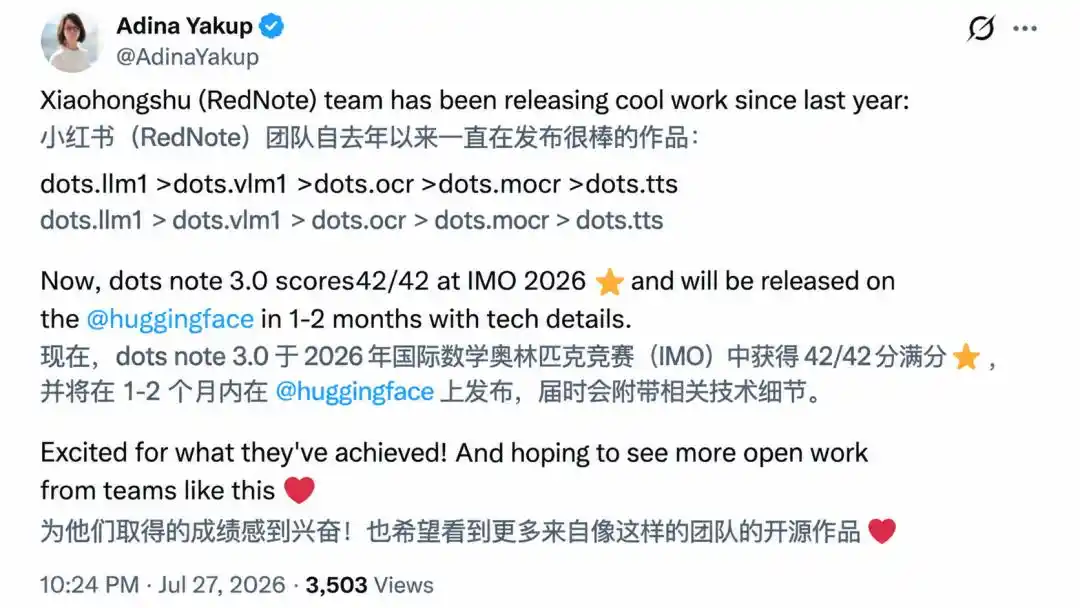
Adina Yakup, Lead of HuggingFace AI Research & Community Ecosystems. Source: X Post
Today, the Little Red Book dots model lab (hereinafter referred to as dots lab) announced the open-sourcing of dots3-note preview! It is also the first open-source version of the dots3 series models, targeting longer-range tasks that are more realistic and harder to evaluate.
In terms of parameters, dots3-note preview has a total of 280B parameters, with 16B active parameters. It supports a 512K ultra-long context window, possesses multimodal understanding capabilities for text, vision, and speech, and is optimized for complex reasoning, Agents, and multimodal perception.
API Entry: https://dots.ai/platform/
Huggingface: https://huggingface.co/dots-studio/dots3-note-prev
GitHub: https://github.com/studio-dots-ai/dots3-note-prev
The IMO perfect score verified this series' capability in mathematical reasoning and proof. This open-sourcing brings the challenge to another category of harder-to-standardize scenarios: travel planning, wedding preparation, and opening a store. These tasks have no single correct answer and can stretch over hours, days, or even longer.
By focusing dots3-note preview on long-range tasks, it also hits a key theme in current Agent development: they are increasingly being asked to independently handle longer and more complete jobs. OpenAI previously disclosed that in May this year, over 70% of users had Codex handle work that would take a human more than an hour; by June, the top 1% of active users by internal OpenAI usage generated over 60 hours of agent turns daily.
However, difficulty quickly diverges when tasks land in different scenarios. Unlike domains like mathematics, code, and engineering where Agent performance is more mature, real-life environments are more open-ended and demands more ambiguous. By placing its 'testing ground' here, dots3-note preview sets higher requirements for its own long-range planning, judgment, and error-correction capabilities.
Judging from data on multiple mainstream benchmarks, the model matches or even surpasses much larger-scale models with several times its parameter count on many reasoning and agent tasks, and its visual capabilities are outstanding within its size category.
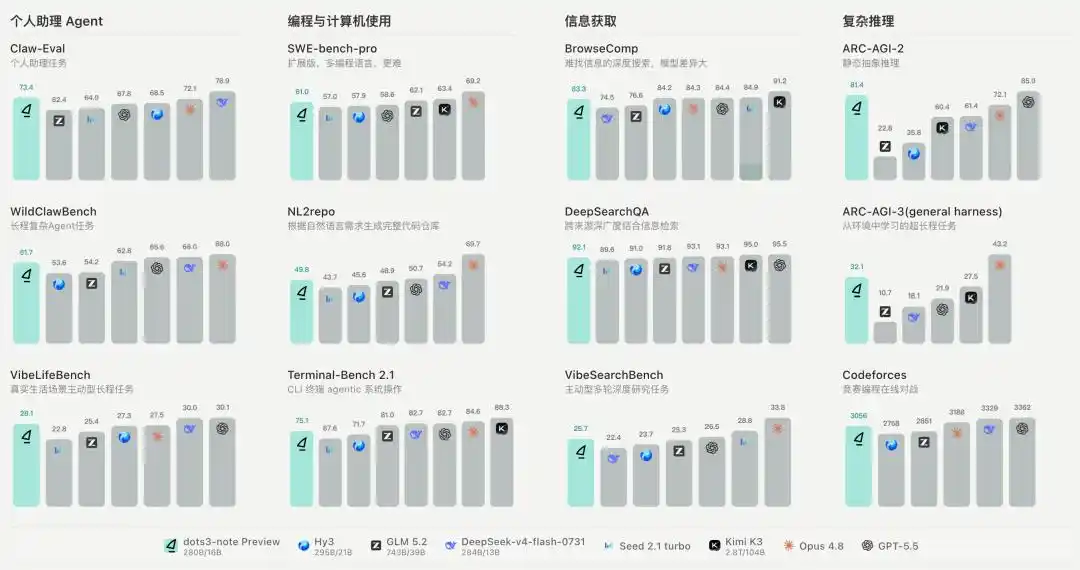
Source: Official Technical Blog
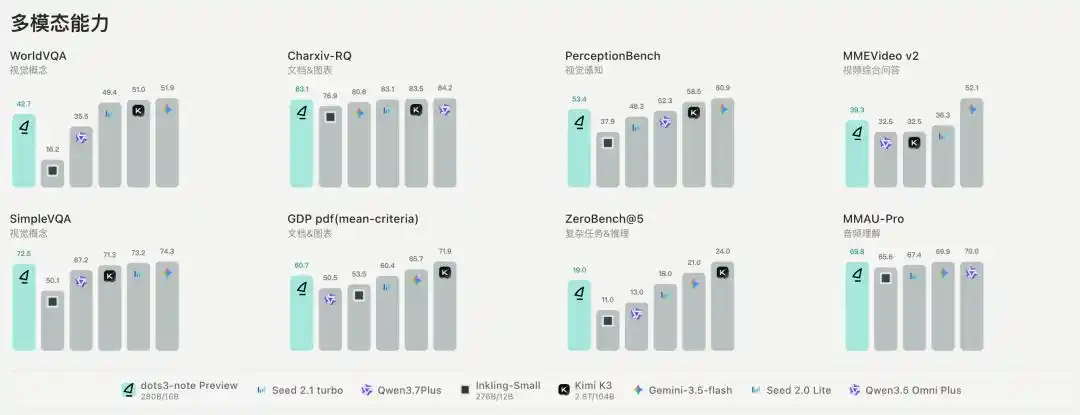
Source: Official Technical Blog
Previously, Little Red Book has successively open-sourced the text large model dots.llm1, the multilingual document layout parsing model dots.ocr, and the multimodal vision understanding large model dots.vlm1. This latest open-sourcing adds the crucial Agent piece to the puzzle.
First-Hand Tests:
Can It Truly Complete Complex Tasks?
A model's real capability goes far beyond leaderboards. Next, we'll use a few cases to see how this model independently progresses and delivers results when faced with tasks involving scattered information, numerous steps, and a continuously changing environment.
Taking Over "Slay the Spire II"
First, let dots3-note preview take over a game of "Slay the Spire II".
The game's difficulty lies in how every choice—which route to take, which card to pick, whether to challenge elites, how to spend gold, whether to rest or upgrade at camp—affects survival probability dozens of turns later. Locally optimal choices can easily sow the seeds for future failure in boss battles.
Without specific training for this game, the model can learn card and enemy mechanics based on combat feedback, while managing health, deck, gold, and potions, constantly weighing choices between shops, camps, and elite fights, advancing all the way to floor 33.
Solving ARC-AGI 3 from Scratch
In the long-range reasoning task ARC-AGI 3, the rules are completely unknown. The model needs to observe the screen, propose hypotheses, and then verify them through operations.
dots3-note preview gradually discovers rules like two blocks moving up/down in sync and mirroring left/right, and explores mechanics like danger tiles, movable markers, pressure switches, and gates.

Whenever a hypothesis proves wrong, it activates a Self-Critiquing mechanism to reassess, writing corrected rules into memory.md—a file akin to the model's notepad, persistently storing dynamic understanding of the environment.


Ultimately, the model solves all 6 levels through 320 operations.

Solving a Renovation Problem by Reading Images
Continuous learning and reasoning abilities must ultimately return to real life.
Take this typical renovation dilemma: simultaneously upload a floor plan and screenshots of specifications for two refrigerator models, with the added information: the kitchen wall near the study already has a 1.5-meter-long countertop installed. Now, we want to place the refrigerator against this wall—will it still fit?
Key information is scattered across different images and text. The model needs to combine the floor plan, existing countertop dimensions, and the two refrigerators' specs to calculate the remaining wall space and provide a fitting conclusion. It also proactively reminds the user to double-check measurements on-site.
The entire process involves visual-spatial understanding, complex reasoning, and tool usage, also demonstrating the model's ability to generate customized answers based on individual real-world environments.

Using the same floor plan, we then ask the model to design several solid wood style renovation schemes for the study.
The model retains previously identified dimensions and lighting information, searches related notes on Little Red Book, organizes four solid wood style schemes, and generates a web page, continuously completing image reading, calculation, retrieval, and content generation.

End-to-End Development of a visionOS App
Finally, let's see if dots3-note preview can independently complete a full end-to-end software engineering task: have it 'develop a native Apple Vision Pro application, referencing Little Red Book's design.'
Upon receiving the task, the model doesn't rush to write code. It first understands product requirements and references 9 interface screenshots, autonomously determining the development plan. This includes adopting a SwiftUI+RealityKit tech stack, planning modules like organizing windows, immersive spaces, and 3D product displays. After finalizing the plan, it prepares materials like local images and 3D models, then progressively implements the code.
The entire project generates 12 Swift files, 1876 lines of code, implementing interfaces like feeds, personal profiles, private messages, and products, and integrates USDZ 3D models. Subsequently, the model autonomously generates an Xcode project, invokes xcodebuild for compilation, and performs checks in the visionOS Simulator, ultimately displaying "BUILD SUCCEEDED."
From requirement understanding and tech selection to code implementation, compilation, and verification, this development workflow is ultimately executed completely.

Judging from the final product, it already possesses a relatively complete set of spatial interactions. The feed can scroll, notes can enter detail pages, and personal profiles and private messages can open as independent windows.

Users can also directly view and switch between different 3D products in the shopping interface.
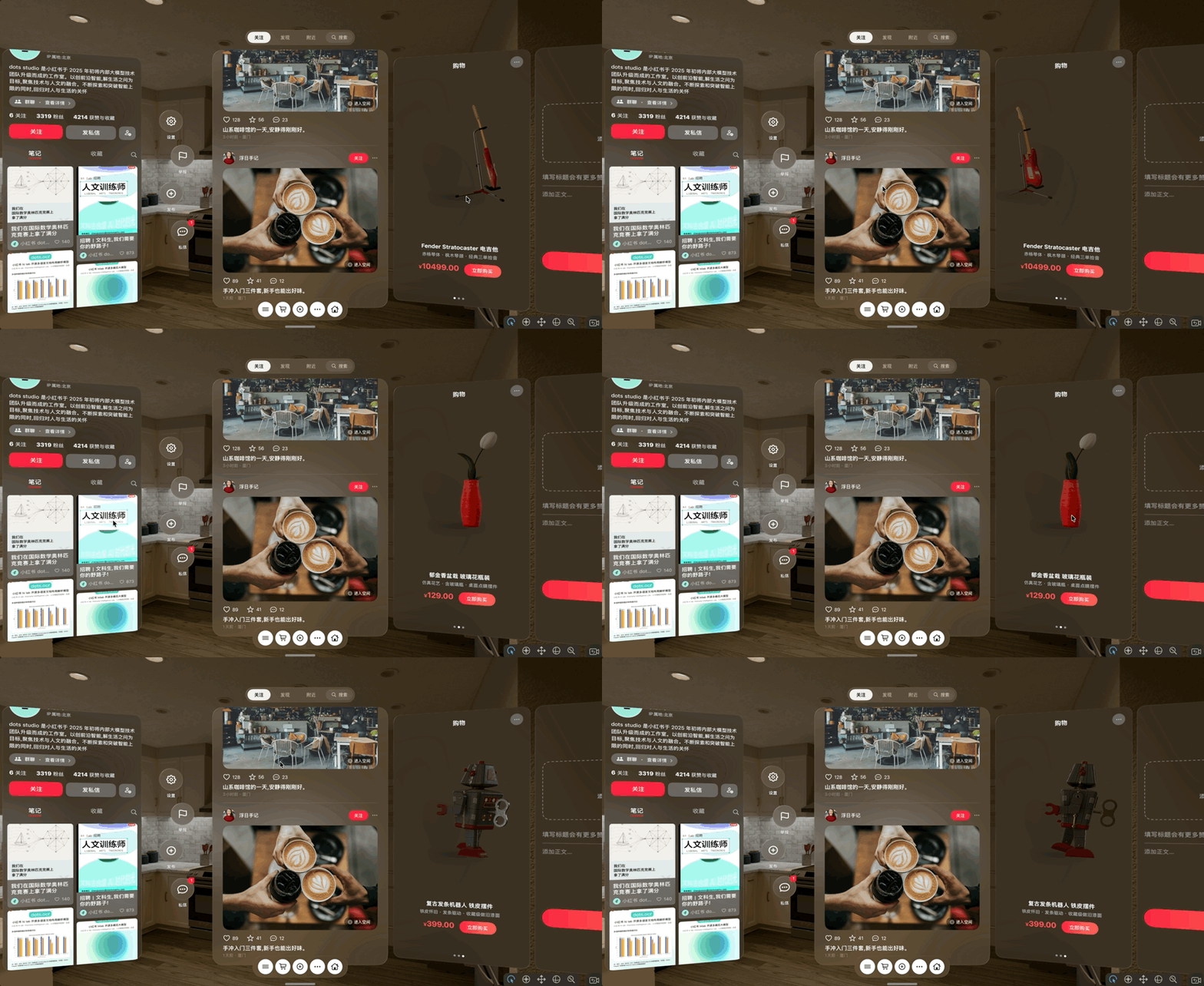
No Standard Answers,
The Model Must Continuously Learn and Self-Correct
From these tests, the most prominent capability of dots3-note preview is its ability to explore while remembering new information, adjust when encountering changes or misjudgments, and persist until delivering results. How is this achieved? The key lies in two things: learning and remembering truly useful information, and promptly detecting and correcting its own judgment deviations.
One primary problem the dots lab had to solve was: can the model continue learning from the environment and users after training concludes?
To train this ability, the dots lab constructed thousands of ultra-long-range novel environments that don't rely on prior knowledge. Agents explore continuously in previously unencountered scenarios, learning new rules and knowledge through interaction with the environment for subsequent decision-making. Moreover, when task length significantly exceeds the model's context window, the model cannot always rely on information already in the context. Through reinforcement learning training, it gradually learns how to retain information useful for solving subsequent problems. This ability has already been validated on ARC-AGI 3.
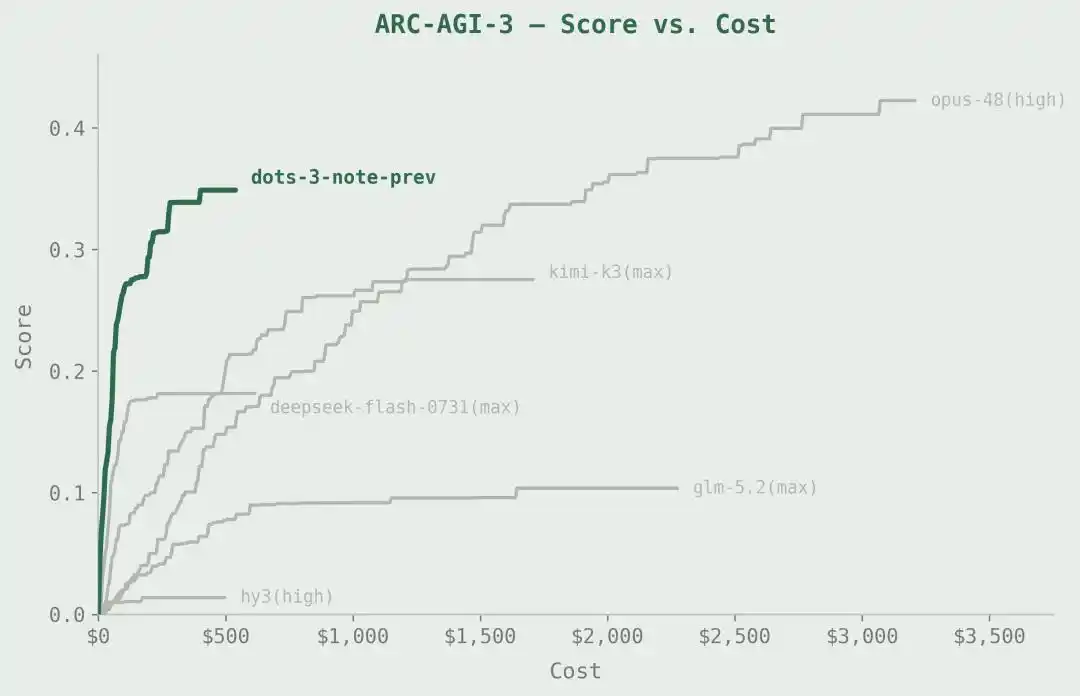
As shown in the figure below, dots3-note preview achieves a score of about 0.35 on ARC-AGI-3 at a cost of less than $500. While the absolute score is lower than Claude Opus 4.8 (high), its cost efficiency is significantly higher.
However, training such a process encounters another major issue: exploration costs for long-range tasks are too high; an Agent might run for over a dozen hours for a single exploration. If we continue using value-free reinforcement learning methods reliant on final rewards, training signals often only arrive after the entire trajectory ends, making efficiency low and making it difficult to attribute success or failure to specific earlier steps.
Methods like PPO can alleviate this, but traditional critics typically estimate the value of the current state through a single fixed-computation forward pass. Faced with complex Agent tasks, the actor can reason repeatedly, call tools, and then decide the next step—something the critic cannot do, easily leading to inaccurate judgments of current progress.
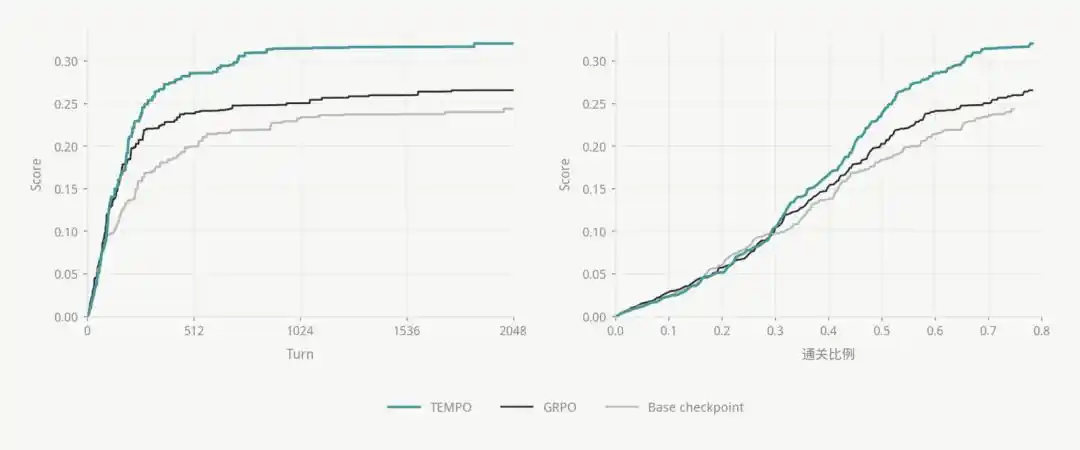
The dots lab proposes TEMPO (Test-time-scaled Value Estimation with Macro-step Policy Optimization). It splits a long trajectory into multiple macro-steps, each containing multiple rounds of model-environment interaction. After a phase ends, the model temporarily switches from actor to critic, and through reasoning, tool usage, and test-time scaling, estimates how much future reward the current state can obtain, then uses this evaluation as a training signal for the unfinished trajectory.
Notably, during TEMPO training, the model must learn both how to act and how to evaluate its own current performance. Leveraging this self-evaluation, reinforcement learning training can be applied to longer tasks and continuously optimize behavior within long trajectories.
Results show that TEMPO's advantage primarily emerges after tasks enter deeper waters. As interaction rounds increase, scores for GRPO and Base checkpoint tend to plateau, while TEMPO continues to improve. In terms of completion progress, the three also show a clear gap in the latter half of tasks.
After introducing the Self-Critiquing mechanism, dots3-note preview's self-evaluation capability proved stronger than initially expected. Even if an Agent hasn't solved a problem yet, it can judge which of two superficially similar intermediate states holds more promise for breakthrough.
Beyond reinforcement learning training, this self-evaluation ability is also reflected in the inference stage. In its earlier participation in IMO 2026, a sibling branch version of dots3-note preview generated proofs while repeatedly checking them through tool calls, modifying and optimizing based on evaluation results, ultimately achieving a perfect score.
In the future, the dots lab will explore recursive self-critiquing in 'open tasks,' enabling the model to judge task progress on its own when clear external rewards are lacking, and accordingly adjust memory and plan subsequent actions.
Little Red Book's combination of 'active memory + ultra-long-trajectory reinforcement learning + mid-process self-evaluation' offers a specific solution for long-range Agents entering the real world.
Why Does Little Red Book Choose "Real-Life Long-Range Agent"?
For Little Red Book, a lifestyle and interest community, it naturally aligns with such real-life tasks. Many issues users discuss daily not only lack a single answer, but often even users themselves may not have clearly defined what they ultimately want.
Travel, weddings, home renovation, fashion styling inherently carry characteristics like varying preferences, constantly supplemented conditions, and dense multimodal information. Little Red Book has long faced these types of complex, long-range demands, making it a natural focus for its Agent research and application scenarios.
Agents in other domains like mathematics and code have shown the industry that in environments with relatively clear goals and verifiable outcomes, AI can break complex tasks into numerous steps and persist for long durations. Conditions in real life are far more troublesome, lacking readily available test cases, with goals and constraints evolving alongside the task. This ambiguity exposes the shortcomings of long-range Agents more clearly.
The two evaluation benchmarks open-sourced by the dots lab visually illustrate these gaps and inadequacies.
One is VibeSearchBench, which examines 'whether the Agent can figure out what the user truly wants when they don't state their needs clearly at once,' covering 20 domains and 200 tasks. The evaluation simulates real users gradually supplementing needs and constraints across multi-turn dialogues, then sees if the model accurately understands user intent.
The other is VibeLifeBench, emphasizing temporal and environmental changes, examining 'whether the Agent can keep up after external conditions change,' covering 10 domains and 20 tasks. Each task contains 20 to 30 stages and sets 1247 atomic checks to verify state consistency, proper tool execution, and final deliverables.
The results show that even top global models like Claude Opus 5 and GPT-5.5 did not reach the set passing level on these two benchmarks.
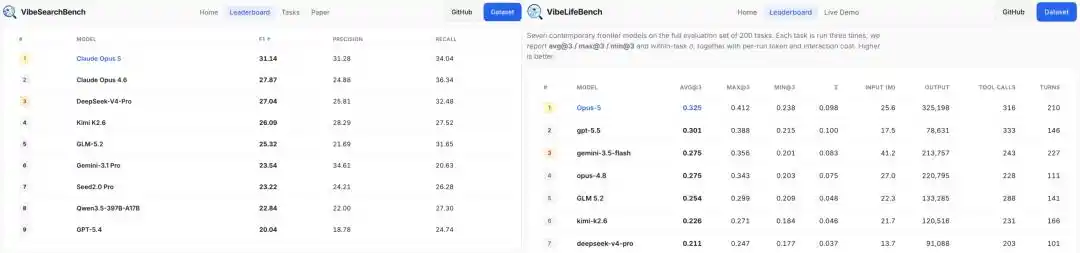
Left: Complete VibeSearchBench leaderboard. Right: Complete VibeLifeBench leaderboard.
VibeSearchBench Homepage: https://vibebench.github.io/VibeSearchBench.github.io/
VibeLifeBench Homepage: https://vibebench.github.io/VibeLifeBench_homepage/
These results illustrate one thing: models are already strong enough for high-difficulty single-point tasks, but stably maintaining this capability for hours or longer remains beyond current Agent reach. Little Red Book's exploration and planning in this area have only just begun.
dots3-note is the most lightweight version in the dots3 series. The currently open-sourced preview version still has room for optimization in experience and detail. According to the dots lab, the official version of dots3-note will also be open-sourced in the near future. In the future, the dots3 series will also release jazz and aria, forming three tiers together with note, covering application needs for different task complexities, response speeds, and computational costs.
For more training method details, please visit the official technical blog (Chinese): https://studio.dots.ai/dots/dots3-zh.html
This article is from the WeChat public account "Almost Human" (ID: almosthuman2014), author: Almost Human Focusing on Agents, editors: Du Wei, Yang Wen