Gemini Earnings Dissection: Credit Cards Become the Major Contributor, Trading Volume Plummets

marsbitPublished on 2026-08-14Last updated on 2026-08-14

Abstract

Gemini Space Station's Q2 2026 financial results reveal a significant shift in its business model. While total revenue rose 37% year-over-year to $45.475 million, the platform's spot trading volume plummeted by 66%. The key driver of growth is now credit card-related revenue, which surged 231% to $16.178 million, surpassing the $12.497 million generated from the core trading platform. This diversification means Gemini's income is no longer solely tied to trading activity. However, the new credit card business introduces different risks. Despite strong revenue, the segment's pre-provision net revenue (PPNR) was $5.457 million, against credit loss provisions of $16.062 million. A significant portion of this provision is attributed to a specific batch of fraudulent accounts from Q1. Furthermore, the rate of accounts delinquent for over 30 days increased from 3.8% to 9.4%. In summary, Gemini is successfully broadening its revenue streams beyond cyclical crypto trading, but its new largest income source comes with substantial credit and operational risks that must be managed alongside its traditional business.

In the latest second-quarter earnings report disclosed by the US-listed crypto exchange platform Gemini Space Station, the most striking feature is not only the increase in total revenue to $45.475 million but also a curve that almost looks inverted.

According to Gemini's Q2 2026 earnings press release, this revenue grew 37% year-over-year. However, the platform's spot trading volume decreased by 66% compared to the same period last year. Trading activity has not returned for this exchange platform, yet revenue on the books is increasing. Where is the money coming from?

Where Revenue Comes From Without Trading Volume Recovery
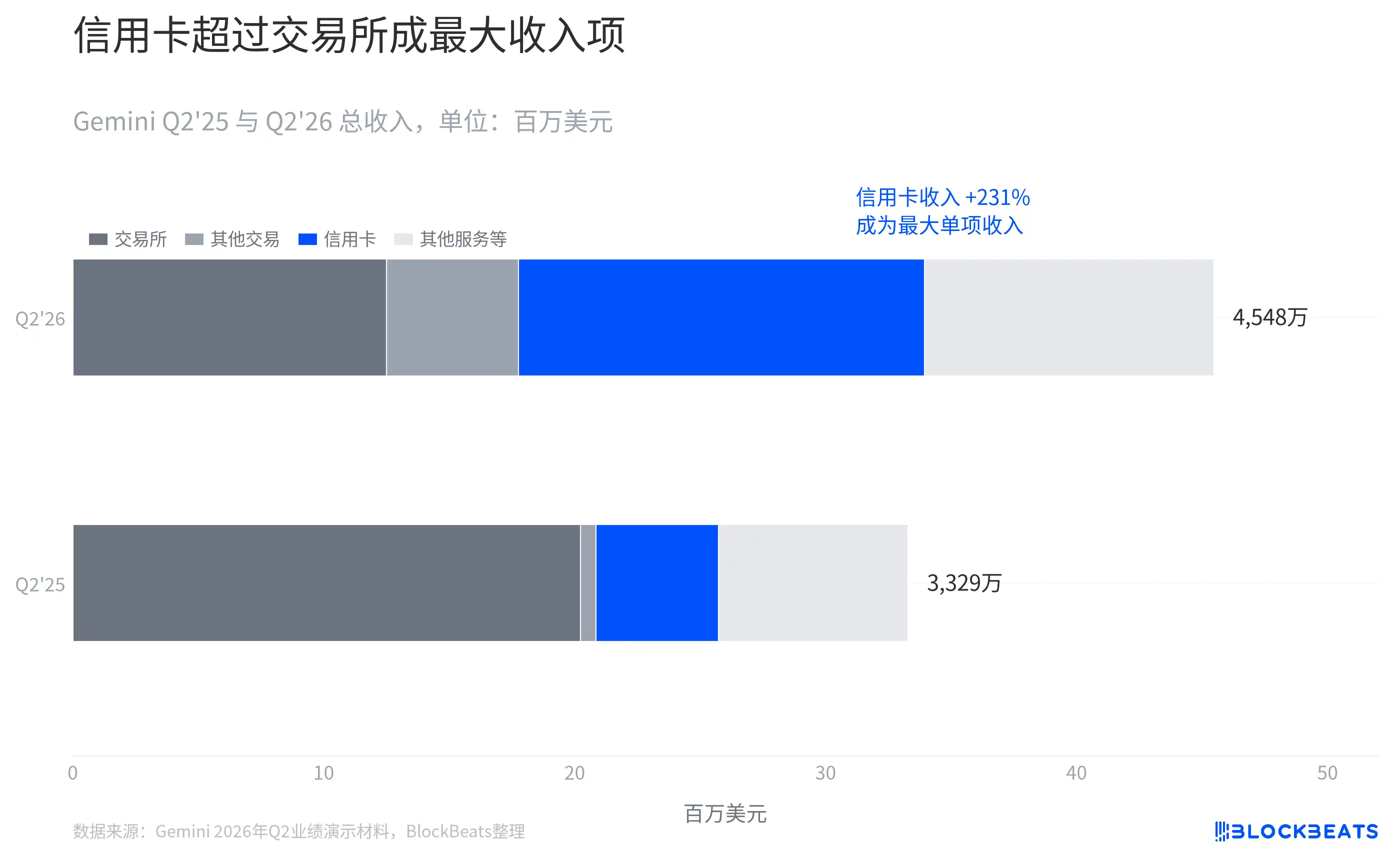
The answer is first hidden in the revenue structure. According to Gemini's Q2 earnings presentation materials, credit card revenue has reached $16.178 million, surpassing the trading platform revenue of $12.497 million. For the first time, this blue segment is longer than the grey bar representing trading platform revenue.

The same earnings presentation materials show that the positions were reversed a year ago. Trading platform revenue was $20.233 million, while credit card revenue was only $4.882 million. Today's Gemini still operates spot trading matching, but its revenue no longer solely follows trading activity.

The speed of this rotation is fast. Credit card revenue increased by 231% year-over-year, while trading platform revenue decreased by 38% year-over-year, both figures from the company's earnings presentation materials. The former filled the gap left by the latter, making credit cards the largest single revenue item.

There is another easily overlooked nuance in this chart. The service revenue and interest income mentioned in these materials account for 59.4% of net revenue, which is based on net revenue, not directly comparable to the stacked bar chart percentages for total revenue. It indicates revenue sources are broadening but alone does not prove profitability has improved.

According to company earnings presentation materials, credit card revenue includes both transaction fees and interest income, which is a different business from pure trading fees. Its own accounts receivable portfolio also means Gemini bears risks related to account quality and repayment speed.

Revenue and Trading Volume Are No Longer the Same Curve
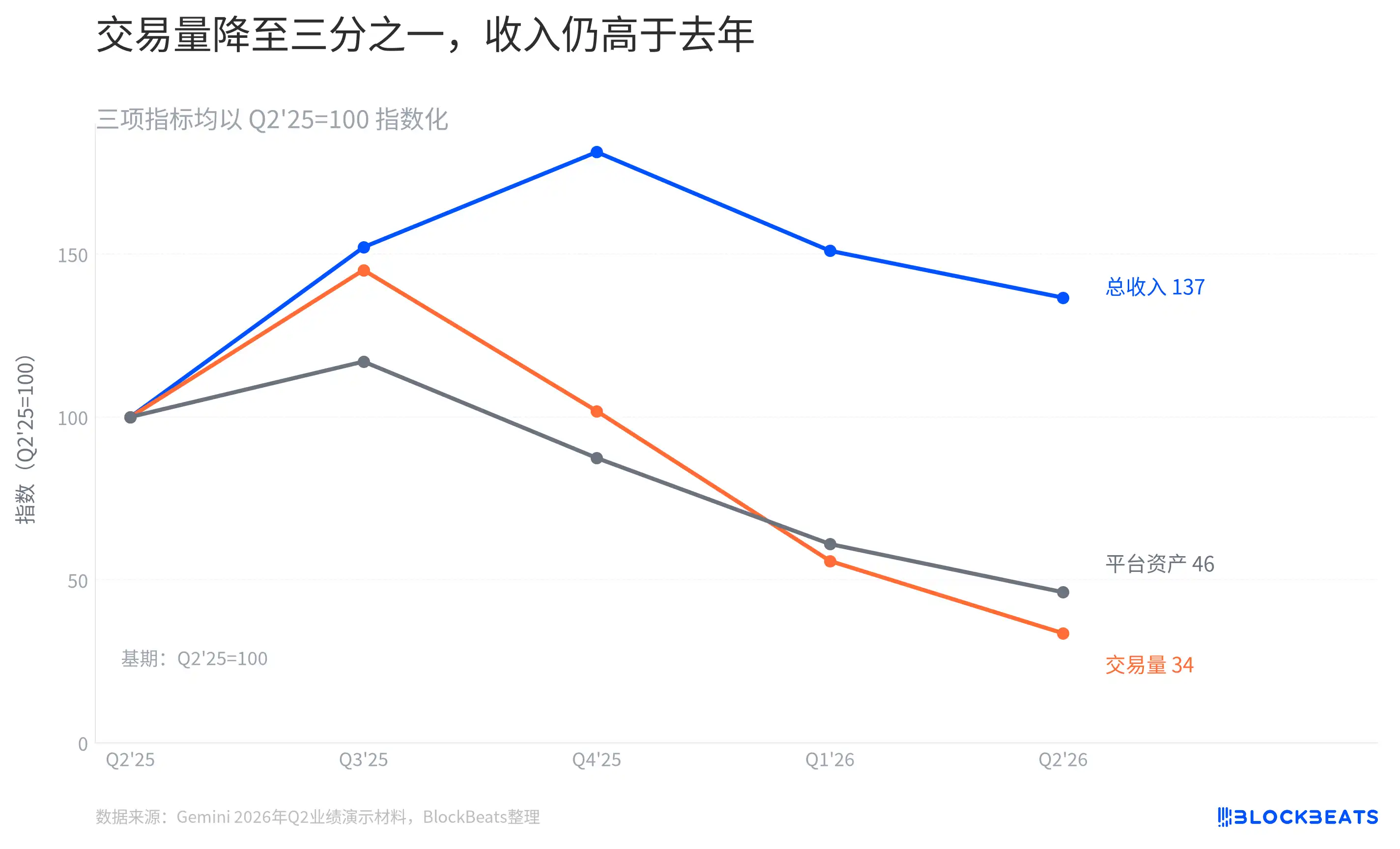
According to company earnings presentation materials, total trading volume in Q2 was $3.8 billion, compared to $11.3 billion a year ago. Judging by the most familiar metrics for trading platforms, Gemini is still in a period of significant contraction.

Placing three indicators on the same baseline period makes the divergence in the chart clear. The revenue line, after pulling back from highs, remains above the starting point, while trading volume and platform assets move downward in sync. Trading volume is no longer the sole key to explaining Gemini's revenue; the product mix is now taking over that explanatory role.

A similar divergence exists on the user side. According to company earnings presentation materials, monthly active transacting users (MTU) increased from 523,000 to 580,000. However, the company's MTU definition covers any user who engaged in revenue-generating activity or whose account generated income in the past 30 days, including non-spot businesses like credit cards. It cannot be directly interpreted as spot trading users remaining active.

This is precisely what product expansion changes. The platform can generate revenue from more types of interactions, weakening the explanatory power of the traditional pointer, trading volume.

However, platform assets are not the company's own money. It includes custody, staking, trading products, customer fiat custody assets, and GUSD reserves. Treating this line as cash freely available to Gemini, or interpreting the revenue divergence as being decoupled from the crypto cycle, would overstep the boundaries set by the financial report.

The change in revenue structure is real, but the conclusion of detachment from the cycle is premature. The five quarters in the chart seem to suggest that Gemini is now distributing the story once dictated by a single trading curve across more business lines.

The New Revenue's Accounting Must Be Calculated from Credit Costs
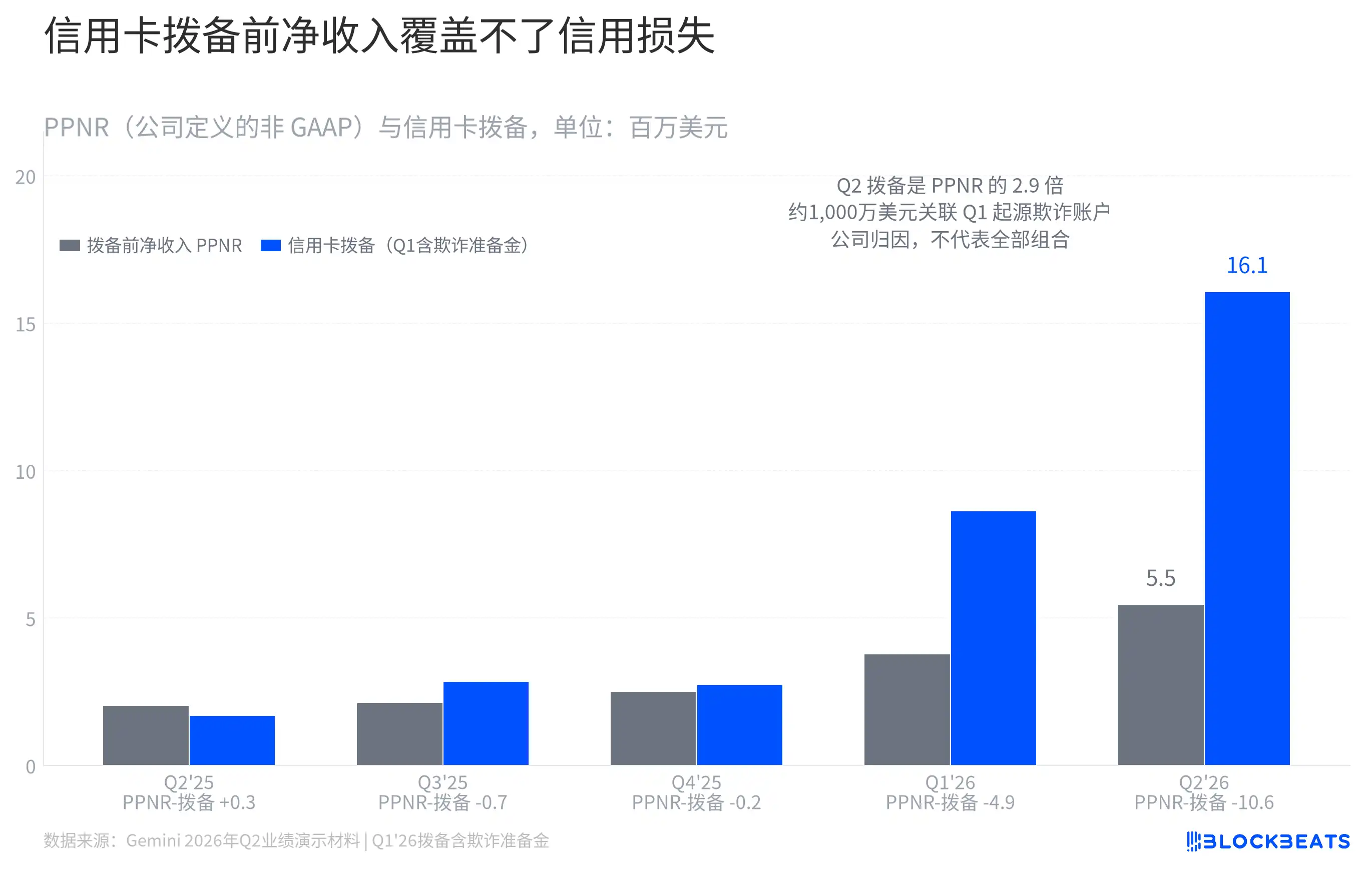
Growth in credit card revenue does not equate to credit cards already contributing profit of the same scale. According to company earnings presentation materials, the company's defined non-GAAP metric, PPNR, is the amount of credit card net revenue after deducting financing debt interest and crypto reward expenses. Q2 PPNR was $5.457 million, while credit card provisions were $16.062 million.

Calculating based on the two disclosed metrics leaves a difference of $10.605 million between them. The second line of the horizontal axis in the chart reads "PPNR - Provisions," not Gemini's net profit. It only answers a narrower question: whether the net income generated by the credit card business before accounting for credit costs is sufficient to cover this portion of provisions.

According to the company press release, approximately $10 million of these provisions are related to a batch of accounts opened in Q1 involving identified identity fraud activities. This is management's attribution to a specific account group and should not be extrapolated as representing the general bad debt rate of the entire card portfolio.

But qualifiers do not erase risk control pressure. The proportion of accounts receivable overdue for more than 30 days increased from 3.8% last quarter to 9.4%, as also disclosed in the company's earnings presentation materials. For a business that has just become the largest revenue source, the revenue curve and the credit cost curve now need to be viewed together.

Gemini's revenue sources have diversified, and the operational variables supporting this revenue have extended from trading activity to credit costs and risk control.


Related Questions

QAccording to the article, what was the most notable change in Gemini Space Station's Q2 2026 revenue structure?

AThe most notable change was that credit card revenue ($16.178 million) surpassed trading platform revenue ($12.497 million), becoming the largest single revenue item for the first time.

QHow did Gemini's total trading volume in Q2 2026 change compared to the same period a year earlier?

AGemini's total trading volume in Q2 2026 was $3.8 billion, which represents a 66% decrease compared to the $11.3 billion volume from the same period a year earlier.

QWhat two major factors are mentioned as potential risks or costs associated with Gemini's growing credit card business?

AThe two major factors are credit costs, specifically provisions for potential losses ($16.062 million in Q2), and a rising delinquency rate, with 30+ day past due receivables increasing from 3.8% to 9.4% quarter-over-quarter.

QWhy does the article caution against interpreting the increase in Monthly Transacting Users (MTU) as a sign that spot trading users are still active?

ABecause Gemini's MTU metric includes any user who engaged in any revenue-generating activity in the past 30 days, which covers credit card and other non-spot trading services, not just spot trading activity.

QWhat does the divergence between the trends of Gemini's total revenue and its trading volume indicate, according to the article?

AThe divergence indicates that Gemini's revenue is no longer solely dependent on trading activity and market cycles. Its revenue sources have diversified, with new business lines like credit cards now contributing significantly and altering the company's financial story.

Related Reads

Selling Block Space Is No Longer Profitable, Arbitrum and MegaETH Venture into Applications

Selling block space is no longer a sustainable core business for blockchains, as it is easily commoditized and generates insufficient revenue to support their valuations, especially when compared to the high fees generated by applications built on them. This report, following up on the "Verticalization" thesis, examines how chains like Arbitrum, Polygon, MegaETH, and Sophon are adapting. It categorizes their strategies into two main paths: **Ecosystem Expansion** and **Product Expansion**. **Ecosystem Expansion** involves chains extending their reach by offering their technology stack to others. Examples include Arbitrum, which earns revenue from chains like Robinhood's L2 built on Arbitrum Stack, and Polygon, which is positioning itself as a payment chain for fintech. However, this model faces challenges, as seen with Optimism's revenue drop after Base left its Superchain, and often fails to translate chain success into sustained token value due to ongoing emissions. **Product Expansion** sees chains vertically integrating by building their own applications to capture more value internally. MegaETH shifted focus to developing first-party consumer apps and launched a native stablecoin, USDm, to capture yield. Similarly, Sophon pivoted from being an independent chain to becoming an application builder on Base. The goal is to directly own the lucrative application fee streams that typically don't flow back to the underlying chain. The conclusion is that with hundreds of chains offering similar block space, differentiation through liquidity alone is not enough. To justify high valuations and ensure sustainability, chains are moving beyond their foundational role. They are evolving into broader ecosystems or application builders themselves, actively working to internalize the value generated within their networks. This represents a pragmatic shift towards utility, where chains are becoming more than just infrastructure providers in a highly competitive landscape.

marsbit2m ago

Selling Block Space Is No Longer Profitable, Arbitrum and MegaETH Venture into Applications

marsbit2m ago

A Glimpse into Crypto Miners in Q2: Rushing into AI Data Centers – Are They Profiting?

Mining companies presented mixed Q2 results as they navigate the shift towards AI data centers alongside their core Bitcoin mining operations. While mining output increased for some, declining Bitcoin prices and rising network difficulty pressured revenues. For instance, MARA mined more Bitcoin year-over-year but saw a 27% revenue drop and a significant net loss, partly due to unrealized losses on Bitcoin holdings. The standout trend is the growing contribution of AI/high-performance computing (HPC) hosting revenue. Core Scientific now derives over 80% of its revenue from high-density hosting, while TeraWulf generates about 71% from HPC leasing. However, the transition is at varying stages. Companies like Riot Platforms and Cipher Digital are in earlier phases, with AI-related revenue still a smaller portion of their total income. The article cautions against conflating massive, long-term AI hosting contracts (often valued in billions) with current quarterly revenue, as income recognition depends on capacity delivery and lease commencement. Financially, net losses were common but driven by different factors: some by Bitcoin price revaluations or warrant fair value changes, others by operational costs exceeding revenue. The sector is diverging into three paths: pure-play miners focusing on efficiency, companies successfully transitioning to AI hosting, and those in a challenging transitional phase where legacy mining income is declining before new AI revenue scales up. The key to future performance lies in reliable power access, timely data center delivery, and converting long-term contracts into consistent quarterly income.

marsbit5m ago

A Glimpse into Crypto Miners in Q2: Rushing into AI Data Centers – Are They Profiting?

marsbit5m ago

DeepSeek's "Self-Evolution" Blueprint, Revealed

DeepSeek, in collaboration with Peking University, has unveiled a new research paper titled "A Programming Paradigm for Spatiotemporal Composability," which outlines the core architecture behind its "Harness" agent platform. The paper introduces **Cordis**, a foundational "Lego-like baseboard" that enables a highly modular and composable system where **everything is a plugin and everything can be reassembled**. The core innovation addresses two major challenges for self-evolving AI agents: **temporal composability** (the ability to dynamically load, unload, and update plugins at runtime without restarting the entire process) and **spatial composability** (managing complex, dynamic dependencies between components). Cordis solves these using two key theoretical concepts adapted for dynamic environments: **revertible effects** (which allow state changes to be cleanly rolled back) and **reactive coeffects** (which enable automatic, declarative dependency resolution). This design is not merely theoretical. It has been validated over four years in the **Koishi** chatbot framework, which is built on Cordis and hosts over 4,000 community plugins. The framework demonstrates live plugin management—enabling, disabling, or updating plugins without disrupting others—and robust handling of dependencies across a decentralized ecosystem. The paper represents DeepSeek's vision for a foundational infrastructure that supports true **self-evolution** in AI agents, allowing them to dynamically modify their own capabilities and tools at runtime. The authors are Yifan Shi (Peking University/DeepSeek, creator of Koishi), Wei Zhang (Peking University), and Tianyi Cui (DeepSeek Harness team lead).

marsbit7m ago

DeepSeek's "Self-Evolution" Blueprint, Revealed

marsbit7m ago

On-Chain Finance Finally Posts a Profitable Ledger: Figure's Quarterly Revenue Doubles, Net Profit Hits $87 Million

Blockchain finance firm Figure Technology Solutions reported a strong second-quarter earnings report, potentially serving as the first major proof of profitability for the sector. The company’s GAAP net revenue reached $226 million, up 113% year-over-year, while net profit surged 192% to $87.4 million, yielding a net profit margin of 38.8%. Its quarterly consumer loan origination volume hit $4.3 billion, marking 132% growth. Figure's business focuses on streamlining the U.S. Home Equity Line of Credit (HELOC) market by shifting the entire loan lifecycle—from origination to securitization—onto its proprietary Provenance blockchain. This backend infrastructure significantly reduces processing time and costs while remaining invisible to end borrowers, who simply benefit from faster, cheaper loans. A key growth driver is the Figure Connect platform, a blockchain-based marketplace connecting loan originators and institutional investors. It accounted for 65% ($2.8 billion) of the quarter's volume, demonstrating strong network effects with 489 partner firms. The company is building an integrated on-chain finance ecosystem that includes its SEC-approved yield-generating stablecoin, YLDS. Notably, Figure has achieved this scale and profitability without relying on token sales or speculative crypto economics, instead choosing a traditional IPO path. Its success suggests blockchain's most practical application in finance may be as an efficient, invisible infrastructure layer that solves specific real-world inefficiencies rather than attempting to overhaul the entire system.

marsbit8m ago

On-Chain Finance Finally Posts a Profitable Ledger: Figure's Quarterly Revenue Doubles, Net Profit Hits $87 Million

marsbit8m ago

Trading

Spot
活动图片