Japan To List First Spot Crypto ETF As Early As 2028 – Report

bitcoinistPublished on 2026-01-27Last updated on 2026-01-27

Abstract

Japan is reportedly set to approve and list its first cryptocurrency-based exchange-traded funds (ETFs) as early as 2028, marking a significant shift in the country’s regulatory stance. The Financial Services Agency (FSA) plans to amend the Investment Trust Act to include cryptocurrencies as eligible assets for ETFs and introduce stronger investor safeguards. Major firms like Nomura Holdings and SBI Holdings are already preparing to launch crypto ETFs, with SBI filing for products linked to Bitcoin, XRP, and a Digital Gold Crypto ETF. This move follows the U.S. approval of spot crypto ETFs in 2024 and aligns with Japan’s broader efforts to embrace digital assets. Finance Minister Satsuki Katayama has expressed support for such products, highlighting their potential as inflation hedges and part of Japan’s "Digital Year" initiatives in 2026. Regulatory reforms also include reclassifying crypto as financial products and exploring a flat 20% tax on crypto income. The asset management industry estimates Japanese crypto ETFs could eventually reach ¥1 trillion ($6.4 billion).

Japan is reportedly likely to approve and list its first wave of crypto-based exchange-traded funds (ETFs) in the next two years as the country’s financial authorities work on rule changes that allow the investment products.

Japan To Join Global Crypto ETF Race In Two Years

On Monday, news media outlet Nikkei Asia reported that Japan’s first crypto ETFs could be listed as early as 2028, offering retail investors easier access to Bitcoin (BTC) and other digital assets.

This would mark a major shift in the country’s regulatory approach to digital asset-based products. Japanese regulators have been cautious about crypto funds, with the Financial Services Agency (FSA) repeatedly expressing its reservations about the investment products.

The FSA plans to amend the Investment Trust Act’s enforcement order to include cryptocurrencies in the list of specified assets for ETFs. Additionally, the agency will propose stronger safeguards to protect investors, Nikkei added without detailing its sources.

Ahead of the regulatory changes, Japanese giants Nomura Holdings and SBI Holdings are preparing to develop the country’s first crypto ETFs. In August, SBI filed to launch an ETF linked to both BTC and XRP, as well as a Digital Gold Crypto ETF, which would allocate 51% to gold and 49% to digital assets to mitigate investment risks.

As reported by Bitcoinist, Japan’s Minister of Finance Satsuki Katayama highlighted earlier this month that US crypto ETFs have expanded as “a means for citizens to hedge against inflation.”

In her New Year’s address at the Tokyo Stock Exchange’s (TSE) Grand Opening Ceremony, Katayama supported a potential launch of crypto-based investment products, suggesting that similar initiatives to those of the US would be pursued in Japan.

Notably, the US approved the first wave of spot crypto ETFs in 2024, based on Bitcoin and Ethereum (ETH), leading pension funds, endowment funds for major universities such as Harvard, and government-affiliated investors to include them in their portfolios.

As of January 23, BTC funds’ total net assets amount to approximately $115.8 billion, according to SoSoValue data. Nikkei noted that Japan’s asset management industry has estimated that Japanese crypto ETFs could eventually reach 1 trillion yen, worth around $6.4 billion.

Authorities Prepare For Japan’s ‘Digital Year’

Japanese authorities have been reviewing their regulatory system over the past few years to develop customer fund safety policies and allow innovation in a more reliable environment.

Last year, the Liberal Democratic Party and the Japan Innovation Party published their upcoming FY2026 Tax Reform. The tax reform is set to introduce significant changes to the existing taxation system, addressing the categorization and regulation of crypto assets, and reclassifying them as financial products.

The reform signals a shift from the regulators’ previous treatment of digital assets as speculative. Moreover, authorities are also exploring introducing a separate taxation system for crypto income, with a flat 20% tax similar to the stock system.

During her New Year’s address, Finance Minister Katayama also recognized the country’s efforts to integrate digital assets and blockchain technology into the local financial markets. She expressed her support of Japan’s development as an asset management nation, affirming that “there is still room for growth.”

Katayama declared that 2026 would be the “Digital Year” for Japan, asserting that this year “is a turning point” in overcoming deflation. Ultimately, she emphasized the importance of stock exchanges in supporting the transition to a growth-oriented economy that opens public access to crypto assets.
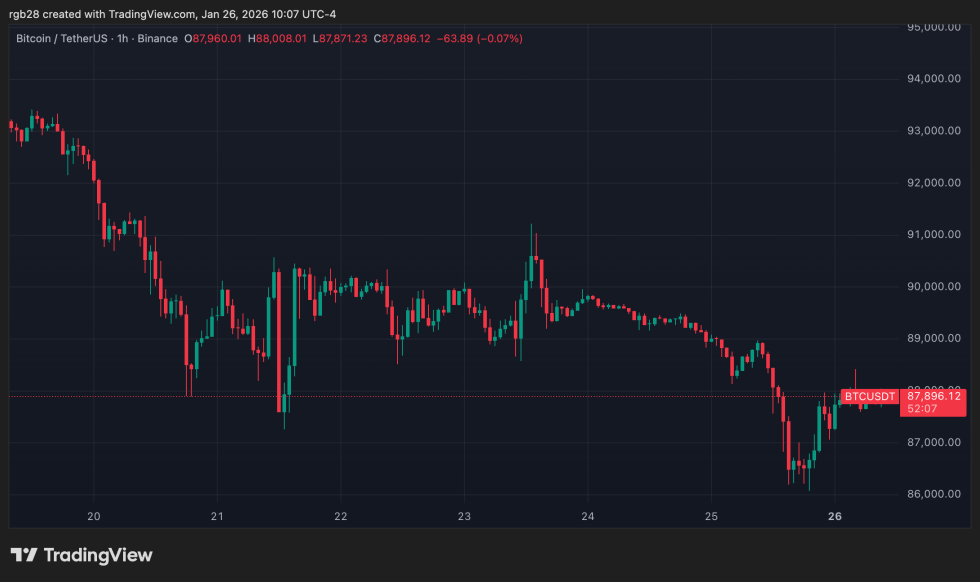
Bitcoin trades at $87,896 in the one-week chart. Source: BTCUSDT on TradingView


Related Questions

QWhen is Japan expected to list its first spot crypto ETFs according to the report?

AAs early as 2028.

QWhich two financial giants are preparing to develop Japan's first crypto ETFs ahead of the regulatory changes?

ANomura Holdings and SBI Holdings.

QWhat specific ETF did SBI Holdings file to launch in August, as mentioned in the article?

AAn ETF linked to both BTC and XRP, as well as a Digital Gold Crypto ETF.

QWhat is the estimated value that Japan's asset management industry believes Japanese crypto ETFs could eventually reach?

A1 trillion yen, worth around $6.4 billion.

QWhat significant change to the taxation of crypto assets is being explored by Japanese authorities?

AIntroducing a separate taxation system for crypto income with a flat 20% tax, similar to the stock system.

Related Reads

Within Strategy's Framework, STRC's Dividend Yield Remains at 12% as Share Price Stays Below Par Value

Michael Saylor, Executive Chairman of Strategy (MSTR), confirmed that the dividend rate for its STRC perpetual preferred shares will remain at 12.00% through August 2026. The rate has increased from 9% at its July 2025 launch to the current high via a "ratchet" mechanism, which permanently raises the rate by 0.5% whenever the share price falls below $95. This mechanism is intended to push the price back toward its $100 par value and support Strategy's "at-the-market" (ATM) program for issuing new shares to fund Bitcoin purchases. However, the mechanism has not worked as intended. STRC shares closed at $89.46 on July 31, remaining about 10-11% below par value despite the record-high dividend. Competition from rival Strive's higher-yielding SATA securities has pressured demand. The persistent discount has forced Strategy to suspend new STRC issuances via its ATM program, limiting this funding channel for Bitcoin acquisitions. STRC's struggles reflect Bitcoin's own volatility, as the preferred shares historically move in tandem. Analysts have warned the ratchet structure carries long-term, one-way risk. A law firm is investigating Strategy's ability to maintain dividend payments if Bitcoin's price stays low. Retail investors own roughly 83% of outstanding STRC shares, a group seen as prone to panic selling during downturns. In response, Strategy has established financial reserves, including a liquidity cushion covering about 26 months of dividend/interest obligations, and a $2 billion share buyback program alongside a Bitcoin monetization framework, though the company emphasized it is not obligated to sell any Bitcoin.

cryptonews.ru38m ago

Within Strategy's Framework, STRC's Dividend Yield Remains at 12% as Share Price Stays Below Par Value

cryptonews.ru38m ago

Analyst: Bitcoin's Price Will Drop to $60k in August, Then Rebound to $70k

Financial analyst Andrey Poroshin has provided a new forecast for Bitcoin's price dynamics in August. Poroshin, an analyst at the Bitbanker exchange, expects the cryptocurrency market to experience a downturn this month, with prices retesting the $60,000 level due to a lack of supportive macroeconomic catalysts. He noted that the recent US Federal Reserve decision to hold interest rates did not significantly impact the market, while inflation remains above the 2% target. Poroshin stated that Bitcoin is ending July under pressure from moderate volatility and a lack of new macroeconomic stimuli, leading to continued market caution. According to his base scenario, Bitcoin will drop to a range of $60,000 to $62,000 before recovering to $70,000. He pointed out that even $70,000 remains below the cost of mining in the US, which has prompted some miners to shift towards AI data center operations. Poroshin cited the winding down of BitMEX's operations as a potential catalyst for a price rebound, suggesting the exit of weaker players often coincides with market reversals and reduced short-term selling pressure. He believes Bitcoin is currently less susceptible to geopolitical shocks, such as the Iran-US conflict, and does not expect significant market changes in August related to the pending CLARITY Act. Looking ahead, Poroshin forecasts that September will bring more active price fluctuations driven by potential Fed rate decisions and possible discussions or approval of the CLARITY Act.

cryptonews.ru38m ago

Analyst: Bitcoin's Price Will Drop to $60k in August, Then Rebound to $70k

cryptonews.ru38m ago

Trading

Spot
活动图片




