Japan Moves to Strengthen Stablecoin Oversight With New Reserve Asset Rules

TheNewsCryptoPublished on 2026-01-27Last updated on 2026-01-27

Abstract

Japan's Financial Services Agency (FSA) has opened a public consultation, until February 2026, on new rules specifying which assets can be used as reserves for yen-backed stablecoins. This move addresses a gap in the updated 2025 Payment Services Act, which allowed stablecoin issuance under trust structures but lacked specific reserve requirements. The draft rules mandate that reserves must include only high-quality assets, such as foreign bonds with strong credit ratings from countries with at least $648 billion in bonds outstanding. The FSA also issued new guidance for financial institutions offering crypto services, requiring them to clearly explain risks to customers. These measures are part of Japan's broader effort to create a safe, regulated stablecoin ecosystem, following the recent launch of compliant stablecoins by major banks and fintech companies.

Japan’s financial regulator, the Financial Services Agency (FSA), has opened public consultation on the new rules that will decide which bond Stablecoin issuers can be used as reserves. The consultation is open until Feb 27, 2026, and the final rules will apply to all regulated yen-backed stablecoins issued in Japan.

In 2025, Japan updates its Payment Service ACT that allows the stablecoins to be issued under trust structures, but it did not clearly specify on what assets the issuers must hold as reserves. The FSA is now addressing the gap to protect users and to ensure stablecoins are fully backed by safe assets.

Stricter rules set by Japan

Under the draft rules, Stablecoin reserves may include certain foreign-issued bonds, but only if they meet the strict conditions. The bonds must have very strong credit ratings, and the issuing country should be big with atleast $648 billion in bonds outstanding. These rules apply to the stablecoins issued through trust-based structures where reserve assets are hold seperately and managed by the users. The new standard clearly defines how those reserves can be invested, ensuring transparency and safety.

The FSA also issued new supervisory guidance for the banks, insurance companies, and their subsidiaries that offer crypto services. A new requirement stated that the company must clearly explain risks to the customers. The aim is to prevent customers from assuming crypto products are risk-free just because they are offered by well-known financial institutions.

The companies that want to handle foreign-issued stablecoins in Japan must explain that the foreign user will not issue or promote the stablecoin to the general public in Japan. The FSA will also work with the overseas regulators to share information and monitor these assets more closely.

These changes are part of the Japans broader plan to build a safe and regulated stablecoin ecosystem. In October, fintech JPYC launched Japan’s first legally recognized yen-backed stablecoins, and Japan’s three biggest banks, MUFG, SMBC, and Mizuho, have launched stablecoins and tokenized deposit pilot programs. The FSA officially supported these efforts in December.

Highlighted Crypto News:

‌Major Altcoin ETFs See Sell-Offs by Grayscale Executives and Digital Currency Group

TagsJapanStablecoin

Related Questions

QWhat is the purpose of Japan's new stablecoin reserve asset rules?

AThe purpose is to strengthen stablecoin oversight by clearly defining which assets issuers must hold as reserves, ensuring stablecoins are fully backed by safe assets to protect users.

QUntil when is the public consultation period open for the new stablecoin rules?

AThe public consultation is open until February 27, 2026.

QWhat are the key requirements for foreign-issued bonds to be included as stablecoin reserves under the draft rules?

AThe bonds must have very strong credit ratings, and the issuing country must be large with at least $648 billion in bonds outstanding.

QWhat new requirement did the FSA issue for banks and insurance companies offering crypto services?

AThey must clearly explain the risks to customers to prevent them from assuming crypto products are risk-free just because they are offered by well-known financial institutions.

QWhich Japanese fintech company launched the country's first legally recognized yen-backed stablecoin?

AFintech company JPYC launched Japan's first legally recognized yen-backed stablecoin.

Related Reads

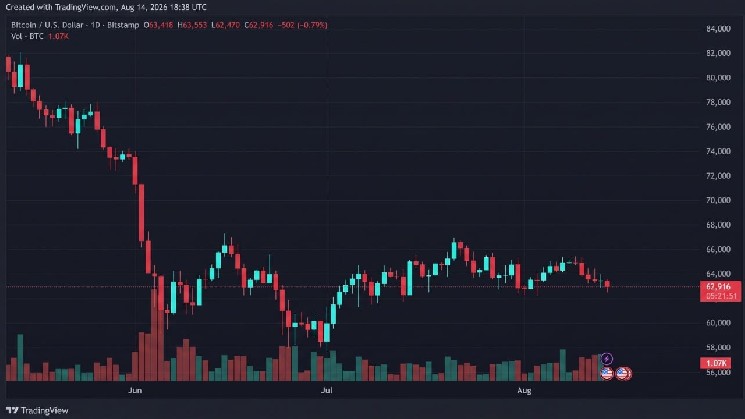
Bitcoin Price Drops to $62,470 as Sellers Retest $63,000 Support Level

Bitcoin's price fell below $63,000 for a second consecutive day on Friday, hitting an intraday low of $62,470. The cryptocurrency later recovered to trade just above $63,000, leaving it nearly flat for the past 24 hours and for August overall, with a weekly loss of 2.6%. The volatility triggered significant liquidations, with $26 million of leveraged long Bitcoin positions liquidated over 24 hours. Market sentiment was further dampened by data showing over $131 million in outflows from spot Bitcoin ETFs for a second straight day, signaling a potential pullback by institutional investors. Adding to the negative pressure, index provider MSCI has proposed new criteria for "non-operating companies" in its global indexes, which could lead to the exclusion of firms holding significant digital assets like Bitcoin on their balance sheets. Companies such as Strategy and Metaplanet could be affected, potentially forcing index-tracking funds to sell their shares. Strategy publicly criticized the proposal, arguing digital assets are legitimate assets and index providers should not dictate what companies can own. Public consultations on MSCI's proposal end September 30, with a final decision expected by October 16. If approved, exclusions could begin in November, potentially triggering sustained institutional selling and damaging a key bridge for Bitcoin adoption in the corporate sector.

cryptonews.ru5h ago

Bitcoin Price Drops to $62,470 as Sellers Retest $63,000 Support Level

cryptonews.ru5h ago

Trading

Spot
活动图片