Is Chainlink Ready to Reverse Its Downtrend?

TheNewsCryptoPublished on 2026-02-26Last updated on 2026-02-26

Abstract

Chainlink (LINK) is trading around $9.24, showing modest gains amid a broader cryptocurrency market rise. It remains above a key monthly support level between $7 and $7.3, which has historically attracted accumulation. However, LINK continues to trade below its 50-day ($10.63) and 200-day ($16.21) moving averages, both of which are declining, indicating sustained downward pressure. Technical indicators like the RSI (near 49) and MACD show neutral to weak momentum, with no strong bullish signals yet. The price is consolidating within a range, with near-term support at $8.20–$8.80 and resistance at $10.00. Overall, LINK appears to be in a phase of short-term consolidation without a decisive trend.

As the cryptocurrency market rose today, supported by a strong short squeeze and resumed institutional inflows, Chainlink (LINK) has shown modest upside, trading around $9.24, with a daily low of $9.08 and a high of $9.54.

While short-term volatility continues to draw attention, LINK remains positioned above a key monthly low between $7 and $7.3. Strong accumulation and buying interest have historically been seen in this area on longer timeframes. It now represents an important structural level, separating broader downside risk from the potential for a sustained recovery if maintained.

Major altcoins followed Bitcoin’s move, posting notable gains as overall market sentiment shifted away from extreme fear levels. At the time of writing, LINK is priced at $9.25 with a market cap of $6.5 billion. Still, the token’s price action continues to reflect consolidation below key moving averages.

On the daily timeframe, Chainlink remains below its 50-day MA near $10.63 and the 200-day MA around $16.21, with the bearish crossover structure still intact. Both moving averages are sloping downwards, a pattern typically associated with sustained downward pressure. The 50-day MA is currently acting as near-term resistance.
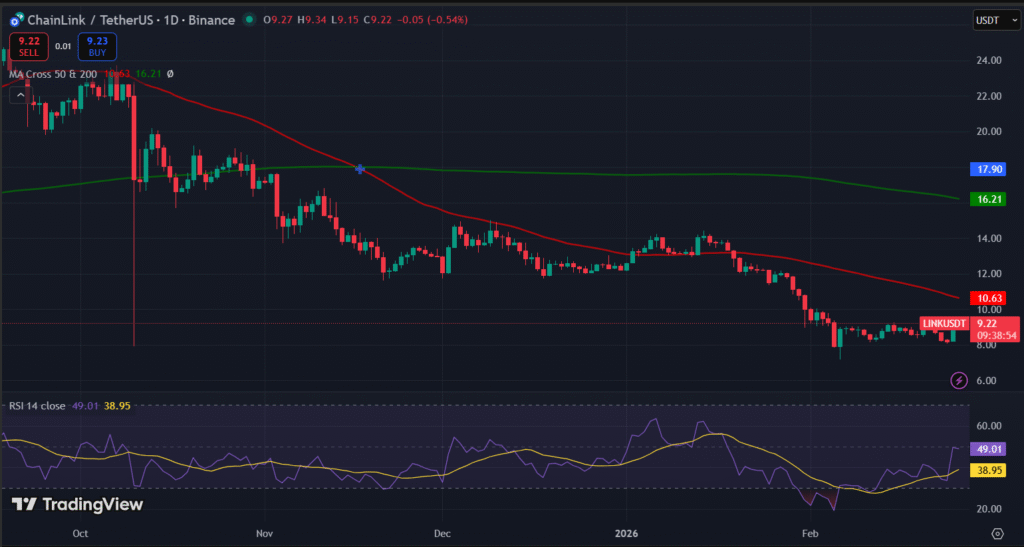
The RSI on the daily chart is near neutral at roughly 49, having rebounded from oversold territory earlier. This indicates that recent selling pressure has eased, but that bullish momentum has not yet strengthened meaningfully.

Zooming in, the MACD indicator remains close to the zero line, with no confirmed bullish crossover. This suggests limited directional momentum in either direction at present.
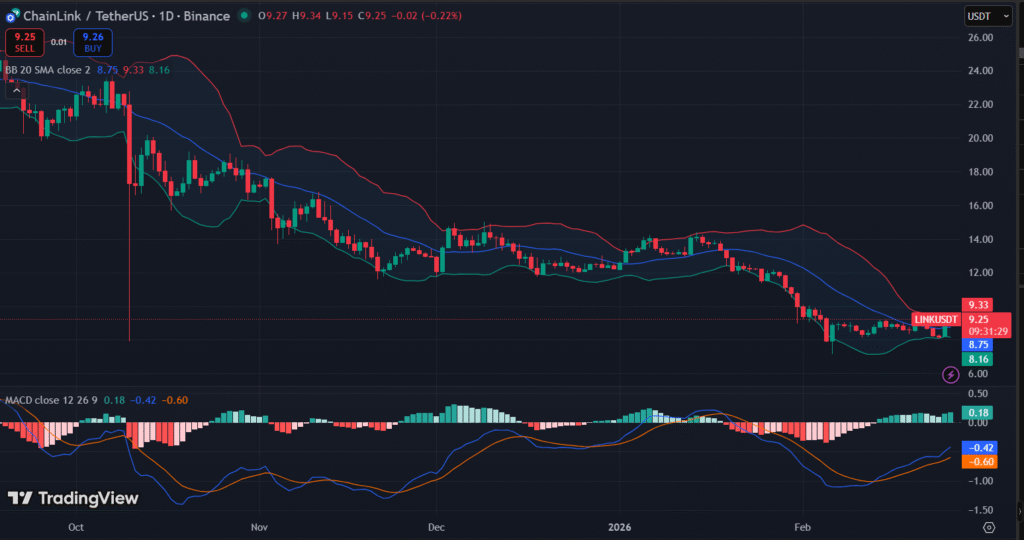
Meanwhile, Bollinger Bands are moderately wide, and the price is trading nearer to the lower band, reflecting recent consolidation and volatility contraction. Price hugging the lower band typically suggests the market is range-bound, rather than signaling a breakout.

If LINK continues the seesaw movement, the immediate support levels are found near the $8.80–$8.20 range, with additional support below these levels if selling pressure intensifies. If momentum picks up further, near-term resistance lies at $10.00, with the 50-day MA serving as a key technical barrier. Overall, Chainlink’s price action suggests continued consolidation in the short term.


TagsAltcoinChainlinkCrypto MarketLINK

Related Questions

QWhat is the current price of Chainlink (LINK) and its key daily trading range as mentioned in the article?

AChainlink is trading around $9.24, with a daily low of $9.08 and a high of $9.54.

QAccording to the technical analysis, what are the moving averages acting as resistance for LINK?

AThe 50-day moving average near $10.63 and the 200-day moving average around $16.21 are acting as resistance, with the 50-day MA serving as near-term resistance.

QWhat does the RSI level of approximately 49 indicate about LINK's momentum?

AAn RSI near 49 indicates that recent selling pressure has eased, but bullish momentum has not yet strengthened meaningfully, placing it in a neutral territory.

QWhat key support level does the article identify for LINK if selling pressure increases?

AThe immediate support levels are found near the $8.80–$8.20 range, with additional support below these levels if selling pressure intensifies.

QWhat overall market condition contributed to the rise in major altcoins including Chainlink?

AMajor altcoins rose due to a strong short squeeze and resumed institutional inflows, which shifted overall market sentiment away from extreme fear levels.

Related Reads

Peeking Through Windows, Precision Hijacking? Two Giants of Prediction Markets Engage in Corporate Espionage

Polymarket, a prediction market platform, is investigating a suspected corporate espionage case involving its main rival, Kalshi. Polymarket accuses Kalshi of stealing business information and copying product launches through potentially illicit means, compiling a "plagiarism file" documenting over a dozen suspiciously coincidental product releases and marketing campaigns. Key incidents include a February 2026 free-grocery pop-up event, where Kalshi launched an almost identical campaign just nine days before Polymarket's scheduled launch, seemingly to siphon attention. Furthermore, an article leaked Kalshi's plans for a perpetual futures trading product merely an hour before Polymarket's own planned announcement for a similar tool in April 2026. Polymarket executives suspect either an internal mole or physical surveillance, noting that the office of Paradigm—a Kalshi investor—directly faces their Manhattan workspace, leading them to install dark window film. Both Paradigm and Kalshi have dismissed the allegations as baseless and ridiculous. Kalshi claims its product developments are independent and coincidental timing is merely market-driven. The rivalry intensifies as both companies secure significant funding, with Polymarket seeking a $15 billion valuation and Kalshi valued at $22 billion amid growing regulatory scrutiny of the prediction market industry.

foresightnews_api4m ago

Peeking Through Windows, Precision Hijacking? Two Giants of Prediction Markets Engage in Corporate Espionage

foresightnews_api4m ago

Hyperliquid, Wall Street's All-Day Trading Convenience Store

**Hyperliquid: Wall Street's 24/7 Trading Convenience Store** Written by Vicky Ge Huang, Wall Street Journal. Hyperliquid, a decentralized crypto trading platform, has become a go-to venue for Wall Street traders, especially during weekends when traditional U.S. markets are closed. Operating 24/7, it allows traders to pre-position or close trades ahead of market opens, capitalizing on events like geopolitical news. The platform, founded by former Hudson River Trading quant Jeff Yan, offers perpetual contracts on a wide range of assets, including Bitcoin, the S&P 500, oil, and even pre-IPO companies like SpaceX. Its growth exemplifies the merging of traditional finance and crypto markets, attracting significant volume from professional traders seeking leverage and constant access. A key differentiator, according to Yan, is user self-custody of assets—a necessity highlighted by the FTX collapse. Despite U.S. regulatory restrictions, some American users reportedly access the platform via VPN, drawn by its ease of use, lack of stringent KYC, and strong community culture on platforms like Discord and X. The platform is not without risks. Perpetual contracts are complex and highly leveraged, leading to massive liquidations during market volatility. Hyperliquid itself saw $10 billion in liquidations during a market crash in October last year. Regulatory warnings emphasize insufficient risk disclosure for retail investors. With about 11 employees, Hyperliquid and its associated blockchain reportedly generated around $800 million in revenue last year. Its native token, HYPE, has surged over 100% since late 2024. The platform plans to expand into prediction markets and options trading, aiming to become a hub for all financial activity.

foresightnews_api6m ago

Hyperliquid, Wall Street's All-Day Trading Convenience Store

foresightnews_api6m ago

Former Bankless Member Lucas: Why I Still Bullish on Ethereum

Former Bankless member Lucas explains why he remains bullish on Ethereum despite widespread pessimism. He acknowledges ETH's poor price performance over the past five years compared to Bitcoin and traditional markets, but draws parallels to historical multi-year consolidations seen in tech giants like Amazon and NVIDIA before major breakouts. Fundamentally, Ethereum is stronger than ever: record-high daily transactions (2.27 million in May 2026), significantly lower average gas fees ($0.27), over 400 million total addresses, and more than 32% of ETH staked, securing the network. Lucas's core thesis remains unchanged: all valuable assets will eventually be tokenized, Ethereum will become the primary settlement layer for these assets, and ETH will capture the resulting value. This transition is already underway. Stablecoins, the first proven tokenized real-world asset (RWA), have a $300+ billion market cap, with 54% settled on Ethereum. The broader RWA sector has surpassed $30 billion, with over 53% deployed on Ethereum. He compares the current RWA adoption phase to early DeFi in 2019-20, suggesting immense growth potential. Key catalysts like the potential passage of the U.S. CLARITY Act in 2026 could accelerate institutional adoption. While other blockchains will share the market, Lucas argues that traditional finance prioritizes Ethereum's security, stability, and established ecosystem for trillion-dollar asset tokenization. He concludes that as global assets migrate on-chain, the market will reprice ETH accordingly.

foresightnews_api9m ago

Former Bankless Member Lucas: Why I Still Bullish on Ethereum

foresightnews_api9m ago

Trading

Spot
Futures
活动图片