Is CFTC ‘ready to take responsibility’ for $3T crypto market?

ambcryptoPublished on 2026-04-02Last updated on 2026-04-02

Abstract

The U.S. Commodity Futures Trading Commission (CFTC) is positioning itself as a leading regulator for the $3 trillion cryptocurrency market. Chair Michael Selig stated the agency is prepared to take on this responsibility and is working with the SEC to harmonize federal oversight. This shift comes amid broader U.S. regulatory improvements, which have supported significant market growth, including a stablecoin market cap exceeding $319 billion. The CFTC has taken steps like publishing a crypto-asset system and offering regulatory relief to developers. However, key legislation, such as the CLARITY Act, remains stalled in Congress. A clearer regulatory framework is seen as crucial for further industry expansion.

Cryptocurrency adoption has accelerated in recent years, prompting governments to develop clearer regulatory frameworks. The United States leads in public adoption and maintains a relatively strong regulatory environment, with scores of 7.7 and 6.2 out of 10, respectively.
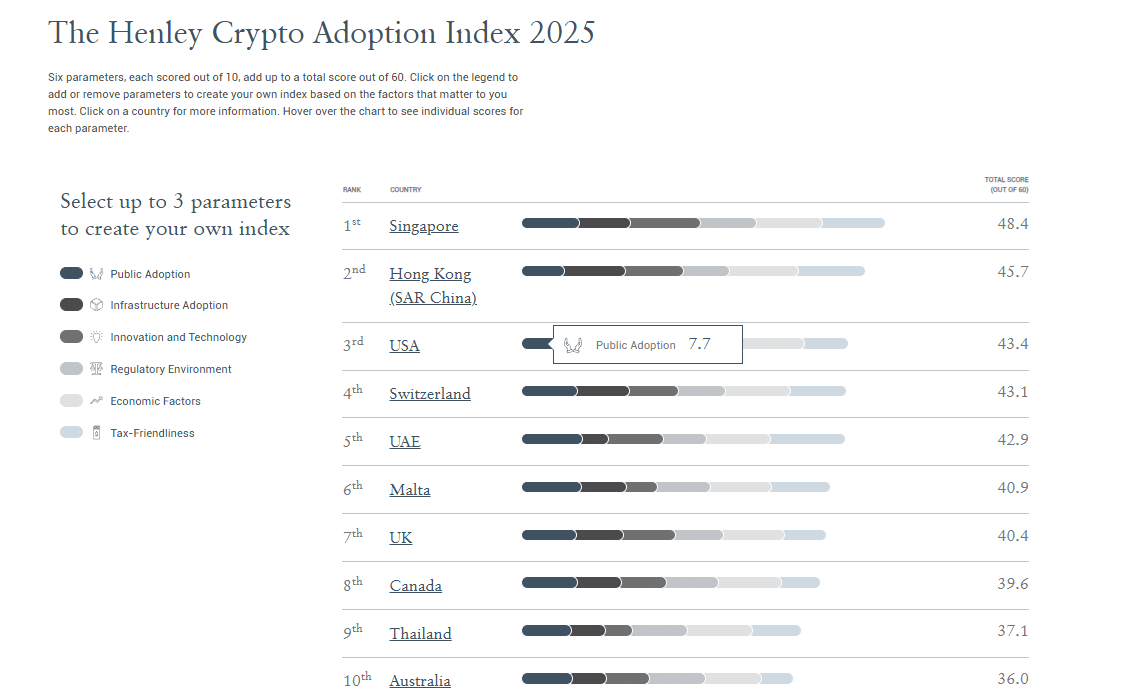
Source: Henley Global

A more favorable regulatory tone, particularly during the Trump administration, has strengthened its position. As the sector expands, the Commodity Futures Trading Commission [CFTC] has taken on a more prominent role, aiming to reduce regulatory burdens and support industry growth.

CFTC signals readiness to oversee crypto market

CFTC Chair Michael Selig said the agency is well prepared to regulate the crypto industry. As part of a summary marking his 100 days in the office, Selig stated,

CFTC is ready to take responsibility for a $3 trillion crypto asset market.

In his statement, he reported that the CFTC and the SEC have formed a joint effort to harmonize federal oversight of the crypto asset market. However, he did not provide a timeline for when Congress might pass a formal market structure bill.

The recent remarks came as the United States Senate continued to review the CLARITY Act. The bill has stalled in the committee amid a dispute over stablecoin yield and related provisions.

Easing crypto regulation accelerates growth.

Besides CFTC’s willingness to lead the crypto industry, the Chair noted major regulatory steps taken to caution the sector.

Selig criticized the prior administration over the use of enforcement in crypto regulation. In doing so, he stated that the agency had improved the regulatory environment by providing no-action relief to digital wallet software developers.

The CFTC published the Taxonomy, the first crypto-asset classification system, which distinguishes digital securities from commodities. Also, the agency argued that it had addressed clarity concerns over tokenized collateral and had launched an innovation task force.

Notably, improvements in regulatory environments, especially with the passage of the GENIUS Act, strengthened market adoption. In fact, stablecoins have grown substantially, exceeding $319 billion in market cap and over $100 billion in trading volume.
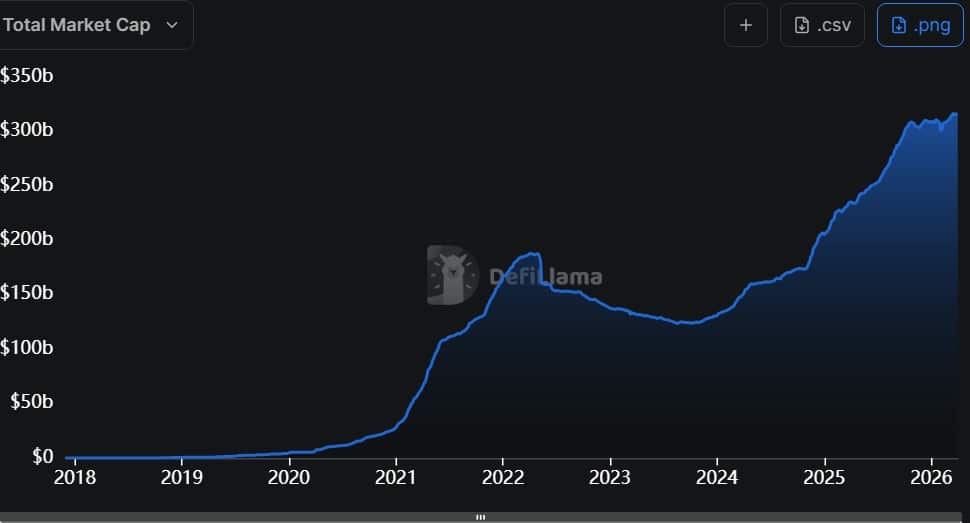
Source: DeFiLlama

The sector’s growth underscores the need for legal clarity, and if properly enacted, the entire crypto market could grow further. Thus, improving regulatory conditions is good news for the broader crypto market and could significantly boost the market if further progress is made.


Final Summary

  • The Commodity Futures Trading Commission is emerging as a key regulator, signaling readiness to oversee a $3 trillion crypto asset market.
  • CFTC Chair Michael Selig confirmed coordination with the Securities and Exchange Commission to align federal oversight.


Related Questions

QWhat is the CFTC's stated readiness regarding the crypto market, and what specific market size was mentioned?

ACFTC Chair Michael Selig stated that the agency is ready to take responsibility for a $3 trillion crypto asset market.

QWhich two US agencies have formed a joint effort to harmonize federal oversight of the crypto market?

AThe Commodity Futures Trading Commission (CFTC) and the Securities and Exchange Commission (SEC) have formed a joint effort for this purpose.

QWhat major legislative act is currently stalled in the US Senate, and what is the primary dispute causing the delay?

AThe CLARITY Act is stalled in committee, primarily due to a dispute over stablecoin yield and related provisions.

QWhat specific action did the CFTC take to improve the regulatory environment for digital wallet software developers?

AThe CFTC provided no-action relief to digital wallet software developers.

QWhat is the name of the first crypto-asset classification system published by the CFTC, and what is its primary function?

AThe CFTC published the Taxonomy, which is the first crypto-asset classification system designed to distinguish digital securities from commodities.

Related Reads

Annual Salary of Millions Competing for Electricians, Meta Rushes to Open Its Own Technical School

The AI boom is facing an unexpected bottleneck: a severe shortage of skilled construction workers and electricians. As tech giants like Meta, OpenAI, and Alphabet race to build massive data centers—such as OpenAI's $16 billion "Stargate" project—they are hitting a critical labor wall. The U.S. needs an estimated 130,000 more electricians, 240,000 construction workers, and 150,000 supervisors by 2030 for AI infrastructure alone, but tens of thousands of electrician jobs go unfilled each year. While AI companies offer high premiums, with electricians earning up to $280,000 annually, worker scarcity still causes massive losses—delays on a single project can cost $14.2 million per month. The complexity of building AI data centers, which require immense power (equivalent to powering hundreds of thousands of homes), sophisticated electrical systems, and advanced liquid cooling solutions, demands highly skilled technicians who are in short supply. To combat this, companies are investing heavily in training. Meta has committed $115 million to a free training school offering tuition, housing, and stipends, targeting 5,000 new workers. OpenAI is partnering with unions to secure skilled labor. These efforts are paying off, with a significant rise in Gen Z interest in trade schools over college. However, the power demands are staggering. AI data centers are driving a rapid surge in electricity consumption, projected to account for up to 12% of U.S. power use by 2028 and raising costs for consumers. Furthermore, the construction boom is project-based, leading to a potential future glut of trained workers once building peaks, which could depress wages industry-wide. The race for AI supremacy now depends as much on skilled hands as on advanced chips.

marsbit1h ago

Annual Salary of Millions Competing for Electricians, Meta Rushes to Open Its Own Technical School

marsbit1h ago

OpenAI No Longer Sells Its Most Expensive Model for Profit

OpenAI is shifting its business strategy away from promoting its most expensive, flagship models for every task. Recent price cuts—80% for GPT-5.6 Luna and 20% for Terra—signal a deeper change: the company now actively advises users that many tasks don't require the most powerful model. Instead, OpenAI recommends a tiered approach: use the high-end GPT-5.6 Sol for complex planning and analysis, then delegate execution to cheaper models like Luna. This mirrors moves by Anthropic, which recently launched Claude Opus 5 at half the price of its top model, Fable 5. Both companies are de-emphasizing flagship models as primary revenue drivers, using them instead for brand prestige and technological showcases. The industry is entering a "mass-market" phase, similar to automotive, where high-volume, cost-effective models handle daily operations and drive scale. OpenAI's price reductions are partly enabled by AI models themselves optimizing underlying code and infrastructure, creating a self-reinforcing cycle of efficiency gains and cost reduction. Competition is shifting from "who is smartest" to "who offers the best value." The goal is no longer selling individual models but fostering widespread API adoption and ecosystem lock-in. By making AI calls cheap and ubiquitous, companies like OpenAI aim to become the indispensable, utility-like infrastructure powering automated workflows—the "water and electricity" of software, quietly embedded everywhere.

marsbit1h ago

OpenAI No Longer Sells Its Most Expensive Model for Profit

marsbit1h ago

Trading

Spot
活动图片




