Iran’s Hidden Crypto Trails Exposed As Arkham Publishes Public Wallet Map

bitcoinistPublished on 2026-05-14Last updated on 2026-05-14

Abstract

Blockchain intelligence firm Arkham has published a public, searchable map of cryptocurrency wallets linked to Iran's central bank, Bank Markazi. The core of the map is two Tron-based wallets that were sanctioned by the U.S. Treasury on April 24, identified as property of the bank and tied to the IRGC-Qods Force and Hezbollah. Approximately $344 million in crypto was frozen in the action, with Tether complying to freeze the funds. Arkham's research aims to serve as a starting point for tracing transaction flows. Analysis reveals a complex, layered system where Iranian oil revenues move through brokers, intermediary wallets, and DeFi protocols to obscure their origin before reaching central bank-linked accounts. While the Tron network itself cannot monitor transactions, it points to a joint financial crime unit with Tether and TRM Labs to flag illicit activity. The exposed wallets are part of a larger trend. Estimates indicate Iran's total crypto transaction volume reached roughly $11.4 billion in 2024 and $10 billion in 2025. Furthermore, Iran is reportedly considering charging crypto tolls for ships in the Strait of Hormuz, signaling digital assets' expanding role beyond sanctions evasion.

Blockchain analytics firm Arkham has built a public, searchable map of crypto wallets it links to Iran’s central bank — a move that puts Tehran’s alleged digital holdings in plain sight of investigators and anyone else curious enough to look.

How Iran Moves Money Through Crypto

The map centers on two Tron-based wallets that were added to the US Treasury’s Specially Designated Nationals list on April 24. Treasury identified both addresses as property of Bank Markazi Jomhouri Islami Iran — the country’s central bank — citing ties to the Islamic Revolutionary Guard Corps-Qods Force and Hezbollah.

Around $344 million in crypto was frozen as part of the action, Treasury Secretary Scott Bessent said, describing the goal as cutting off Tehran’s ability to generate, move, and bring home funds.

Stablecoin issuer Tether confirmed it had frozen the funds at the request of US authorities, citing activity tied to unlawful conduct, without naming Iran directly in its public statement.
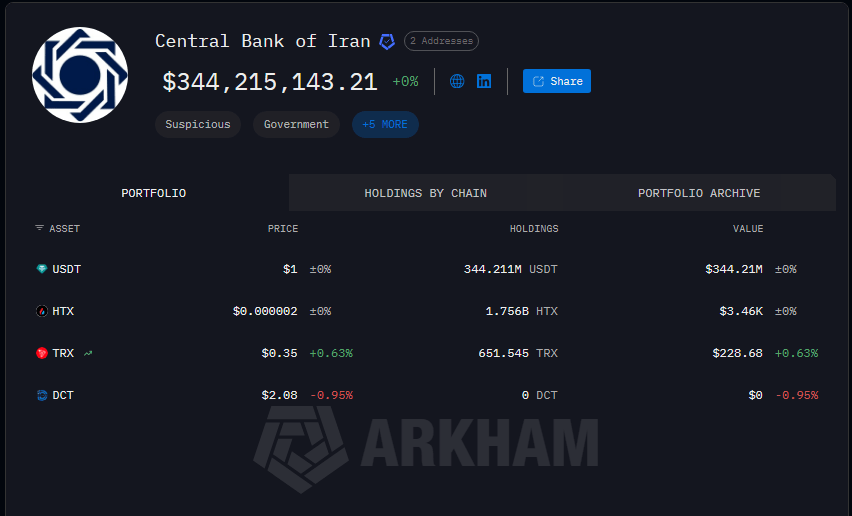
Arkham published its research on May 11, grouping the sanctioned addresses under a Central Bank of Iran entity page that it says can be used as a starting point to trace connected wallets and transaction flows.

The firm said the wallets hold TRC-20 tokens — a token standard that runs on the Tron network and includes USDT, the world’s largest stablecoin.

A Layered System Built To Hide

The money trail is not simple. According to Chainalysis, Iranian oil revenues passed through brokers, intermediary wallets, cross-chain bridges, and decentralized finance protocols before ending up in accounts linked to Iran’s central bank and IRGC-connected entities. The pipeline was built for concealment, layered step by step to obscure its origins.

A TRON spokesperson said the network itself cannot monitor or block individual transactions, but pointed to the T3 Financial Crime Unit — a joint effort between TRON, Tether, and TRM Labs launched in 2024 — as its main tool for flagging abuse.

BTCUSD trading at $80,564 on the 24-hour chart: TradingView

The unit works with law enforcement to freeze hundreds of millions in funds tied to sanctioned groups and terrorism financing, the spokesperson said. Tether declined to comment separately.

Iran’s Crypto Activity Runs Deep

The exposed wallets are just one piece of a much larger picture. Based on estimates from TRM Labs and Chainalysis, Iran’s total crypto transaction volume reached roughly $11.4 billion in 2024 and $10 billion in 2025.

Meanwhile, Iran is said to be looking into charging crypto-denominated tolls to ships passing through the Strait of Hormuz — a sign that digital assets are being considered as a revenue channel well beyond sanctions evasion.

Featured image from Bitcoin Policy Institute, chart from TradingView

Related Questions

QWhat did the blockchain analytics firm Arkham do regarding Iran's crypto activity?

AArkham built a public, searchable map of crypto wallets it links to Iran's central bank, exposing Tehran's alleged digital holdings.

QWhat was the amount of crypto frozen by the US Treasury action related to Iran, and what were the cited reasons?

AAround $344 million in crypto was frozen. The US Treasury identified the wallets as property of Iran's central bank, citing ties to the Islamic Revolutionary Guard Corps-Qods Force and Hezbollah.

QHow does the article describe the complexity of Iran's money trail involving crypto?

AThe money trail is described as not simple; it involved a layered system built for concealment, passing through brokers, intermediary wallets, cross-chain bridges, and DeFi protocols to obscure origins before reaching accounts linked to Iran's central bank.

QAccording to estimates mentioned, what was Iran's estimated total crypto transaction volume in 2024 and 2025?

ABased on estimates from TRM Labs and Chainalysis, Iran's total crypto transaction volume reached roughly $11.4 billion in 2024 and $10 billion in 2025.

QWhat is one potential future use of digital assets by Iran mentioned in the article, beyond sanctions evasion?

AIran is said to be looking into charging crypto-denominated tolls to ships passing through the Strait of Hormuz, indicating digital assets are being considered as a broader revenue channel.

Related Reads

Breaking: OpenAI Undergoes Major Reorganization, President Brockman Assumes Command

OpenAI has announced a major internal reorganization just months before its anticipated IPO. The company is merging its three flagship product lines—ChatGPT, Codex, and the API platform—into a single, unified product organization. The most significant leadership change involves co-founder and President Greg Brockman moving from a background technical role to take full, permanent control over all product strategy. This follows the indefinite medical leave of AGI Deployment CEO Fidji Simo. Additionally, ChatGPT's longtime lead, Nick Turley, has been reassigned to enterprise products, with former Instagram executive Ashley Alexander taking over consumer offerings. The consolidation, internally framed as a strategic move towards an "Agentic Future," aims to break down internal silos and create a cohesive "Super App." This planned desktop application would integrate ChatGPT's conversational abilities, Codex's coding power, and a rumored internal web browser named "Atlas" to autonomously perform complex user tasks. The reorganization occurs amid significant internal and external pressures. OpenAI has recently seen a wave of high-profile departures, including Sora co-lead Bill Peebles and other senior technical leaders, leading to concerns about a thinning executive bench. Externally, rival Anthropic recently secured funding at a staggering $900 billion valuation, surpassing OpenAI's own. Google's upcoming I/O developer conference also poses a competitive threat. Analysts suggest the dramatic restructure is a pre-IPO move to present a clearer, more focused narrative to Wall Street—streamlining operations and demonstrating decisive leadership under Brockman to counter internal turbulence and intense market competition.

marsbit51m ago

Breaking: OpenAI Undergoes Major Reorganization, President Brockman Assumes Command

marsbit51m ago

Two Survival Structures of Market Makers and Arbitrageurs

Market makers and arbitrageurs represent two distinct survival structures in high-frequency trading. Market makers primarily use limit orders (makers) to profit from the bid-ask spread, enjoying high capital efficiency (nominally 100%) but bearing inventory risk. This "inventory risk" arises from passive, fragmented, and discontinuous order fills in the limit order book (LOB). This risk, while a potential cost, can also contribute to excess profit if managed within control boundaries, allowing for mean reversion. Market makers essentially sell "time" (uncertainty over execution timing) to the market for price control and low fees. In contrast, cross-exchange arbitrageurs typically use market orders (takers) to exploit price differences or funding rates, resulting in lower nominal capital efficiency (requiring capital on both exchanges) and higher transaction costs. Their risk exposure stems from asymmetries in exchange rules (e.g., minimum order sizes), execution latency, and infrastructure risks (e.g., ADL, oracle drift). These exposures are active, exogenous gaps that primarily erode profits rather than contribute to them. Arbitrageurs essentially sell "space" (capital sunk across venues) for localized, immediate certainty. Both strategies engage in a trade-off between execution friction and residual risk. Optimal systems allow for temporary, controlled risk exposure rather than enforcing zero exposure at all costs. Their evolution converges towards hybrid models: arbitrageurs may use maker orders to reduce costs, while market makers may use taker orders or hedges for risk management. Ultimately, both use different forms of risk exposure—market makers exposing inventory, arbitrageurs immobilizing capital—to extract marginal, hard-won certainty from the market.

链捕手51m ago

Two Survival Structures of Market Makers and Arbitrageurs

链捕手51m ago

Who Will Define the Rules of the AI Era? Anthropic Discusses the 2028 US-China AI Landscape

This article, based on Anthropic's analysis, outlines the intensifying systemic competition between the U.S./allies and China for AI leadership by 2028. It argues that access to advanced computing power ("compute") is the critical bottleneck, where the U.S. currently holds a significant advantage through chip export controls and allied innovation. However, China's AI labs remain competitive by exploiting policy loopholes—via chip smuggling, overseas data center access, and "model distillation" attacks to copy U.S. model capabilities—keeping them close to the frontier. The piece presents two contrasting scenarios for 2028. In the first, decisive U.S. action to tighten compute controls and curb distillation locks in a 12-24 month AI capability lead, cementing democratic influence over global AI norms, security, and economic infrastructure. In the second, policy inaction allows China to achieve near-parity through continued access to U.S. technology, enabling Beijing to promote its AI stack globally and integrate advanced AI into its military and governance systems, altering the strategic balance. Anthropic contends that maintaining a decisive U.S. lead is essential for shaping safe AI development and governance. The core recommendation is for U.S. policymakers to urgently close compute and model access loopholes while promoting global adoption of the U.S. AI technology stack to secure a lasting strategic advantage.

marsbit2h ago

Who Will Define the Rules of the AI Era? Anthropic Discusses the 2028 US-China AI Landscape

marsbit2h ago

Trading

Spot
Futures
活动图片