Institutional Shift? Jane Street Turns Toward Ethereum After Reducing Bitcoin ETF Exposure

bitcoinistPublished on 2026-05-16Last updated on 2026-05-16

Abstract

Institutional investors are increasingly shifting focus from Bitcoin to Ethereum, with Jane Street notably reducing its Bitcoin ETF exposure while increasing its stake in ETH. This reflects a broader trend of institutions viewing Ethereum not just as an altcoin but as a distinct macro asset, driven by its growing role in DeFi and tokenization. Concurrently, Ethereum's network recorded its highest realized profits in three weeks, with $74.58 million in profits despite a recent price dip, as earlier accumulators sold into the downturn. On-chain data shows increased transaction volume and distribution activity at around $2,241, suggesting cautious investor sentiment. Analysts advise monitoring for deeper realized losses as a potential bottoming signal before considering aggressive positions.

For long, Bitcoin has remained the major target for institutional investors, but lately Ethereum is turning up strongly on their radars too. Many companies have begun to accumulate the leading altcoin at a significant rate, with some even dumping a portion of their Bitcoin holdings to buy more ETH.

Jane Street Shows Interest In Ethereum

As the crypto sector expands, the market is now experiencing a major shift in institutional investors’ interest. A number of companies are starting to increase their exposure to Ethereum while reducing their exposure to Bitcoin.

Jane Street is changing the way it is exposed to cryptocurrencies by increasing its stake in Ethereum and decreasing its holdings in Bitcoin Exchange-Traded Funds (ETFs). The move is gaining attention throughout the crypto market because it may represent shifting institutional preferences in the market for digital assets.

Deci, a market commentator, stated that Jane Street’s addition of ETH funds and reduction of exposure to BTC ETFs does not automatically make them ETH maximis. However, it does point to a growing and real rotation.

Large investors are becoming more interested in ETH, possibly due to its growing role in Decentralized Finance (DeFi), tokenization, and blockchain infrastructure, even though Bitcoin has long dominated institutional portfolios. According to the expert, institutional investors are beginning to treat ETH less like an altcoin and more like a separate macro asset next to Bitcoin and Gold.

In the expert’s view, BTC was the first digital store of value, but now ETH is becoming the financial infrastructure trade. Such a distinction, he believes, is where the market keeps underpricing the altcoin.

ETH Network Sees A Large Realized Profit Margin

After a brief price rebound, Ethereum has witnessed a surge in realized profits, indicating a shift in market dynamics. On Thursday, Santiment, a market intelligence and on-chain data analytics platform, reported that ETH registered its highest network realized profits in 3 weeks.

This may appear counterintuitive to see a spike of $74.58 million in realized profits because ETH’s price has fallen by 5.5% over the past 3 days. However, this trend is linked to investors’ behavior during the price action. ETH holders with a much lower cost basis are selling into the dip.

While ETH traded below $2,000 throughout much of February and March, savvy traders accumulated despite war fears and heightened uncertainty in crypto at the time. Furthermore, wallets that were collected during those months are still profitable despite this mid-May downturn. Meanwhile, many have chosen to sell while they believe they still have a chance to make money.
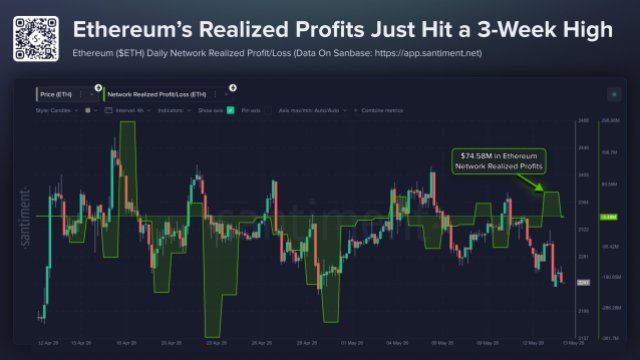
Source: Chart from Santiment on X

Santiment also highlighted an increase in the volume of on-chain movement on the Ethereum blockchain. The 4-hour candles exhibit significant price compression at $2,241, indicating increased distribution activity on the chain. Historically, more transactions have led to more realized P&L events. When volume is increased, even little individual profits add up to significant network-level totals.

Based on current ETH trader behavior, Santiment noted that investors are leaning cautious. However, this does not mean new investors should be bearish. Rather, the platform suggests watching for deeper realized losses as a potential bottoming signal and avoiding aggressive positioning until the distribution phase shows clear signs of ending.

ETH trading at $2,265 on the 1D chart | Source: ETHUSDT on Tradingview.com

Related Questions

QWhat significant shift in institutional investment is highlighted in the article regarding Jane Street?

AThe article highlights that Jane Street is increasing its exposure to Ethereum while reducing its holdings in Bitcoin ETFs, indicating a shift in institutional interest towards Ethereum.

QAccording to market commentator Deci, what does Jane Street's move signify about institutional preferences?

AAccording to Deci, while Jane Street's move does not automatically make them 'ETH maximalists,' it points to a growing and real rotation in institutional investment, with Ethereum being treated more as a separate macro asset alongside Bitcoin and Gold.

QWhat on-chain data did Santiment report regarding Ethereum, and why was it considered counterintuitive?

ASantiment reported that Ethereum registered its highest network realized profits in 3 weeks, with a spike of $74.58 million. This was considered counterintuitive because ETH's price had fallen by 5.5% over the preceding 3 days.

QWhat behavior among ETH holders explains the surge in realized profits despite a price drop?

AThe surge in realized profits is explained by ETH holders with a much lower cost basis selling into the price dip. These savvy traders had accumulated ETH when it traded below $2,000 in February and March, so they were still profitable and chose to sell during the mid-May downturn.

QWhat current trader behavior does Santiment note, and what advice does it give to new investors based on this?

ASantiment notes that current ETH investors are leaning cautious. It advises new investors to watch for deeper realized losses as a potential bottoming signal and to avoid aggressive positioning until the distribution phase shows clear signs of ending.
Related Reads

Who Funds the Agents?

**Summary: Who Funds AI Agents?** OpenAI recently shut down a feature allowing AI agents to shop for users, highlighting the challenge of creating a secure and regulated environment for agent-driven transactions. While payment infrastructure exists, a crucial governance layer—defining spending limits, fraud detection, tax handling, and return policies—is largely missing. The potential is enormous: AI agents already processed $73M across 176M transactions last year, with McKinsey forecasting this could grow to $3-5T in global consumer commerce by 2030. The core competition isn't just about processing payments, which can be very cheap (especially with crypto-based settlement), but about controlling the rules that govern agent spending. Key players like Stripe and Coinbase are racing to dominate this governance layer. Stripe's acquisition of wallet provider Privy allows it to set spending policies, identity checks, and human-in-the-loop approvals directly at the wallet level. Similarly, Coinbase's stack, including its x402 protocol and AgentKit, embeds governance rules. This vertical integration across settlement, wallet, and governance layers is becoming the dominant strategy. Control over the governance layer is where significant future value lies. If agents handle trillions in transactions, even a small fee for managing compliance, fraud prevention, and policy enforcement could generate billions in annual revenue. The companies that successfully integrate across the payment stack will capture value from idle agent balances, transaction fees, and governance services, positioning themselves as the foundational banks of the AI agent economy.

marsbit1m ago

Who Funds the Agents?

marsbit1m ago

A Nation Blocks Chips, a Giant Buys a Nuclear Power Plant: Why It's Time to Seriously Consider DeAI

**Title: Great Powers Blockade Chips, Giants Buy Nuclear Plants: Why It's Time to Seriously Consider DeAI** In May 2026, the US closed loopholes for Chinese firms to acquire advanced NVIDIA chips via overseas subsidiaries. That same month, Kenya halted a $1B geothermal data center project involving Microsoft, fearing its immense energy consumption. Meanwhile, Huawei announced mass production of its Ascend AI chip. These disparate events underscore a new reality: the competition for computing power ("compute") has escalated beyond the tech industry, becoming a geopolitical and infrastructural battleground. A new era of oligopoly is forming, with control over the AI stack—from GPU chips (NVIDIA) and cloud platforms (AWS, Azure, Google Cloud) to foundational models (OpenAI, Anthropic)—concentrating in a few Western "AI Octopus" corporations. This centralization creates systemic risks: pricing power and platform lock-in for users, infrastructure fragility, and a widening "compute divide" that threatens to marginalize nations without independent AI capacity. An "AI Iron Curtain" is deepening through export controls. In response, some nations like Saudi Arabia and the UAE are investing heavily to buy compute power, aiming to transition from oil to AI economies. The EU seeks to triple its compute capacity by 2030 to reduce dependency. However, the spending gap is vast, with four US tech giants alone planning ~$750B in AI capex for 2026. The race is increasingly constrained by energy, with AI tasks consuming up to 1000x more power than web searches, pushing firms to even acquire nuclear plants. This landscape is fueling interest in Decentralized AI (DeAI). It proposes a third way: using open protocols to coordinate a global network of idle GPUs, independent developers, and data centers, creating an AI infrastructure without a single controlling entity. Leveraging blockchain and cryptographic verification, DeAI aims to break market concentration, disperse energy demands, reduce geopolitical dependencies, and enhance transparency. While still nascent in performance and stability, DeAI's core promise is not immediate superiority but providing a crucial alternative architecture to resist monopoly, censorship, and centralized power. As specialized AI hardware costs fall and open-source models flourish, the window to build this foundation is open. The very existence of such competition serves as a vital check against the inevitable abuse of concentrated power.

marsbit55m ago

A Nation Blocks Chips, a Giant Buys a Nuclear Power Plant: Why It's Time to Seriously Consider DeAI

marsbit55m ago

Outpoll Review: A Prediction Market Platform Built for Active Traders

Outpoll Review: A Prediction Market Platform Built for Active Traders In recent years, prediction markets have grown from a niche sector to a mainstream arena, attracting billions in trading volume and institutional capital. However, the user experience and tools for traders have not kept pace. Outpoll, a new global prediction market platform, aims to fill this gap by providing enhanced trading infrastructure for active and professional traders. Built on standard prediction market principles, Outpoll allows users to trade on the outcome of specific events. It uses fully collateralized contracts with USDC settlement, charges a competitive 0.1% fee per trade, and provides clear settlement rules upfront to minimize disputes. A key focus for Outpoll is its professional-grade trading tools. The platform supports limit and market orders, as well as take-profit and stop-loss orders for open positions—features uncommon in prediction markets. For automated trading, Outpoll offers comprehensive REST and WebSocket APIs, enabling portfolio management, price arbitrage, and integration with existing tools. The platform also features a creator-led market model, where approved experts and community leaders can create and manage markets for niche topics under platform supervision. Its integrated interface combines news feeds directly with trading functions, allowing users to monitor events and manage positions seamlessly. Outpoll launched with a native Android app (available on Google Play) and plans an iOS version later this year. In summary, Outpoll distinguishes itself with trader-focused tools, practical APIs, transparent and collateralized markets, integrated news, and an expanding creator program. For active traders, its advanced order types and API access alone make it a platform worth watching. Outpoll is now globally accessible via outpoll.com and Google Play.

marsbit1h ago

Outpoll Review: A Prediction Market Platform Built for Active Traders

marsbit1h ago

Trading

Spot
Futures

Hot Articles

Discussions

Welcome to the HTX Community. Here, you can stay informed about the latest platform developments and gain access to professional market insights. Users' opinions on the price of ETH (ETH) are presented below.

活动图片