Insanity: Company A's IPO Fantasy Stretches to $30 Trillion, the Size of the US GDP

marsbitPublished on 2026-08-26Last updated on 2026-08-26

Abstract

Anthropic, the creator of Claude, has reportedly claimed in its upcoming IPO filing a total addressable market (TAM) exceeding $30 trillion. This figure, comparable to the entire U.S. GDP, surpasses the recent $28.5 trillion TAM claimed by SpaceX, setting a new record. The number is derived by estimating the value of all human work potentially replaceable by AI across industries. The article highlights the stark contrast between this immense market projection and Anthropic's current financials. With a projected 2028 revenue of around $200 billion, capturing just 0.67% of its stated TAM would be needed to justify its targeted $2 trillion IPO valuation. This move from a recent private valuation of $96.5 billion represents a rapid doubling ahead of the public listing. Internally, the company exhibits a notable contradiction. As a Public Benefit Corporation, it emphasizes a mission-driven culture over pure profit. Co-founder Dario Amodei, with a $15.5 billion net worth and a pledge to donate 80% of his wealth, has expressed concern about wealth concentration. Yet, during hiring, candidates are reportedly asked how they would feel if the company's stock dropped to zero for safety reasons, testing their commitment beyond financial gain. The piece critiques the inflated TAM trend among tech IPOs and frames Anthropic's situation as a unique tension: leveraging the largest-ever market potential to fuel a historic IPO while simultaneously questioning the very financial motivations i...

So exaggerated!

$30 trillion. This is the number Anthropic is preparing to write into its prospectus.

30,000,000,000,000 dollars.

Just yesterday, The Wall Street Journal reported that the creator of Claude will tell investors it faces a potential revenue opportunity exceeding $30 trillion.
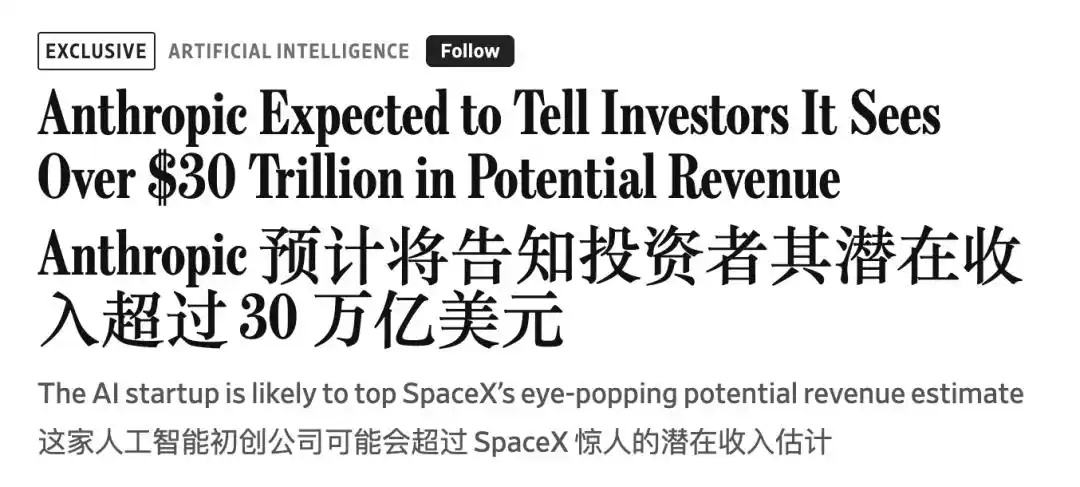
Anthropic secretly submitted its draft IPO filing to the SEC on June 1st, with a public version expected to be released as early as the end of this month.

The US annual GDP is about $32.4 trillion. In other words, a five-year-old company with fewer than 4,000 employees has painted its revenue ceiling as large as the entire United States.

Three months ago, Musk's SpaceX wrote $28.5 trillion in its prospectus, calling it "the largest addressable market in human history." That record hasn't even had time to cool before being trampled underfoot.
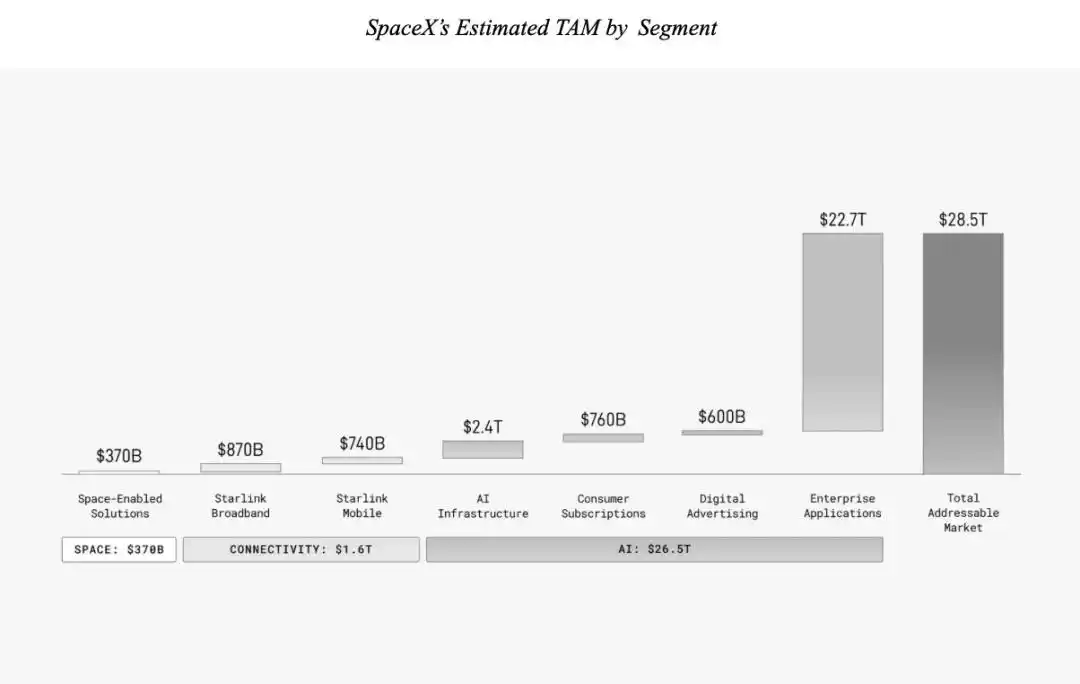
Anthropic added an extra $1.5 trillion to SpaceX's number.

It's like two people competing to see whose mouth is bigger. One says, "I can swallow the entire sun." The other says, "I can swallow the sun, plus Mars."

The Yardstick Called TAM is Broken

This number is called TAM — total addressable market. In plain English, it means: Assuming you achieve a 100% monopoly in this business, what's the maximum amount of money you could make in a year?

TAM is a standard item for tech IPOs and has always been the one with the least accountability.

Uber quoted $6 trillion in 2019, based on the mileage value of all private cars globally plus public transport services. WeWork quoted $3 trillion in its ultimately aborted IPO. Both numbers were ridiculed at the time.

In the AI era, this yardstick has been stretched to the breaking point.

Among the S&P 1500, 191 tech companies had combined revenues of $2.4 trillion last year. The market Anthropic painted is 12 times the sum of them all.

Aswath Damodaran, a finance professor at NYU nicknamed the "Dean of Valuation." Before SpaceX's IPO, he told The Wall Street Journal that SpaceX's AI-related TAM "was already at the edge of reasonable and then pushed past it."
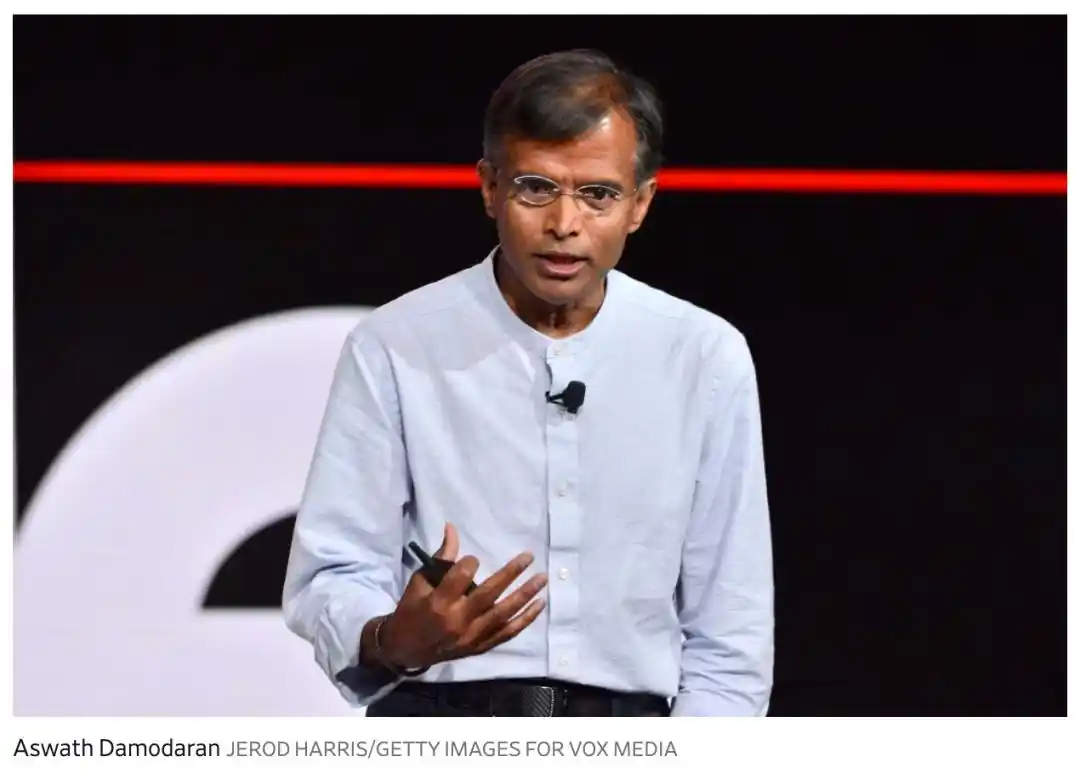
He said that looking at a figure of $28.5 trillion. If he saw $30 trillion, his glasses would probably shatter on the spot.

The tech media Gizmodo was even less polite: The dialogue between companies and investors has always been an art of making things look as good as possible. A number like $30 trillion basically dares someone to call your bluff.
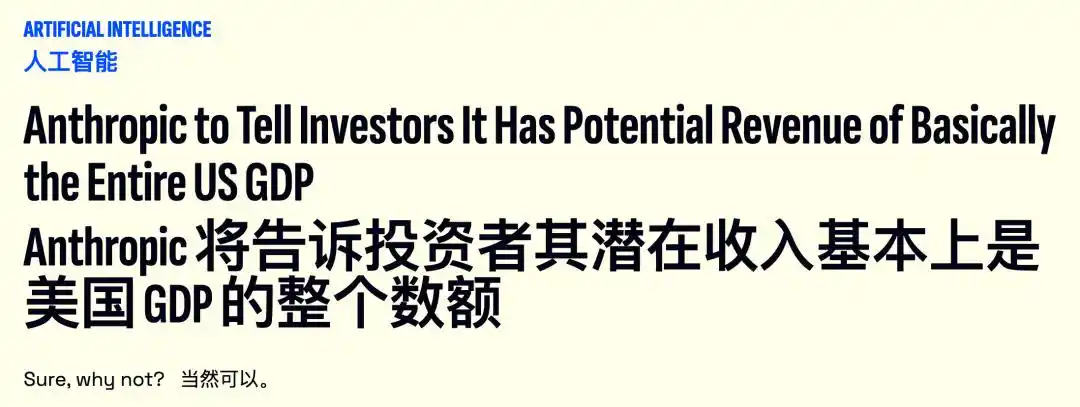
The question arises: How exactly was this number calculated?

The answer: Include all work that can be done by AI models.

Note, at this point, this is no longer about estimating the market size for a specific industry.

This is about putting a price tag on all the work humanity can outsource. Programming, writing, customer service, law, financial analysis, medical diagnosis... Everything done by humans, as long as AI could potentially take it over, is bundled together, priced, and presented to Wall Street.

Anthropic, please don't.

The number feels "unreal" because no one knows the speed at which AI will penetrate various industries, nor how much work it will ultimately take over.

Looking at Anthropic's current business, the gap becomes apparent.

In Q2 of this year, its revenue more than doubled to $11.6 billion, with an annualized run rate of about $47 billion. According to a Reuters report on August 15th, the company expects its 2028 revenue to be between $190 and $200 billion, and the IPO valuation is based on these projections.

Dividing the most optimistic $200 billion by $30 trillion equals 0.67%.

Thus, the story Anthropic is pitching to investors becomes: This market is so vast that even if I capture just six-thousandths of it, I can support a $2 trillion valuation.

This doesn't resemble a business plan; it's more like a math problem. See, as long as the denominator is big enough, I only need a tiny slice.

Anthropic's target valuation is $2 trillion, while its post-money valuation after raising $65 billion in May is $96.5 billion. From its last private round to the moment of the bell, capital is expected to more than double its worth in a few months.

SpaceX's stock price is a ready reference. It rose initially after listing, dropped below $105 in early August, and has now returned to around the $135 offering price.

A Person Worth $15.5 Billion

Begins Worrying Employees Are Too Focused on Money

A $2 trillion IPO would instantly turn many Anthropic employees into millionaires.

SpaceX has already demonstrated this once.

The scale at Anthropic will only be larger.

But just as everyone is salivating over this number, the company is using another number to screen candidates internally.

According to an Axios exclusive on August 24th, Anthropic now directly asks candidates in its cultural interview: If the company one day abandons its AI ambitions for safety reasons, and the stock price consequently drops to zero, how would you feel?

A candidate posted his honest answer on the anonymous workplace forum Blind: "I answered honestly with a 'no' — I wouldn't be happy if the stock went to $0. I want to do the most good, stay ethical, and also build a sustainable business."

According to this candidate, the interviewer didn't seem satisfied with that answer.
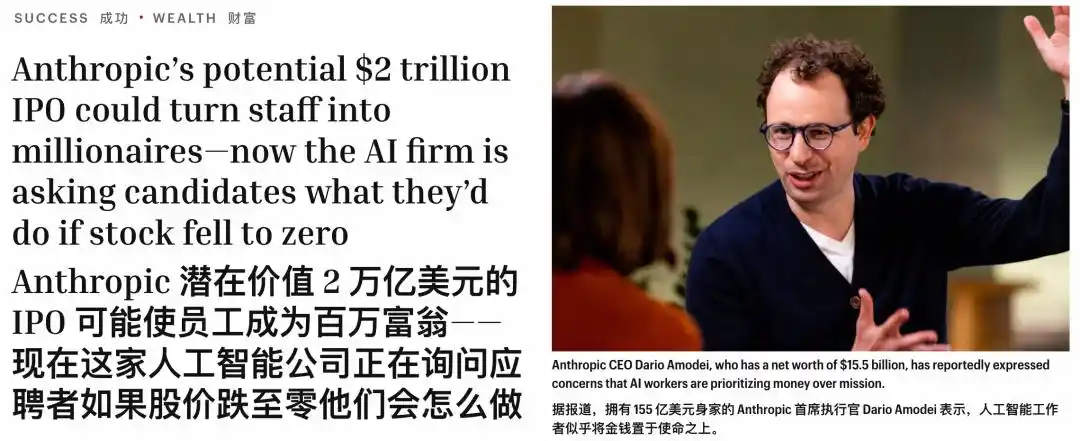
Anthropic offers base salaries between $320,000 and $405,000 for software engineer positions.

This is where the company's greatest contradiction lies.

Dario Amodei's personal net worth is approximately $15.5 billion — a number that doubled after the May funding round.

In January of this year, he published a 20,000-word essay titled "The Adolescence of Technology," which included a line: The real worry is a level of wealth concentration that could tear society apart. He also specifically criticized wealthy tech figures who view philanthropy as inherently a scam, saying, "It is sadly the case that many rich people... have recently adopted a cynical and nihilistic attitude."

He, along with the other six co-founders including his sister Daniela, pledged to donate 80% of their respective wealth. At current valuations, this sum exceeds $86 billion.

Simultaneously, he worries that new hires are joining not for the mission, but for the potential windfall.

Anthropic is a Public Benefit Corporation, and its charter stipulates it cannot operate solely to maximize shareholder profit.

The company's values statement reads: Ultimately, the mission is why we're all here.
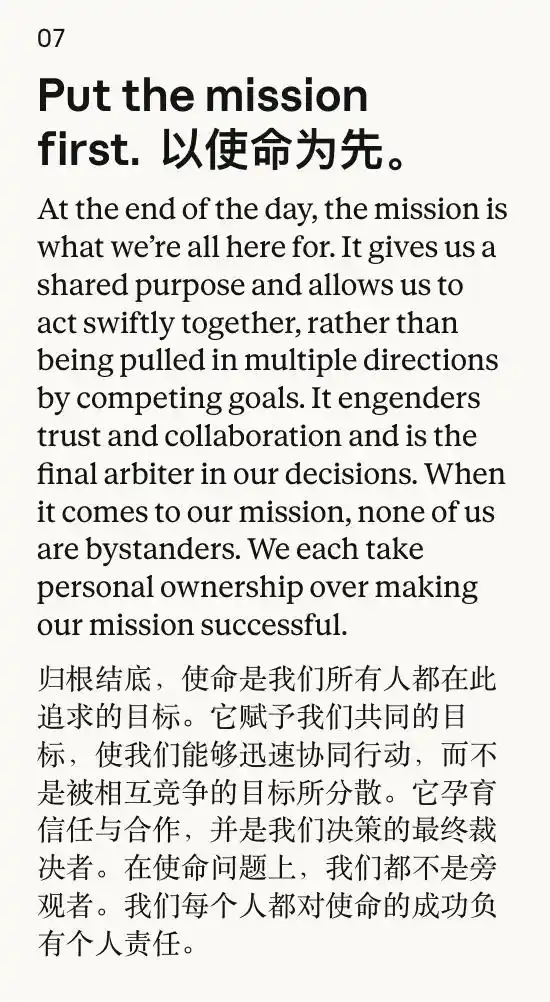
This statement was once just on the careers page, costing no one anything. Now, it is to be written into the prospectus, right next to $30 trillion.

After going public, it will face quarterly earnings calls, analysts questioning gross margins, and shareholders demanding returns.

A Public Benefit Corporation that declares its mission supersedes profit is leveraging the largest TAM in human history to drive one of the largest IPOs in human history.

There is a hint of irony.

A CEO, personal worth $15.5 billion, pledges to donate 80%, yet worries employees are only in it for the money. Then asks in interviews: Will you stay if the stock goes to zero?

This contradiction is the unique distortion of AI companies in this era —

On one side, it packages all work humanity can hand over to AI into a $30 trillion pie and presents it to Wall Street.

On the other side, it turns the very same IPO into an interview question for every potential hire: If all of this goes to zero, will you still stay?

References: https://www.wsj.com/tech/ai/anthropic-expected-to-tell-investors-it-sees-over-30-trillion-in-potential-revenue-a611efea

This article is from the WeChat public account "新智元" (New Wisdom Source), author: ASI启示录, editor: Solomon


Related Questions

QWhat is the TAM (Total Addressable Market) figure Anthropic plans to present in its IPO filing, and how does it compare to the US GDP?

AAnthropic plans to present a TAM of over $30 trillion. This figure is nearly equivalent to the entire US GDP, which is approximately $32.4 trillion.

QWhat recent precedent did Anthropic's reported $30 trillion TAM surpass, and by how much?

AAnthropic's reported $30 trillion TAM surpassed the precedent set by SpaceX, which cited a $28.5 trillion TAM in its own filing just three months earlier. Anthropic's figure is $1.5 trillion larger.

QAccording to the article, how does Anthropic's current revenue (annualized run rate) compare to its projected 2028 revenue and its claimed TAM?

AAnthropic's current annualized revenue run rate is about $47 billion. Its projected 2028 revenue is between $190-$200 billion. Even the optimistic $200 billion projection represents only about 0.67% of its claimed $30 trillion TAM.

QWhat specific cultural screening question is Anthropic reportedly asking job candidates, as mentioned in the article?

AAnthropic is reportedly asking candidates in cultural interviews: 'If the company one day abandons its AI ambitions for safety reasons, causing the stock price to fall to zero, how would you feel?'

QWhat is the central contradiction or irony highlighted by the article regarding Anthropic's IPO and its stated mission?

AThe central irony is that Anthropic, a Public Benefit Corporation (PBC) whose charter states it cannot prioritize shareholder profit maximization and claims its mission is paramount, is using the largest claimed TAM in history ($30 trillion) to potentially achieve one of the largest IPOs in history, creating immense personal wealth for its founders and employees.

Related Reads

a16z Deep Dive: Stop Chasing the 'AI Smell', Here's a Practical Guide to Writing with AI

"Don't Obsess Over AI Detection: A Practical Guide to Writing Alongside AI" by Steph Zinn (a16z Crypto) This guide moves beyond the flawed premise that AI-generated text can be easily spotted by a set of "tells" and that these features automatically mean poor quality. Instead, it focuses on how writers and founders can use LLMs effectively by understanding, controlling, and editing the common stylistic tendencies of AI-assisted prose. The article breaks down AI writing "tells" into four key dimensions: **1. Rhetorical Features (Insight-Shaped Writing):** AI often produces semantically empty, "corporate-sounding" filler language—vague profundities, hedging phrases, excessive parallelism, and summary statements. The advice is to ruthlessly edit these out, using prompts to make language more specific and direct. **2. Voice Features (The Alexa Voice):** Default AI writing relies on a narrow, fungible vocabulary of low-friction, abstract words and cliché phrases that lack personality. While this generic voice is acceptable for support docs or mass communications, founders should preserve their unique voice for impactful writing. Use LLMs to identify and replace jargon, aiming for concrete, distinctive word choices. **3. Structural Features (Form Without Function):** AI tends towards over-structured text with excessive subheadings, lists, roadmaps, and the rigid "three-point" framework. While clear structure is good for readability and SEO, it shouldn't force ideas into unnatural containers. Choose a structure that serves the format and purpose, borrowing from effective examples. **4. Punctuation Features (Dash Panic):** The overuse of em dashes and colons has become a hallmark, but writers shouldn't avoid useful punctuation just to seem "human." The key is avoiding repetitive, distracting patterns. Use punctuation that is grammatically correct and supports the flow of your argument. The core argument is that many so-called AI flaws are just amplified versions of existing bad writing habits. The goal isn't to eliminate AI's role but to use it as a tool while maintaining editorial control. The final question shouldn't be "Can this be detected as AI?" but "Does this writing effectively do its job?"

marsbit29m ago

a16z Deep Dive: Stop Chasing the 'AI Smell', Here's a Practical Guide to Writing with AI

marsbit29m ago

Podcast Notes | Conversation with Tom Lee: Bitmine Acquiring Nearly 5% of Total ETH Supply Is Not the End Goal, ETH Price Target Set at $10,000

In a podcast interview, Tom Lee, Chairman of BitMine Immersion Technologies, discusses the company's strategy to accumulate nearly 5% of the total Ethereum supply within 14 months, using equity financing and avoiding debt. BitMine has consistently purchased ETH for over 60 consecutive weeks, with recent weeks combining buybacks with purchases. The company's substantial ETH holdings generate approximately $300 million in annual staking rewards, covering operational costs like the dividends for its 9.5% perpetual preferred stock (BMNP). Lee positions ETH as a store-of-value asset, likening it to stocks or land, rather than a pure cash-flow instrument. Looking ahead, Lee suggests BitMine may continue buying beyond the 5% target if institutional adoption grows. He outlines a bullish price target for ETH: surpassing $5,000 in a new crypto bull cycle and potentially exceeding $10,000 within 1-2 years, driven by Wall Street tokenization and AI-related demand. The discussion also covers BitMine's evolution into an ecosystem player, funding Ethereum Foundation spin-offs and developing its Maven staking platform. Lee acknowledges his significant financial interests are tied to ETH's price and BitMine's performance. The interview provides a framework for evaluating ETH as a long-term asset, emphasizing staking yield sustainability and future institutional demand, while noting the uncertainties surrounding macro cycles and real-world adoption.

marsbit30m ago

Podcast Notes | Conversation with Tom Lee: Bitmine Acquiring Nearly 5% of Total ETH Supply Is Not the End Goal, ETH Price Target Set at $10,000

marsbit30m ago

Pricing Risk Assets in 8 Hours: Tonight's PCE to Set the Discount Rate, Nvidia to Test Earnings Tomorrow Morning

"Pricing Risk Assets in 8 Hours: PCE to Set the Discount Rate Tonight, NVIDIA to Test Profits Tomorrow Morning" Risk asset prices hinge on two variables: the numerator (earnings expectations) and the denominator (the discount rate). Both will be recalibrated within eight hours. First, at 20:30 Beijing time, the US Bureau of Economic Analysis releases July PCE inflation data and the second estimate of Q2 GDP. Consensus expects mild core PCE growth, but a surge in key PPI components poses an upside risk. A hotter-than-expected print could push Treasury yields and the dollar higher, threatening the recent rally in Bitcoin (BTC) above $80K, which was fueled by falling yields. A benign reading would support risk assets. Market sentiment is already "greedy" (Fear & Greed Index at 74), making it vulnerable to disappointment. Second, around 04:20, NVIDIA reports its Q2 FY27 earnings. While consensus revenue of ~$91.85B slightly exceeds company guidance, the market has priced in a beat. The key will be the magnitude of the beat and, crucially, the Q3 guidance. As a bellwether for tech and AI narratives, NVIDIA's results will significantly impact overall risk appetite and AI-related crypto tokens. The combination creates four scenarios: 1) Benign PCE & strong NVIDIA guidance confirms the bullish trend. 2) Hot PCE & strong NVIDIA leads to conflicted signals and likely volatility for BTC. 3) Benign PCE & weak NVIDIA guidance pressures tech but offers some macro support for BTC. 4) Hot PCE & weak NVIDIA guidance presents a "double whammy," risking a sharp pullback in BTC toward the $75K-$76K support zone. The outcomes will set the tone for markets ahead of the upcoming Jackson Hole symposium.

marsbit1h ago

Pricing Risk Assets in 8 Hours: Tonight's PCE to Set the Discount Rate, Nvidia to Test Earnings Tomorrow Morning

marsbit1h ago

Trading

Spot
活动图片