Indonesia lists 29 licensed crypto platforms as big exchanges explore market

cointelegraphPublished on 2025-12-22Last updated on 2025-12-22

Abstract

Indonesia's Financial Services Authority (OJK) has published a whitelist of 29 licensed cryptocurrency platforms, including major international players like Upbit, to help users identify legally authorized exchanges. The move comes as global firms such as Robinhood and OSL Group expand into Indonesia—one of the world’s fastest-growing crypto markets with over 17 million traders. The list follows stricter regulations (OJK Regulation No. 23/2025) that enhance oversight of digital assets, require prior approval for derivatives trading, and mandate investor knowledge tests. These measures aim to align with international standards and strengthen consumer protection in the rapidly expanding crypto economy.

Indonesia’s Financial Services Authority (OJK) has published a whitelist of 29 licensed crypto platforms, officially spelling out which exchanges are legally allowed to operate in the country.

The list, which includes names of entities and their apps or platforms, is meant to serve as an official reference for users to verify whether a provider is properly licensed before trading.

OJK has urged the public to transact only with entities on the list and to treat unlisted platforms as unlicensed operators.
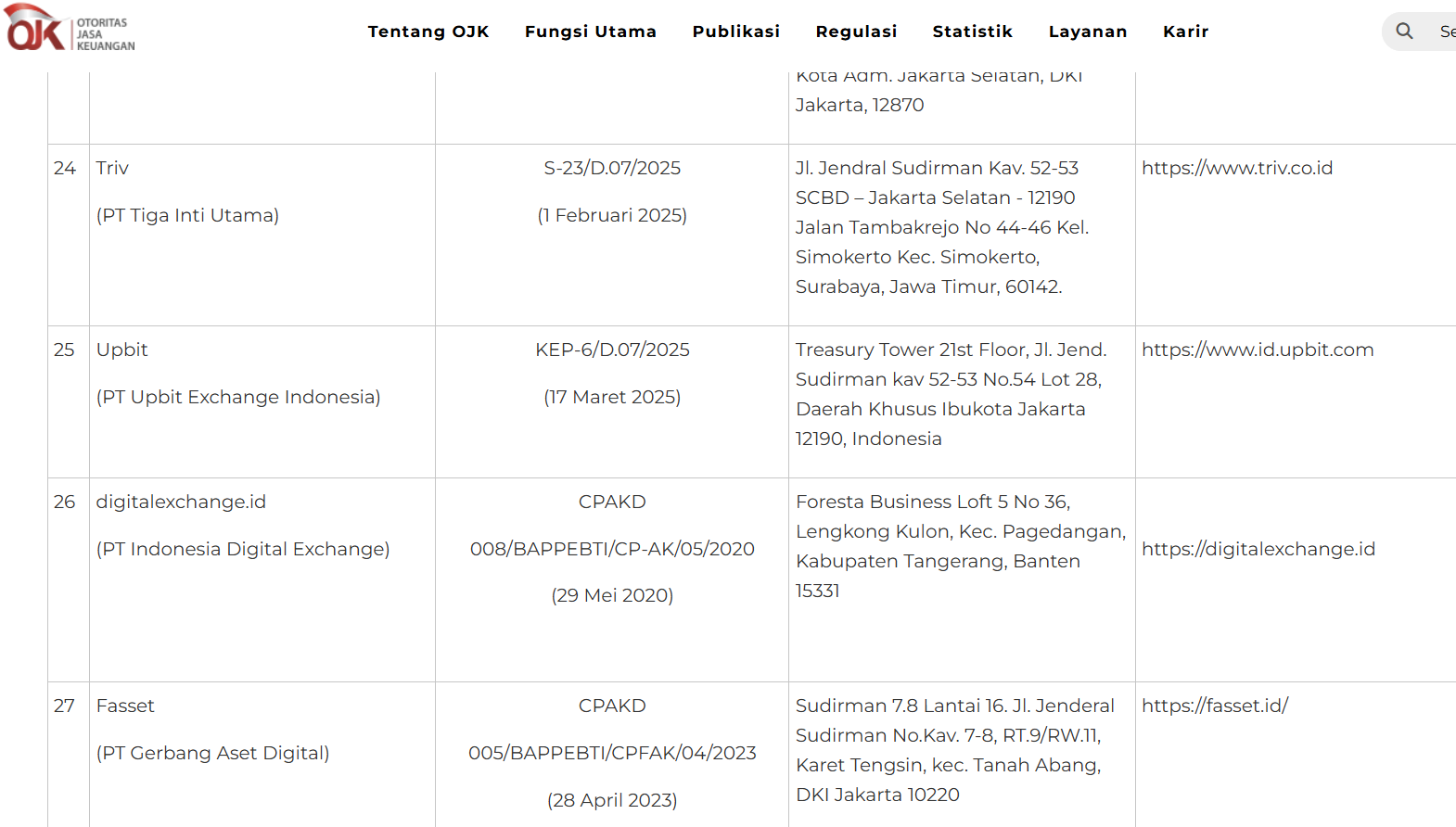
South Korea’s largest exchange, Upbit, is included among licensed exchanges. Source: OJK

​Global crypto players eyeing Indonesia

The clarification of who can legally offer crypto services lands as global players move to lock in Indonesian footholds.

Robinhood signed deals earlier this month to acquire Indonesian brokerage Buana Capital and licensed digital asset trader PT Pedagang Aset Kripto, a move that gives it entry to a market with more than 19 million capital‐market investors and about 17 million crypto traders.

Related: Indonesia’s digital rupiah CBDC to get ‘stablecoin’ companion backed by government bonds

Hong Kong–based OSL Group completed its acquisition of licensed local exchange Koinsayang in September, securing regulatory approval to offer spot and derivatives trading.

Related: Survey finds 6 in 10 of Asia’s rich plan to ramp up crypto buying

Tightening oversight of digital assets

The whitelist follows OJK Regulation No. 23/2025, which tightens oversight of digital financial assets, including crypto and related derivatives. The rule bars exchanges from facilitating trades in assets that are not registered or approved by a licensed digital asset exchange, and it introduces a framework for digital asset derivatives that requires prior OJK approval at the exchange level.

Platforms must implement margin mechanisms via segregated funds or digital assets, and consumers have to pass a knowledge test before accessing derivatives. These are measures the regulator said were designed to align with international supervisory standards and strengthen investor protection.

Related: Ripple’s big Singapore win: What the expanded license allows now

Among fastest-growing markets worldwide

Indonesia’s tightening grip on licensing comes as the country cements its place as a major crypto market. Robinhood and industry data providers describe Indonesia as one of Southeast Asia’s fastest‐growing crypto economies, with tens of millions of investors across capital markets and digital assets.

Chainalysis’ 2025 Global Crypto Adoption Index places Indonesia in the global top 10 for crypto adoption and notes that the country has been among the most dynamic markets worldwide, highlighting its growing presence in global digital asset activity.


Related Questions

QHow many licensed crypto platforms has Indonesia's Financial Services Authority (OJK) officially listed?

AIndonesia's Financial Services Authority (OJK) has published a whitelist of 29 licensed crypto platforms.

QWhat major South Korean exchange is included in Indonesia's list of licensed crypto platforms?

ASouth Korea's largest exchange, Upbit, is included among the licensed exchanges in Indonesia.

QWhich company recently acquired Indonesian brokerage Buana Capital and licensed digital asset trader PT Pedagang Aset Kripto?

ARobinhood signed deals to acquire Indonesian brokerage Buana Capital and licensed digital asset trader PT Pedagang Aset Kripto.

QWhat does OJK Regulation No. 23/2025 introduce for digital asset derivatives trading?

AOJK Regulation No. 23/2025 introduces a framework for digital asset derivatives that requires prior OJK approval at the exchange level and mandates that consumers pass a knowledge test before accessing derivatives.

QHow does Indonesia rank globally in terms of crypto adoption according to Chainalysis' 2025 index?

AAccording to Chainalysis' 2025 Global Crypto Adoption Index, Indonesia is placed in the global top 10 for crypto adoption.

Related Reads

From 'Old Dogs' to 'New Darlings': How AI is Revaluing Old Infrastructure, from Dell to Nokia

"Old Dogs" Become AI's New Darlings: Revaluing Legacy Infrastructure The AI investment narrative is shifting. Beyond the spotlight on core chipmakers like Nvidia, a new wave of interest is rising for legacy tech companies—Dell, HPE, Nokia, Cisco, Corning, Western Digital—once labeled as slow-growth, outdated stories. This resurgence stems from AI's evolution from model development to real-world deployment, creating massive demand for physical infrastructure. As AI moves into data center construction and enterprise adoption, the focus turns to who can actually build and deliver complex systems. These established players hold decades of experience in supply chains, integration, networking, and enterprise delivery—assets now critical for scaling AI. The revaluation can be grouped into three key infrastructure areas: 1. **Servers & Integration (e.g., Dell, HPE):** They are becoming essential system integrators, transforming GPUs into full-scale AI servers with networking, power, and cooling, then delivering them to clients. Strong recent earnings and AI-specific revenue/order growth for Dell and HPE underscore this shift. 2. **Networking & Connectivity (e.g., Corning, Nokia, Cisco):** As AI clusters grow, high-speed data transfer becomes paramount. Corning benefits from fiber demand for data center links, Nokia is exploring AI-integrated wireless networks (AI-RAN), and Cisco sees surging orders for data center switches—all critical for efficient AI operations. 3. **Storage (e.g., Western Digital, Seagate):** The AI data explosion requires vast capacity. Beyond high-speed memory (HBM), there's growing need for high-capacity HDDs to store training data, logs, video, and cold/archival data cost-effectively. This revaluation, however, is not a blanket endorsement. True reassessment requires concrete proof: AI-driven orders and revenue growth, upward revisions to company guidance, and sustainable improvements in profit quality, not just top-line sales. In essence, AI is not turning all old tech firms into high-growth stocks; it is selectively re-pricing the "old assets" of companies that are mission-critical for building the new AI infrastructure, transforming their legacy capabilities into renewed growth engines.

marsbit9m ago

From 'Old Dogs' to 'New Darlings': How AI is Revaluing Old Infrastructure, from Dell to Nokia

marsbit9m ago

Probability in the Price: How World Cup Odds Are Calculated

**The Probability in the Price: How World Cup Odds Are Calculated** Two major systems released their "championship probabilities" before the 2026 World Cup, and they disagreed on the favorite. Prediction market aggregators listed France at around **17%**, while the Opta supercomputer gave European champion Spain **16.1%**. These numbers look similar, but their production methods are fundamentally different. The market's **17%** is the **price** that clears after hundreds of millions of dollars in trading across platforms like Polymarket and Kalshi, where contracts trade between 0 and 100 cents, directly representing implied probability. This liquidity is provided by crypto-native market makers like Wintermute, though the market still has "the liquidity profile of an early-stage" asset class. In contrast, Opta's **16.1%** is a **simulated frequency**. Its model uses team data (including betting market odds as an input) to estimate match probabilities, then runs **10,000 full tournament simulations**, counting how often each team wins. Which is more accurate? There is **no rigorous, cross-tournament academic study** directly comparing their track records. However, a persistent **longshot bias**—where low-probability outcomes are systematically overvalued—observed in traditional betting for nearly a century, has also been found in modern crypto prediction markets. Research shows low-price contracts on Kalshi/Polymer less likely to pay out than their implied odds suggest. Unlike traditional bookmakers, prediction markets operate on **public blockchain ledgers**, making every transaction auditable and enabling such research. However, price formation is also influenced by **regulatory uncertainty**, as seen in recent US state-level bans and legal battles over jurisdiction. In summary, the "probability" you see is either a **market-clearing price** subject to behavioral biases and liquidity constraints, or a **model-simulated frequency** that partially incorporates market data. The question of which method is more reliable remains open, highlighting the importance of asking: **How was this number produced?**

marsbit38m ago

Probability in the Price: How World Cup Odds Are Calculated

marsbit38m ago

Trading

Spot
Futures
活动图片




