Indiana Advances Bitcoin Rights Law as U.S. States Deepen Crypto Integration

bitcoinistPublished on 2026-02-26Last updated on 2026-02-26

Abstract

Indiana lawmakers have passed House Bill 1042, known as the Bitcoin Rights Bill, which now awaits the governor's signature. If enacted, the law would allow state-managed investment funds—including retirement plans for public employees and education savings programs—to offer cryptocurrency ETFs as voluntary investment options. It also establishes legal protections for individuals using or holding digital assets, including the right to accept crypto payments and use self-custodied wallets, while prohibiting public agencies from restricting lawful crypto activities. The bill aligns with a broader trend of U.S. states integrating digital assets into public financial systems and is set to take effect in July 2026.

Indiana is moving closer to formally embedding crypto into its public financial system after lawmakers approved House Bill 1042, commonly referred to as the Bitcoin Rights Bill. The legislation has cleared both legislative chambers and now awaits the signature of Governor Mike Braun.

Related Reading: Binance Faces US Senate Inquiry Tied To $1.7 Billion In Sanctions-Related Transactions

If enacted, the law would allow certain public investment programs to provide exposure to crypto through regulated ETFs and establish legal protections for individuals who use or hold digital assets. The measure reflects a broader shift among U.S. states as they explore how crypto fits within traditional finance.
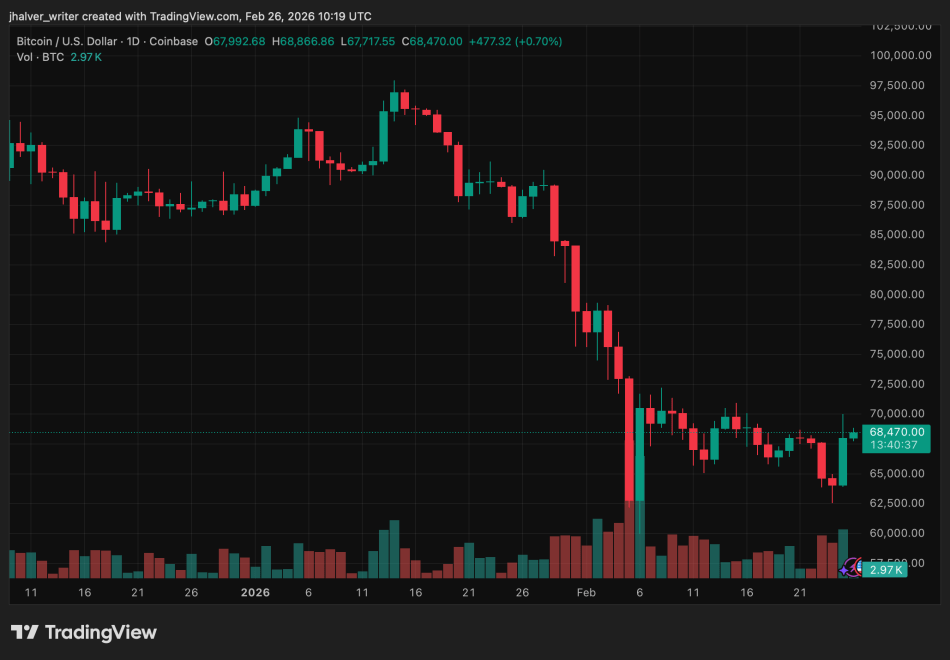
BTC's price trends to the downside with some sideways action on low timeframes as seen on the daily chart. Source: BTCUSD on Tradingview

Public Funds and Retirement Plans Open to Crypto ETFs

HB 1042 permits state-managed investment funds to include cryptocurrency ETFs as investment options rather than allowing direct token purchases. The approach aims to provide exposure through regulated financial products while maintaining oversight mechanisms.

Under the bill, several state-administered programs must offer self-directed brokerage accounts containing at least one digital asset investment option. These include retirement plans for teachers, public employees, and legislators, as well as the Hoosier START 529 education savings program.

Participation would remain voluntary, meaning individuals could choose whether to allocate funds toward crypto-related investments. Before rollout, the state must establish approved investment structures designed to manage compliance and risk oversight.

The legislation also allows eligible investment funds from outside Indiana to allocate assets into crypto ETFs under the state’s framework, potentially expanding institutional participation beyond state borders.

Legal Protections for Digital Asset Users

Beyond access to investment, the bill introduces protections for cryptocurrency users. Public agencies, with limited exceptions, would be restricted from banning or limiting lawful digital asset activities.

Residents would retain the right to accept crypto payments for legal goods and services and to store assets in self-custodied or hardware wallets. The proposal also prevents the state from imposing special taxes on crypto transactions and requires taxation rules to align with those applied to other financial activities.

Supporters argue that these provisions provide legal clarity for individuals and businesses operating in the digital asset space, while critics continue to highlight concerns about market volatility and retirement risk exposure.

Part of a Broader U.S. Policy Shift

Indiana’s move comes amid growing institutional interest in cryptos, following the expansion of crypto ETFs and evolving federal policy discussions on retirement portfolio diversification. Other states are considering similar measures, signaling a gradual shift toward incorporating digital assets into public finance structures.

HB 1042, introduced by State Representative Kyle Pierce, completed the legislative process after the House approved Senate amendments. If Governor Braun signs the bill, the law is scheduled to take effect on July 1, 2026, triggering implementation by state agencies and retirement administrators.

Related Reading: Netherlands To Amend Controversial 36% Tax On Unrealized Crypto, Stock Gains

As more states evaluate crypto-focused legislation, Indiana’s decision could serve as another trigger to the continued adoption of crypto in other states’ financial systems.

Cover image from ChatGPT, BTCUSD chart on Tradingview

Related Questions

QWhat is the main purpose of Indiana's House Bill 1042, also known as the Bitcoin Rights Bill?

AThe main purpose is to allow certain public investment programs to provide exposure to cryptocurrency through regulated ETFs and to establish legal protections for individuals who use or hold digital assets.

QWhich specific state-administered programs must offer a digital asset investment option under this bill?

AThe programs include retirement plans for teachers, public employees, and legislators, as well as the Hoosier START 529 education savings program.

QWhat are some of the key legal protections for cryptocurrency users provided by this legislation?

AThe bill prevents public agencies from banning lawful digital asset activities, allows residents to accept crypto payments and use self-custodied wallets, and prohibits special taxes on crypto transactions, requiring taxation to align with other financial activities.

QHow does the bill propose to provide crypto exposure to public funds without allowing direct token purchases?

AIt permits state-managed investment funds to include cryptocurrency ETFs as investment options, providing exposure through these regulated financial products.

QWhen is the Indiana Bitcoin Rights Bill scheduled to take effect if signed by the governor?

AThe law is scheduled to take effect on July 1, 2026, if signed by Governor Mike Braun.

Related Reads

Bitcoin Withdrawals Continue: 8 Years of Storage in a Coldcard Cold Wallet Ended in Zero

Coldcard Hardware Wallet Hacked: Losses Mount Due to Vulnerable Seed Generation A critical vulnerability in Coldcard hardware wallets has led to a continued wave of fund thefts. According to Galaxy Research, the total stolen has reached 1,367.05 BTC (approx. $88.6 million) from 4,585 addresses, a significant increase from the initial 594.5 BTC reported on July 30, 2026. Most of the stolen funds remain on the attackers' addresses. The issue is not with the current firmware, which Coinkite has updated, but with seed phrases generated on vulnerable devices between March 2021 and the release of fixed firmware versions. Due to a programmer error, devices switched from using a hardware random number generator to the software-based Yasmarang generator, which was initialized with publicly accessible data like the chip's serial number. This made the seed phrases predictable through offline brute-force attacks, meaning wallets remain at risk until funds are moved to a new wallet generated with the patched firmware. Affected devices include Mk2/Mk3 with firmware 4.0.1–4.1.9 (and up to 5.0.3), Mk4/Mk5 up to version 5.6.0, and Q models up to 1.5.0Q. The only exceptions are seeds created with a high-entropy method like at least 50 independent dice rolls or a strong unique BIP-39 passphrase. All other owners must generate a new seed on the fixed firmware and transfer their assets. A case highlighting the human impact involves a 39-year-old long-term investor who lost 2 BTC (approx. $130,000) in minutes. He had accumulated the Bitcoin over eight years through physical labor, viewing it as a financial lifeline and a retirement plan in a country suffering from hyperinflation. His story underscores that even conservative "buy and hold in cold storage" strategies can be compromised by such underlying technical flaws. From a technical perspective, this incident echoes historical failures where weak random number generators undermined cryptographic security, challenging the assumption that offline storage is automatically foolproof.

cryptonews.ru1h ago

Bitcoin Withdrawals Continue: 8 Years of Storage in a Coldcard Cold Wallet Ended in Zero

cryptonews.ru1h ago

Trading

Spot
活动图片





