Hyperliquid's Monthly Trading Volume of $225 Billion: How Will HIP-4 Ignite the Prediction Market?

marsbitPublished on 2026-02-05Last updated on 2026-02-05

Abstract

Hyperliquid processed over $225 billion in monthly trading volume in January 2026, while the entire prediction market sector handled around $23 billion. The introduction of HIP-4 aims to integrate outcome contracts—binary event-based derivatives—into the same margin framework as perpetual futures, enabling shared collateral and unified risk management. This integration allows traders to manage event exposure alongside perpetual positions within a single portfolio, improving capital efficiency and enabling sophisticated strategies like hedging and volatility trading. As a result, prediction markets could see significant volume growth: conservative estimates project $28 billion in monthly trading, with medium and strong adoption scenarios reaching $33 billion and over $40 billion, respectively. By merging event-driven contracts with core derivatives infrastructure, HIP-4 transforms prediction markets from isolated betting platforms into integral components of broader crypto trading strategies, potentially unlocking billions in new activity.

Author: Predictefy

Compiled by: Deep Tide TechFlow

Deep Tide Guide: In January 2026, prediction markets processed over $23 billion in nominal trading volume. In the same month, Hyperliquid alone processed over $225 billion. Outcome trading could bring tens of billions of dollars in new trading volume to prediction markets.

Predictefy analysis indicates that the key to HIP-4 lies in integrating outcome contracts into the same margin framework as perpetual futures, bringing event trading into the same environment as other crypto derivatives.

This could bring tens of billions of dollars in new trading volume and open interest to prediction markets in a short period. Conservative estimates suggest partial adoption could reach $28 billion in monthly trading volume, moderate adoption $33 billion, and strong integration over $40 billion.

Full text below:

Prediction markets processed over $23 billion in nominal trading volume in January 2026. Hyperliquid alone processed over $225 billion in the same month. Outcome trading could bring tens of billions of dollars in new trading volume to prediction markets.

Prediction markets are growing rapidly, but they primarily operate in isolation. You can trade event outcomes, but these positions are not within the same systems traders use to manage broader market risks.

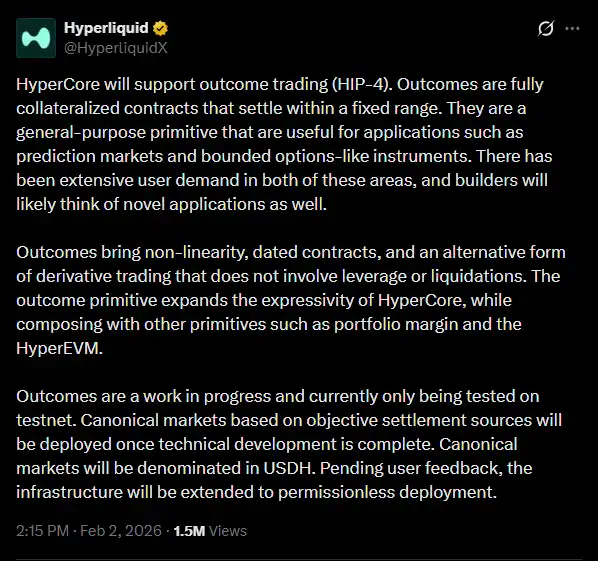
HIP-4 changes this. On Hyperliquid, outcome contracts share the same margin framework with perpetual futures, bringing event trading into the same environment as other crypto derivatives.

This could bring tens of billions of dollars in new trading volume and open interest to prediction markets in a short time. Here’s how it works.
Prediction Markets Are Already Substantial

Over the past year, prediction markets have moved beyond niche activity.

  • Weekly trading volume on major platforms has repeatedly exceeded $6 billion
  • A recent month recorded approximately $23.8 billion in nominal trading volume
  • Market share remains concentrated, with platforms like Polymarket, Opinion, and Kalshi dominating most activity

Despite this growth, prediction markets still primarily function as standalone venues. Event exposure, directional crypto exposure, and volatility exposure typically require separate platforms, collateral pools, and risk systems. This fragmentation limits capital efficiency and constrains the types of strategies traders can implement.

Outcome Contracts Bring Risk into Core Infrastructure

Outcome contracts introduced via HIP-4 have several defining characteristics:

  • Positions are fully collateralized
  • Settlement occurs within a fixed and bounded payment range
  • No liquidation mechanism
  • Contracts are event-based or time-based
  • Positions are integrated into the same margin framework as perpetual futures

Binary contracts themselves are not new. The structural change lies in their integration into a unified derivatives engine. Event exposure can now share collateral with perpetual positions, allowing risk to be managed at the portfolio level rather than the individual market level.

Improvements in Capital Efficiency

Previously, implementing event-driven strategies typically required traders to:

  • Deposit collateral on a prediction market platform
  • Deposit separate collateral on a perpetual futures venue for hedging
  • Manage risk and margin independently across venues

This setup increased capital requirements and operational complexity.

With outcome contracts in a shared trading environment, event exposure and directional hedging can be managed together. Portfolio margin systems can recognize offsetting risks, reducing total margin usage. This aligns event trading with established derivatives risk management practices.

Current Market Size and Trading Volume Growth Potential

Prediction markets processed approximately $20-25 billion in monthly trading volume in January 2026 under today's isolated structure, with event trading located outside the broader derivatives stack.

In contrast, Hyperliquid recorded over $225 billion in perpetual futures volume in the same month, with daily perpetual trading volumes reaching the multi-billion dollar range. The pool of derivatives liquidity is already much deeper than standalone prediction market activity.

If HIP-4 improves capital efficiency and makes event positions easier to hedge within the same system, trading activity could expand through structural churn—more strategies running on the same capital.

Conservative scenario suggests:

  • Partial adoption → $28 billion monthly prediction market trading volume
  • Moderate adoption → $33 billion
  • Strong integration → Over $40 billion

These estimates reflect strategy integration, not hype cycles, and do not include the ongoing monthly growth already seen in prediction market volume, which could push total volumes even higher.

Prediction Markets Begin to Resemble Options Infrastructure

Outcome contracts introduce:

  • Non-linear payouts
  • Event-driven settlement
  • Bounded risk profiles

These characteristics overlap with options-like exposure. This creates a foundation for:

  • Event volatility strategies
  • Structured products incorporating outcome positions
  • Systematic portfolios combining event and market risks
  • Protocols building new products on top of outcome primitives

Prediction markets shift from being primarily narrative-driven to becoming available components in broader financial strategies.

Competitive Landscape

Standalone prediction market platforms retain advantages in brand recognition, liquidity depth, and simplicity. However, platforms integrating event risk with perpetual contracts and other derivatives offer:

  • Shared collateral pools
  • Instant hedging within the same environment
  • Portfolio-level risk netting

Even partial migration of more advanced trading flows could affect where capital-efficient and hedge-intensive activities concentrate.

Signals of Adoption

Structural adoption will be reflected in trading behavior, not just headline volume:

  • Pairing of outcome positions with perpetual hedges
  • Growth in open interest around macro and policy events
  • Emergence of vaults or structured strategies built on outcome exposure
  • Narrowing spreads relative to standalone prediction market venues

These signals indicate outcomes are being used as financial instruments, not isolated event trades.

Conclusion

Prediction markets have achieved scale but have until now been structurally separated from the broader derivatives stack.

HIP-4 introduces a framework where event risk can coexist with perpetual futures within shared trading infrastructure. As this model evolves, prediction markets may increasingly function as components of diversified risk portfolios, rather than standalone betting venues.


Related Questions

QWhat is the key innovation of HIP-4 on Hyperliquid, and how does it impact prediction markets?

AHIP-4 introduces outcome contracts integrated into the same margin framework as perpetual futures, allowing event trading to occur within the same environment as other crypto derivatives. This integration enhances capital efficiency and enables portfolio-level risk management, potentially bringing billions in new trading volume to prediction markets.

QHow does the trading volume of prediction markets compare to Hyperliquid's perpetual futures volume in January 2026?

AIn January 2026, prediction markets processed over $23 billion in nominal trading volume, while Hyperliquid alone handled over $225 billion in perpetual futures volume during the same month.

QWhat are the potential trading volume scenarios for prediction markets with the adoption of HIP-4?

AConservative adoption could reach $28 billion monthly trading volume, medium adoption $33 billion, and strong integration could exceed $40 billion, reflecting strategic integration rather than hype cycles.

QHow do outcome contracts on Hyperliquid improve capital efficiency for traders?

AOutcome contracts allow event exposure and directional hedges to be managed together within a shared trading environment. The portfolio margin system recognizes offsetting risks, reducing total margin usage and aligning event trading with established derivatives risk management practices.

QWhat competitive advantages do platforms with integrated event risk and perpetual contracts offer compared to standalone prediction markets?

AThey provide shared collateral pools, instant hedging within the same environment, and portfolio-level risk netting, which may attract capital-efficient and hedge-intensive activities even if standalone platforms retain advantages in brand recognition and simplicity.

Related Reads

This Week's Key Events Preview | U.S. to Release April CPI Data; U.S. Senate Banking Committee to Review "Digital Asset Market Structure Act of 2025"

Weekly News Preview: Key events for May 12-16 include major economic and crypto industry developments. On Tuesday, May 12, the U.S. will release its April CPI data. Additionally, the gaming blockchain Ronin will begin a 10-hour migration to an Ethereum Layer 2, built on OP Stack with EigenDA for data availability. This aims to leverage Ethereum's security and settle RON's annual inflation below 1%. Base's first independent network upgrade, "Base Azul," is scheduled for mainnet activation on Wednesday, May 13, focusing on security, performance, and developer experience enhancements. Thursday, May 14, sees the U.S. Senate Banking Committee voting on the "Digital Asset Market Structure Act of 2025." In other news, Solana DeFi protocol Carrot will shut down, setting a final withdrawal deadline due to impacts from the Drift exploit. The Moscow Exchange will launch futures trading for Solana, Ripple, and Tron indices (RUB-settled) for qualified investors. Multiple service closures are scheduled for Friday, May 15. Dmail Network will begin winding down due to unsustainable infrastructure costs and failed commercialization. Users must export data before this date. Separately, the Cosmos-based lending blockchain UX Chain will fully shut down. Finally, on Saturday, May 16, gaming infrastructure provider Lattice will wind down operations, with its Redstone Layer 2 network ceasing. Users are urged to withdraw assets, especially from contracts like Uniswap pools, before the shutdown.

链捕手53m ago

This Week's Key Events Preview | U.S. to Release April CPI Data; U.S. Senate Banking Committee to Review "Digital Asset Market Structure Act of 2025"

链捕手53m ago

Morning Post | Trump Media Group Releases Q1 Financial Report; Top Three DeFi Applications Return Nearly $100 Million in Revenue to Token Holders in 30 Days; Michael Saylor Shares Bitcoin Tracker Info Again

**Title: Daily Briefing | Trump Media Group Releases Q1 Report; Top 3 DeFi Apps Return Nearly $100M to Token Holders; Michael Saylor Signals Potential Bitcoin Buy** **Summary:** Key developments in the past 24 hours include: * **Economic Outlook:** Goldman Sachs has pushed back its forecast for the next two Federal Reserve interest rate cuts to December 2026 and March 2027, citing persistent inflationary pressures from energy costs. This delayed timeline is expected to tighten liquidity flow into risk assets, including cryptocurrencies. * **DeFi & Revenue:** Data from DefiLlama shows that three leading DeFi applications—Hyperliquid, Pump.fun, and EdgeX—collectively distributed $96.3 million in revenue to their token holders over the last 30 days. This trend highlights a shift in the crypto community's focus towards real protocol earnings and sustainable economic models. * **Corporate Bitcoin Moves:** Michael Saylor, founder of MicroStrategy (note: referred to as 'Strategy' in the text, likely a typographical error), has signaled potential upcoming Bitcoin purchases by posting a "Bitcoin Tracker" update, following a pattern that typically precedes the company's official disclosure of new acquisitions. * **Market Integrity:** Prediction market platform Polymarket announced updates to address platform issues, including identifying and banning clusters of accounts involved in "ghost-fill" activities and implementing measures to prevent bulk account creation. * **Regulation:** The Bank of England Governor warned that stablecoin regulation could lead to tensions between US and international regulators. In South Korea, the National Tax Service has launched a pilot program to entrust seized virtual assets to private custody firms for management. * **Meme Token Trends:** GMGN data lists the top trending meme tokens on Ethereum (e.g., HEX, SHIB), Solana (e.g., FWOG, TROLL), and Base (e.g., SKITTEN, PEPE) over the past day. **Financial Note:** Trump Media & Technology Group reported a Q1 loss of approximately $4 billion, primarily attributed to unrealized losses on its Bitcoin and other digital asset holdings.

链捕手1h ago

Morning Post | Trump Media Group Releases Q1 Financial Report; Top Three DeFi Applications Return Nearly $100 Million in Revenue to Token Holders in 30 Days; Michael Saylor Shares Bitcoin Tracker Info Again

链捕手1h ago

Telegram Takes Direct Control of TON, Social Traffic Rewrites the Public Chain Narrative

Telegram founder Pavel Durov announced that Telegram will replace the TON Foundation as the core driver and largest validator of The Open Network (TON). Key initiatives include a sixfold reduction in transaction fees, performance upgrades, and improved developer tools within the next few weeks. This marks a strategic shift from Telegram merely providing user access to deeply integrating TON into its platform's core infrastructure. The goal is to transform Telegram's massive social traffic into sustainable on-chain activity. While viral mini-apps like Notcoin have demonstrated Telegram's ability to drive user adoption, TON aims to support frequent, low-value transactions inherent to social platforms—such as tipping, in-app payments, and game rewards. Ultra-low fees and sub-second finality (0.6 seconds) are crucial to making blockchain interactions seamless and nearly invisible within the Telegram user experience. However, Telegram's increased central role raises questions about network decentralization. Durov argues that Telegram's participation will attract more large validators, thereby enhancing decentralization. TON also offers high annual staking rewards (18.8%), aiming to retain capital within its ecosystem. The fundamental challenge for TON is no longer leveraging Telegram's user base, but becoming an indispensable, seamless infrastructure layer for Telegram's everyday applications—moving from an adjacent chain to an embedded utility.

marsbit1h ago

Telegram Takes Direct Control of TON, Social Traffic Rewrites the Public Chain Narrative

marsbit1h ago

Trading

Spot
Futures

Hot Articles

How to Buy 4

Welcome to HTX.com! We've made purchasing 4 (4) simple and convenient. Follow our step-by-step guide to embark on your crypto journey.Step 1: Create Your HTX AccountUse your email or phone number to sign up for a free account on HTX. Experience a hassle-free registration journey and unlock all features.Get My AccountStep 2: Go to Buy Crypto and Choose Your Payment MethodCredit/Debit Card: Use your Visa or Mastercard to buy 4 (4) instantly.Balance: Use funds from your HTX account balance to trade seamlessly.Third Parties: We've added popular payment methods such as Google Pay and Apple Pay to enhance convenience.P2P: Trade directly with other users on HTX.Over-the-Counter (OTC): We offer tailor-made services and competitive exchange rates for traders.Step 3: Store Your 4 (4)After purchasing your 4 (4), store it in your HTX account. Alternatively, you can send it elsewhere via blockchain transfer or use it to trade other cryptocurrencies.Step 4: Trade 4 (4)Easily trade 4 (4) on HTX's spot market. Simply access your account, select your trading pair, execute your trades, and monitor in real-time. We offer a user-friendly experience for both beginners and seasoned traders.

3.9k Total ViewsPublished 2025.10.20Updated 2025.10.29

How to Buy 4

Discussions

Welcome to the HTX Community. Here, you can stay informed about the latest platform developments and gain access to professional market insights. Users' opinions on the price of 4 (4) are presented below.

活动图片