HyperEVM Ecosystem Heats Up: Memes Pause, Next Robinhood?

marsbitPublished on 2026-08-26Last updated on 2026-08-26

Abstract

The HyperEVM ecosystem is experiencing a surge in activity, shifting from its role as infrastructure for Hype to a high-volatility trading arena. This shift is driven by HYPE reaching a new all-time high and a rapid memecoin rotation, causing network gas fees to spike above those on Ethereum Mainnet. Key drivers include HYPE's price performance, rising over 35% in a week following public endorsement. The memecoin sector saw explosive growth, with EGG achieving a 14,000%+ 24-hour surge and CHAMELEON capitalizing on founder narrative, though both have since retraced significantly. The ecosystem's infrastructure is developing rapidly. Motion.meme serves as a launchpad for new tokens, akin to Pump.fun. Kinetiq (KNTQ) is a leading liquid staking protocol, with its tokenomics bolstered by revenue from its new HIP-3 perp exchange launchpad. HyperLend (HPL) has emerged as a major lending market with high TVL, and Project X is the dominant DEX by trading volume. In conclusion, the current heat is primarily a revaluation driven by HYPE's price. For a sustained "HyperEVM Season," key challenges include user retention post-meme frenzy, the ability of utility projects to generate real revenue, and critically, the prohibitively high gas fees (often $10-20 per transaction) which threaten to cap the ecosystem's growth and mainstream adoption.

Over the past few days, HyperEVM abruptly transitioned from being infrastructure dedicated to Hype into a "high-volatility trading ground"—amid HYPE hitting new all-time highs and a rapid meme rotation, the on-chain Gas on HyperEVM once surged to over ten dollars per transaction, far exceeding that of the Ethereum mainnet!

The underlying driver of this market movement stems primarily from HYPE's strong performance following Trump's endorsement. HYPE is currently priced around $79.65, up 35.4% over 7 days and 38.7% over 30 days, reaching a new all-time high of $83.27 yesterday.

Roundup of Popular Memes and Projects on HyperEVM
Meme: EGG and CHAMELEON Ignite Sentiment

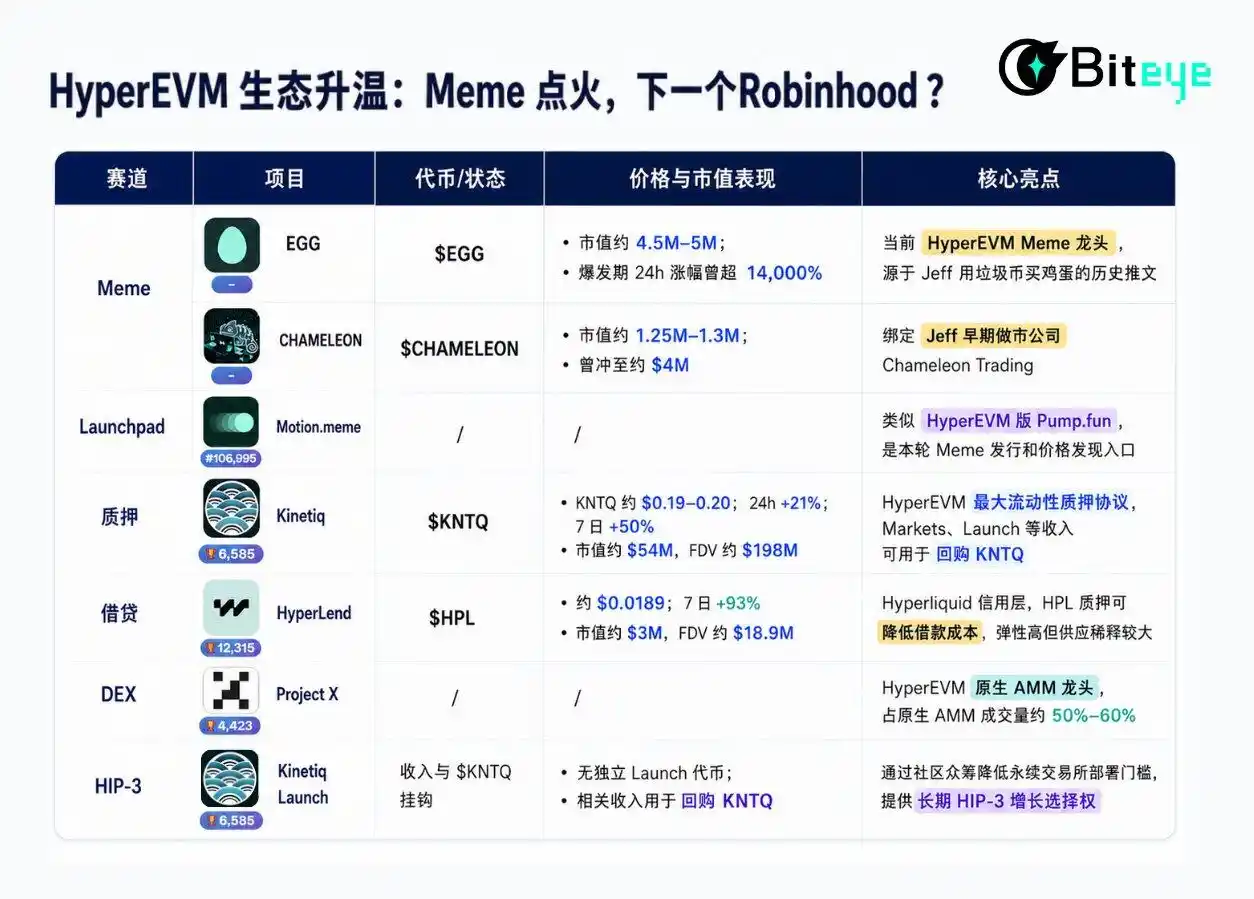
EGG: The Current Sentiment Leader on the Hype Chain

EGG originates from an early tweet by Jeff Yan: "Just buy eggs with your shitcoins."

The community packaged it into a native HyperEVM meme, creating mini-games and the interactive website eggonhype.com.

Contract: 0xb75d5ee14708e7efbea939311090061d72265608

Summary: During its explosive phase, EGG saw a 24h increase of over 14,000%, with its market cap once reaching approximately $8M–9M, but it has since experienced a significant pullback.

CHAMELEON: Narratives from Jeff's Early Entrepreneurial History

CHAMELEON is tied to Jeff's real entrepreneurial history. Before Hyperliquid existed, Jeff operated Chameleon Trading, and his X account handle remains @chameleon_jeff to this day.

Contract: 0xddfed493a114d610C5709FEFd22BAEF40DC23428

Summary: CHAMELEON's market cap once surged to around $4M but has since retraced by approximately 65%–70%.

Launchpad: Motion

Motion.meme is akin to the HyperEVM version of Pump.fun. Projects first undergo price discovery via a Bonding Curve before moving to the HyperSwap V3 pool for trading.

Its fee mechanism is as follows:

· Token Launch Fee: 0.05 HYPE;

· Bonding Phase: Approximately 0.5% platform fee;

· HyperSwap Pool Fee: Approximately 0.01%;

Summary: Motion plays the "pickaxe seller" role in this round of the meme rally. If the HyperEVM Meme Season's momentum proves sustainable, Motion will significantly benefit.

Staking: Kinetiq (KNTQ)

Kinetiq is the largest liquid staking protocol on HyperEVM. Users stake HYPE to receive kHYPE, gaining staking rewards while also being able to use kHYPE for lending and providing liquidity.

KNTQ's advantage lies in its relatively clear value capture: Revenue from Markets, Launch, and part of the validator income is used to buy back KNTQ and distribute it to sKNTQ stakers.

Summary: Overall, Kinetiq appears to be the most fundamentally sound utility project in this round of HyperEVM activity.

HIP-3: Kinetiq Launch

Kinetiq Launch is a launchpad for HIP-3 perpetual trading platforms.

Deploying a HIP-3 trading platform requires staking over 500,000 HYPE, which at current prices is nearly $40M. Kinetiq Launch allows the community to crowdfund this capital and uses independent exLST tokens to isolate risks between different trading platforms.

Summary: Launch revenue earned by Kinetiq is used to repurchase KNTQ, adding the new narrative of "HIP-3 Trading Platform Incubator" to KNTQ.

Lending: HyperLend (HPL)

HyperLend is the primary lending market on HyperEVM, supporting the collateralization of assets like HYPE and kHYPE, and is positioned as the credit layer for Hyperliquid.

· TVL: Approximately $570M

· Borrowing Volume: Approximately $308M

Summary: HPL can be staked as sHPL to reduce borrowing costs, with a potential rebate cap of up to 80%. The market is bullish on it due to its "low market cap, high TVL" profile.

DEX: Project X

Project X is a concentrated liquidity AMM with leading transaction volume on HyperEVM.

· TVL: Approximately $45.8M

· 24h Volume: Approximately $152M

Summary: Among HyperEVM's native AMMs, Project X accounts for approximately 50%–60% of the trading volume share.

Conclusion:

Currently, the HyperEVM hype seems more like an ecosystem revaluation driven by HYPE's new highs. Whether this can evolve into a genuine HyperEVM Season requires further observation: the retention rate of users attracted by meme fever, and whether a series of utility projects can convert into real users and actual revenue.

Moreover, every time HyperEVM activity increases and on-chain transactions become active, the Gas fees spike noticeably. During peak periods, the cost per transaction can easily reach 10–20 U. While this increases the demand for HYPE Gas and its burn, it also caps the potential ceiling for meme trading and the long-term prosperity of the HyperEVM ecosystem.


Related Questions

QWhat are the main factors driving the recent surge in activity on HyperEVM according to the article?

AThe primary drivers are the strong performance of the HYPE token following an endorsement from Trump and a fast-paced meme coin rotation. HYPE reached a new all-time high of $83.27, with 7-day and 30-day gains of 35.4% and 38.7% respectively. This led to a 'high volatility trading field' with on-chain gas fees spiking above those on the Ethereum mainnet.

QWhich two meme coins on HyperEVM are highlighted as the major emotional drivers, and what are their respective narratives?

AThe two highlighted meme coins are EGG and CHAMELEON. EGG's narrative originates from a past tweet by Jeff Yan, 'Just buy eggs with your shitcoins.' CHAMELEON is tied to Jeff Yan's real entrepreneurial history, named after his former company, Chameleon Trading, which existed before Hyperliquid.

QWhat is the role of the Motion.meme platform in the HyperEVM ecosystem?

AMotion.meme serves as a launchpad similar to Pump.fun on HyperEVM. It functions as the 'shovel seller' for the meme coin season. Projects first go through a Bonding Curve for price discovery and are then listed for trading in HyperSwap V3 pools, with the platform charging fees at each stage.

QAccording to the article, what is Kinetiq (KNTQ) and what makes it a key 'utility-type project' on HyperEVM?

AKinetiq is the largest liquid staking protocol on HyperEVM. Users stake HYPE to receive kHYPE, which can be used for additional yield, borrowing, and providing liquidity. Its value capture is clear: revenue from Markets, Launch, and some validator income is used to buy back KNTQ tokens and distribute them to sKNTQ stakers.

QWhat is identified as a significant challenge that could limit the long-term growth of the HyperEVM ecosystem?

AA major challenge is the high on-chain transaction (gas) costs. During peak activity, the cost per transaction can reach $10–20 USD. While this increases demand for and burn of HYPE tokens, it limits the potential for meme trading volume and the overall long-term prosperity of the HyperEVM ecosystem.

Related Reads

Japanese Interest Rates Return to 1996 Levels: Can Bitcoin's 'Decoupling Narrative' Withstand the September Rate Hike?

Japan's borrowing costs have hit their highest level since 1996, with 30-year and 10-year government bond yields rising significantly. This marks a major shift for a country long reliant on negative rates. Meanwhile, Bitcoin surged 22% in a week, topping $80,000. The core question is whether crypto's apparent decoupling from traditional market turbulence can withstand potential interest rate hikes by the Bank of Japan (BOJ) in September. For years, the yen carry trade—borrowing cheap yen to invest in higher-yielding assets—has fueled global risk assets. This leverage, estimated at up to $500 billion, relies on near-zero Japanese rates. The BOJ raised its policy rate to 1.0% in June, a 31-year high, with a further hike expected in September. A rapid yen appreciation could quickly wipe out carry trade profits and trigger deleveraging, as seen in August 2024 when Bitcoin and Japanese stocks fell sharply. Currently, however, the yen is weakening, which could temporarily support the carry trade and risk assets. Japan faces a debt dilemma. Its national debt has soared to a record ¥1,346 trillion. Raising rates could stabilize the yen but drastically increase debt servicing costs. The BOJ has signaled a slower pace of policy normalization to ensure market stability. Japan's large-scale selling of US Treasuries to fund currency intervention has also contributed to rising global yields. Bitcoin's recent resilience challenges traditional risk-asset logic. A pessimistic view holds that significant BOJ tightening and a stronger yen would force global deleveraging, pulling Bitcoin down. Higher yields also make interest-bearing assets relatively more attractive than Bitcoin. An optimistic scenario suggests that continued yen weakness could make Bitcoin an appealing hedge for Japanese investors. Japanese institutional interest is growing, with regulatory progress potentially paving the way for spot crypto ETFs by 2027. The key event is the BOJ's September 17-18 meeting. Market focus will be less on the expected rate hike to 1.25% and more on the future policy guidance. A hawkish signal aiming for higher rates could strengthen the yen and unwind carry trades. A dovish stance, constrained by debt concerns, could further weaken the yen, potentially benefiting Bitcoin via a weaker dollar and local demand. The current market prices in a slow evolution of Japan's debt issues. While Bitcoin may be trading on yen weakness and institutional adoption, the 30-year yield near 4% is a significant risk signal. The correlation between the yen's direction and Bitcoin remains crucial and could reverse swiftly if the BOJ alters market expectations in September.

marsbit2m ago

Japanese Interest Rates Return to 1996 Levels: Can Bitcoin's 'Decoupling Narrative' Withstand the September Rate Hike?

marsbit2m ago

Trading

Spot
活动图片