Hyperbeat: Launching a 'Bank' on Hyperliquid

marsbitPublished on 2026-04-09Last updated on 2026-04-09

Abstract

Hyperbeat, a protocol built on Hyperliquid, has launched "Liquid Banking," a self-custodial banking solution deployed on HyperEVM. It integrates stablecoin deposits, VISA card spending, perpetual trading, and multi-currency fiat on/off ramps into a single on-chain smart wallet. The core feature is "Credit Mode," powered by Morpho's lending engine. Users deposit assets like BTC or ETH as collateral. When spending with the VISA card, the system instantly borrows stablecoins via Morpho to complete payments, while the collateral remains on-chain earning yield. There is no grace period—interest accrues immediately upon spending. Hyperbeat uses its native stablecoin, beatUSD, issued in partnership with Paxos. Deposit yields come from real borrowing interest generated by consumer spending. Fiat services are provided by Noah, supporting multiple currencies, and the VISA card is issued by Third National via infrastructure from Rain. As a self-custodial system, user assets stay in their smart wallet. To prevent fraud, withdrawals require a cooling period and operator approval for collateral removal. The system emphasizes transparency and on-chain security but places responsibility on users to manage their account health, with no customer support to reverse errors.

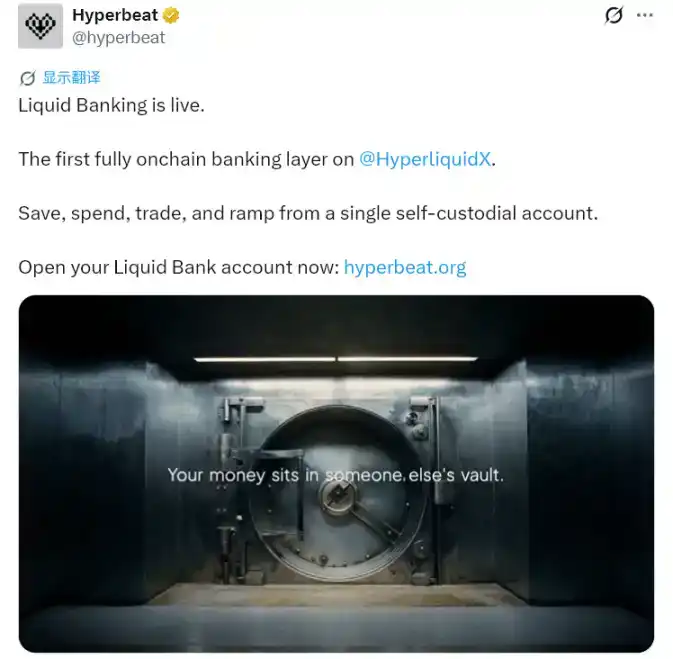
On April 8, Hyperliquid's native protocol Hyperbeat launched Liquid Banking, a self-custodied 'bank' deployed on HyperEVM, integrating stablecoin deposits, VISA card spending, perpetual contract trading, and multi-currency fiat on/off ramps into a single on-chain smart wallet.
The Hyperbeat team transitioned from being among the first validators on the Hyperliquid testnet. Initially just 5 people, they self-funded a start with approximately $200,000. The two co-founders, Kilian Boshoff(@Fundi_Crypto) and 800.HL(@degennQuant), maintain a low profile; the former has a background from Stellenbosch University in South Africa. The company is registered in the Cayman Islands.

In August 2025, it completed a $5.2 million seed round co-led by ether.fi Ventures and Electric Capital, with participation from Coinbase Ventures, Maelstrom, Anchorage Digital, and others, valuing the company at approximately $40 million.

Morpho Provides the Engine, Building a 'Bank' in Ten Months

The core selling point of Liquid Banking is Credit Mode.
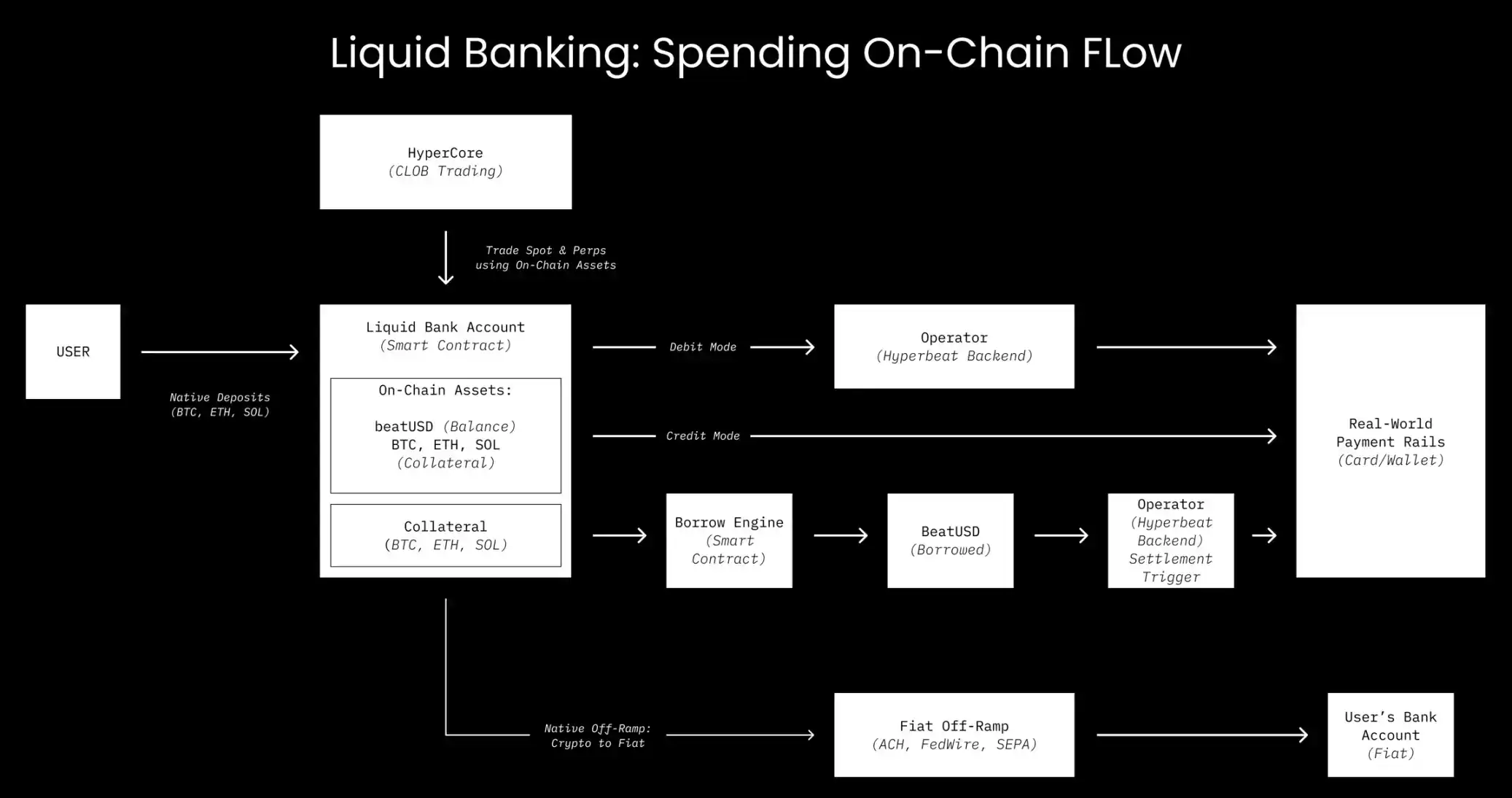
Users deposit assets like BTC, ETH, HYPE, etc., as collateral. When swiping the VISA card, the system instantly borrows stablecoins through the Morpho Blue market to complete the payment, while the collateral remains on-chain, continuing to generate yield. The user never interacts with a borrowing interface; the act of swiping the card is itself an on-chain loan.

The underlying lending engine comes from Morpho. Hyperbeat integrates Morpho into the user's smart wallet through an on-chain whitelist mechanism. Currently, Credit Mode operates on six isolated markets, with collateral covering HYPE, UBTC, UETH, USOL, and even the gold token XAUT.

Hyperbeat does not touch the core lending logic; Morpho does not touch the user interface. The former builds the 'bank frontend,' the latter supplies the 'credit engine.'

Stablecoin deposits for Liquid Banking center around beatUSD, a native stablecoin issued in partnership with Paxos Labs. Paxos provides the stablecoin infrastructure (underpinned by USDG0). The yield from the reserves flows directly back into Hyperbeat's rewards program and is ultimately distributed to users, rather than remaining with the issuer.

The deposit-side USD+ vault automatically allocates user funds to protocols like Morpho, Hypuur, Hyperlend, Felix, etc., offering 3%-8% APY.

The yield comes from the real borrowing interest paid by Credit Mode consumers. The more spending, the higher the deposit yield. But the sustainability of this cycle depends on the volume of real consumption.

Spend Without Selling Crypto, But Interest Accrues Immediately on Swipe

Fiat on/off ramps for Liquid Banking are provided by Noah, supporting USD (ACH, FedWire) and EUR (SEPA) deposits, with a unique IBAN bound to each account.
In March 2026, direct top-ups and withdrawals for Vietnamese Dong and Malaysian Ringgit were added. Withdrawals also cover over ten currencies including British Pounds, Dirhams, and Thai Baht.

The VISA card is issued by Third National, with underlying infrastructure from Rain, a Visa Principal Member. By early January 2026, Rain's financing round valued it at $1.95 billion, with an annualized processing volume exceeding $3 billion, covering over a hundred countries.

The card tier is Visa Signature,附带机场贵宾厅等权益 (includes benefits like airport lounge access). Foreign currency transactions incur a 1% FX fee (based on Visa's official exchange rate), with no annual fee and no transaction fees; ATM withdrawals cost $1 + 0.65%; the default monthly spending limit is $100,000.

The borrowing利率 (interest rate) for Credit Mode fluctuates with the utilization rate of the Morpho market, but there is no grace period. Every instance of 'spending without selling crypto' starts accruing interest the second the card is swiped.

Hyperbeat's official 'no hidden fees' refers to the transparency of the yield strategy, not the card's fee pricing. The Credit Mode borrowing rate is dynamically determined by the Morpho market. The lack of a grace period means the real-time cost of the convenience of 'spending without selling crypto' exists and is not low.

The Cost of Self-Custody is a One-Day Cooling Period

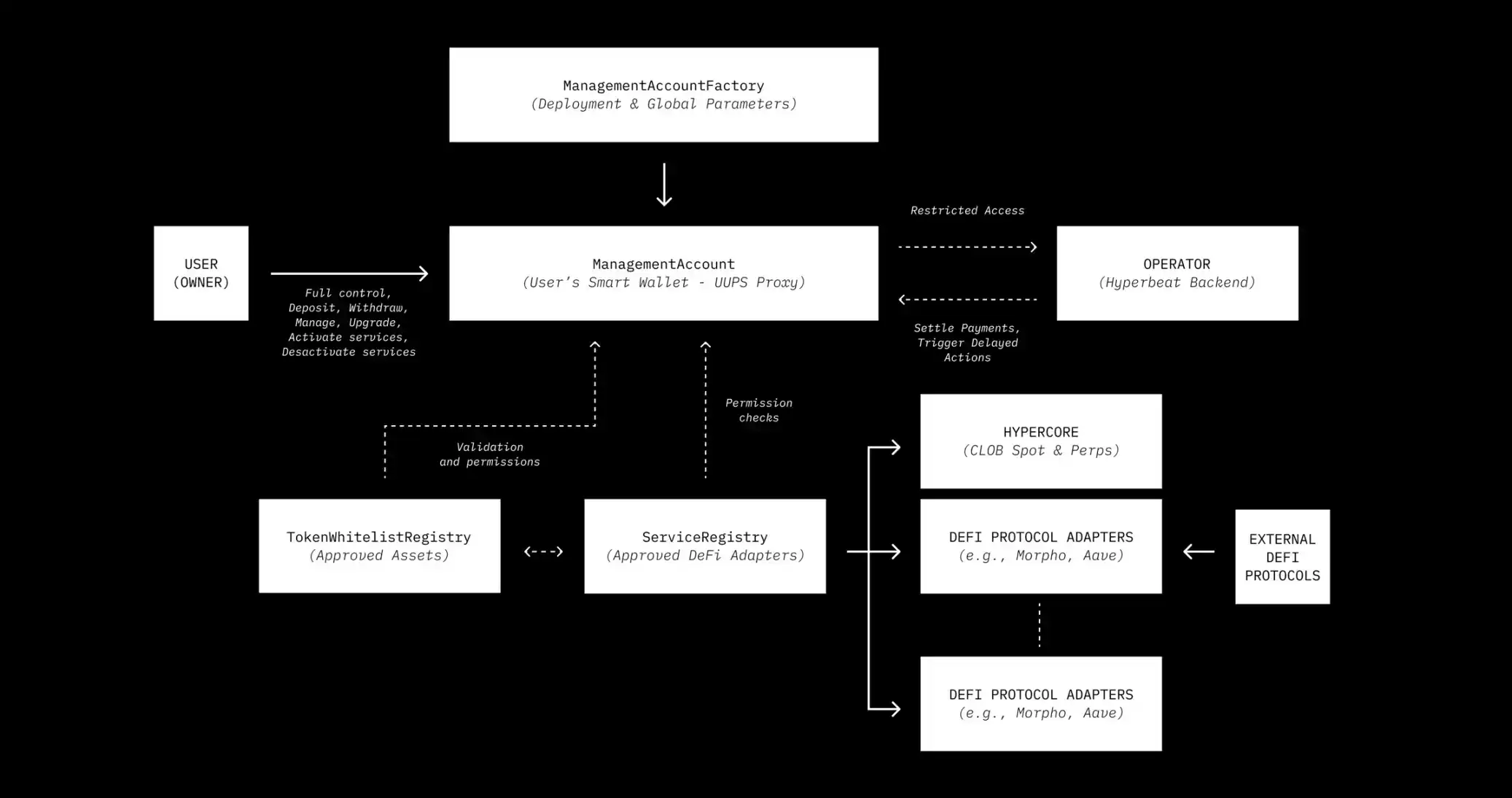
Unlike all centralized crypto cards, user assets always remain in their self-controlled ManagementAccount smart wallet. The Hyperbeat backend only has a restricted Operator role, able to execute settlements only within user-set limits and unable to transfer assets to unauthorized addresses.

But self-custody must solve one problem: what if a user withdraws funds right after swiping the card? Hyperbeat introduces an on-chain timelock mechanism.

Withdrawing settlement tokens requires a cooling period and a confirmation process. Withdrawing collateral requires Operator approval to prevent bad debt. Switching modes also has a delay. The contracts were audited by Zellic and Nethermind, with key management provided by Turnkey.

These frictions are not a bug; they are a feature. They acknowledge the speed difference between on-chain settlement and offline consumption, filling the gap with contract rules rather than 'please believe us.' But users must monitor their health factor themselves; there is no customer service to undo operational mistakes.


Related Questions

QWhat is the core feature of Hyperbeat's Liquid Banking product launched on Hyperliquid?

AThe core feature is Credit Mode, which allows users to spend stablecoins borrowed instantly via Morpho Blue markets using their crypto assets as collateral, all within a single on-chain smart wallet without manually interacting with a lending interface.

QWhich companies were the lead investors in Hyperbeat's $5.2 million seed round and what was the valuation?

AThe seed round was co-led by ether.fi Ventures and Electric Capital, with participation from CoinBase Ventures, Maelstrom, and Anchorage Digital, valuing the company at approximately $40 million.

QHow does Hyperbeat's Credit Mode generate yield for stablecoin depositors?

AYield is generated from the real borrowing interest paid by consumers using Credit Mode. User deposits are automatically allocated to protocols like Morpho, Hypuur, Hyperlend, and Felix, with the interest from spending/borrowing flowing back to the reward program and ultimately to depositors.

QWhat is a key operational difference and potential cost for users of the Hyperbeat VISA card compared to traditional credit cards?

AA key difference is that there is no interest-free grace period. Borrowing interest starts accruing from the very second a transaction is made, and the rate is dynamically determined by the Morpho market's utilization.

QWhat is a key security feature and its associated user trade-off in Hyperbeat's self-custody model?

AA key security feature is the on-chain timelock and cooldown period for withdrawing settled tokens or collateral, which prevents bad debt but introduces a delay (e.g., a one-day cooldown) and requires users to actively manage their health factor without the ability for customer support to reverse mistakes.

Related Reads

Google and Amazon Simultaneously Invest Heavily in a Competitor: The Most Absurd Business Logic of the AI Era Is Becoming Reality

In a span of four days, Amazon announced an additional $25 billion investment, and Google pledged up to $40 billion—both direct competitors pouring over $65 billion into the same AI startup, Anthropic. Rather than a typical venture capital move, this signals the latest escalation in the cloud wars. The core of the deal is not equity but compute pre-orders: Anthropic must spend the majority of these funds on AWS and Google Cloud services and chips, effectively locking in massive future compute consumption. This reflects a shift in cloud market dynamics—enterprises now choose cloud providers based on which hosts the best AI models, not just price or stability. With OpenAI deeply tied to Microsoft, Anthropic’s Claude has become the only viable strategic asset for Google and Amazon to remain competitive. Anthropic’s annualized revenue has surged to $30 billion, and it is expanding into verticals like biotech, positioning itself as a cross-industry AI infrastructure layer. However, this funding comes with constraints: Anthropic’s independence is challenged as it balances two rival investors, its safety-first narrative faces pressure from regulatory scrutiny, and its path to IPO introduces new financial pressures. Globally, this accelerates a "tri-polar" closed-loop structure in AI infrastructure, with Microsoft-OpenAI, Google-Anthropic, and Amazon-Anthropic forming exclusive model-cloud alliances. In contrast, China’s landscape differs—investments like Alibaba and Tencent backing open-source model firm DeepSeek reflect a more decoupled approach, though closed-source models from major cloud providers still dominate. The $65 billion bet is ultimately about securing a seat at the table in an AI-defined future—where missing the model layer means losing the cloud war.

marsbit4h ago

Google and Amazon Simultaneously Invest Heavily in a Competitor: The Most Absurd Business Logic of the AI Era Is Becoming Reality

marsbit4h ago

Computing Power Constrained, Why Did DeepSeek-V4 Open Source?

DeepSeek-V4 has been released as a preview open-source model, featuring 1 million tokens of context length as a baseline capability—previously a premium feature locked behind enterprise paywalls by major overseas AI firms. The official announcement, however, openly acknowledges computational constraints, particularly limited service throughput for the high-end DeepSeek-V4-Pro version due to restricted high-end computing power. Rather than competing on pure scale, DeepSeek adopts a pragmatic approach that balances algorithmic innovation with hardware realities in China’s AI ecosystem. The V4-Pro model uses a highly sparse architecture with 1.6T total parameters but only activates 49B during inference. It performs strongly in agentic coding, knowledge-intensive tasks, and STEM reasoning, competing closely with top-tier closed models like Gemini Pro 3.1 and Claude Opus 4.6 in certain scenarios. A key strategic product is the Flash edition, with 284B total parameters but only 13B activated—making it cost-effective and accessible for mid- and low-tier hardware, including domestic AI chips from Huawei (Ascend), Cambricon, and Hygon. This design supports broader adoption across developers and SMEs while stimulating China's domestic semiconductor ecosystem. Despite facing talent outflow and intense competition in user traffic—with rivals like Doubao and Qianwen leading in monthly active users—DeepSeek has maintained technical momentum. The release also comes amid reports of a new funding round targeting a valuation exceeding $10 billion, potentially setting a new record in China’s LLM sector. Ultimately, DeepSeek-V4 represents a shift toward open yet realistic infrastructure development in the constrained compute landscape of Chinese AI, emphasizing engineering efficiency and domestic hardware compatibility over pure model scale.

marsbit4h ago

Computing Power Constrained, Why Did DeepSeek-V4 Open Source?

marsbit4h ago

Trading

Spot
Futures

Hot Articles

What is $BANK

Bank AI: A Revolutionary Step in the Future of Banking Introduction In an era marked by rapid advancements in technology, Bank AI stands at the intersection of artificial intelligence (AI) and banking services. This innovative project seeks to redefine the financial landscape, enhancing operational efficiency, security measures, and customer experiences through the power of AI. As we embark on this exploration of Bank AI, we will delve into what the project entails, its operational dynamics, its historical context, and significant milestones. What is Bank AI? At its core, Bank AI represents a transformative initiative aimed at integrating artificial intelligence into various banking operations. This project harnesses the capabilities of AI to automate processes, improve risk management protocols, and enhance customer interaction through personalised services. The primary objectives of Bank AI include: Automation of Banking Functions: By leveraging AI technologies, Bank AI aims to automate routine tasks, reducing the burden on human resources and enhancing efficiency. Enhanced Risk Management: The project utilises AI algorithms to predict and identify risks, thereby fortifying security measures against fraud and other threats. Personalisation of Banking Services: Bank AI focuses on offering tailored financial products and services by analysing customer data and behaviours. Improving Customer Experience: The implementation of AI-driven solutions, such as chatbots and virtual assistants, aims to provide users with more human-like interactions, revolutionising the way customers engage with banks. With these goals, Bank AI positions itself as a crucial player in rendering banking more efficient, secure, and user-centric. Who is the Creator of Bank AI? Details regarding the creator of Bank AI remain unknown. As such, no specific individual or organisation has been identified in the available information. The anonymity surrounding the project's inception raises questions but does not detract from its ambitious vision and objectives. Who are the Investors of Bank AI? Similar to the project's creator, specific information regarding the investors or supporting organisations of Bank AI has not been disclosed. Without this information, it is challenging to outline the financial backing and institutional support that might be propelling the project forward. Nevertheless, the importance of having a robust investment foundation is pivotal for sustaining development in such an innovative field. How Does Bank AI Work? Bank AI operates on several innovative fronts, focusing on unique factors that differentiate it from traditional banking frameworks. Below are key operational features: Automation: By applying machine learning algorithms, Bank AI automates various manual processes within banks. This results in reduced operational costs and allows human workers to redirect their efforts towards more strategic activities. Advanced Risk Management: The integration of AI into risk management practices equips banks with tools to accurately predict potential threats such as fraud, ensuring that customer information and assets remain secure. Tailored Financial Recommendations: Through continuous learning from customer interactions, the AI systems develop a nuanced understanding of user needs, enabling them to offer tailored advice on financial decisions. Enhanced Customer Interactions: Utilizing chatbots and virtual assistants powered by AI, Bank AI enables a more engaging customer experience, allowing users to have their queries resolved quickly, thus reducing wait times and improving satisfaction levels. Together, these operational features position Bank AI as a pioneer in the banking sector, establishing new benchmarks for service delivery and operational excellence. Timeline of Bank AI Understanding the trajectory of Bank AI requires a look at its historical context. Below is a timeline highlighting important milestones and developments: Early 2010s: The conceptualisation of AI integration into banking services began to gain attention as banking institutions recognised the potential benefits. 2018: A marked increase in the implementation of AI technologies occurred when banks started using AI tools like chatbots for basic customer service and risk management systems for improved security handling. 2023: The sophistication of AI continued to advance, with generative AI being introduced for more complex tasks such as document processing and real-time investment analysis. This year marked a significant leap in the capabilities afforded to banks by AI technology. 2024-Current Status: As of this year, Bank AI is on an upward trajectory, with ongoing research and developments poised to further enhance capabilities in banking operations. Continued exploration of AI applications hints at exciting developments yet to come. Key Points About Bank AI Integration of AI in Banking: Bank AI focuses on adopting artificial intelligence to streamline banking processes and improve user experiences. Automation and Risk Management Focus: The project strongly emphasises these areas, aiming to shift the burden of routine tasks while enhancing security frameworks through predictive analytics. Personalised Banking Solutions: By harnessing customer data, Bank AI enables tailored banking services that cater to individual user needs. Commitment to Development: Bank AI remains committed to ongoing research and development efforts, ensuring its adaptability and ongoing relevance as technology continues to evolve. Conclusion In summary, Bank AI exemplifies a crucial step forward in the banking industry, leveraging artificial intelligence to reshape operational paradigms, enhance security, and promote customer satisfaction. Despite gaps in information surrounding the creator and investors, the clear objectives and functional mechanisms of Bank AI provide a strong foundation for its ongoing evolution. As AI technology continues to advance and merge with the banking sector, Bank AI is well-positioned to significantly impact the future of financial services, enhancing the way we understand and interact with banking.

152 Total ViewsPublished 2024.04.06Updated 2024.12.03

What is $BANK

Discussions

Welcome to the HTX Community. Here, you can stay informed about the latest platform developments and gain access to professional market insights. Users' opinions on the price of BANK (BANK) are presented below.

活动图片