HSBC, Standard Chartered To Receive First Stablecoin Licenses In Hong Kong – Report

bitcoinistPublished on 2026-03-14Last updated on 2026-03-14

Abstract

Hong Kong is expected to issue its first stablecoin licenses within two weeks, with HSBC and Standard Chartered reportedly among the first recipients. The Hong Kong Monetary Authority (HKMA) is prioritizing institutions already authorized to issue banknotes, favoring them for their strong capital base and ability to ensure safety and adoption. The Stablecoins Ordinance, enacted last August, requires any issuer of fiat-referenced stablecoins, especially HKD-denominated tokens, to obtain a license. Standard Chartered, in a joint venture with Animoca Brands and HKT, plans to issue an HKD-pegged stablecoin and has participated in the HKMA’s sandbox program. HSBC, though not part of the sandbox, has engaged with digital asset players and focused on tokenization projects. The move comes as China tightens restrictions on virtual assets and tokenization domestically, positioning Hong Kong as a regulated testing ground for financial innovation and a gateway for Chinese assets on the blockchain.

Hong Kong is expected to grant the first batch of stablecoin issuer licenses within two weeks, reportedly choosing HSBC and Standard Chartered as the first companies to obtain the long-awaited approval.

HSBC, Standard Chartered Lead Hong Kong’s Stablecoin Race

On Friday, Bloomberg reported that HSBC, Hong Kong’s largest bank by assets, and a joint venture led by Standard Chartered are set to be among the first companies to receive the Hong Kong Monetary Authority’s (HKMA) stablecoin licenses this month.

Authorities are reportedly prioritizing institutions already authorized to issue banknotes and will approve the two banks in the first batch, according to people familiar with the matter. Notably, the HKMA favors bank-led stablecoin issuers due to their robust capital base and ability to ensure greater safety while facilitating wider adoption, the sources affirmed.

Last month, the financial authority’s Chief Executive, Eddie Yue, announced it would grant the first, limited batch of stablecoin provider licenses in March as the review of 36 applications was nearly completed.

The HKMA enacted the Stablecoins Ordinance last August, which directs any individual or entity seeking to issue any fiat-referenced stablecoin (FRS) in Hong Kong, or any Hong Kong Dollar (HKD)-denominated token, to obtain a license from the financial regulator.

The number of licenses and the timetable had not yet been finalized and were subject to change. However, sources suggested March 24 as a possible date, as revealed by the South China Morning Post (SCMP), which first broke the news.

Industry sources suggested that Hong Kong’s licensing regime will initially prioritize the local currency. Standard Chartered has already announced plans to issue a Hong Kong dollar-pegged token.

The London-based bank, alongside Animoca Brands and Hong Kong Telecommunications (HKT), formed a joint venture last year to apply for a license to issue a HKD-denominated stablecoin.

Since 2024, the trio has been part of the financial authority’s stablecoin issuer sandbox program, which enabled limited-scale tests of these tokens across various scenarios, including e-commerce payments, cross-border trade settlements, and tokenized asset trading.

RD Technologies, a Hong Kong-based fintech firm founded by former HKMA CEO Norman Chan Tak-lam, and JD Coinlink, the fintech arm of Chinese e-commerce giant JD.com, also started testing HKD-pegged tokens under the regulator’s sandbox program last year.

Meanwhile, HSBC’s potential approval has reportedly surprised the industry, given the bank’s absence from the HKMA-led sandbox. HSBC has focused on tokenization projects, including tokenized deposits.

However, the bank had reportedly been actively engaged with local and global players in the digital-asset space and is committed to playing a central role in Hong Kong’s evolving financial ecosystem.

A ‘Testing Ground’ For Mainland Financial Innovation

Hong Kong’s expected approvals come amid China’s recent decision to explicitly prohibit onshore tokenization of real-world assets (RWAs), intensify scrutiny of related offshore activities, and prohibit the issuance of yuan-pegged offshore stablecoins without authorization.

Last month, Chinese authorities reaffirmed their long‐standing ban on virtual assets, saying that domestic companies and overseas entities under their control are prohibited from issuing virtual currencies abroad without official approval.

As reported by Bitcoinist, legal experts have suggested that Hong Kong’s ambitions to establish itself as a leading regulated hub for stablecoins were at risk of being hindered by the People’s Bank of China’s explicit crackdown on the sector.

Nonetheless, experts also believe Hong Kong could serve as a testing ground for financial innovations, given competition with the US and favorable conditions for the internationalization of the yuan, the SCMP noted.

“Hong Kong is a testing field for Chinese assets and money to go abroad on the blockchain,” Raymond Chan, chairman of the Greater Bay Area FinTech League, told the news outlet. “We are the firewall defending against challenges that may disrupt the market in China, thanks to our full set of regulations.”
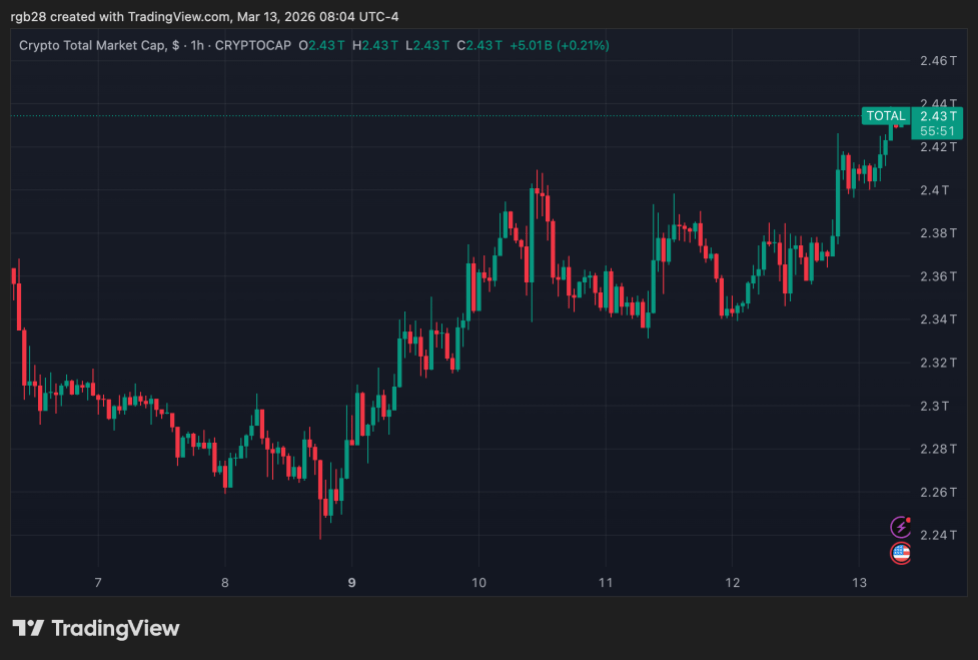
The total crypto market capitalization is at $2.43 trillion in the one-week chart. Source: TOTAL on TradingView


Related Questions

QWhich two companies are reportedly set to receive the first stablecoin licenses from the HKMA?

AHSBC and a joint venture led by Standard Chartered.

QWhat is the primary reason the HKMA favors bank-led stablecoin issuers, according to the report?

ADue to their robust capital base and ability to ensure greater safety while facilitating wider adoption.

QWhat type of stablecoin will the licensing regime initially prioritize?

AThe local currency, specifically the Hong Kong dollar (HKD).

QWhat role is Hong Kong expected to play for mainland China in the context of financial innovation, according to experts cited in the article?

AHong Kong is expected to serve as a testing ground or 'testing field' for financial innovations and for Chinese assets to go abroad on the blockchain.

QWhat was the name of the HKMA program that allowed companies to test stablecoins in a limited capacity?

AThe HKMA's stablecoin issuer sandbox program.

Related Reads

In Jinjiang, Fujian, a Storage Super Unicorn Lies Quiet

In Fujian's Jinjiang, a city known for sportswear, lies a quiet semiconductor giant: Fujian Jinhua Integrated Circuit Co. (JHICC). Once a promising domestic DRAM manufacturer alongside Yangtze Memory and ChangXin Memory Technologies (CXMT), its journey was derailed in 2018 when the U.S. placed it on an Entity List and filed criminal charges for alleged trade secret theft. This halted production for years. A turning point came in February 2024 when a U.S. federal court found JHICC not guilty. However, it had lost crucial time. While CXMT soared to become a top-valued A-share company in 2024, JHICC, with an estimated valuation of 80 billion RMB, was just restarting. Its current output is primarily customized DDR4 chips, not the advanced DDR5/HBM demanded for AI, but it still benefits from the broader memory chip upcycle. JHICC's story is tied to Chen Zhengkun, a veteran engineer who left Micron to lead the venture. Founded in 2016 with state-backed funding, JHICC partnered with Taiwan's UMC to develop DRAM technology. Rapid progress was cut short by the U.S. actions, which Micron initiated, partly due to its heavy reliance on the Chinese market. Post-sanctions, Chen's team worked to rebuild the production line with reduced reliance on U.S. technology. According to its records, JHICC achieved small-scale production and revenue growth under immense pressure. It now focuses on the stable "niche" DRAM market (e.g., TVs, routers) with a monthly capacity of ~40,000 wafers, aiming for 60,000 by 2026. It holds over 1,000 patents but remains on the Entity List. For Jinjiang, investing in JHICC was a bold industrial leap. The local government provided unwavering financial and logistical support during the crisis, helping the company survive. JHICC has become the anchor for a growing local semiconductor cluster. Though its scale lags behind domestic peers, JHICC's persistence symbolizes a hard-won foothold in a global market long dominated by Samsung, SK Hynix, and Micron. Having missed one boom, it seeks a place in the new AI-driven memory supercycle.

marsbit1h ago

In Jinjiang, Fujian, a Storage Super Unicorn Lies Quiet

marsbit1h ago

Trading

Spot
活动图片




