How Wagyu Is Changing the Monero Narrative: One Tool Lifting Years of Price Suppression

比推Published on 2026-01-14Last updated on 2026-01-14

Abstract

Wagyu, a new exchange tool, is breaking years of price suppression on Monero (XMR) by addressing a critical flaw in its acquisition process. Since 2018, despite strong demand, XMR's price remained stagnant, primarily because major exchanges delisted it, forcing over 60% of users to rely on instant swap services. These offshore services charged exorbitant fees (effectively 3-4%) and often froze funds under "AML checks," creating constant sell pressure as they immediately converted XMR profits to stablecoins. This parasitic cycle drained an estimated $30,000-$100,000 daily from the market. Wagyu v2 routes orders to Hyperliquid, providing exchange-level pricing and near-zero fees, eliminating the need for exploitative swap services. By removing this sell pressure and allowing true price discovery, Wagyu has already processed millions in trades, contributing to XMR's recent breakout above $600. The tool is effectively saving Monero by connecting genuine demand directly to real market liquidity.

Written by: PerpetualCow.hl

Compiled by: AididiaoJP, Foresight News

Original Title: How Wagyu Is Saving Monero: How One Tool Is Breaking Years of Price Suppression?


A few days ago, I exposed the trillion-dollar instant exchange industry. Today, I'm connecting the dots that haven't been pieced together yet on Crypto Twitter.

Since 2018, while almost every other cryptocurrency has been surging, the price of Monero (XMR) has been stuck in a range.

Most attribute this to exchange delistings, regulatory pressure, or the narrative that 'privacy coins are dead.'

They are all wrong.

To understand what's happening, you must first delve deep into the history of Monero XMR, including all the exchange delistings, and how most people actually buy this coin.

The Real Demand for Monero XMR

People have always wanted Monero, not just for privacy, but because it's seen as a store of value alternative to Bitcoin, like a 21st-century Swiss bank account.

Its utility didn't change just because exchanges got scared of regulation and delisted it.

This can be compared to illegal drug trade: when it's impossible to buy from a legitimate pharmacy, addicts will seek out more dubious channels, paying a higher price to get what they need.

As a result, the demand for Monero flowed to instant exchange services, not centralized exchanges.

Think from the perspective of an average user in 2024:

You want to buy Monero, but Binance just delisted it, and Coinbase won't touch it. Other small exchanges that still trade Monero are likely to freeze your funds for dealing with this coin.
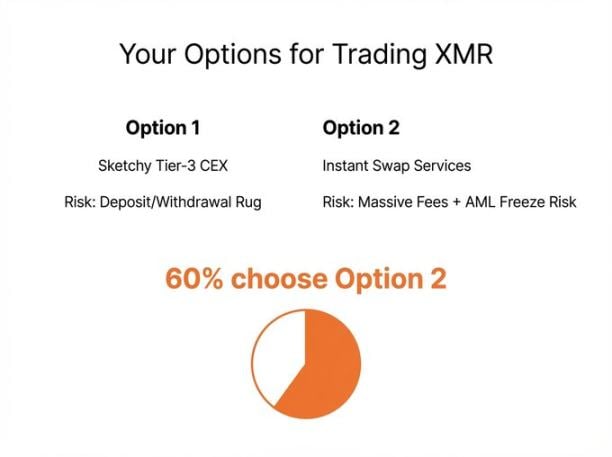
You only have two choices:

Find a third-rate exchange that still lists Monero and pray they don't run off with the money.

Use an instant exchange service, pay high fees, and pray they don't freeze your funds indefinitely under the pretext of 'AML review'.

Over 60% of users chose the second path.

These services became the de facto on/off ramps for the Monero ecosystem.

They are, of course, unregulated and offer terrible exchange rates, but users have no other choice.

After all legitimate exchanges abandoned Monero, the instant exchange industry became the only channel, absorbing all Monero trading volume.

Tracking the Flow of Funds

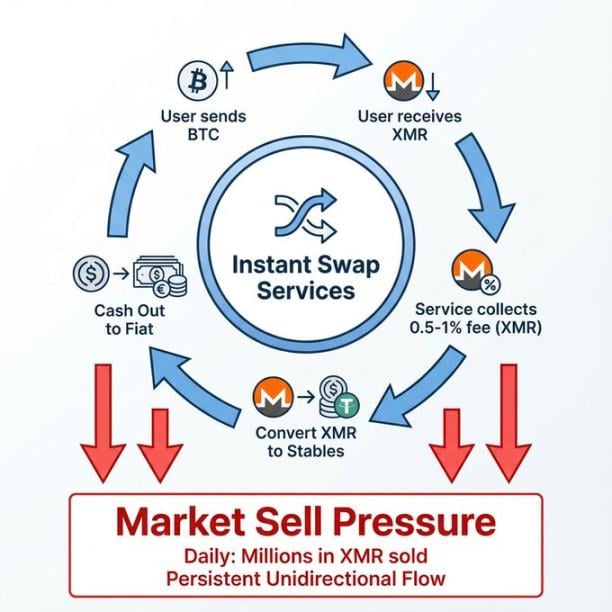
All instant exchange services operate the same way:

The user sends Bitcoin and receives Monero, with the service secretly charging a 3-4% fee (while ostensibly only charging 0.5-1%).

But these fees are priced in Monero.

So how do these service providers handle the Monero they receive?

They don't hold it long-term; they are not believers. These are offshore companies chasing fiat profits, who immediately convert Monero to stablecoins and cash out.

Just like that, millions of dollars worth of Monero are sold into the market every day.

In market microstructure terms, this creates a persistent one-way outflow of funds. Regardless of overall market conditions, these services are constantly selling. While this is just their business model, the impact on price is devastating.
Quantifying the Capital Drain

In my previous article, I estimated the instant exchange industry handles about $1.5 trillion in transactions annually (across all chains), and that's just the on-chain verifiable part.

Monero's volume is invisible due to its privacy features, but industry estimates suggest it accounts for about 20% of total instant exchange flow.

Assume $30 billion worth of Monero is exchanged through these services annually.

Conservatively, the actual figure might be half of that, around $15 billion.

At an average fee of 0.75% (most actually charge 1%), the Monero fees collected annually are worth about $112.5 million.

All of this Monero is sold into the market.

This means over $300,000 in passive selling pressure every day. It's like an invisible pump constantly draining value from Monero.

And this is a conservative estimate. If Monero truly accounts for 20% of the volume and fees are 1%, that's $300 million annually, approaching $1 million in daily selling pressure.

But it doesn't end there; there's also the 'AML Trap'.

The AML Trap

This is the 'dirty secret' I exposed in my last article: these services, while advertising 'No KYC', arbitrarily freeze user funds under the pretext of 'AML review'.

It's estimated that 2-5% of transactions through instant exchange services get frozen. The rate is higher for large transactions.

This creates a vicious cycle:

Small transactions go through but are charged fees 10-20 times higher than normal

Large transactions are completely frozen, often permanently

Only a fraction of the actual buying demand actually reaches the market
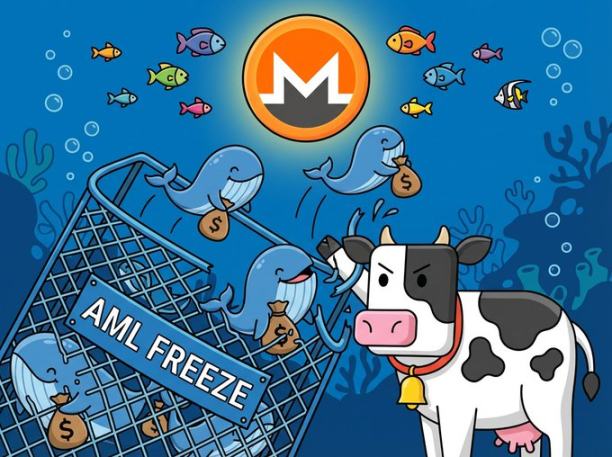
This creates the most brutal price discovery barrier: buyers who could actually influence the price are systematically excluded from the market.

The real demand for Monero has always been far higher than its price reflects. The instant exchange industry either extracts from this demand or outright chokes it off.

A Captive Market

Let me be clear about this vicious cycle:

The instant exchange industry did not win the market through competitiveness. They gained a monopoly position when all exchanges delisted Monero, and then proceeded to extract the maximum possible from users who had nowhere else to go.
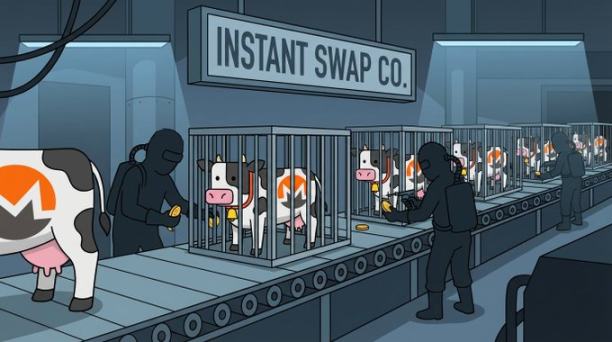
1% fees plus terrible exchange rates, plus random fund freezes.

Users tolerate it because they have no choice, and these service providers know it.

This is what happens when an entire asset class is forced into a single channel controlled by anonymous offshore operators: they extract with an uncompetitive product.

Every cent they extract turns into selling pressure on Monero.

Wagyu's Solution

Two days ago, Wagyu v2 launched.
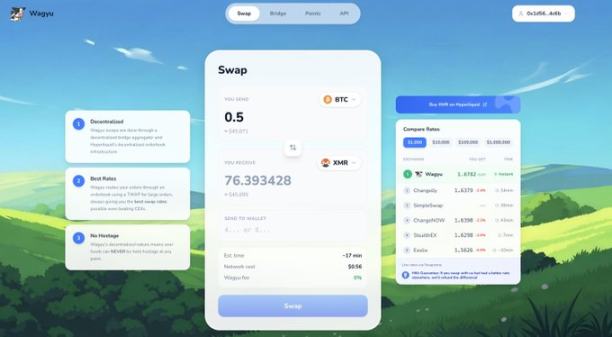
The core idea is simple: let Monero users enjoy the same pricing level as exchange traders.

When you exchange through Wagyu, your order is routed to @Hyperliquidx—where the most competitive market makers in crypto compete for orders.

These are the same market makers that provide liquidity for Binance, Bybit, and OKX, offering tiny spreads.

The result: you get exchange-level prices and fees. No more 1% or 0.5%, but ultra-low rates like professional traders.

For the first time since Monero was delisted from exchanges, users don't have to get 'ripped off' just for using their own assets.
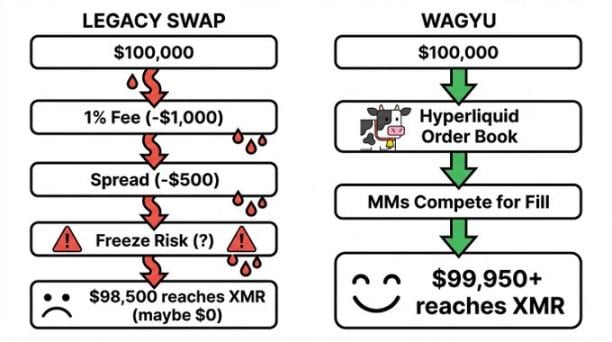
A single $100,000 transaction prevents over $1,000 in selling pressure from hitting the market.

Within 48 hours of launch, Wagyu v2 has already processed millions in exchanges, offering the best market prices:
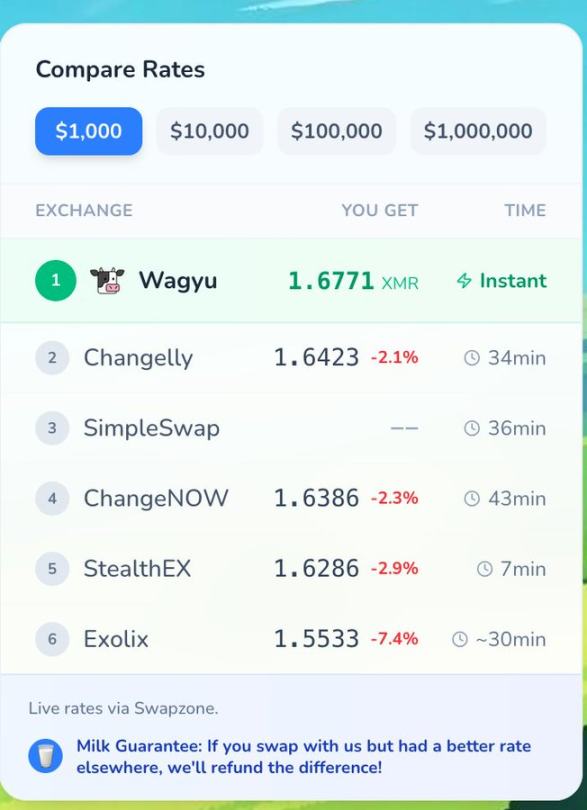
Trades that would have gone through traditional services, been charged over 1% in fees, and caused the market to instantly absorb tens of thousands in selling pressure, are now happening through Wagyu.

$1 million exchange through traditional services = $10,000 worth of Monero sold

The same $1 million exchange through Wagyu = Zero forced selling

Multiply this effect by every large Monero buyer who discovers they no longer have to be 'robbed'.

Reversing the Vicious Cycle

For years, Monero has been trapped in a negative feedback loop:
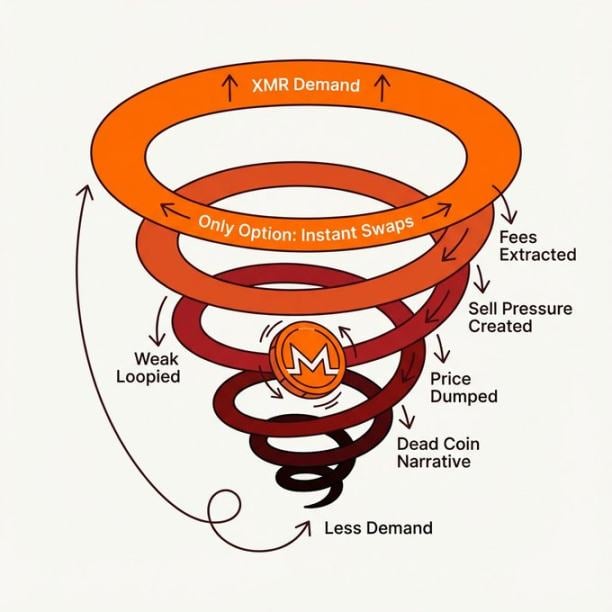
The instant exchange industry acted as a value extraction layer, sitting between buyers and the real price. They intercepted demand, extracted profits, and distorted price signals. Users couldn't bypass them because there was no alternative.

Now, that has changed.

Just two days after launch, volume is already migrating to Wagyu. People are realizing they can get Binance-level pricing for an asset Binance won't even list, and the word is spreading fast.

The cycle is reversing:
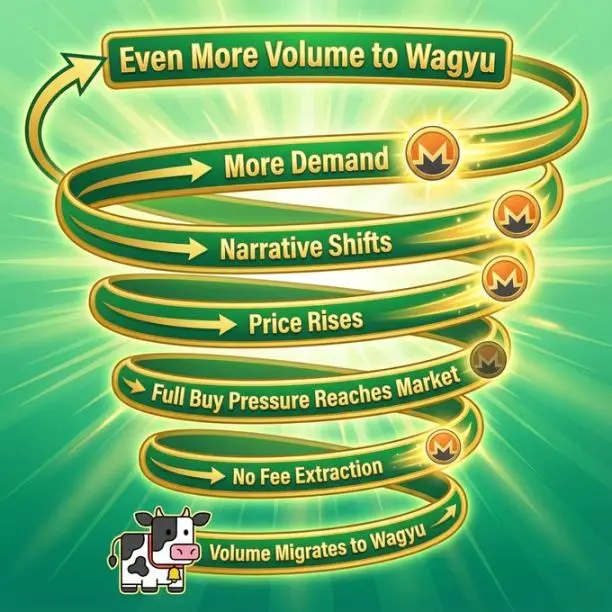
It's no coincidence that Monero broke through $600 and began its first price discovery in years.

Wagyu Is Saving Monero

I'm not going to be modest about this:

Every exchange made through Wagyu instead of a traditional service is real buying pressure that reaches the market.

Every million-dollar trade that flows through us means over $10,000 won't be sold onto other holders.

We are not extracting from the Monero ecosystem; we are plugging it directly into real liquidity.

The parasitic layer that has suppressed Monero for years has finally met its competitor. And we are not competing on their terms—we are making their entire model obsolete.

When users can get exchange-level pricing with zero freeze risk through Wagyu, who will pay 1% fees to anonymous offshore services that might freeze their funds?

No one will.

What This Means

I'm not here to give price predictions. I don't know if Monero will go to $1,000, $2,000, or fall back to $400.

But I know for sure: for the first time since being delisted from exchanges, demand for Monero can truly translate into price.

We've been live for only two days and are already processing millions in trades—trades that would have continuously 'bled' the market.

With the 'ceiling' removed, Monero at $600 is still undervalued. At least now, the market will truly decide its value.

Price discovery is finally possible, and Wagyu is making it happen.


Twitter:https://twitter.com/BitpushNewsCN

Bitpush TG Group:https://t.me/BitPushCommunity

Bitpush TG Subscription: https://t.me/bitpush

Original link:https://www.bitpush.news/articles/7602589

Related Questions

QWhat is the main reason the author argues that Monero's price was suppressed for years?

AThe author argues that Monero's price was suppressed due to the parasitic extraction by instant exchange services, which acted as the primary on/off-ramp after centralized exchanges delisted XMR. These services charged high fees (effectively 3-4%) and immediately sold the XMR fees for stablecoins, creating constant sell pressure of an estimated $30,000 to $100,000 daily.

QHow did the instant exchange industry impact Monero's price discovery according to the article?

AThe instant exchange industry severely distorted Monero's price discovery by intercepting demand, charging exorbitant fees, and systematically freezing large transactions. This created a one-way outflow of value, preventing genuine buy-side demand from reaching the market and influencing the price.

QWhat solution does Wagyu v2 provide to the problem described in the article?

AWagyu v2 routes user orders to the Hyperliquid exchange, where professional market makers provide highly competitive, exchange-level pricing and minimal fees. This allows users to trade XMR without the excessive fees and freezing risks of traditional instant exchanges, eliminating the forced selling pressure those services created.

QWhat was the estimated annual volume of Monero processed by instant exchanges, and what was the resulting sell pressure?

AThe article estimates that instant exchanges processed approximately $150 billion to $300 billion in annual Monero volume. With an average fee of 0.75% to 1%, this resulted in $112.5 million to $300 million worth of XMR being sold annually, creating a daily sell pressure of over $300,000 to nearly $1 million.

QHow does the author describe the change in the market cycle for Monero after the introduction of Wagyu?

AThe author states that the negative feedback loop, where instant exchanges extracted value and suppressed the price, is now reversing. With Wagyu providing a efficient, non-extractive on-ramp, genuine buy-side demand can finally reach the market, allowing for true price discovery for the first time since XMR was delisted from major exchanges.

Related Reads

20 Billion Valuation, Alibaba and Tencent Competing to Invest, Whose Money Will Liang Wenfeng Take?

DeepSeek, an AI startup founded by Liang Wenfeng, is reportedly in talks with Alibaba and Tencent for an external funding round that could value the company at over $20 billion. This marks a significant shift, as DeepSeek had previously relied solely on funding from its parent company,幻方量化 (Huanfang Quantitative), and had resisted external investment. The potential valuation would place DeepSeek among the top-tier AI model companies in China, comparable to competitors like MoonDark (valued at ~$18 billion) and ahead of recently listed firms like MiniMax and Zhipu. The funding—which could range from $600 million (for a 3% stake) to $2 billion (for 10%)—is seen as a move to secure resources for model development, retain talent, and support infrastructure needs, particularly as competition in inference models and AI agents intensifies. Both Alibaba and Tencent are eager to invest, not only for financial returns but also to integrate DeepSeek into their broader AI ecosystems. However, DeepSeek’s leadership is cautious about maintaining independence and may prefer financial investors over strategic ones to avoid being locked into a specific tech ecosystem. Alternative options, such as state-backed funds, offer longer-term capital and policy support but may come with slower decision-making and potential constraints on global expansion. With competing AI firms accelerating their IPO plans, DeepSeek’s window for securing optimal terms may be narrowing. The final decision will reflect a trade-off between capital, resources, and strategic independence.

marsbit42m ago

20 Billion Valuation, Alibaba and Tencent Competing to Invest, Whose Money Will Liang Wenfeng Take?

marsbit42m ago

After Losing 97% of Its Market Value, iQiyi Attempts to Use AI to Forcefully Extend Its Lifespan

After losing 97% of its market value since its 2018 peak, iQiyi is aggressively pivoting to AI in a desperate attempt to survive. At its 2026 World Conference, CEO Gong Yu announced an "AI Artist Library" with over 100 virtual performers and a new AIGC platform, "NaDou Pro," promising faster production and lower costs. This shift comes as the company faces severe financial distress: its market cap sits near delisting thresholds at $1.36 billion, with significant losses, declining membership revenue, and depleted cash flow. The AI strategy has sparked controversy. Top actors have issued legal threats against unauthorized digital replicas, while in Hengdian, over 134,000 background actors are seeing their already scarce job opportunities vanish as AI replaces them for background roles. iQiyi's move represents a fundamental shift from being a high-cost content buyer to a landlord" to becoming a "platform capitalist" that transfers production risk to creators. This contrasts with competitors like Douyin (TikTok's Chinese counterpart), which is investing heavily in *real* actor-led short dramas, betting that authentic human connection retains users better than AI-generated content. The article draws a parallel to the 1920s transition to "talkies," which made cinema musicians obsolete but ultimately enriched the art form. In contrast, iQiyi's AI drive is framed not as an artistic evolution but as a cost-cutting measure that could degrade storytelling, replacing genuine human emotion with algorithmically calculated stimulation and potentially numbing audiences' capacity for empathy. The core question remains: can a company focused solely on financial survival preserve the art of storytelling?

marsbit45m ago

After Losing 97% of Its Market Value, iQiyi Attempts to Use AI to Forcefully Extend Its Lifespan

marsbit45m ago

Only a 50% Chance of Passing This Year, Can the CLARITY Bill Succeed Before the Midterm Elections?

The CLARITY Act, which passed the House in July 2025 with strong bipartisan support (294-134), faces a critical juncture in the Senate. The Senate Banking Committee is expected to hold a markup soon, but key issues remain unresolved, including stablecoin yield provisions, DeFi regulations, and securing full Republican committee support. Other contentious points involve the Blockchain Regulatory Certainty Act (BRCA), ethics amendments for government officials, and SEC-related matters. The legislative calendar is tight, with limited time before the midterm elections. If the committee markup is delayed beyond mid-May, the chances of passage in 2026 drop significantly. Senator Cynthia Lummis has warned that failure this year could delay comprehensive crypto market structure legislation until 2030 or later. Galaxy estimates the probability of the CLARITY Act becoming law in 2026 is only about 50%. The bill provides crucial regulatory clarity by defining jurisdictional boundaries between the SEC and CFTC, establishing a path for decentralization, and bringing digital commodity intermediaries under federal regulation. Its passage is seen as vital before potential power shifts in the next Congress, which could bring less favorable leadership to key committees. The timeline is compressed, and the bill must compete for floor time with other priorities like Iran authorization and DHS appropriations. Key hurdles include finalizing the stablecoin yield compromise text, addressing law enforcement concerns about BRCA, and navigating political dynamics around SEC nominations. The outcome of the Banking Committee markup and the level of bipartisan support will be critical indicators of its future success.

marsbit1h ago

Only a 50% Chance of Passing This Year, Can the CLARITY Bill Succeed Before the Midterm Elections?

marsbit1h ago

Trading

Spot
Futures

Hot Articles

How to Buy ONE

Welcome to HTX.com! We've made purchasing Harmony (ONE) simple and convenient. Follow our step-by-step guide to embark on your crypto journey.Step 1: Create Your HTX AccountUse your email or phone number to sign up for a free account on HTX. Experience a hassle-free registration journey and unlock all features.Get My AccountStep 2: Go to Buy Crypto and Choose Your Payment MethodCredit/Debit Card: Use your Visa or Mastercard to buy Harmony (ONE) instantly.Balance: Use funds from your HTX account balance to trade seamlessly.Third Parties: We've added popular payment methods such as Google Pay and Apple Pay to enhance convenience.P2P: Trade directly with other users on HTX.Over-the-Counter (OTC): We offer tailor-made services and competitive exchange rates for traders.Step 3: Store Your Harmony (ONE)After purchasing your Harmony (ONE), store it in your HTX account. Alternatively, you can send it elsewhere via blockchain transfer or use it to trade other cryptocurrencies.Step 4: Trade Harmony (ONE)Easily trade Harmony (ONE) on HTX's spot market. Simply access your account, select your trading pair, execute your trades, and monitor in real-time. We offer a user-friendly experience for both beginners and seasoned traders.

3.3k Total ViewsPublished 2024.03.29Updated 2025.06.04

How to Buy ONE

Discussions

Welcome to the HTX Community. Here, you can stay informed about the latest platform developments and gain access to professional market insights. Users' opinions on the price of ONE (ONE) are presented below.

活动图片