How Can War News Turn into Millions in Profits a Step Ahead?

比推Published on 2026-03-02Last updated on 2026-03-02

Abstract

The article "How War News Turns into Millions in Profits" explores the rise of prediction markets like Polymarket and Kalshi as digital arenas for wagering on geopolitical events, using the hypothetical U.S.-Israel airstrike on Iran on February 28, resulting in the death of Iran’s Supreme Leader Ali Khamenei, as a case study. These platforms saw surging trading volumes, with Polymarket’s market on "Will Khamenei be ousted by February 28?" reaching $95.93 million in daily volume. While Polymarket operates with anonymity and a profit-based fee model, Kalshi faced controversy for refusing to fully pay out on contracts tied to deaths, citing ethical concerns. The piece also highlights suspicions of insider trading, with some wallets making highly timed, profitable bets ahead of the strike. The trend raises questions about morality, market manipulation, and the need for stricter regulation as prediction markets blur the lines between real-world conflict and digital profit-seeking.

Author: Ma He, Foresight News

Original Title: Prediction Platforms Are Becoming the Digital Battlefield of Postmodern Warfare


On February 28, the United States and Israel jointly launched an airstrike against Iran, resulting in the death of Iran's Supreme Leader Ali Khamenei. This attack shook Middle Eastern geopolitics. In the 21st century, the flames of war continue to spread everywhere, and its impact has also stirred up huge waves in the prediction markets of the crypto world.

Polymarket and Kalshi became another "battlefield" outside the actual war zone. Traders placed bets on the timing of the attack, regime change, and ceasefire dates, with trading volumes soaring to astronomical figures.

In war, some are always quietly making a fortune.

Polymarket became a "barometer" of the conflict. Since last December, they had set up a market for "When will the US strike Iran?" covering various date options.

The prediction market "Will Khamenei step down by February 28?" saw a daily trading volume of $95.93 million on February 28, becoming one of the platform's largest geopolitical markets ever. Its trading volume reached $54.15 million on March 31.
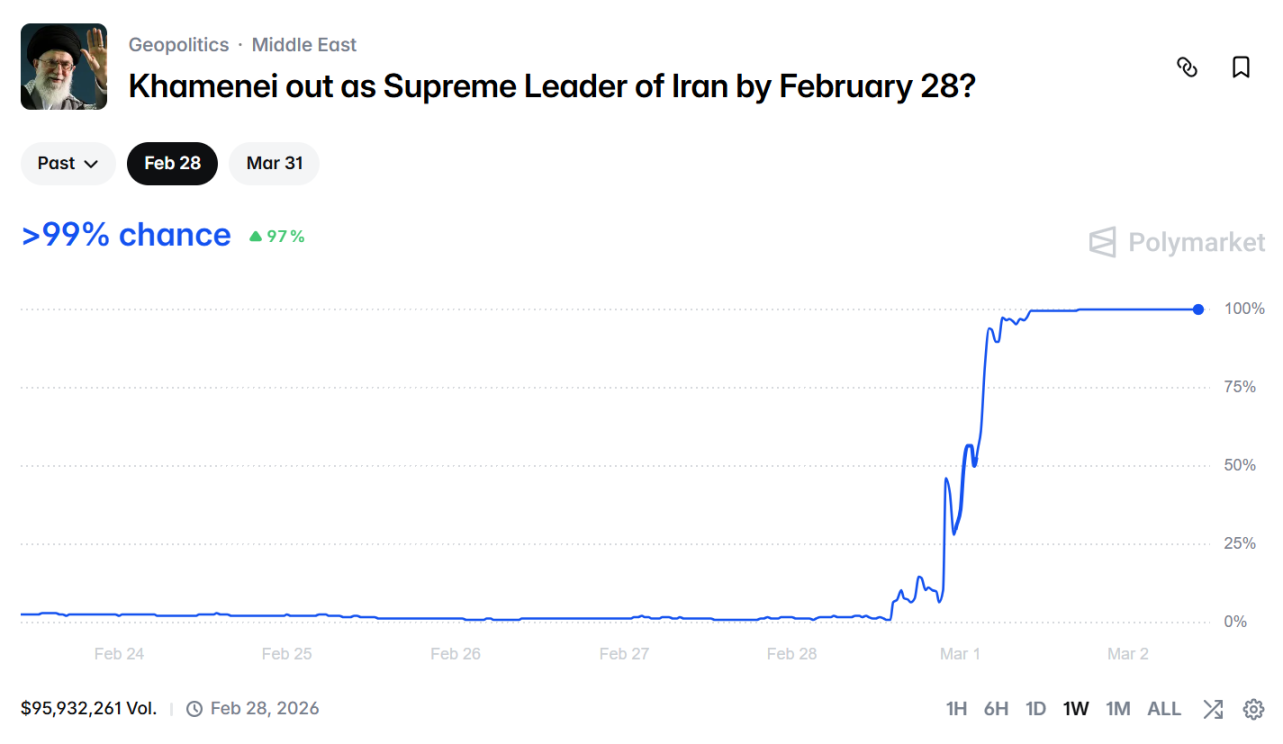
After the attack was confirmed, this market quickly settled to "Yes" (it is still in the final dispute period), as Khamenei's death directly led to him "stepping down."

Although Polymarket currently does not charge any transaction fees for the vast majority of its regular markets (including all political, geopolitical, pop culture, and long-term macro events), in early 2026, Polymarket introduced fees for specific high-frequency trading markets. The expansion of its brand influence has a significantly positive impact on its revenue growth.

Furthermore, the global version of Polymarket uses a profit-based fee model. Its core logic is: users do not need to pay fees when placing buy or sell orders daily, but when users close a position for profit, the platform charges a 2% fee on the net profit. This model only taxes the "winners."

Taking the example in the image, if the total net profit of the winners is $10 million, the income from this single prediction market alone would reach $200,000.

Traders flocked there not only for the thrill but also because these markets reflect news in real time—much faster than traditional media. As soon as news of the attack broke, contract prices instantly jumped, demonstrating the market's "efficiency."

There are always winners in war. In the past, those who profited from conflicts were often arms dealers, oil giants, or intelligence peddlers—think of Lockheed during World War II or the oil tycoons during the Cold War, who made fortunes through contracts and resource monopolies. Ordinary people? At best, they were bystanders; war meant loss and uncertainty for them. But now, crypto prediction markets have颠覆ed this landscape. Platforms like Polymarket allow retail investors to also bet on geopolitical events, from the date of US-Iran airstrikes to the probability of regime change, sharing a piece of the pie with just a few clicks.

However, participating in this game also blurs ethical boundaries. This shift is striking: the "dividends" of war have spread from the physical supply chain to the digital gambling table. Arms dealers are still making money, but prediction markets have turned ordinary users into new players. They don't produce missiles, but they can "predict" explosions on the blockchain and profit handsomely.

When conflicts escalate, platform trading volumes explode; the war economy has gone digital.

But this also raises many questions—does the thrill of making money dilute compassion for real suffering?

Kalshi, as another player, also got a share of the pie. Their "Will Khamenei step down?" market had a trading volume of tens of millions of dollars (slightly varying by source). On the day of the attack, trading volume in this market surged, reaching tens of millions of dollars in a single day.

But Kalshi's handling of the situation sparked controversy. A clause in the platform's rules states "no settlement on death," meaning that if stepping down is due to death, the "Yes" contract will not be paid in full.

After the attack, Kalshi suspended the market. CEO Tarek Mansour posted on X to explain: they oppose profiting from an individual's death, so they would settle at the last traded price before the death and refund all fees in full. Mansour emphasized that this was to uphold "moral bottom lines" and avoid the platform becoming a "death betting pool." Some users complained that this was like changing the rules mid-game, but Kalshi insisted this was a pre-set term, with details clarified just the day before the attack.
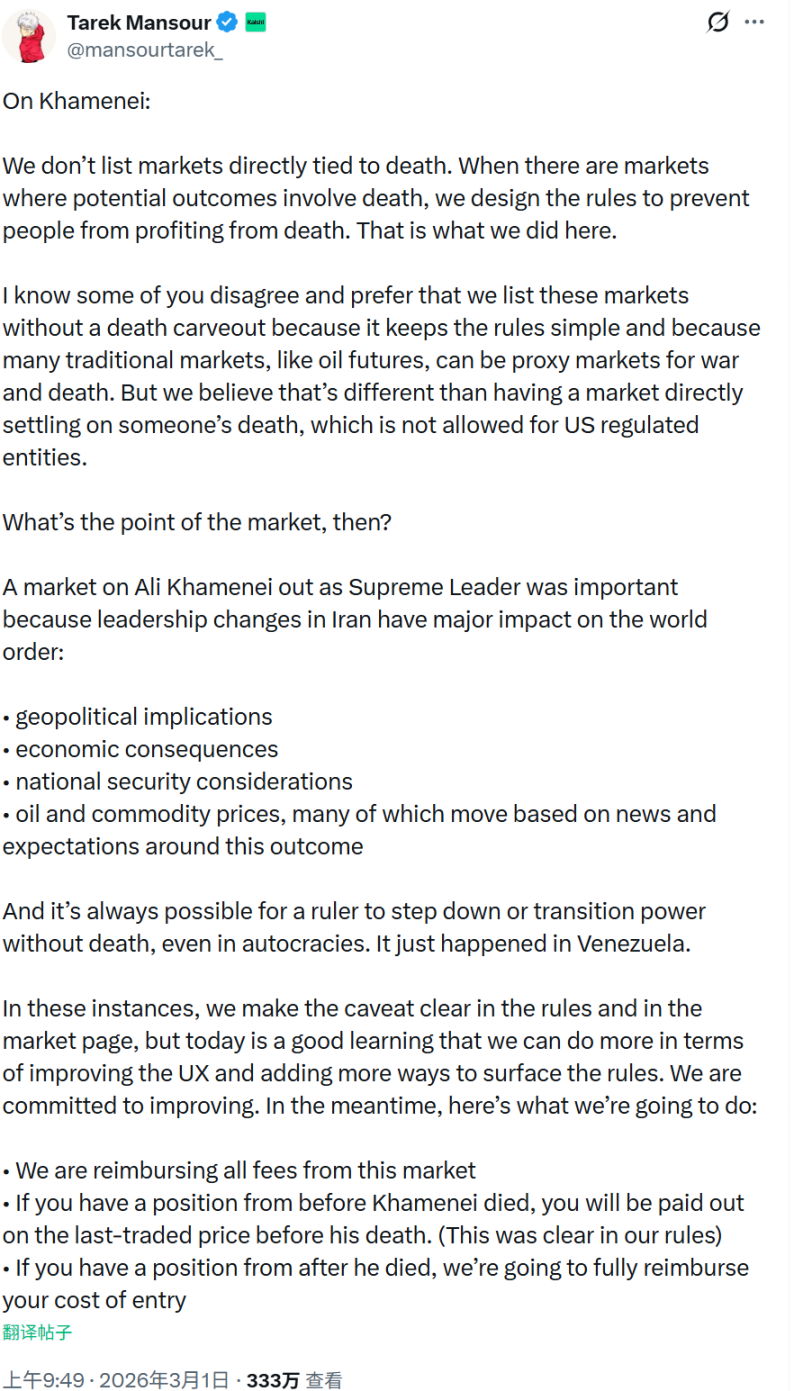
As a result, the platform lost money but gained a reputation for "not making money from the dead."

Polymarket has high user anonymity, attracting global funds; Kalshi is more compliant but restricts markets related to war and assassination.

However, while most players bet based on gut feeling, some insiders are also quietly making a fortune.

On Polymarket, the timing of some accounts' bets was so precise that it raised suspicions of insider trading. Blockchain analysis company Bubblemaps discovered that six newly created wallets placed bets on a US strike against Iran on February 28 just hours before the attack, collectively profiting about $1 million.
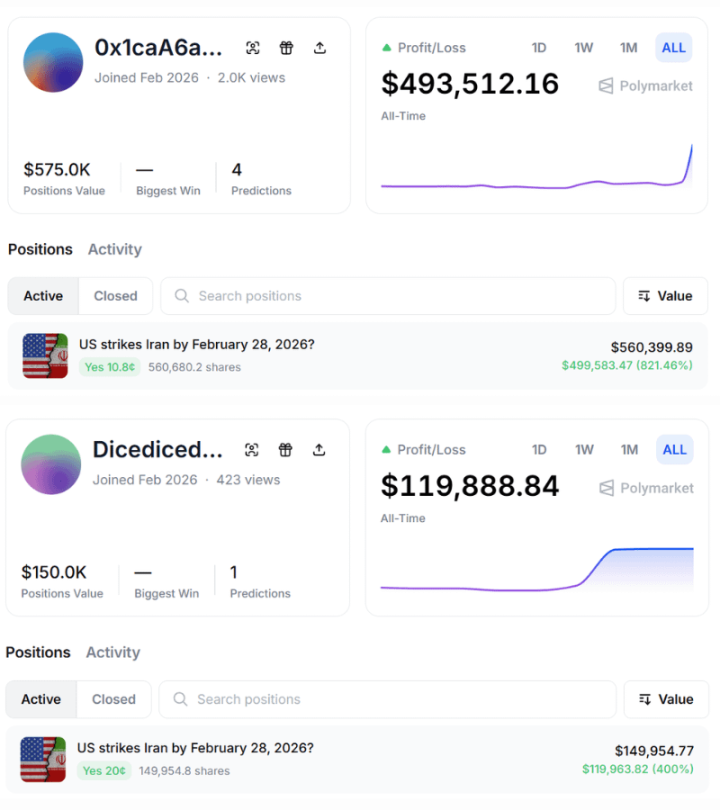
These 6 wallets were all created in February of this year. Almost all their trading was concentrated on contracts predicting the timing of the US military strike. Some positions were established hours before the first news of explosions emerged from Tehran, with contract purchase prices as low as around $0.10. Analysts stated that such concentrated betting behavior before major geopolitical events is characteristic of "suspected insider trading" previously seen in prediction markets.

However, the report also pointed out that the related accounts had incurred losses in other predictions before, and the US government had publicly warned weeks earlier that military action was possible. Therefore, the timing of the trades alone is not sufficient to directly prove illegal activity.

These are not isolated cases. Polymarket has faced similar质疑 in the past, such as during the 2024 Super Bowl or the Venezuela incident. But this time the scale is larger, involving national security. The CFTC has warned about insider trading in the past, and Kalshi recently penalized famous YouTube creator MrBeast's team editor, Artem Kaptur, for insider trading. Polymarket operates overseas with loose regulation, becoming a gray area.

US Representative Ritchie Torres is promoting legislation called the "2026 Public Integrity in Financial Prediction Markets Act," which aims to restrict government officials with access to non-public information from trading on related prediction markets. Meanwhile, Polymarket has faced regulatory restrictions or bans in multiple countries in recent years, including the Netherlands, France, Italy, and Singapore.

Of course, not everyone won. Many bet on the wrong date and suffered heavy losses. Currently, Polymarket has updated its website's top display, pinning all prediction markets related to the Iran situation to the top.
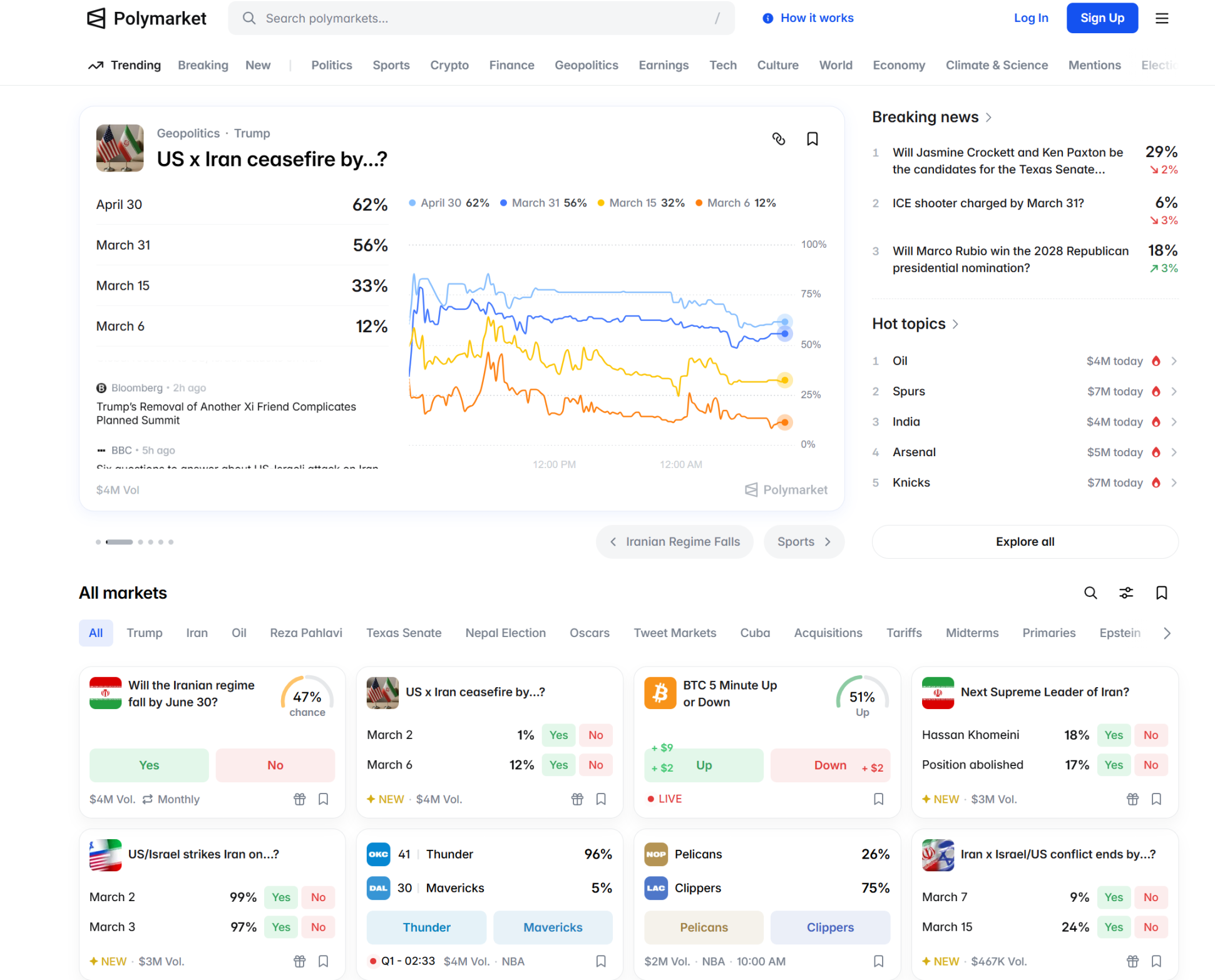
Overall, this "war profit" exposed the double-edged sword of prediction markets: on one hand, they provide real-time data intelligence and insights; on the other hand, they are easily manipulated or exploited with insider information.

Under the trend of "everything can be bet on," future betting in prediction markets may require stricter regulation and clearer rules. After all, the stakes are real money, but behind them are real lives.


Twitter:https://twitter.com/BitpushNewsCN

Bitpush TG Discussion Group:https://t.me/BitPushCommunity

Bitpush TG Subscription: https://t.me/bitpush

Original link:https://www.bitpush.news/articles/7615813

Related Questions

QWhat are the two main prediction markets discussed in the article that saw massive trading volumes related to the US-Israel airstrike on Iran?

AThe two main prediction markets discussed are Polymarket and Kalshi.

QHow does Polymarket's global version generate revenue from its users?

APolymarket's global version uses a profit-based fee model, charging users a 2% fee on their net profits only when they close a winning position, effectively taxing only the 'winners'.

QWhat controversial action did Kalshi take regarding its market on 'Whether Khamenei would step down' after the airstrike, and why?

AKalshi paused its market and settled it based on the last trading price before the event, citing a pre-existing 'no settlement on death' clause. The CEO stated this was to uphold moral standards and avoid profiting from an individual's death.

QWhat evidence suggests potential insider trading on Polymarket related to the airstrike?

ABlockchain analysis firm Bubblemaps found six newly created wallets that placed bets on the US striking Iran on February 28th just hours before the attack, collectively profiting approximately $1 million.

QWhat legislative action is mentioned in the article as a response to concerns about prediction markets?

AUS Representative Ritchie Torres is promoting legislation called the '2026 Financial Prediction Market Public Integrity Act,' which aims to restrict government officials with non-public information from trading on such prediction markets.

Related Reads

After 50x Storage Surge, Justin Sun Always Looks to the Next Decade

Sun Yuchen, known for his controversial stunts like a $30 million lunch with Warren Buffett (canceled due to a kidney stone) and eating a $6.2 million duct-taped banana, is often overshadowed by a significant fact: his decade-long track record of spotting major investment trends. In 2016, he famously advised young people to invest in Bitcoin, Nvidia, Tesla, and Tencent instead of buying property. A hypothetical $20,000 investment in Nvidia and Tesla from that list would now be worth over 50 million RMB. His latest major call was on November 6, 2025, predicting a "50x storage opportunity" tied to the AI boom, which materialized with Sandisk's stock surging nearly 50-fold by 2026. Looking ahead, Sun now focuses on the next frontier: Physical AI. He identifies four key areas: 1. **Embodied AI/Robotics**: He sees this reaching its "iPhone moment," with companies like UBTech and Galaxy General leading in commercialization. 2. **Drones**: Viewed as the first commercially viable form of Physical AI, revolutionizing sectors from warfare (e.g., AeroVironment's Switchblade) to logistics. 3. **Spatial Computing**: Beyond VR, it's about AI understanding physical space, a foundational technology for robotics and autonomous systems, exemplified by Apple's Vision Pro. 4. **Space Exploration**: After a 2025 suborbital flight with Blue Origin, Sun advocates for space as the ultimate frontier, discussing blockchain's potential role in space asset management and data transactions. His investment philosophy involves betting on entire, inevitable trends rather than single companies. For robotics, he sees Tesla (the body/manufacturer) and Nvidia (the brain/AI platform) as complementary plays. In defense drones, he highlights companies making tanks obsolete (AeroVironment) and those augmenting fighter jets (Kratos). For space, he participated in Blue Origin's flight and anticipates SpaceX's potential IPO to redefine the sector's valuation. Sun Yuchen's vision frames the next two decades not as a revolution in information flow (like the internet), but in the fundamental operation of the physical world through AI-powered robots, autonomous systems, and spatial intelligence, ultimately extending human and AI activity into space. While many still focus on conventional assets, he continues to look toward the next technological horizon.

marsbit35m ago

After 50x Storage Surge, Justin Sun Always Looks to the Next Decade

marsbit35m ago

The Billionaires Behind the Most Expensive Midterm Election in History

"The Most Expensive Midterm Elections and Their Billionaire Backers" This analysis details the unprecedented scale of spending in the 2026 midterm elections, highlighting the key billionaire donors shaping the political landscape. Jeff Yass, founder of Susquehanna International Group, has contributed over $81 million, ranking third among individual donors behind George Soros ($102.6M) and Elon Musk ($84.8M). Yass is a major donor to Trump's MAGA Inc. and supports school choice and various candidates. Overall, federal committees have raised over $4.7 billion this cycle, with political ad spending projected to reach $10.8 billion. Republican-aligned groups are significantly out-raising their Democratic counterparts. "Dark money" from undisclosed sources continues to grow. The core stakes involve control of Congress and policy direction for Trump's final term. Donors are also motivated by specific issues: Sergey Brin and Chris Larsen are funding opposition to a proposed California wealth tax and supporting crypto-friendly policies. Other top donors include OpenAI's Greg Brockman and his wife Anna ($50M total to MAGA Inc. and an AI-focused PAC), Richard Uihlein ($45.3M to conservative causes), venture capitalists Marc Andreessen and Ben Horowitz (each over $44M to crypto/AI PACs and MAGA Inc.), Miriam Adelson ($42.6M to GOP leadership PACs), Paul Singer ($33.9M), and Diane Hendricks ($25.8M to MAGA Inc.). The article notes that the peak fundraising period is still ahead, with major primaries approaching.

marsbit37m ago

The Billionaires Behind the Most Expensive Midterm Election in History

marsbit37m ago

The Largest IPO in History Is Approaching, Surpassing SpaceX, 28 Years of AI Self-Iteration, Countdown to Intelligence Explosion

"Anthropic Nears Trillion-Dollar IPO, Fueled by Explosive Growth and 2028 'Intelligence Explosion' Warning Anthropic is considering a deal valuing the AI company near $1 trillion, potentially leading to one of the largest IPOs ever and surpassing SpaceX. Its revenue has skyrocketed, with Annual Recurring Revenue (ARR) reaching $45 billion in May 2026—a 500% increase in just five months. This vertical growth curve is attributed to its key products, Claude Code and Cowork, dominating AI coding and enterprise collaboration. Beyond commercial success, co-founder Jack Clark issued a pivotal warning in an interview: there is a greater than 50% chance that by the end of 2028, AI systems will achieve recursive self-improvement—the ability to autonomously build a 'better version' of themselves, initiating an 'intelligence explosion.' This prophecy underpins the company's astronomical valuation, as the market prices in the potential for transformative and disruptive AI. Further signaling its ambition, Anthropic formed a $1.5 billion joint venture with Goldman Sachs and Blackstone, aiming to disrupt traditional consulting firms like McKinsey by deploying Claude AI for complex strategic work. This move tests AI's capacity to replace high-level cognitive labor, a precursor to its predicted autonomous evolution. The narrative presents a dual future: unprecedented economic opportunity alongside significant risks like economic restructuring and security threats. Anthropic's meteoric rise and Clark's 2028 prediction frame the coming years as a countdown to a potential technological singularity."

marsbit49m ago

The Largest IPO in History Is Approaching, Surpassing SpaceX, 28 Years of AI Self-Iteration, Countdown to Intelligence Explosion

marsbit49m ago

Trading

Spot
Futures
活动图片