Hot Interactions Collection | xStocks Points Event Now Live; Tempo Mainnet Launches (March 25)

Odaily星球日报Published on 2026-03-25Last updated on 2026-03-25

Abstract

This article highlights three major interactive opportunities in the crypto space: 1. **xStocks**: A tokenized stock platform backed by Kraken, allowing users to trade tokenized versions of real-world assets. It recently launched an xPoints rewards program where users can earn points by holding tokenized stocks, borrowing/lending, and providing liquidity. Users can connect their wallet, complete daily check-ins, and join the Telegram for bonus points. 2. **Tempo**: A payment-focused Layer 1 blockchain incubated by Stripe and Paradigm. Unlike typical blockchains, it uses stablecoins like USDC/USDT for gas fees. After raising $500M in funding, it has now launched its mainnet. Users can create a wallet using a passkey and bridge USDC to the Tempo network via Stargate. 3. **Forte Protocol**: A blockchain infrastructure project focused on compliance and economic tools, which raised $910M in 2021. It has launched two Galxe quests: one for social media tasks (X account required) and another for Galxe subscribers or users with a high Human Passport score.

Original | Odaily Planet Daily (@OdailyChina)

Author | Asher (@Asher_ 0210)

xStocks: U.S. Stock Tokenization Platform

Project Introduction

Backed Finance is an infrastructure provider responsible for issuing on-chain representations of traditional financial assets, including stocks, ETFs, and bonds. The company was acquired by Kraken in December 2025 and launched xStocks in June of the same year, offering tokenized stock products backed by real stocks held by Swiss custody partners. Currently, xStocks is integrated into multiple centralized platforms, including Kraken, Gate, Bybit, and Bitget, and supports Ethereum, Solana, and Tron.

On March 11, xStocks announced on platform X the launch of the xPoints rewards program. On March 18, it announced that points (xPoints) are now viewable. Users automatically accumulate points by holding tokenized stocks in their wallets, establishing positions in lending markets, and providing liquidity on DEXs.

Interaction Tutorial

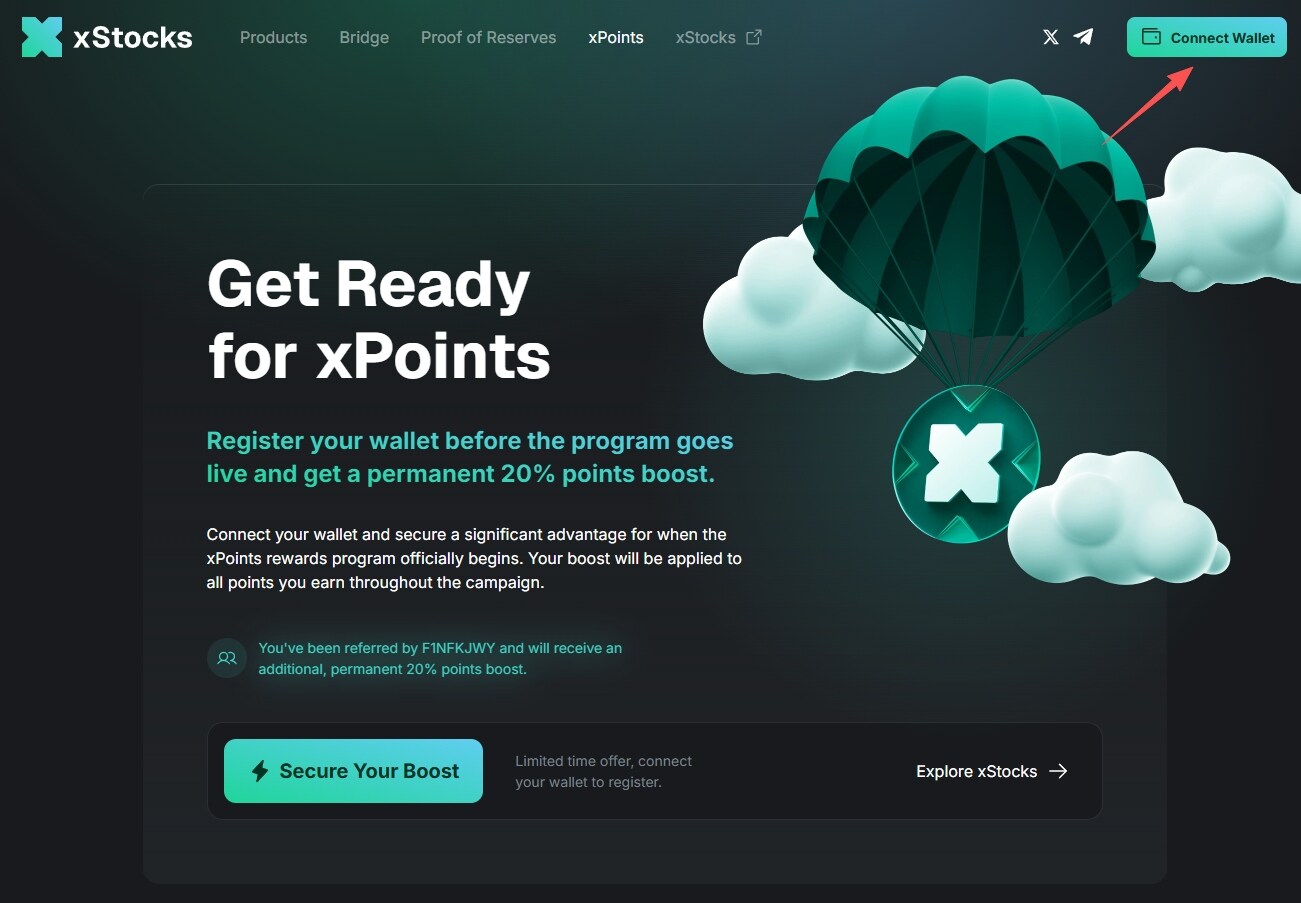
STEP 1. Go to the official website (Link: https://defi.xstocks.fi/points), click "Connect Wallet" to log in.
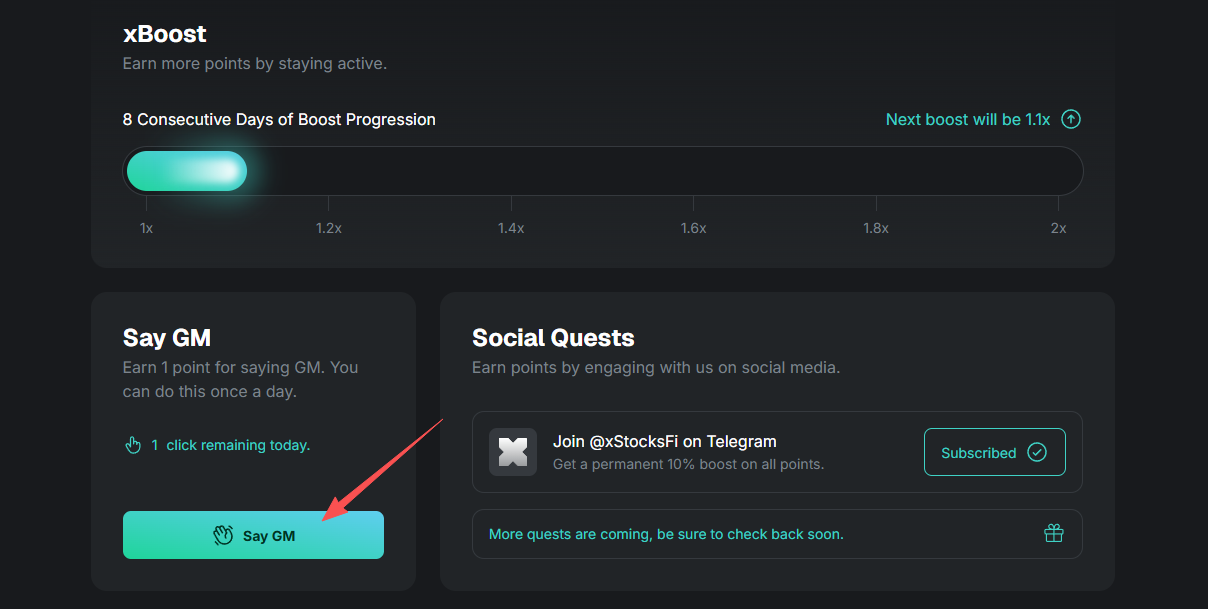
STEP 2. Click GM (daily check-in type task) to earn points. Additionally, joining the official TG and verifying will grant a 10% points bonus.
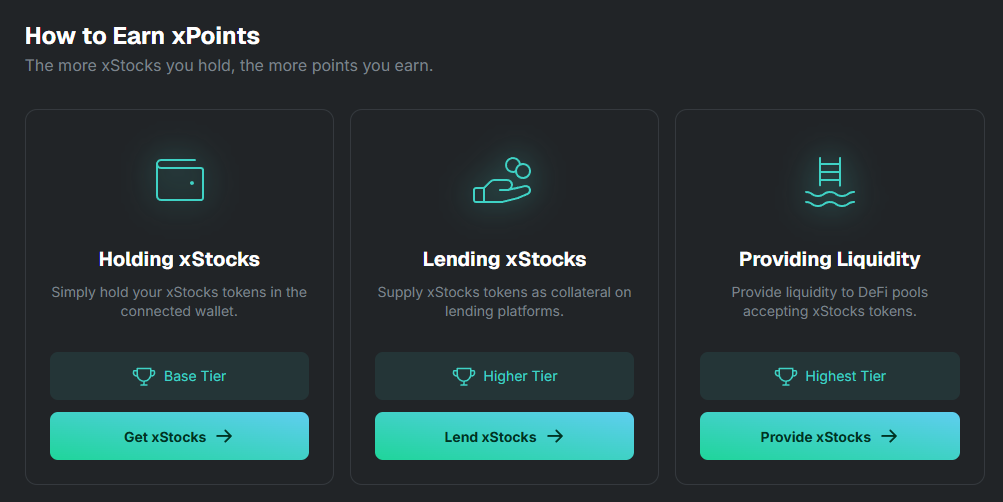
STEP 3. Earn points through three main methods: holding xStocks tokens, borrowing xStocks tokens, and providing liquidity for xStocks tokens, with increasing weight for each method.
Tempo: L1 Project Focused on the Payments Track

Project Introduction

Tempo is an L1 project focused on payments, jointly incubated by Stripe and Paradigm. Its biggest difference from traditional public chains is that it does not issue its own native token but directly accepts mainstream stablecoins like USDC and USDT as Gas.

According to ROOTDATA data, Tempo completed a $500 million Series A funding round on October 8, 2025, led by venture capital giants Greenoaks and Joshua Kushner's Thrive Capital. This round valued Tempo at $5 billion, with participation from Sequoia Capital, Ribbit Capital, and Ron Conway's SV Angel.

On March 18, Tempo announced the launch of its mainnet, marking the official transition of its stablecoin payment system from the testing phase to practical application.

Interaction Tutorial

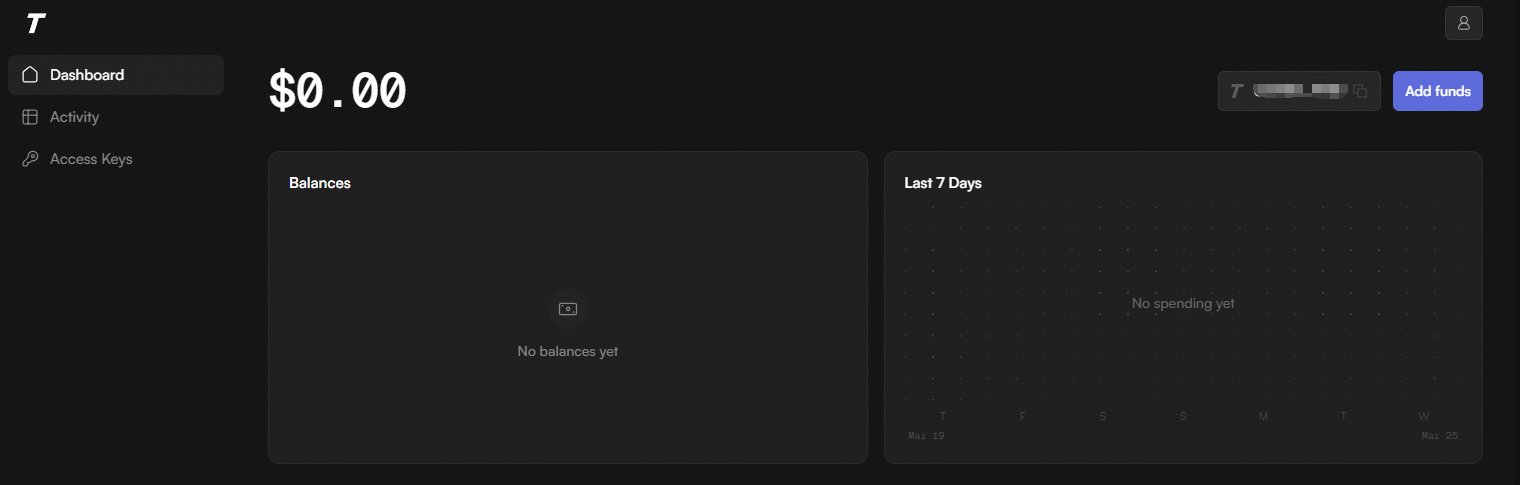
STEP 1. Create a Tempo wallet (Link: https://wallet.tempo.xyz/welcome) by logging in using your computer/phone's Passkey.
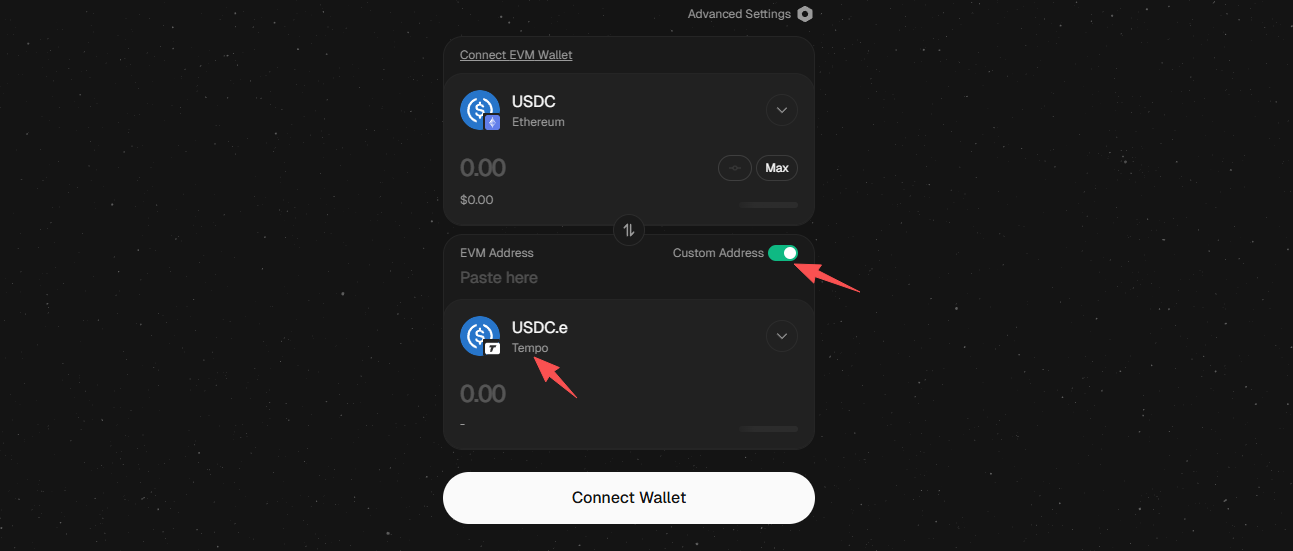
STEP 2. Bridge USDC (Link: https://stargate.finance/). Select USDC, choose the Tempo network as the destination chain, select "Custom address" for the recipient address, paste the newly created Tempo wallet address, and confirm the bridge.
Forte Protocol: Blockchain Infrastructure Focused On-Chain Compliance and Economic Tools

Project Introduction

The Forte Protocol project was established in 2018. It is a set of open-source on-chain compliance and economic rule engines, providing open-source on-chain solutions aimed at creating a secure environment to support healthy and stable digital asset economies. Its trust and privacy protection solutions enable developers to manage compliance risks, promote economic stability, and leverage instant liquidity.

According to ROOTDATA data, Forte Protocol completed two funding rounds as early as 2021, raising a total of $910 million.

Recently, Forte Protocol launched Season 0 tasks on Galxe. Currently, there are 2 tasks available to participate in.

Interaction Tutorial

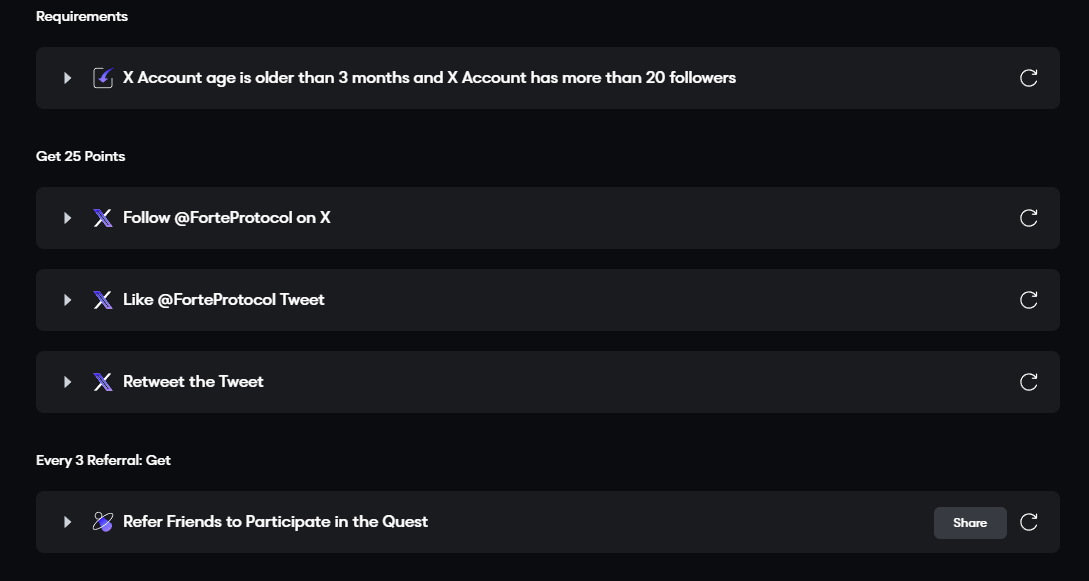
Galxe Task One: Spread the Word (Link: https://app.galxe.com/quest/ForteProtocol/GCHxctYayA?referral_code=GRFr2JLgLym0F_CjZtICIKop6-k3a5AWWjkhuI2Kg5uvmw): X account must be older than 3 months with more than 20 followers, and complete social tasks.
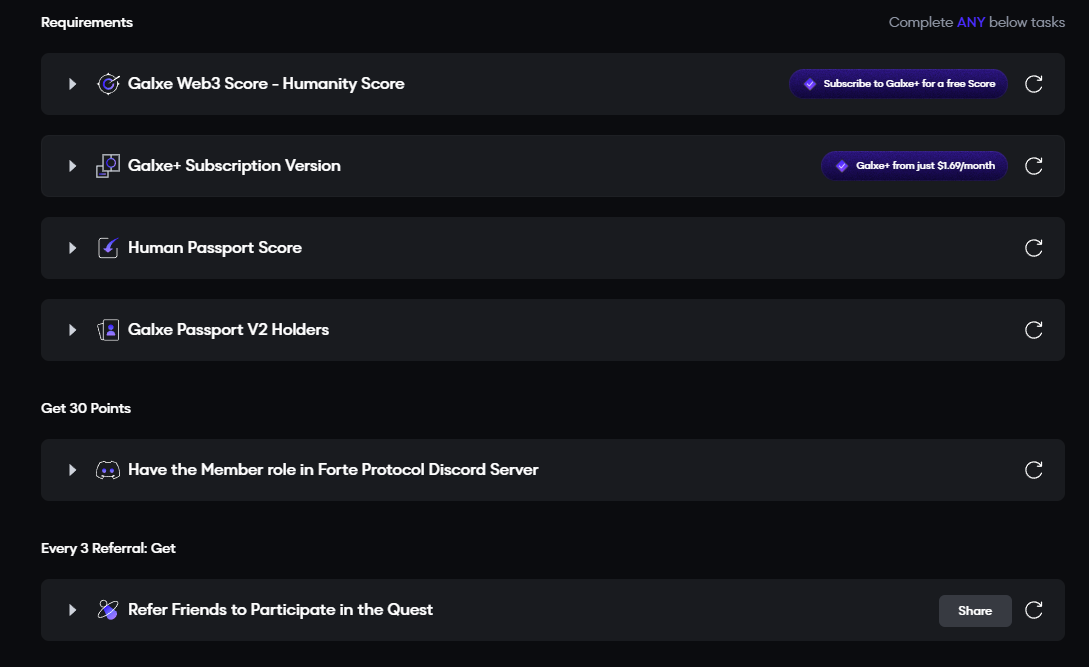
Galxe Task Two: (Link: https://app.galxe.com/quest/ForteProtocol/GCLHFtYfPg?referral_code=GRFr2JPsJmm0Fjrq5tICIKopwKZDR_ow6bG-TQ5tpNQM1dw): Requires a Galxe subscription membership or a Human Passport score that meets the requirements.
Related Questions

QWhat is xStocks and what recent activity did they launch?

AxStocks is a tokenized stock platform that provides on-chain representations of traditional financial assets like stocks, ETFs, and bonds, backed by real stocks held by Swiss custodians. They recently launched an xPoints points program where users can earn points by holding tokenized stocks, establishing positions in lending markets, and providing liquidity on DEXs.

QWhich major exchange acquired Backed Finance, the company behind xStocks?

AKraken acquired Backed Finance in December 2025.

QWhat is Tempo and what makes it different from traditional blockchains?

ATempo is a payment-focused Layer 1 blockchain project incubated by Stripe and Paradigm. Unlike traditional blockchains, it does not have a native token and instead uses mainstream stablecoins like USDC and USDT for gas fees.

QHow much funding did Tempo raise in its Series A round and what was it valued at?

ATempo raised $500 million in its Series A funding round, which valued the company at $5 billion.

QWhat is Forte Protocol and what type of tasks did they recently launch on Galxe?

AForte Protocol is a blockchain infrastructure project focused on on-chain compliance and economic tools. They recently launched 'Season 0' tasks on Galxe, including a 'Spread the Word' social media task and another task requiring a Galxe subscription or a specific Human Passport score.

Related Reads

Google and Amazon Simultaneously Invest Heavily in a Competitor: The Most Absurd Business Logic of the AI Era Is Becoming Reality

In a span of four days, Amazon announced an additional $25 billion investment, and Google pledged up to $40 billion—both direct competitors pouring over $65 billion into the same AI startup, Anthropic. Rather than a typical venture capital move, this signals the latest escalation in the cloud wars. The core of the deal is not equity but compute pre-orders: Anthropic must spend the majority of these funds on AWS and Google Cloud services and chips, effectively locking in massive future compute consumption. This reflects a shift in cloud market dynamics—enterprises now choose cloud providers based on which hosts the best AI models, not just price or stability. With OpenAI deeply tied to Microsoft, Anthropic’s Claude has become the only viable strategic asset for Google and Amazon to remain competitive. Anthropic’s annualized revenue has surged to $30 billion, and it is expanding into verticals like biotech, positioning itself as a cross-industry AI infrastructure layer. However, this funding comes with constraints: Anthropic’s independence is challenged as it balances two rival investors, its safety-first narrative faces pressure from regulatory scrutiny, and its path to IPO introduces new financial pressures. Globally, this accelerates a "tri-polar" closed-loop structure in AI infrastructure, with Microsoft-OpenAI, Google-Anthropic, and Amazon-Anthropic forming exclusive model-cloud alliances. In contrast, China’s landscape differs—investments like Alibaba and Tencent backing open-source model firm DeepSeek reflect a more decoupled approach, though closed-source models from major cloud providers still dominate. The $65 billion bet is ultimately about securing a seat at the table in an AI-defined future—where missing the model layer means losing the cloud war.

marsbit3h ago

Google and Amazon Simultaneously Invest Heavily in a Competitor: The Most Absurd Business Logic of the AI Era Is Becoming Reality

marsbit3h ago

Computing Power Constrained, Why Did DeepSeek-V4 Open Source?

DeepSeek-V4 has been released as a preview open-source model, featuring 1 million tokens of context length as a baseline capability—previously a premium feature locked behind enterprise paywalls by major overseas AI firms. The official announcement, however, openly acknowledges computational constraints, particularly limited service throughput for the high-end DeepSeek-V4-Pro version due to restricted high-end computing power. Rather than competing on pure scale, DeepSeek adopts a pragmatic approach that balances algorithmic innovation with hardware realities in China’s AI ecosystem. The V4-Pro model uses a highly sparse architecture with 1.6T total parameters but only activates 49B during inference. It performs strongly in agentic coding, knowledge-intensive tasks, and STEM reasoning, competing closely with top-tier closed models like Gemini Pro 3.1 and Claude Opus 4.6 in certain scenarios. A key strategic product is the Flash edition, with 284B total parameters but only 13B activated—making it cost-effective and accessible for mid- and low-tier hardware, including domestic AI chips from Huawei (Ascend), Cambricon, and Hygon. This design supports broader adoption across developers and SMEs while stimulating China's domestic semiconductor ecosystem. Despite facing talent outflow and intense competition in user traffic—with rivals like Doubao and Qianwen leading in monthly active users—DeepSeek has maintained technical momentum. The release also comes amid reports of a new funding round targeting a valuation exceeding $10 billion, potentially setting a new record in China’s LLM sector. Ultimately, DeepSeek-V4 represents a shift toward open yet realistic infrastructure development in the constrained compute landscape of Chinese AI, emphasizing engineering efficiency and domestic hardware compatibility over pure model scale.

marsbit3h ago

Computing Power Constrained, Why Did DeepSeek-V4 Open Source?

marsbit3h ago

Trading

Spot
Futures
活动图片





