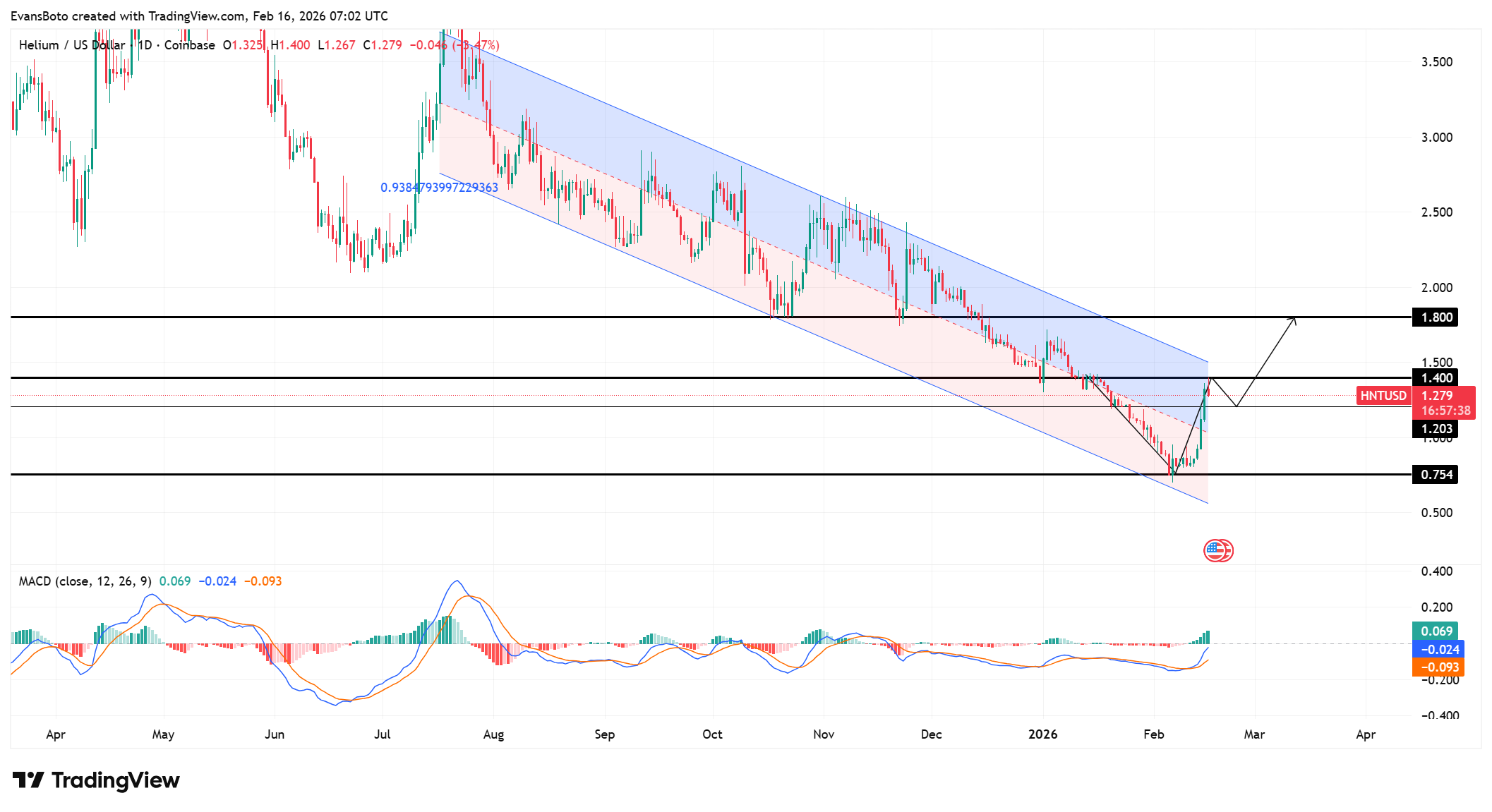
Helium [HNT] has surged over 20% to $1.36, rebounding sharply from regression channel lows near $0.75 as buyers return aggressively.
Price now trades around $1.27 after reaching $1.40 intraday, marking its strongest upward reaction in months.
This rebound emerged precisely from the lower boundary of a descending regression trend channel that has guided the broader decline since mid-2025.
However, HNT now approaches the channel’s upper boundary, where previous rallies stalled.
At the same time, structural sell pressure still lingers beneath the surface, creating tension between price recovery and underlying flow.
Helium tests upper regression channel
HNT has reclaimed the $1.20 level and pushed into the $1.40 supply zone, marking a decisive short-term shift in structure.
Price now sits near the upper boundary of a descending regression trend channel that has guided the broader decline for months.
This boundary aligns closely with the $1.50 region, while stronger horizontal resistance rests at $1.80. Therefore, price faces layered overhead pressure at a technically sensitive zone.
A sustained hold above $1.40 could open room toward $1.80. However, rejection near the channel ceiling would reinforce the prevailing downtrend.
At the same time, MACD prints 0.069, with the signal line at -0.024 and the histogram turning positive. Green bars are now expanding after prolonged compression, showing strengthening bullish energy.
However, the indicator still hovers near neutral territory. Buyers must maintain follow-through to validate this breakout attempt.
Sell pressure lingers beneath the rally
Despite the sharp rebound from $0.75, the 90-day Spot Taker CVD still reflects taker sell dominance.
This reading shows aggressive market sells continue to outweigh buys on a cumulative basis. This creates a divergence between rising price and persistent sell-side flow.
In other words, price climbs even while broader spot aggression favors sellers. Such divergence can weaken rallies if demand fails to absorb supply fully.
However, rapid technical rebounds sometimes unfold under similar conditions when short-term buyers overwhelm liquidity temporarily.
If spot buyers increase conviction, the CVD trend could stabilize and gradually shift. Until that shift appears clearly, the rally remains technically impressive yet structurally fragile.
Open Interest expansion reflects new positions
Open Interest has increased 22.83% to $4.40 million during this surge. That expansion signals traders are opening fresh positions rather than merely closing shorts.
If short covering drove this rally alone, Open Interest would likely decline. Instead, derivatives traders now position aggressively around current levels.
Rising Open Interest alongside advancing price can support continuation if buyers maintain control.
However, leverage also increases downside risk near resistance zones. Should price reject near $1.50 or $1.80, liquidation pressure could amplify volatility quickly.
Therefore, positioning has become sensitive to price behavior at the regression channel ceiling, where leverage could either fuel extension or accelerate reversal.
Rising participation, confirmed
The Spot Volume Bubble Map now shows heating clusters, reflecting expanding spot participation.
Larger bubbles correspond with heightened trading activity during this rebound phase. Increased engagement supports the move from $0.75 toward the $1.40 region.
Rising participation often strengthens breakout attempts because it reflects genuine liquidity rotation.
However, continuation requires sustained activity above reclaimed resistance. If volume contracts sharply near the $1.50 boundary, buying enthusiasm could fade rapidly.
On the other hand, persistent bubble expansion beyond the regression ceiling would validate structural repair more convincingly.
Therefore, liquidity flow now plays a decisive role in determining whether Helium builds on this surge or stalls beneath overhead supply.
Relief bounce or structural shift?
Helium has delivered a powerful rebound from channel lows and now challenges the upper boundary of its regression trend structure.
Technical indicators show rebuilding strength, and participation has expanded. However, structural sell pressure and overhead resistance still dominate the broader picture.
If price sustains strength above $1.40 and pushes toward $1.80 with expanding participation, recovery could gain traction.
Yet rejection at the channel ceiling would reaffirm the prevailing downtrend. Helium now stands at a clear structural decision point.
Final Summary
- Helium rebounded over 20% from $0.75 channel lows to test the $1.40–$1.50 resistance zone, signaling a strong short-term structural recovery.
- However, persistent sell-side flow, rising Open Interest, and overhead channel resistance suggest the rally remains fragile.






