Has the Crypto Talent Market Saturated with an 80% Plunge in Job Openings?

marsbitPublished on 2026-01-19Last updated on 2026-01-19

Abstract

Has the crypto job market reached saturation? The data from early 2026 suggests a sharp slowdown. In the first two weeks of January 2026, only 85–90 new unique job postings were recorded across major crypto-focused job boards—an 80% drop compared to the same period in 2025, which saw around 38 postings per day. Despite the decline, certain trends stand out: 60% of roles are technical/engineering positions, while 40% are non-technical or business development roles. About 65% of openings are mid-to-senior level, indicating that companies are prioritizing experienced talent to lead core projects. Most roles require 5+ years of experience, with management positions demanding 7+ years. Hiring remains strongest among growth-stage companies that have completed Series A funding or beyond. Key areas attracting talent include infrastructure, stablecoins, and payment/fintech startups. Prediction markets like Kalshi and Polymarket are also actively competing for talent. A notable shift is the rising influence of the Solana ecosystem. For the first time since 2016, Solana attracted a larger share of new developers (22%) than Ethereum (16%) in 2024. With a 70% year-over-year increase in ecosystem funding in Q3 2025, Solana is challenging Ethereum’s long-standing dominance in developer and hiring markets. Looking ahead, the author suggests that the crypto job market will continue to evolve. Projects with strong fundamentals, real users, and sustainable revenue models are likely to succe...

Written by: willthetrill

Compiled by: Chopper, Foresight News

Has the recruitment market in the cryptocurrency industry become saturated? The answer is both yes and no. Although there were layoffs sporadically in December, overall, the momentum of hiring in the fourth quarter remained strong.

To uncover the truth, I specifically extracted data from major vertical recruitment websites in the crypto industry for the first two weeks of January 2026 (this data does not include official recruitment pages of companies). The results showed that only 85-90 new independent positions were added during this period.

This year's start has been quite quiet. In contrast, the data for January 2025 was quite impressive, with a total of 1,192 positions posted in that month alone, making it the highest month for recruitment in all of 2025.
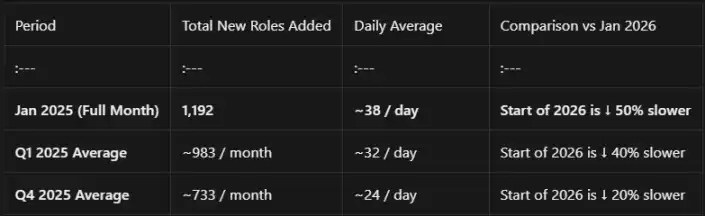
Data as of January 12, 2026

In the first two weeks of January 2025, the average daily number of positions posted was about 38; in the same period of 2026, the average daily number of positions posted was only about 6.5.

Recruitment activity in early January decreased by approximately 80% compared to the same period last year. This data confirms the widespread speculation: the industry's start this year is far less heated than last year.

Analyzing the details of the above job data, the main characteristics of the current recruitment market are as follows:

  • Distribution of job types: Technical/engineering positions account for 60%, while non-technical/business development positions account for 40%.
  • Distribution of job levels: Mid-to-senior positions such as specialists/senior specialists/supervisors/department heads account for about 65%. This signal indicates that companies are prioritizing the recruitment of experienced talent to lead key projects related to core product development and business growth.
  • Experience requirements: Most positions require candidates to have more than 5 years of relevant experience; management positions require more than 7 years of experience.

When conducting screening interviews with candidates, I often ask them: What currently attracts you to the crypto industry? The answers are invariably two: prediction markets and stablecoins. Therefore, it is no surprise that the data shows about 60% of recruitment demand is concentrated in infrastructure teams, stablecoin projects, and payment/fintech infrastructure startups. Additionally, the talent war between Kalshi and Polymarket continues, and this competition is expected to persist.

The most aggressive recruiters at the moment are those growth-stage enterprises (i.e., companies that have completed Series A funding or above). A quick glance at the recruitment pages of several companies and information on the Ashby platform can also confirm this conclusion.

  • Series A companies: Lifi Protocol has 13 open positions, Privy IO (acquired) has 10 open positions, Crossmint has 10 open positions, Coinflow Labs has 14 open positions;
  • Series B companies: TurnkeyHQ has 12 open positions;
  • Series C companies: Raincards has 49 open positions;
  • Series D companies: Anchorage has 66 open positions.

However, perhaps more intriguing is the change in talent flow.

Having worked full-time in crypto recruitment for 5 years, I can't help but reflect: "Has there ever been a public chain ecosystem, like Solana, that challenged Ethereum's dominance in the recruitment and developer growth arena?" The answer is: no, at least not on such a scale.

Looking back, other public chains like Polkadot and Cosmos have all experienced phases of rapid growth in developer numbers, but they have never been able to pose a challenge to Ethereum of the same magnitude in terms of market share and sustained recruitment scale.

Solana is the first ecosystem truly capable of competing with Ethereum. In 2024, it set a historic record: for the first time since 2016, the proportion of new contributing developers exceeded that of Ethereum. Solana attracted over 22% of the new developers in the crypto industry, while Ethereum's proportion was about 16%. This phenomenon is quite rare, especially considering that in the past, Ethereum almost monopolized the vast majority of new talent.
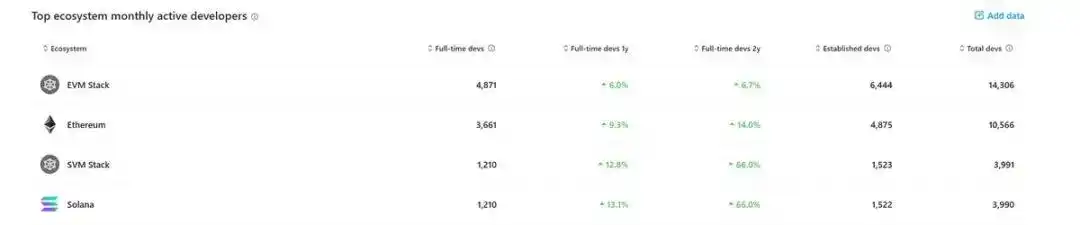
Data source: Electric Capital "Developer Report," as of January 14, 2026

In the third quarter of 2025 alone, 23 Solana ecosystem projects completed financing, raising a total of $211 million, representing a 70% year-on-year growth in ecosystem financing scale.

For example: When a project completes a $13.5 million financing round (such as Raikucom's financing in the third quarter of 2025), its first priority is to recruit 5-10 senior engineers to build the core engineering team and business development team. Such positions often do not appear on public recruitment websites but are instead filled through investor/angel investor networks, hackathon events, and targeted headhunting.

The crypto industry is constantly evolving, and the landscape of the recruitment market will change accordingly. Through token issuance, crypto technology has been able to drive the maximization of development in internet capital markets. However, the reality is that the vast majority of tokens issued in the past two years have seen their prices decline.

I believe that in 2026, the ripple effects of this phenomenon will gradually emerge, impacting companies' risk financing methods, market expansion strategies, and, of course, talent recruitment strategies.

The projects that will stand out this year will undoubtedly be those with solid business fundamentals, a real user base, solving actual needs, and most importantly, those capable of generating revenue.


Related Questions

QAccording to the data, what was the percentage decline in daily job postings in the crypto industry in early January 2026 compared to the same period in 2025?

AThe daily job postings in early January 2026 declined by approximately 80% compared to the same period in 2025.

QWhat are the two main areas that candidates are most attracted to in the crypto industry, as mentioned in the article?

AThe two main areas that attract candidates are prediction markets and stablecoins.

QWhich blockchain ecosystem is highlighted as the first to seriously challenge Ethereum's dominance in terms of developer recruitment and growth?

AThe Solana ecosystem is highlighted as the first to seriously challenge Ethereum's dominance in developer recruitment and growth.

QWhat type of companies are currently the most aggressive in their hiring efforts within the crypto space?

AGrowth-stage companies (those that have completed Series A funding or later) are currently the most aggressive in their hiring efforts.

QWhat key characteristic is mentioned for projects that are expected to stand out in 2026?

AProjects that are expected to stand out in 2026 are those with solid business fundamentals, a real user base, solving actual needs, and, most importantly, the ability to generate revenue.

Related Reads

Will the Fed Definitely Raise Interest Rates in September? How Will Crypto and U.S. Stocks Withstand the Pressure?

The market's expectation for a September Fed rate hike surged dramatically in early August, jumping from under 50% to over 80% within a week. This shift followed a contentious July FOMC meeting, where a 9-3 vote to hold rates revealed growing dissent from hawkish members advocating for an immediate hike to combat persistent inflation. The primary catalyst for this repricing is rising oil prices, driven by renewed geopolitical tensions around the Strait of Hormuz, which threaten global supply. Energy costs directly influence inflation metrics, making the upcoming July CPI report (due August 12th) a critical data point. If it shows inflation reaccelerating, the probability of a September hike will solidify. For Bitcoin and crypto assets, this is typically bearish news. Bitcoin continues to behave as a high-beta, liquidity-sensitive risk asset. A rate hike raises the opportunity cost of holding non-yielding assets and could drive capital toward money markets, pressuring crypto prices in the short term. However, historical patterns suggest that if a hike is perceived as the end of a tightening cycle rather than the start, any negative price impact may be brief. U.S. stocks, particularly crypto-linked equities like Coinbase and growth-oriented tech stocks, are also vulnerable. Higher rates increase discount rates in valuation models, putting pressure on high-multiple companies. This coincides with a pivotal tech earnings season where investor focus has shifted from massive AI capital expenditure to tangible revenue and cash flow generation. Companies with negative cash flow and weak growth narratives could face heightened volatility if borrowing costs rise in September. In summary, a September Fed hike has evolved into a mainstream market scenario. Key factors to watch are oil prices, the July CPI report, and Fed communications, which will determine the final decision and its impact on volatile crypto and equity markets.

marsbit2m ago

Will the Fed Definitely Raise Interest Rates in September? How Will Crypto and U.S. Stocks Withstand the Pressure?

marsbit2m ago

A 'Overlooked' Market Event: Joint US-Japan-South Korea Intervention, Rare US Treasury Involvement, and Bessent's Quiet 'Market Rescue'?

Summary: The United States, Japan, and South Korea executed their largest coordinated foreign exchange intervention in nearly 30 years. The action targeted depreciation pressure on the Japanese yen and South Korean won. This move is seen as a significant effort by the US to stabilize the financial markets of its key allies and prevent the spillover of risks. Key details: * Japan reportedly intervened on July 30 using approximately 8.45 trillion yen (about $52.8 billion). South Korean authorities also intervened that day, selling dollars to support the won. * Notably, the US Treasury Department intervened directly in yen markets for the first time in roughly 30 years. The New York Fed, reportedly acting on behalf of the Treasury, sold euros to buy yen via Goldman Sachs and Morgan Stanley on July 31. Analysts view the use of the euro-yen pair as a way to alleviate yen pressure without adding selling pressure to the US dollar. * Prior to the action, the New York Fed conducted "rate checks" on both USD/JPY and EUR/JPY, a newer signaling tool that falls between verbal and physical intervention. The intervention is interpreted as going beyond traditional currency stabilization. Analysts, such as Michael Hartnett of Bank of America, suggest it resembles a "Price Keeping Operation" for the AI era. The core US objectives are perceived to be: 1. Preventing rapid yen depreciation from triggering a sharp rise in Japanese government bond yields. 2. Containing financial stress from spreading across Asian markets like South Korea and Japan. 3. Reducing the risk of disorderly capital flows impacting the US bond market. This coordinated action underscores the importance of Japan and South Korea as critical partners in the US semiconductor and AI supply chain. Stabilizing their financial markets is seen as vital to mitigating risks to the broader tech industry and the US market itself. The intervention coincides with market pressures, including the KOSDAQ index hitting a low since October 2022. While seen as a move to control volatility, some analysts caution it may not fundamentally reverse existing market trends.

marsbit6m ago

A 'Overlooked' Market Event: Joint US-Japan-South Korea Intervention, Rare US Treasury Involvement, and Bessent's Quiet 'Market Rescue'?

marsbit6m ago

Will the Federal Reserve Definitely Raise Interest Rates in September? How Will Cryptocurrencies and US Stocks Bear the Pressure?

In early August 2024, market expectations for a September Federal Reserve rate hike surged dramatically, from below 50% to over 80%, driven by renewed inflation concerns. This shift followed a contentious July FOMC meeting where a 9-3 vote to hold rates revealed a growing hawkish faction advocating for an immediate hike, citing prolonged above-target inflation. The key catalyst is escalating conflict near the Strait of Hormuz, which has pushed oil prices up approximately 20% in July, threatening to reignite inflation. The next critical data point is the July CPI report on August 12th; a hot reading could solidify hike expectations. For crypto assets, particularly Bitcoin, this represents near-term pressure. Bitcoin continues to exhibit high-beta, risk-on characteristics, making it sensitive to tightening liquidity and higher opportunity costs. However, historical precedent suggests that if a hike is perceived as the cycle's end rather than its start, the negative impact may be brief, with markets quickly pivoting to anticipate future rate cuts. U.S. stocks, especially crypto-linked equities like Coinbase and high-valuation tech stocks, face amplified volatility. Higher rates increase discount rates in valuation models, pressuring growth stocks. This coincides with a pivotal tech earnings season where investor focus has shifted from massive AI capital expenditures to demonstrable revenue and cash flow generation. Companies with negative cash flows and weak growth narratives could see severe pressure if a September hike materializes, as financing costs would rise. Key indicators to watch include oil prices, upcoming inflation data, and Fed commentary at events like the Jackson Hole symposium.

Odaily星球日报6m ago

Will the Federal Reserve Definitely Raise Interest Rates in September? How Will Cryptocurrencies and US Stocks Bear the Pressure?

Odaily星球日报6m ago

Trading

Spot
活动图片




