Has Hook Summer Truly Arrived? sato, Lo0p, FLOOD Ignite the New Uniswap v4 Narrative

Odaily星球日报Published on 2026-05-11Last updated on 2026-05-11

Abstract

With the broader market showing signs of recovery, a new wave of interest has emerged around Ethereum-based meme coins. Following ASTEROID, tokens like sato, sat1, Lo0p, and FLOOD, built upon the Uniswap v4 Hook protocol, are capturing market attention. Their market capitalizations range from millions to tens of millions of dollars, injecting much-needed focused liquidity into a market lacking narratives. This article explores whether this trend signifies an incoming "Hook Summer" and its potential impact on UNI's price. Hooks are essentially plug-in smart contracts for Uniswap v4 liquidity pools, allowing developers to inject custom logic at key points in a pool's lifecycle (like initialization, adding/removing liquidity, swaps). This transforms the AMM into programmable building blocks. Key highlighted projects include: * **sato**: Peaked over $38M market cap. It utilizes a v4 curve for minting/burning; buying locks ETH as reserve to mint new tokens, while selling redeems ETH from the reserve and burns tokens. * **sat1**: Market cap briefly exceeded $10M, promoted as an "optimized sato," but later declined significantly. * **Lo0p**: Reached nearly $6.6M. It's a lending AMM protocol where buying LO0P tokens locks them as collateral, allowing users to borrow ETH from the pool reserve at 40% LTV, aiming to improve capital efficiency for idle ETH in LPs. * **FLOOD**: Peaked near $6M. Its mechanism directs asset reserves from buys into Aave v3 to generate yield, with f...

Original | Odaily Planet Daily (@OdailyChina)

Author | Wenser (@wenser 2010 )
As the broader market shows slight signs of recovery, the heat for Ethereum ecosystem Meme coins has reignited. Following ASTEROID, ecosystem tokens like sato, sat1, Lo0p, and FLOOD, which are backed by the Uniswap v4 Hook protocol, have gradually become the focus of market attention. Their market capitalizations range from several million to tens of millions of dollars, bringing much-needed concentrated liquidity to the crypto market that has been lacking narratives. In this article, Odaily Planet Daily will briefly review the information about these tokens and explore whether this wave of excitement can drive a recovery in the UNI token price.

Has Hook Summer Arrived? 4 Major Ecosystem Tokens, Intelligent Liquidity Management

According to Uniswap's official documentation, Hooks are essentially "plugin-style smart contracts" custom-designed for liquidity pools (Pools) in Uniswap v4. Unlike traditional Uniswap V2/V3 which only have a fixed constant product curve (x*y=k), Hooks allow developers to automatically inject custom logic before or after key lifecycle events of a pool (initialization, adding/removing liquidity, Swap, Donate, etc.), thereby turning the entire AMM (Automated Market Maker) into programmable "Lego bricks". In addition to the earlier uPEG, recent representative projects are as follows:

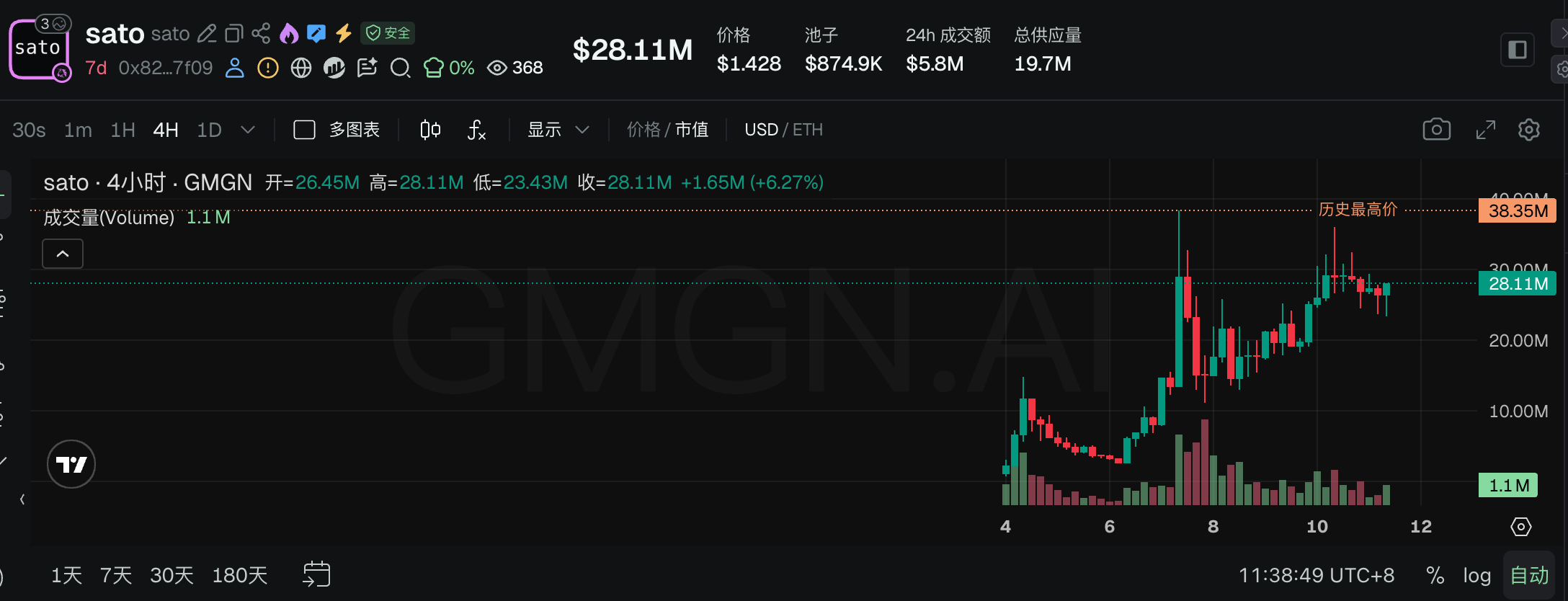
sato: Market Cap Peak Over $38 Million

CA: 0x829f4b62eebe12af653b4dd4ffc480966f7d7f09

Current Market Cap: Approximately $28 Million

On May 4th, immediately after sato's debut, Odaily Planet Daily briefly introduced it. At that time, its market cap was only $9 million. This token is minted and burned through the Uniswap v4 bonding curve mechanism. Buying generates new tokens and locks ETH as reserves, while selling exchanges ETH from the reserves and burns tokens. At that point, its cumulative buy volume had approached 1000 ETH. Subsequently, sato's market cap once exceeded $30 million.

Although community users later discovered its curve mechanism had buy-sell price disparities, causing its market cap to once drop below $13 million, its innovative mechanism and first-mover advantage have kept its current market cap around $28 million, with a 24-hour trading volume nearing $6 million.
sat1: Market Cap Peak Over $10 Million

CA: 0x8f66337a0c2a02202fd91dd596c411cf977c6060

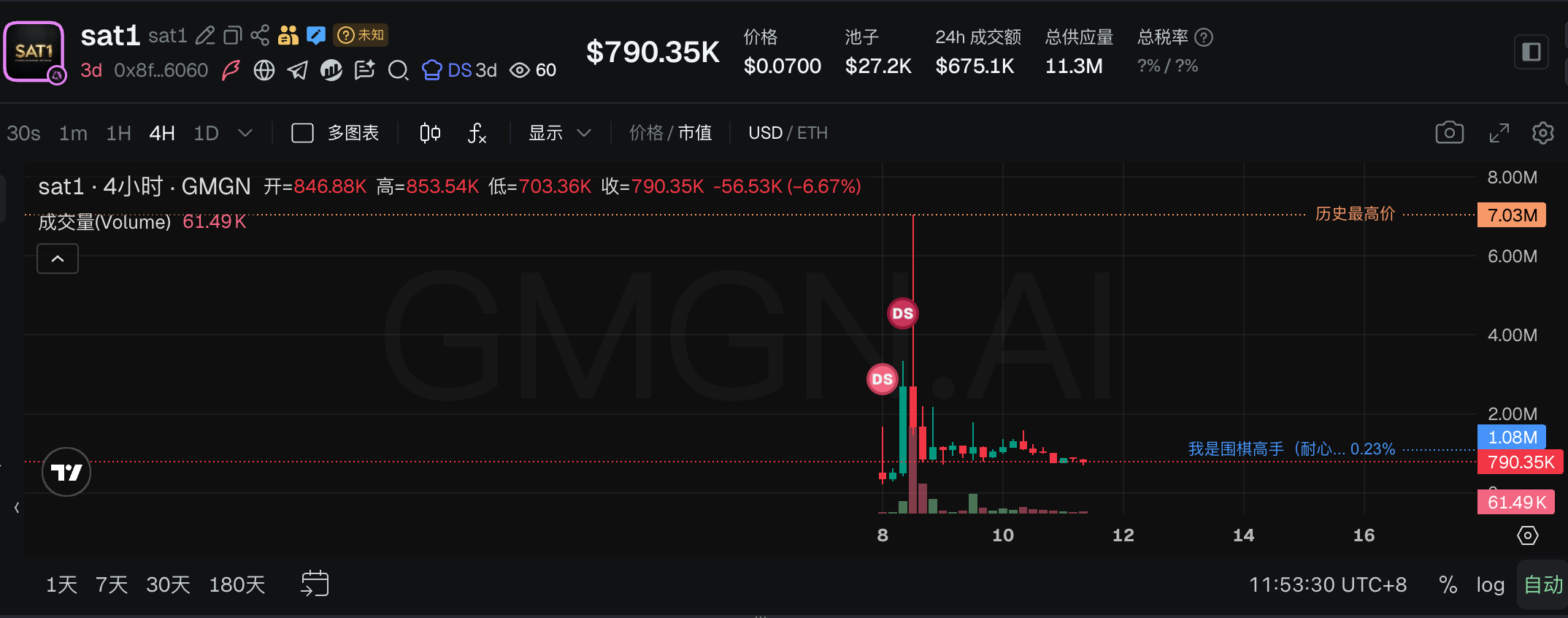
Current Market Cap: Approximately $800,000

On May 8th, sat1, marketed as an "optimized version of sato", reached its hype peak. Thanks to strong promotion by crypto KOL Huanba Longwang (Dragon King) in WeChat groups, the token's market cap once surpassed $10 million. However, following subsequent backlash, the project eventually spiraled downwards, with its market cap now less than a tenth of its peak.
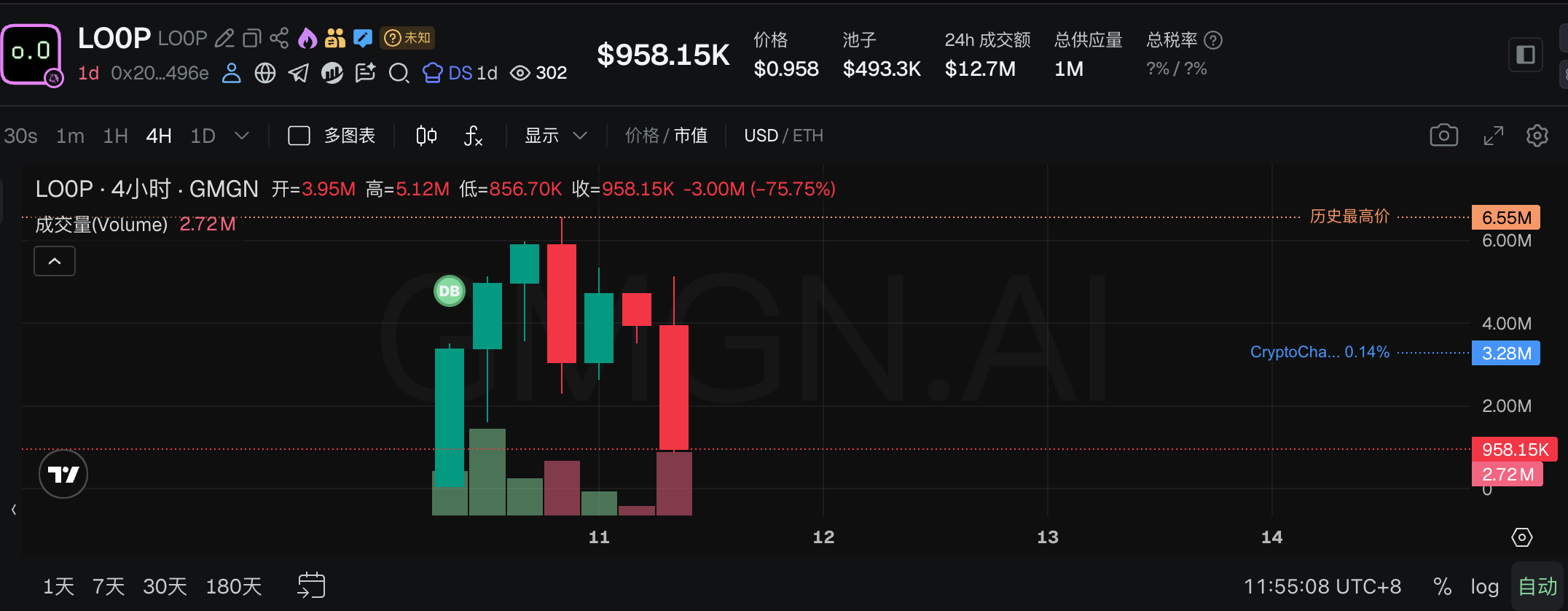
Lo0p: Market Cap Peak Close to $6.6 Million

CA: 0x20ea861b3acec90d3a15b4755d9a1cf1f161496e

Current Market Cap: Approximately $960,000

Official Account: https://x.com/lo0pio

On May 10th, Lo0p's market cap once exceeded $6 million, with a daily increase of over 110x. Similarly, Lo0p's main concept is a "lending AMM protocol based on Uniswap v4 Hooks", aiming to solve the idle ETH capital efficiency issue in LP pools. Users buy LO0P tokens through a bonding curve, which are locked as collateral (without selling), and can directly borrow ETH from the pool reserves at a 40% LTV; borrowing does not directly impact the spot price, and the post-liquidation mechanism attempts to refill the LP band. Hooks inject custom logic during Swap/liquidity lifecycle events, achieving "collateralized lending + LP rewards + borrowing interest" composite returns while maintaining pool price stability. Its core mechanism lies in "built-in lending."
FLOOD: Market Cap Peak Nearly $6 Million

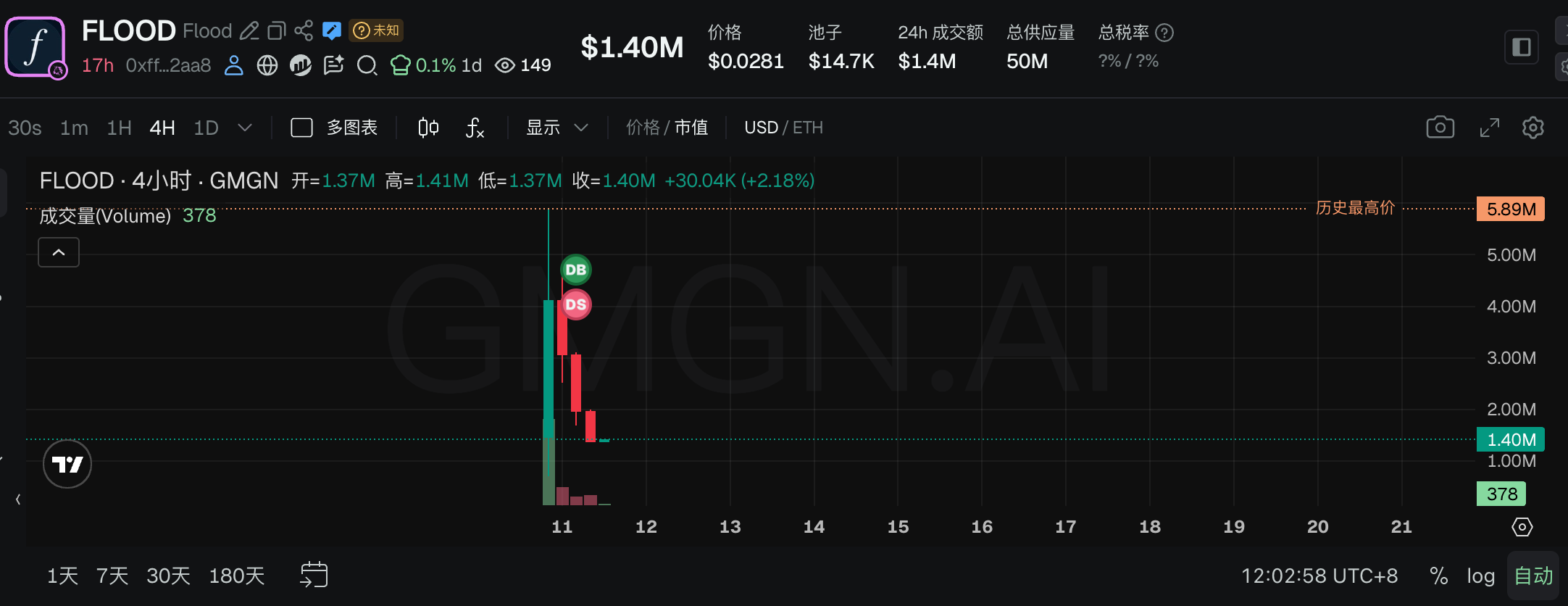
CA: 0xff003fbe8b8d5e7f271a9cb9f2780003daed2aa8

Current Market Cap: Approximately $1.4 Million

Official Account: https://x.com/flood_markets

On May 10th, FLOOD's market cap once exceeded $5 million. As the hype subsided, its current market cap is around $1.4 million. It is reported that FLOOD has a total supply of 50 million tokens. Its special mechanism is: the asset reserves generated from user purchases enter the corresponding Aave v3 market to earn yield; transaction fees are also retained within the pool, used to increase reserves and influence token price. The core lies in the Aave integration for automatic yield, with the Hook mechanism playing the role of "automatic rebalancing and yield recycling". No wonder some community users remarked: "Buying funds enter the pool → pool assets earn interest on Aave → interest stays in the pool → long-term price increase. So this is using my money to deposit and earn interest?"
Hook Mechanism Tokens Drive Uniswap Ecosystem Development: UNI Bullish Long-Term, But Limited Short-Term Gains

Thanks to the rapid development of the Uniswap v4 Hook mechanism, ecosystem tokens in this sector have become a category alongside Meme coins and project ecosystem tokens. In the long run, they can further attract users and capital liquidity to participate in Uniswap v4 liquidity pool trading and development.

Combined with the previous news that "Uniswap has turned on the fee switch, with a portion of protocol fees used to burn UNI tokens," the long-term fundamentals of UNI appear steady and positive.

However, in the short term, the emergence of Hook mechanism tokens cannot directly drive a rise in the UNI token price. Factors such as the lifecycle and sustainability of these tokens, token price volatility versus transaction fee proportions, and UNI's susceptibility to crypto regulatory policies and broader market trends intervene.

Therefore, in summary, the Hook ecosystem is a "long-term nutrient" for UNI, but in the short term, it acts more like a "catalyst" rather than a "booster."

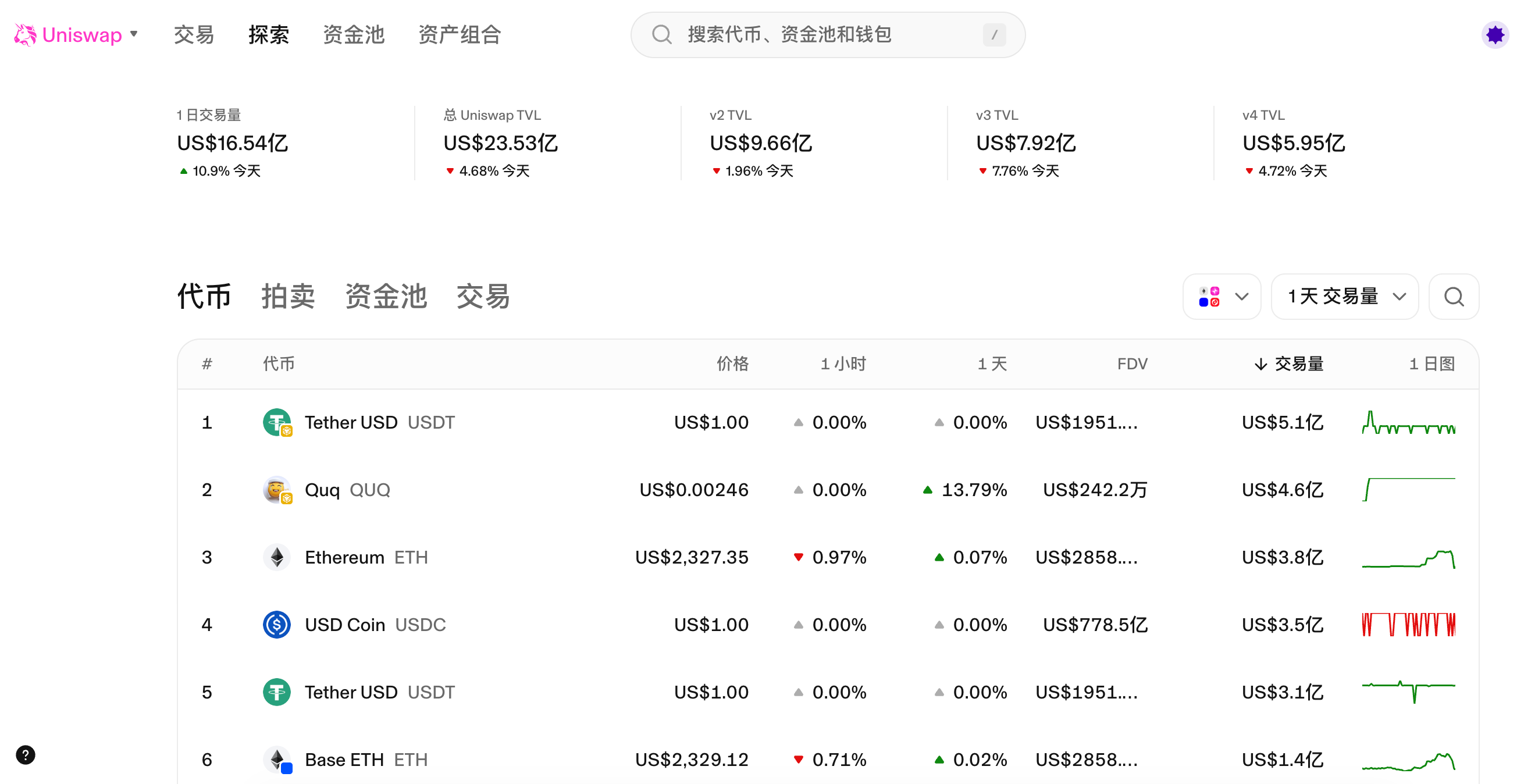
Furthermore, according to the Uniswap official website, the current v4 TVL is approximately $595 million, slightly lower than v3 ($792 million) and v2 ($966 million) liquidity pools. Thus, v4 and the Hook ecosystem still require time to accumulate strength and gradually grow into mainstream liquidity management protocols in the market.
Finally, Odaily Planet Daily reminds readers that the above tokens are all early-stage technological innovation experiments and may contain unknown bugs or other risks. Please be aware of relevant risks when participating in trading. The above information does not constitute investment advice.

Related Questions

QAccording to the article, what is a Uniswap v4 Hook and what is its primary function?

AA Uniswap v4 Hook is a 'plugin smart contract' designed for liquidity pools (Pools). It allows developers to automatically inject custom logic at key lifecycle points of a pool (such as initialization, adding/removing liquidity, Swap, Donate, etc.), transforming the AMM into programmable 'Lego blocks', unlike the traditional constant product curve (x*y=k) of V2/V3.

QWhat unique mechanism does the FLOOD token implement using its Hook?

AFLOOD's Hook integrates with Aave v3. When users buy the token, the generated asset reserves are deposited into the corresponding Aave v3 market to generate yield. The trading fees are also retained within the pool to increase reserves and influence the token's price. The Hook facilitates automatic rebalancing and the flow of generated interest back into the pool.

QWhat problem does the Lo0p protocol aim to solve, and what is its core feature?

AThe Lo0p protocol aims to solve the problem of idle ETH capital efficiency in LP pools. Its core feature is 'built-in lending'. Users can buy LO0P tokens as collateral (without selling) and borrow ETH directly from the pool reserves at a 40% LTV. This mechanism is designed to not directly impact the spot price and attempts to refill the LP band upon liquidation.

QWhat is the article's conclusion regarding the impact of Hook mechanism tokens on the price of UNI in the short and long term?

AThe article concludes that Hook mechanism tokens serve as 'long-term nutrients' for UNI, contributing positively to its fundamentals. However, in the short term, they act more like a 'catalyst' rather than a 'propellant' for a direct price increase, as their impact is moderated by factors like token lifecycle sustainability and broader market trends.

QBased on the article, what was a key risk or criticism identified by the community regarding the sato token's initial mechanism?

AThe community discovered that sato's curve mechanism had a significant buy-sell price spread (slippage), which led to a sharp decline in its market capitalization, dropping from over $38 million to around $13 million at one point.

Related Reads

Fei-Fei Li's Team Clarifies the Concept of 'World Models', Sora Merely a Renderer

"World Models" has become a widely used yet confusing term in AI. To address this, a team led by Fei-Fei Li and World Labs proposed a functional taxonomy based on the Partially Observable Markov Decision Process framework. This taxonomy categorizes systems called "world models" into three distinct projections: Renderers, Simulators, and Planners. Renderers, like OpenAI's Sora and other video generation models, focus on producing photorealistic visual outputs for human perception. They prioritize visual fidelity over physical accuracy. Simulators, such as NVIDIA Omniverse, aim to compute precise future environmental states for computational tasks like engineering analysis or digital twins. Planners, like Vision-Language-Action models, take in observations and goals to output executable actions for robots or agents. The article clarifies that most current "world models," including Sora, are primarily Renderers. They generate convincing visuals but lack the core ability to simulate state transitions based on actions, a key requirement for a true world model in classic reinforcement learning definitions. This conceptual confusion has practical implications, leading to potential misalignment in technology selection, investment, and public understanding of AI capabilities. Clear categorization is crucial. It helps enterprises avoid costly mistakes (e.g., using a renderer for robot training), allows investors to accurately assess markets, and enables researchers to build comparable benchmarks. While future systems may integrate these functions, recognizing current boundaries is essential for honest assessment and progress.

marsbit35m ago

Fei-Fei Li's Team Clarifies the Concept of 'World Models', Sora Merely a Renderer

marsbit35m ago

Bloomberg Uncovered: How Do China's Wealthy Circumvent the Annual $50,000 Limit to Transfer Assets?

**Summary: How Wealthy Chinese Circumvent $50,000 Annual Foreign Exchange Limits** Despite China's strict capital controls, including an annual $50,000 per person foreign exchange quota, an estimated $150 billion in funds still leaves the country annually via various gray and underground channels. This report outlines the evolution of China's "capital wall" and the methods used to bypass it. **The Evolving Capital Controls:** * **Foundation (1994):** The system of "current account convertibility with strict capital account controls" was established. * **Quota Set (2007):** The $50,000 individual annual forex purchase limit was formalized. * **Crackdown Begins (2015-2017):** Following market volatility, enforcement tightened. Banks were required to scrutinize transactions, and channels like using UnionPay cards for Hong Kong insurance premiums or buying overseas property were blocked. * **Digital & Legal Upgrades (2024-2026):** Enhanced algorithms now flag suspicious patterns (e.g., "smurfing"). The Common Reporting Standard (CRS) provides Chinese tax authorities with data on citizens' offshore accounts. Unlicensed cross-border brokers have been targeted. **Five Primary Methods for Moving Capital:** 1. **Underground Banking / "Hawala" (Duiqiao):** The largest-scale method. No money crosses borders. Clients pay RMB to a domestic account; an overseas associate deposits equivalent foreign currency into the client's offshore account. Risks include high fees, account freezes, and legal penalties. 2. **"Smurfing" or "Ant Moving":** Using multiple individuals' $50,000 quotas to pool funds for one offshore recipient. Increasingly detected by anti-money laundering algorithms. 3. **Trade Invoice Manipulation:** Businesses over-invoice imports or under-invoice exports via offshore shell companies, creating a pretext to transfer excess funds abroad under the guise of trade. 4. **Channel Migration:** After a crackdown on internet brokers, funds flow toward more compliant but costly channels like major banks' cross-border wealth management services or Qualified Domestic Institutional Investor (QDII) quotas. 5. **Structural Arrangements:** High-net-worth individuals use complex, high-cost legal structures involving offshore trusts, insurance, and investment migration programs to transfer asset ownership. **Regulatory Response: Focusing on People, Not Just Money** The current strategy extends oversight from enterprises to **individual residents**. Tools like CRS allow retroactive visibility into offshore assets. Cryptocurrencies, once seen as a potential loophole, are now actively monitored and prosecuted as an illegal channel. The underlying driver remains: with significant wealth concentrated among millions of affluent households seeking diversification amid domestic economic shifts, the incentive to move assets offshore persists despite regulatory barriers.

marsbit55m ago

Bloomberg Uncovered: How Do China's Wealthy Circumvent the Annual $50,000 Limit to Transfer Assets?

marsbit55m ago

Trading

Spot
Futures
活动图片