Grayscale says Zcash can challenge Bitcoin’s network effects as privacy demand grows

cointelegraphPublished on 2026-08-27Last updated on 2026-08-27

Abstract

Grayscale suggests that Zcash could challenge Bitcoin's dominance as demand for financial privacy grows, fueled by concerns over AI-powered surveillance. In a research report, Grayscale's Zach Pandl argues that Zcash's ability to shield transaction information provides a "second mover advantage" against Bitcoin's network effects. ZEC has surged nearly 19-fold in the past year, yet its market cap remains under 1% of Bitcoin's, indicating potential upside if it gains market share. Grayscale estimates Zcash could reach over $4,000 per coin if it captures 5% of Bitcoin's market cap. However, it cautions that ZEC remains a high-risk, volatile investment and that Bitcoin's liquidity is a strong defense. Institutional interest is growing, as evidenced by Cypherpunk Technologies acquiring a major Zcash mining fleet.

Zcash could emerge as a meaningful challenger to Bitcoin’s dominance among digital assets as the rapid adoption of artificial intelligence puts a premium on financial privacy and fuels concerns over AI-powered surveillance, according to Grayscale.

In a new research report, Grayscale head of research Zach Pandl said Zcash (ZEC) has “second mover advantages” that could help it challenge Bitcoin’s (BTC) entrenched network effects, something previous alternatives such as Litecoin (LTC) have failed to achieve.

Central to Pandl’s argument is financial privacy. Zcash can shield transaction information, which Grayscale argues could become increasingly valuable as AI systems become better at analyzing financial activity at scale.

The report comes after ZEC’s roughly 19-fold increase over the past year. Despite those gains, Zcash remains valued at less than 1% of Bitcoin’s market capitalization, a disparity Grayscale sees as evidence of further upside if Zcash can capture market share.

Pandl acknowledged that Bitcoin’s liquidity and entrenched network remain powerful defenses of its dominant position. Grayscale also warned that Zcash remains a high-risk investment and that any further gains could be volatile and uneven.
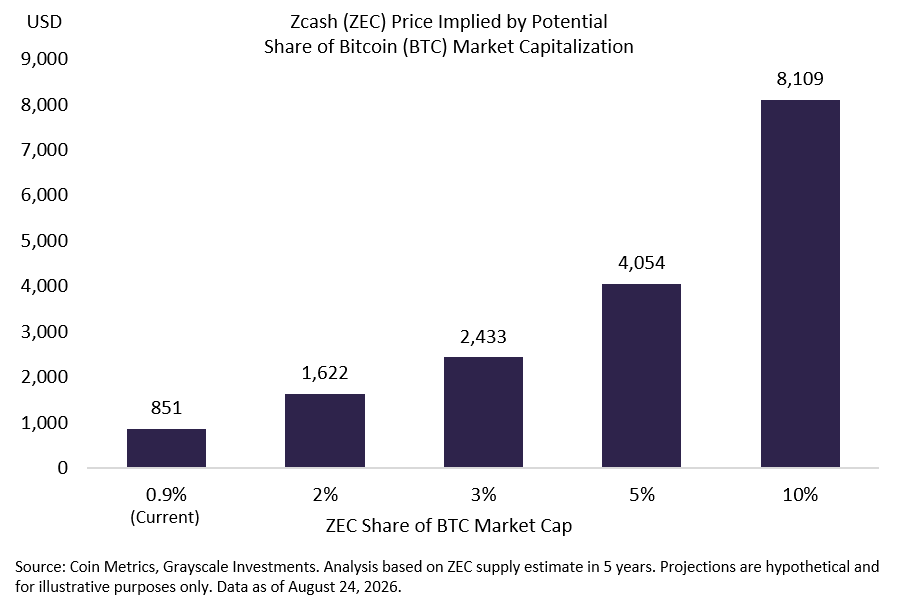
Zcash could be valued at more than $4,000 if its market capitalization reached 5% of Bitcoin’s. Source: Grayscale

Related: Zcash’s Ironwood upgrade faces possible delay over infrastructure readiness

Zcash ecosystem attracts institutional capital

Interest in the Zcash ecosystem is broadening alongside ZEC’s strong price performance. As Cointelegraph recently reported, Nasdaq-listed privacy technology company Cypherpunk Technologies expanded its Zcash exposure by acquiring a mining fleet from Winklevoss Capital in a $33.33 million equity-based transaction.

The operation is already online across US facilities, producing about 4.2 GSol/s of Equihash hashrate, or roughly 18% of the Zcash network’s total computing power. Cypherpunk said the deal made its mining arm the network’s largest active fleet.

Related: Strategy’s $66B Bitcoin machine hinges on capital markets, not BTC price: Report


Related Questions

QAccording to Grayscale, why could Zcash emerge as a meaningful challenger to Bitcoin?

AAccording to Grayscale, Zcash could emerge as a meaningful challenger to Bitcoin as the rapid adoption of artificial intelligence increases the premium on financial privacy and fuels concerns over AI-powered surveillance, leveraging Zcash's ability to shield transaction information.

QWhat advantage does Zach Pandl from Grayscale attribute to Zcash in its potential to challenge Bitcoin?

AZach Pandl from Grayscale attributes 'second mover advantages' to Zcash, which could help it challenge Bitcoin's entrenched network effects, something previous alternatives like Litecoin have failed to achieve.

QWhat recent development in the Zcash ecosystem indicates growing institutional interest?

AA recent development indicating growing institutional interest is Nasdaq-listed privacy technology company Cypherpunk Technologies expanding its Zcash exposure by acquiring a mining fleet from Winklevoss Capital in a $33.33 million equity-based transaction.

QWhat potential price target for Zcash did Grayscale mention based on a specific market capitalization scenario?

AGrayscale mentioned that Zcash could be valued at more than $4,000 if its market capitalization reached 5% of Bitcoin's.

QDespite Zcash's strong price performance, what risk does Grayscale highlight regarding the asset?

ADespite Zcash's strong price performance, Grayscale highlights that it remains a high-risk investment and that any further gains could be volatile and uneven.

Related Reads

Why Ethereum Staking Will Change in 2026

The article discusses the evolving role of Ethereum (ETH) staking, shifting from a niche crypto enthusiast topic to a mainstream portfolio management tool for financial advisors and institutional investors. It explains how staking works in Ethereum's Proof-of-Stake network, detailing validator requirements and methods like solo staking, pools, exchanges, and liquid staking protocols, each with its own risk-reward profile (e.g., liquidity, control, technical requirements). A key point is staking's growing importance for corporate treasuries, where staking rewards represent a significant income stream, unlike non-yielding Bitcoin holdings. Looking ahead, the article highlights the anticipated 'Glamsterdam' upgrade in late 2026 as a pivotal development expected to enhance scalability, decentralization, and post-quantum resistance, further solidifying Ethereum's institutional appeal. It also emphasizes that while staking offers passive income and network participation, risks include technical failures, slashing penalties, platform/custodial risks, and regulatory uncertainty. For advisors, the conclusion stresses the need to evaluate staking providers beyond just promised yields, focusing on reliability, fees, withdrawal terms, security, and the specifics of reward structures (protocol vs. MEV-based). The regulatory landscape and infrastructure maturity around digital asset custody are noted as critical adjacent topics to monitor.

cryptonews.ru11m ago

Why Ethereum Staking Will Change in 2026

cryptonews.ru11m ago

Scott Bessent's Risky Bond Buyback Operation Could Fuel Bitcoin Price Surge

Bitcoin returned to the $80,000 level on Thursday, breaking past a key $79,000 resistance point, on news of an upcoming $92 billion U.S. Treasury bill auction scheduled for August 31st. The price recovery saw Bitcoin reach a daily high of $80,808, though it faced brief selling pressure. The cryptocurrency was trading around $80,400 by late morning EST, marking a roughly 3% daily increase and pushing its market cap back to $1.61 trillion. This surge positions Bitcoin for a monthly gain of over 20%, a sharp reversal from July's flat performance. The volatility led to $105 million in leveraged Bitcoin positions being liquidated in 24 hours, with short positions accounting for the majority of losses. Analysts note the large-scale Treasury auction could drain short-term market liquidity, potentially pushing yields higher and pressuring risk assets like stocks and crypto. Furthermore, a recent article in The Economist warns that U.S. Treasury Secretary Scott Bessent's policies risk undermining confidence in the American financial system. The report criticizes measures to artificially cap long-term bond yields and a shift towards issuing more short-term T-bills, which shortens the overall debt duration and increases vulnerability to future rate hikes. This approach, along with distorting market pricing mechanisms, could jeopardize long-term investor trust in U.S. sovereign debt. Prominent figures like Ray Dalio suggest such policies are reducing the inflation-adjusted yield of traditional fixed-income assets, potentially driving capital seeking a store of value towards alternatives like gold and Bitcoin, whose prices have risen since the Treasury's announcements.

cryptonews.ru12m ago

Scott Bessent's Risky Bond Buyback Operation Could Fuel Bitcoin Price Surge

cryptonews.ru12m ago

Trading

Spot
活动图片