Grayscale Files Spot BNB ETF Application With US SEC — Report

bitcoinistPublished on 2026-01-24Last updated on 2026-01-24

Abstract

Grayscale has filed an application with the U.S. SEC to launch a spot exchange-traded fund (ETF) for BNB, the native token of the Binance ecosystem. The proposed ETF, to be listed under the ticker GBNB on Nasdaq if approved, would allow U.S. investors to gain exposure to BNB without directly holding the asset. This move follows a similar earlier application by VanEck and reflects Grayscale's continued expansion into crypto-linked investment products. Former Binance CEO Changpeng Zhao welcomed the filing as a step toward making the U.S. a hub for crypto. Bloomberg ETF analyst James Seyffart suggested that approval could imply the SEC views BNB as a commodity rather than a security. At the time of reporting, BNB was trading around $890, down nearly 5% over the past week.

In an interesting development, Grayscale has applied to the United States Securities and Exchange Committee to launch a spot exchange-traded fund (ETF) linked to BNB, the Binance Ecosystem’s native token. This move marks a power play by the asset management firm to further establish itself in the cryptocurrency space.

Grayscale Looks To Add To List Of Crypto-Linked ETFs

On Friday, January 23, Grayscale filed an S-1 registration statement with the SEC to launch a spot BNB exchange-traded fund in the US. According to the SEC filing, the proposed Grayscale ETF would hold the Binance ecosystem’s native token directly and issue shares designed to track the token’s market value.

This Grayscale investment product, if approved, would offer US investors exposure to the BNB token without having to own or hold the asset themselves. The asset manager’s registration statement also revealed that the exchange-traded fund would trade on the Nasdaq exchange under the ticker symbol GBNB, subject to regulatory approval.
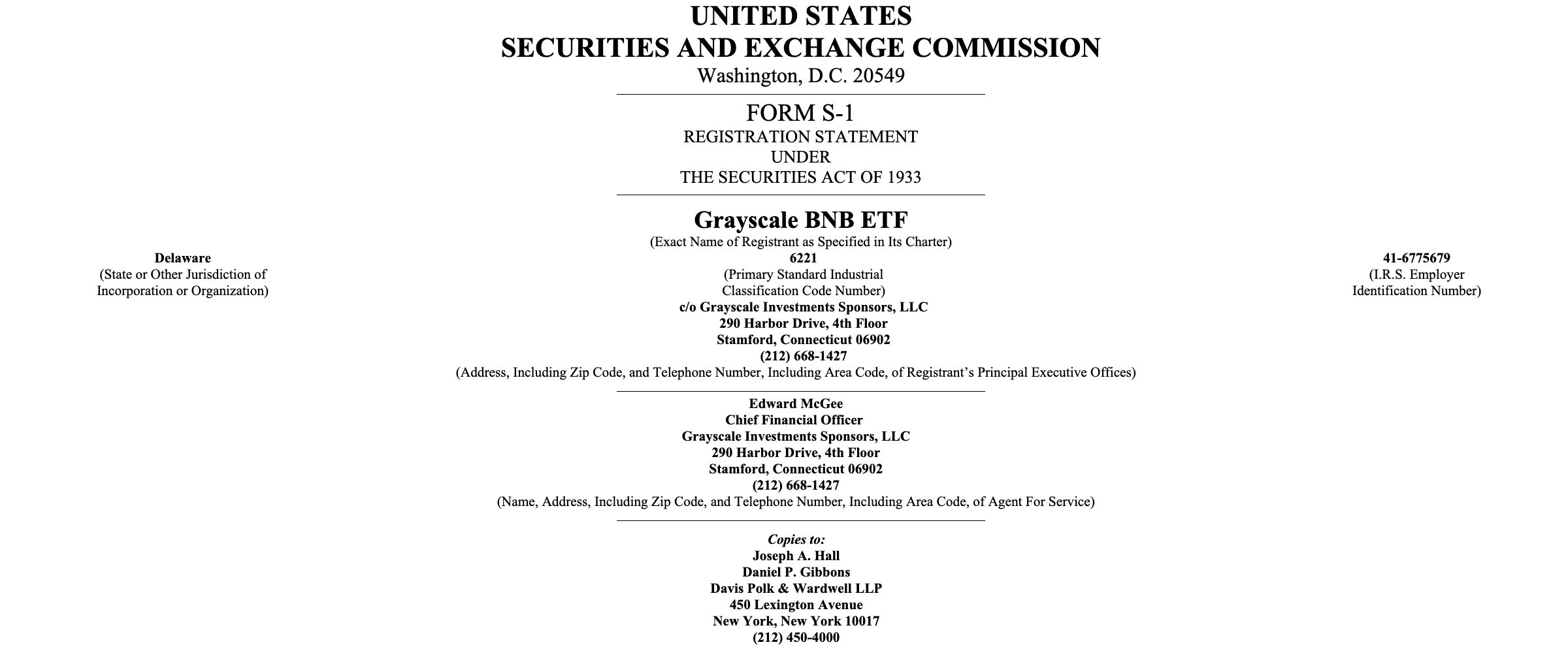
Source: SEC

It is worth mentioning that Grayscale is not the first asset manager to file for a spot BNB ETF, as VanEck applied as far back as April 2025. However, this latest filing reflects the firm’s resolve to expand its list of crypto-linked investment products, especially after the successful launch of the Bitcoin and Ethereum ETFs.

It was always only a matter of time before BNB, the fourth-largest cryptocurrency by market capitalization, received extra attention from institutions focused on exchange-traded products. As such, this move by Grayscale has caught the attention of the cryptocurrency market, including former Binance CEO Changpeng ‘CZ’ Zhao.

In a Friday post on the social media platform X, CZ said that Grayscale’s submission of its S-1 filing to the SEC represents a small step toward making the United States the capital of crypto. “A small step in helping to make America the Capital of Crypto, by giving access to the 3rd largest crypto,” the Binance co-founder wrote on Friday.

Meanwhile, Bloomberg ETF expert James Seyffart concurred that a spot ETF approval could mean that the BNB token will be classified as a commodity rather than a security. This is because the approval of an exchange-traded fund is often an indication that the SEC views the underlying asset as a commodity rather than as a security.

BNB Price At A Glance

After making a play for $900 on Friday afternoon, the price of BNB now stands at around $890. According to data from CoinGecko, the fourth-largest cryptocurrency is down by nearly 5% in the past seven days.

The price of BNB on the daily timeframe | Source: BNBUSDT chart on TradingView


Related Questions

QWhat type of ETF application has Grayscale filed with the SEC, and for which cryptocurrency?

AGrayscale has filed an application for a spot exchange-traded fund (ETF) linked to BNB, the native token of the Binance ecosystem.

QOn which exchange and under what ticker symbol would the proposed Grayscale BNB ETF trade, if approved?

AIf approved, the ETF would trade on the Nasdaq exchange under the ticker symbol GBNB.

QAccording to the article, who was the first asset manager to file for a spot BNB ETF, and when did they do it?

AVanEck was the first asset manager to file for a spot BNB ETF, applying back in April 2025.

QWhat did Bloomberg ETF expert James Seyffart suggest an ETF approval could mean for the classification of BNB?

AJames Seyffart suggested that an ETF approval could mean the BNB token would be classified as a commodity rather than a security.

QWhat was the price of BNB and its 7-day performance at the time the article was written?

AThe price of BNB was around $890, and it was down by nearly 5% over the past seven days.

Related Reads

In Jinjiang, Fujian, a Storage Super Unicorn Lies Quiet

In Fujian's Jinjiang, a city known for sportswear, lies a quiet semiconductor giant: Fujian Jinhua Integrated Circuit Co. (JHICC). Once a promising domestic DRAM manufacturer alongside Yangtze Memory and ChangXin Memory Technologies (CXMT), its journey was derailed in 2018 when the U.S. placed it on an Entity List and filed criminal charges for alleged trade secret theft. This halted production for years. A turning point came in February 2024 when a U.S. federal court found JHICC not guilty. However, it had lost crucial time. While CXMT soared to become a top-valued A-share company in 2024, JHICC, with an estimated valuation of 80 billion RMB, was just restarting. Its current output is primarily customized DDR4 chips, not the advanced DDR5/HBM demanded for AI, but it still benefits from the broader memory chip upcycle. JHICC's story is tied to Chen Zhengkun, a veteran engineer who left Micron to lead the venture. Founded in 2016 with state-backed funding, JHICC partnered with Taiwan's UMC to develop DRAM technology. Rapid progress was cut short by the U.S. actions, which Micron initiated, partly due to its heavy reliance on the Chinese market. Post-sanctions, Chen's team worked to rebuild the production line with reduced reliance on U.S. technology. According to its records, JHICC achieved small-scale production and revenue growth under immense pressure. It now focuses on the stable "niche" DRAM market (e.g., TVs, routers) with a monthly capacity of ~40,000 wafers, aiming for 60,000 by 2026. It holds over 1,000 patents but remains on the Entity List. For Jinjiang, investing in JHICC was a bold industrial leap. The local government provided unwavering financial and logistical support during the crisis, helping the company survive. JHICC has become the anchor for a growing local semiconductor cluster. Though its scale lags behind domestic peers, JHICC's persistence symbolizes a hard-won foothold in a global market long dominated by Samsung, SK Hynix, and Micron. Having missed one boom, it seeks a place in the new AI-driven memory supercycle.

marsbit1h ago

In Jinjiang, Fujian, a Storage Super Unicorn Lies Quiet

marsbit1h ago

Trading

Spot
活动图片




