Google Engineer Arrested For Using Company’s Own Search Data To Win $1.2 Million On Polymarket

bitcoinistPublished on 2026-05-28Last updated on 2026-05-28

Abstract

A Google information security engineer, Michele Spagnuolo, has been arrested and charged with commodities fraud, wire fraud, and money laundering. Prosecutors allege he used confidential internal Google search data to place bets on the crypto-based prediction market Polymarket, winning approximately $1.2 million by knowing outcomes before the public. Using an internal tool showing real-time search trends, he reportedly placed successful wagers on contracts tied to Google's "Year in Search" rankings for 2025. This is the second federal criminal case involving Polymarket insider trading in just over a month, following an April arrest of a U.S. Army sergeant accused of using classified military information. The cases highlight increasing legal scrutiny of prediction markets, with blockchain transparency aiding prosecutors. Google placed Spagnuolo on leave and is cooperating with authorities.

A Google information security engineer has been arrested and charged with commodities fraud, wire fraud, and money laundering after allegedly using confidential internal company data to place a series of bets on Polymarket — the crypto-based prediction market platform — winning approximately $1.2 million by knowing the outcomes of his wagers before the trading public did.

The US Attorney’s Office for the Southern District of New York unsealed the complaint against Michele Spagnuolo, 36 — also known by his Polymarket account alias “AlphaRaccoon” — on May 27, 2026. Spagnuolo, an Italian citizen residing in Switzerland, was arrested in New York and appeared before US Magistrate Judge Sarah Netburn, where he was released on a $2.25 million bond secured by $1 million in cash, per the DOJ’s official statement. He did not enter a plea.
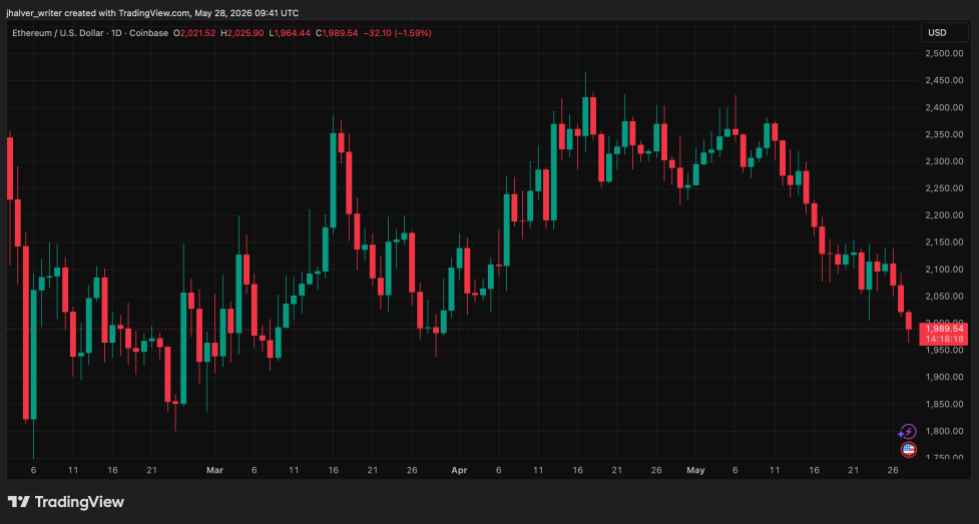
ETH's price trends to the downside on the daily chart. Source: ETHUSD on Tradingview

How The Scheme Worked

According to the unsealed complaint, Spagnuolo had access to an internal Google software tool — bearing a banner marked “Google Confidential” in red text — that provided real-time visibility into what users were searching across Google’s platform, including data that fed directly into Google’s annual “Year in Search” rankings, per the DOJ filing.

Beginning in May 2024, Spagnuolo created a Polymarket account and began placing bets on contracts tied to which individuals would rank on Google’s most-searched list for 2025 — markets Polymarket launched last fall, per the complaint.

Prosecutors allege Spagnuolo transferred approximately $3.8 million in USDC to his Polymarket address and placed bets including a $381.12 “yes” wager that the artist d4vd would rank in Google’s most-searched list and correctly predicted contracts such as “Will Zohran Mamdani rank in the Top 5 most searched” and “Will Squid Game be the number one searched TV show,” per CNBC’s reporting of the complaint. His success rate across these markets was, according to the complaint, no accident. He knew the answers before the markets settled.

The CFTC filed a simultaneous civil case against Spagnuolo seeking monetary disgorgement, restitution, and additional penalties, per the complaint. Google confirmed it had placed Spagnuolo on leave and was cooperating with law enforcement — noting that the tool he used was technically available to all employees, but that using confidential information to place bets represented a serious breach of company policy, per a statement reported by ABC News.

The Second Case In Thirty Days

The Spagnuolo arrest is the second federal criminal case tied to Polymarket insider trading in just over a month. In April 2026, US Army Special Forces Master Sergeant Gannon Ken Van Dyke was arrested for allegedly using classified military knowledge of the planned capture of Venezuelan President Nicolás Maduro to place bets on Polymarket, reportedly netting more than $400,000. Van Dyke has pleaded not guilty, per CNN’s reporting.

Polymarket’s chief legal officer Olivia Chalos said in a statement that the company worked closely with the US Attorney’s Office and the CFTC on the Spagnuolo case — noting that Polymarket is the only prediction platform to date whose cooperation has led to insider trading charges in the United States, and that the blockchain-based nature of the platform means bad actors leave footprints.

This development marks a critical and accelerating moment for the nascent prediction market sector. Two federal insider trading arrests in thirty days — one involving military classified information, the other corporate search data — arriving simultaneously with an active congressional investigation into Polymarket and Kalshi, confirms that the legal perimeter around prediction markets is closing fast. The transparency of blockchain trading, once seen primarily as a feature for users, is now functioning as a forensic trail for federal prosecutors.

Cover image from Grok, ETHUSD chart from Tradingview

Related Questions

QWhat was the Google engineer accused of doing, and how much did he allegedly win?

AThe Google engineer, Michele Spagnuolo, was accused of using confidential internal search data to place bets on Polymarket's prediction markets, specifically those tied to Google's 'Year in Search' rankings. He allegedly won approximately $1.2 million by knowing the outcomes before the trading public.

QWhat specific internal tool did the Google engineer allegedly misuse, and what kind of data did it provide?

AHe allegedly misused an internal Google software tool that displayed a 'Google Confidential' banner. This tool provided real-time visibility into what users were searching across Google's platform, including data that fed directly into Google's annual 'Year in Search' rankings.

QWhat were the federal criminal charges brought against Michele Spagnuolo?

AMichele Spagnuolo was charged with commodities fraud, wire fraud, and money laundering.

QAccording to the article, what was the other recent insider trading case involving Polymarket?

AIn April 2026, US Army Special Forces Master Sergeant Gannon Ken Van Dyke was arrested. He was accused of using classified military knowledge about the planned capture of Venezuelan President Nicolás Maduro to place bets on Polymarket, allegedly netting more than $400,000.

QHow did Polymarket's chief legal officer characterize the platform's role in the Spagnuolo case?

APolymarket's chief legal officer, Olivia Chalos, stated that the company worked closely with authorities, that Polymarket is the only prediction platform whose cooperation has led to U.S. insider trading charges, and that the blockchain-based nature of the platform means bad actors leave forensic footprints.

Related Reads

U.S. Government Bans Foreign Nationals from Using Fable 5, Anthropic Issues Rebuttal

U.S. Government Bans Foreign Access to Fable 5, Anthropic Issues Rebuttal On June 12th, the U.S. government ordered AI company Anthropic to immediately suspend all foreign access—including foreign nationals within the U.S. and Anthropic's own foreign employees—to its newly released Fable 5 and Mythos 5 AI models, citing national security concerns. This forced Anthropic to temporarily disable access to both models for all users globally, as it cannot technically differentiate user nationality at scale. The models, released just three days prior, represent Anthropic's highest public capability tier. Fable 5 is the first publicly available model from the advanced "Mythos" family, while Mythos 5 is a less-restricted version for approved cybersecurity and critical infrastructure partners. The government's directive was reportedly triggered by claims from another company that it could "jailbreak" Mythos 5, raising alarm within the Trump administration. Anthropic, in a detailed public statement, strongly challenged this rationale. The company argues the demonstrated "jailbreak" is a narrow, non-generalized technique that merely involves identifying minor, known software vulnerabilities—a capability common to other publicly available models like OpenAI's GPT-5.5 and routinely used by cybersecurity defenders. Anthropic stated it has complied with the order but disagrees with the government's standard, warning that applying it industry-wide would halt all new frontier model deployments. The company criticized the lack of a transparent, fact-based legal process and expressed confidence the situation stems from a misunderstanding. It is working to restore access and will release more technical details within 24 hours. Other Anthropic models remain unaffected.

链捕手14m ago

U.S. Government Bans Foreign Nationals from Using Fable 5, Anthropic Issues Rebuttal

链捕手14m ago

The Revelation from the Raydium Theft Incident: New DeFi Vulnerabilities Lurking in Forgotten Old Contracts

**Raydium Exploit Reveals DeFi's Hidden Risk: Forgotten "Zombie" Contracts** A recent attack on Raydium's deprecated V3 AMM pools resulted in a loss of approximately $1.34 million. The hacker exploited pools that were no longer supported by Raydium's current UI or SDK but remained fully functional and accessible on-chain. This incident highlights a critical, often overlooked category of risk in DeFi: inactive or legacy smart contracts that projects fail to properly decommission. Since March 2025, there have been at least 8 publicly reported attacks targeting such abandoned contracts, with total losses around $10.8 million. Including older pools and deprecated features, the count rises to 10 incidents with roughly $22.5 million in losses. These "zombie contracts" represent a lifecycle management failure rather than a code vulnerability, yet they are typically misclassified under general "code bug" categories in security reports, masking the true scale of the problem. The root cause is that projects often merely document a contract as "deprecated" without taking essential technical steps to secure it: withdrawing remaining assets, disabling external call functions, and implementing ongoing monitoring. These forgotten, under-monitored components become prime targets for attackers. To address this, the industry needs to recognize "zombie contracts" as a distinct risk category and establish standardized decommissioning protocols. Essential steps should include: 1) a formal retirement announcement, 2) removal of all front-end integrations, 3) withdrawal of locked assets, 4) disabling key contract functions, 5) ongoing security monitoring, 6) clear user communication, and 7) a post-mortem analysis. The value of a DeFi project lies not only in its current TVL but also in the security of its historical codebase, which has now become a new attack surface.

Foresight News2h ago

The Revelation from the Raydium Theft Incident: New DeFi Vulnerabilities Lurking in Forgotten Old Contracts

Foresight News2h ago

Robots Begin to 'Consume Data': The Hidden Production Chain from Indian Data Factories to Billion-Dollar Humanoid Robots

Robots have started to 'consume data,' driving the formation of a new industrial supply chain focused on producing training data for embodied AI. Unlike large language models, which are trained on vast internet text corpora, embodied AI models face a 'data desert' in the physical world. This has created a massive demand for first-person perspective video data (Ego Data), captured by workers wearing cameras in places like Indian garment factories. Companies like Neocambrian AI are establishing 'data factories' where workers perform standardized tasks (e.g., sorting clothes, kitchen organization) to generate thousands of hours of video. Research, such as NVIDIA's EgoScale, demonstrates that scaling this human demonstration data predictably improves robot performance, particularly for dexterous manipulation. This has validated a training path combining large-scale human data for pre-training with smaller amounts of robot-specific data for fine-tuning. The value of different data types varies significantly, forming a 'data pyramid.' The base consists of low-cost, large-scale internet and Ego Data. Higher layers include more expensive motion-capture data (e.g., from data gloves), simulation/synthetic data, and the most costly and scarce layer: real robot teleoperation data. This demand has spawned a layered ecosystem of data suppliers: low-cost data factories, motion capture and alignment specialists, robot-native teleoperation service providers, simulation data companies, and platforms aiming for data standardization. Robot companies themselves are adopting a 'layered procurement' strategy: outsourcing generic Ego Data while building in-house capabilities for robot-specific adaptation data and the critical deployment/failure data generated in real-world applications. The industry is shifting focus from hardware and basic mobility to the data pipelines required for general-purpose capability. While parallels exist to data labeling companies like Scale AI in the LLM boom, the physical complexity of robot data—involving action success ambiguity and sim-to-real gaps—requires more integrated solutions for data collection, annotation, and a continuous feedback loop. The race is on to build the data engines that will teach robots to operate reliably in the unstructured real world.

marsbit4h ago

Robots Begin to 'Consume Data': The Hidden Production Chain from Indian Data Factories to Billion-Dollar Humanoid Robots

marsbit4h ago

Trading

Spot
Futures
活动图片