The Revelation from the Raydium Theft Incident: New DeFi Vulnerabilities Lurking in Forgotten Old Contracts

Foresight NewsPublished on 2026-06-13Last updated on 2026-06-13

Abstract

**Raydium Exploit Reveals DeFi's Hidden Risk: Forgotten "Zombie" Contracts** A recent attack on Raydium's deprecated V3 AMM pools resulted in a loss of approximately $1.34 million. The hacker exploited pools that were no longer supported by Raydium's current UI or SDK but remained fully functional and accessible on-chain. This incident highlights a critical, often overlooked category of risk in DeFi: inactive or legacy smart contracts that projects fail to properly decommission. Since March 2025, there have been at least 8 publicly reported attacks targeting such abandoned contracts, with total losses around $10.8 million. Including older pools and deprecated features, the count rises to 10 incidents with roughly $22.5 million in losses. These "zombie contracts" represent a lifecycle management failure rather than a code vulnerability, yet they are typically misclassified under general "code bug" categories in security reports, masking the true scale of the problem. The root cause is that projects often merely document a contract as "deprecated" without taking essential technical steps to secure it: withdrawing remaining assets, disabling external call functions, and implementing ongoing monitoring. These forgotten, under-monitored components become prime targets for attackers. To address this, the industry needs to recognize "zombie contracts" as a distinct risk category and establish standardized decommissioning protocols. Essential steps should include: 1) a formal ret...


Author: Gino Matos

Compiler: Luffy, Foresight News


TL;DR:


  • Hackers stole approximately $1.34 million in assets by exploiting Raydium's long-discontinued V3 Automated Market Maker liquidity pools.
  • This incident exposes a widespread issue: Old contracts decommissioned by DeFi projects are still operational on-chain. These forgotten underlying infrastructures have become easily overlooked attack targets.
  • Public reports indicate that since March 2025, there have been at least 8 similar theft incidents targeting old contracts within the industry, suggesting that a vast amount of unattended legacy code remains externally callable.


Recently, a vulnerability in Raydium's AMM V3 resulted in a loss of $1.34 million. This incident involved five liquidity pools outside the project's current product ecosystem. These pools were unsupported by Raydium's UI or SDK and inaccessible to ordinary users, yet they were ultimately exploited by hackers.


This attack targeted the neglected old contracts and underlying infrastructures within the industry, revealing major flaws in the full lifecycle management of smart contracts. This type of problem is not unique to this one Solana-based decentralized exchange.


The Overlooked Risk Category


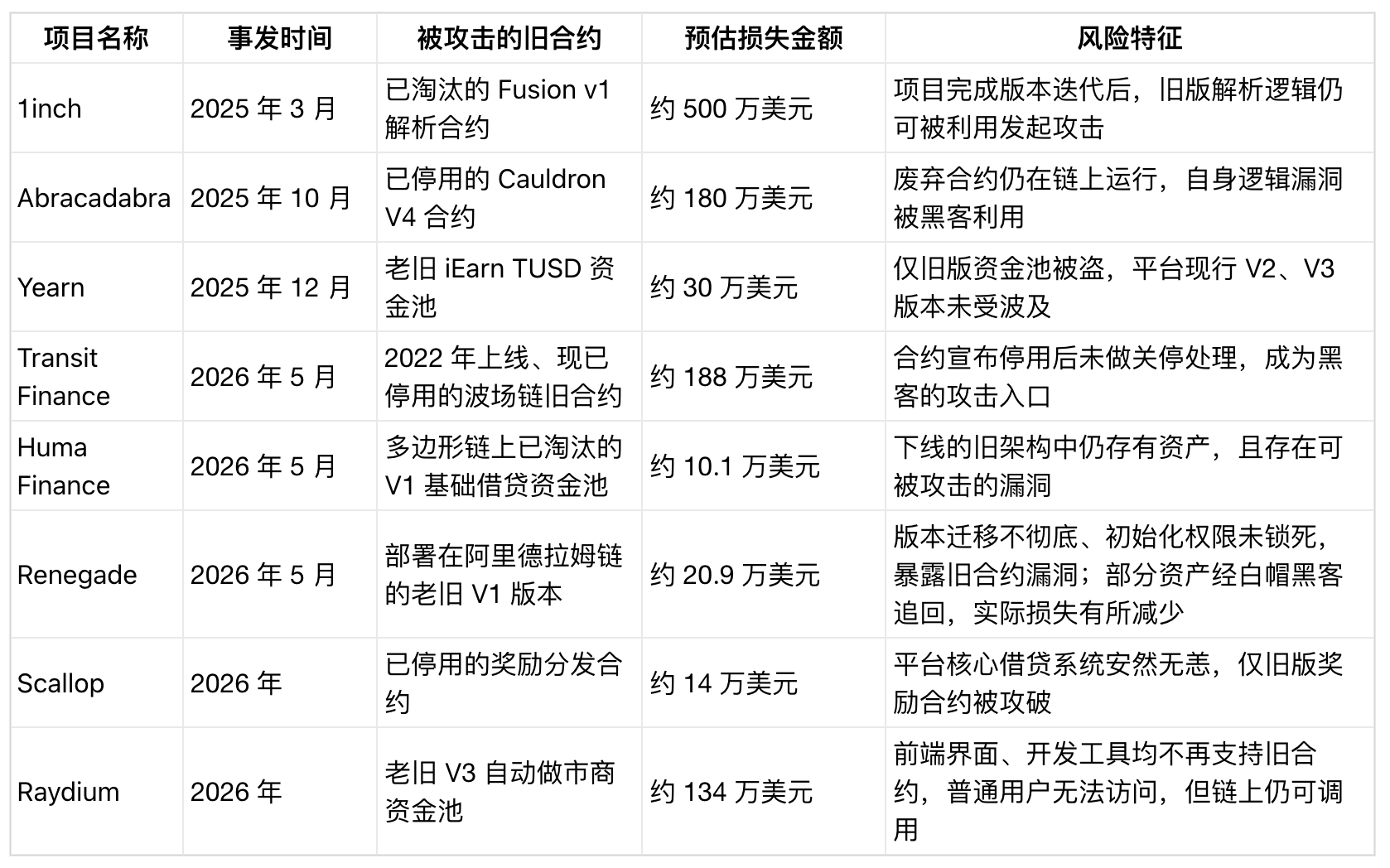
According to publicly available security incident reports, from March 2025 to the present, there have been at least 8 confirmed attack cases explicitly due to abandoned, phased-out, or old contracts, with cumulative losses of approximately $10.8 million.


If attacks involving old liquidity pools and outdated supporting products are included in the statistics, the number of related incidents reaches 10 (including this Raydium theft), with total losses amounting to about $22.5 million.


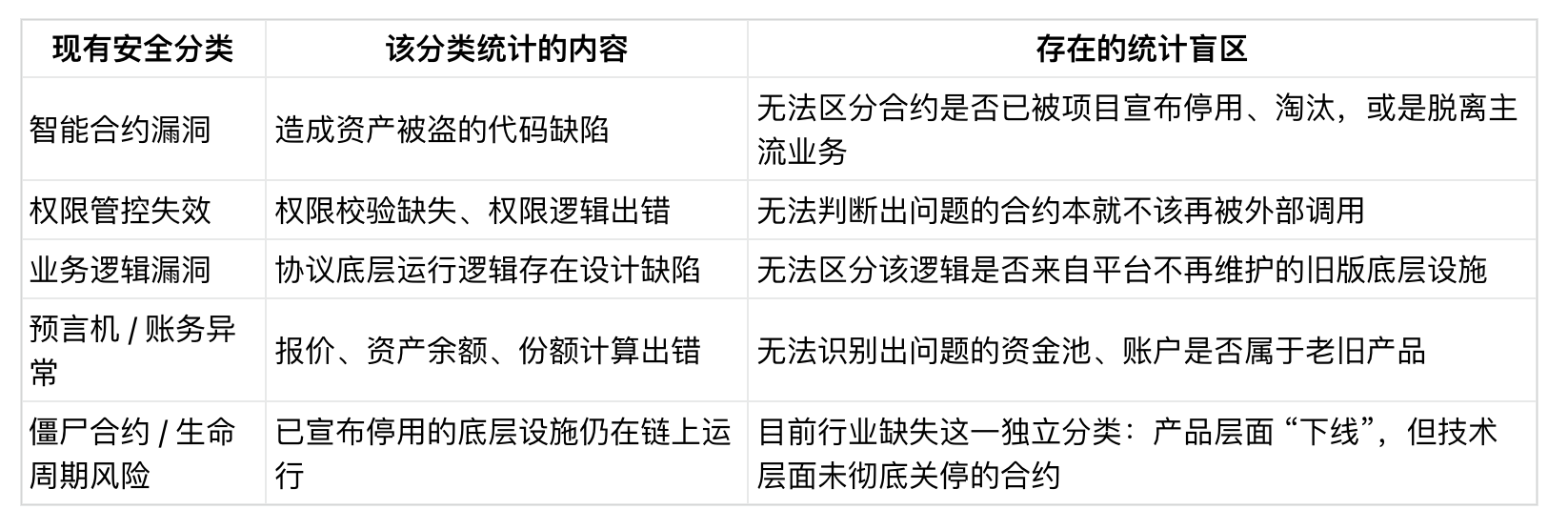
Most current industry security incident tracking platforms categorize attack types based on technical causes. Common classifications include: smart contract code vulnerabilities, permission control failures, oracle manipulation, private key leakage, cross-chain bridge defects, etc.


Zombie contracts (i.e., old contracts declared discontinued by projects but still normally callable on-chain) belong to a completely different risk dimension. They are security incidents caused by failures in contract lifecycle management, yet they have always been buried within the statistical entries of various conventional vulnerabilities and have not been classified separately.


The reason Raydium's V3 AMM liquidity pools were abandoned stems from the formal shutdown of the Serum project they relied on, rendering this set of old contracts completely non-functional. The corresponding liquidity assets have been idle on-chain ever since.


Raydium's currently used new version of the contract performs dual verification of two key pieces of information: first, it checks asset proportions through a total supply verification mechanism; second, it verifies the minting address of liquidity tokens and various associated account information.


However, this outdated V3 contract completely omitted these two verification processes. Hackers exploited this vulnerability by forging new liquidity tokens and impersonating legitimate certificates, directly bypassing all risk control rules.


In this incident, a total of approximately 150,177 RAY, 5,603 SOL, and 893,700 USDC were stolen. These assets had been stored in the platform's old liquidity pools for a long time. Although detached from mainstream operations, their on-chain call permissions were never deactivated.


Eight Cases Reveal Common Problems


Since 2025, several well-known DeFi projects have stumbled over old contracts. All incidents share the same characteristics: the project team claimed that the current version of the product and active users were unaffected, but because the old contracts were not completely shut down, the project treasury ultimately bore the full losses.


Why Old Contract Risks Are Overlooked


Currently, the vast majority of industry security incident classification systems focus on attack methods, tampering targets, and code failure points, representing an analytical perspective "starting from technical vulnerabilities." This also leads to the masking of zombie contract incidents. The core of such problems is never coding errors, but the failure of projects to execute the necessary complete shutdown of old contracts.


A 2025 industry research paper analyzed 50 major global crypto security incidents between 2022 and 2025, with cumulative losses exceeding $1 billion. The study pointed out that high-harm on-chain attacks are often the result of chain risk superposition, simultaneously involving human operations, daily maintenance, economic models, contract lifecycle management, community governance, and other levels.


The paper proposed a four-layer root cause analysis framework, clearly classifying contract lifecycle management vulnerabilities and community governance vulnerabilities as independent risk categories separate from code writing vulnerabilities. The zombie contract problem is a typical lifecycle management vulnerability. However, in existing security statistics systems, such incidents are uniformly categorized as "code vulnerabilities," and the corresponding loss data is concealed under other classifications, failing to attract sufficient industry attention.


Beware the "Contract Graveyard": Old Infrastructure Becomes a New Attack Hotspot


If DeFi projects continue to treat "contract shutdown" as an optional, trivial matter—merely annotating "this contract is discontinued" in product documentation without transferring idle assets, disabling call functions, or continuously monitoring status—then hackers will persistently target this "contract graveyard."


Every large DeFi project's historical deployment records have now become attack targets that hackers can search and exploit. The currently counted $22.5 million in losses is merely the value from publicly exposed cases; the real risk is far higher.


Those old liquidity pools holding assets but detached from mainstream user workflows, historical authorization interfaces, and early partnership integration modules receive far less operational monitoring than current business systems, making them precisely the preferred targets for hackers.


To change the status quo, "zombie contracts" must first be listed as an independent risk category with separate incident statistics. Secondly, the contract decommissioning process must be incorporated into standardized security procedures, placed on equal footing with code audits. Only by implementing full lifecycle operations and maintenance can the attack surface be effectively reduced.


Currently, the industry's handling methods are largely similar. Raydium used its project treasury to cover the $1.34 million loss. Transit Finance and Huma Finance also bore user losses through the project side.


This also means that contract decommissioning is no longer just a documentation annotation task; it is an essential security control link.


Seven Security Control Standards for Contract Decommissioning


For the shutdown of old contracts, the industry can establish standardized control processes. The specific requirements and their functions are as follows:
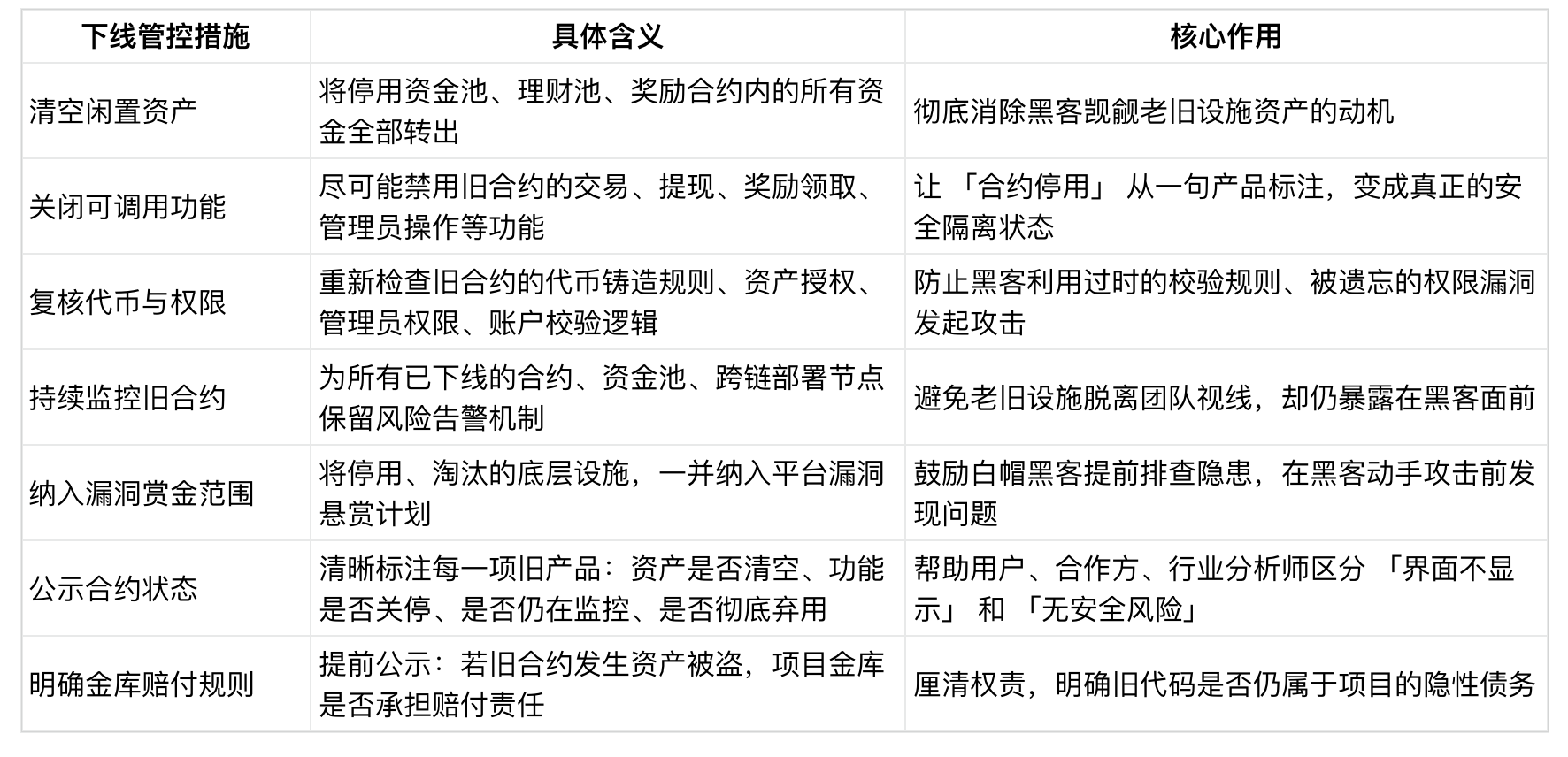


Simply annotating "contract discontinued" in documentation merely shifts the security risk to the project treasury, while the attack vulnerability remains. Announcing a shutdown only at the product level without a complete technical deactivation leaves old contracts perpetually callable: project teams neglect oversight, while hackers watch closely at all times.


The value of a DeFi project is not only reflected in its current total value locked (TVL) but also in the historical code and underlying architectures accumulated along its journey. And this forgotten history has now become a new security突破口 (breakthrough point).


Related Questions

QWhat is the main vulnerability exploited in the recent Raydium hack, and what was the estimated loss?

AThe main vulnerability was in Raydium's deprecated V3 Automated Market Maker (AMM) liquidity pools. Hackers exploited these old, inactive contracts to steal approximately $1.34 million worth of assets.

QAccording to the article, what new risk category does the Raydium incident and similar attacks highlight for the DeFi industry?

AThe incident highlights the risk category of 'zombie contracts' or outdated smart contracts that have been deprecated but remain operational and callable on the blockchain, becoming overlooked attack surfaces.

QHow many similar attacks targeting outdated or deprecated contracts have been reported since March 2025, and what is the total estimated loss mentioned?

ASince March 2025, there have been at least 8 reported attacks specifically targeting deprecated or old contracts, with a cumulative loss of about $10.8 million. Including older liquidity pools and related products, the total is 10 incidents with losses around $22.5 million.

QWhy are these 'zombie contract' risks often overlooked in current security incident classifications?

ACurrent security classifications focus on technical vulnerabilities (like code bugs, oracle manipulations). 'Zombie contract' issues stem from lifecycle management failures—contracts not being properly decommissioned—and are therefore often mis-categorized under general 'code vulnerability' labels, obscuring their specific nature.

QWhat does the article suggest as a key action to properly address the risk of outdated contracts?

AThe article suggests establishing standardized security control processes for contract decommissioning. This includes measures like withdrawing all idle assets, permanently disabling key functions, revoking permissions, and continuous monitoring, treating contract sunsetting as a critical security task on par with code auditing.

Related Reads

Mining Firms Flock to AI, but Wall Street Cools Valuation Enthusiasm. The Earnings Season Reveals Who's 'Swimming Naked'?

Bitcoin mining companies are increasingly pivoting to AI and HPC (high-performance computing) infrastructure, but Wall Street is growing skeptical, demanding proof of a viable business model over mere announcements. An analysis shows that while early AI-related announcements triggered significant stock price movements (average absolute change of 24.1%), recent similar news has had a much smaller market impact (average ~10.2%), despite the underlying business value of AI/HPC hosting contracts improving. A review of Q2 2024 earnings from five major mining firms reveals a mixed picture: * **Marathon Digital (MARA):** Reported declining revenue ($175M, down 27%) and a large net loss ($610M+). Its AI/HPC transformation remains in the building phase, contributing negligible revenue so far. * **Core Scientific:** Successfully shifted its business model, with AI/HPC hosting now dominating revenue (83% of total $164.2M). However, this came with high capital expenditure and negative shareholder equity. * **TeraWulf:** Showed early results from its pivot, with HPC leasing generating 71% of its total revenue ($44.77M). It secured major long-term contracts but also reported a significant net loss. * **Hut 8:** Achieved substantial revenue growth ($74.9M, up 81.4%) driven by computing operations and completed commercialization of its first major AI data center campus. It remains unprofitable on a net income basis. * **CleanSpark:** Revenue still relies entirely on Bitcoin mining ($138M, down 30.5%). Its main AI highlight was signing a $6.6 billion, 20-year data center lease, but revenue from it is not expected until late 2027. The key takeaway is that the market's focus has shifted from the "AI story" to tangible execution, project delivery capabilities, customer quality, and the ability to generate future cash flow.

marsbit32m ago

Mining Firms Flock to AI, but Wall Street Cools Valuation Enthusiasm. The Earnings Season Reveals Who's 'Swimming Naked'?

marsbit32m ago

All Metrics Smashing Records, Yet Stock Prices Plunge Across the Board

Memory giants like Western Digital (WDC) and SanDisk (SNDK) reported blockbuster earnings in the summer of 2026, featuring毛利率 exceeding 80%, massive customer prepayments, and long-term supply agreements. Despite this seemingly perfect performance, their stocks plummeted post-earnings (WDC down 13%, SNDK down 7%), along with peers like Micron. The collapse highlights a core market rule: "good" isn't enough; results must beat already sky-high expectations. With valuations at peak "perfect asset" levels, even slightly conservative forward guidance triggered a sell-off. The market saw "peak performance" as a signal to exit. Beneath the stellar numbers, four反常 trends emerged: 1. **Financialized Pricing:** Customers provide百亿级 in upfront "interest-free deposits" to secure future capacity. 2. **Reversed Cost Curve:** Advanced DRAM (HBM4, DDR6) costs are rising per bit due to complex packaging, breaking Moore's Law. 3. **AI vs. Consumer Split:** Data center storage demand soars (+103% for SanDisk), while consumer electronics demand weakens under high costs. 4. **HDD Revival:** Hard drives, now used for AI agent context caching, see毛利率 near 55-57%. Underlying隐忧 persist. Soaring capital expenditure (CapEx) by SK Hynix and Micron risks future oversupply. Revenue growth is increasingly driven by price hikes, not surging shipment volumes (bit growth), making profits vulnerable to any price correction. In conclusion, while AI has created a long-term growth narrative, transforming storage into "strategic infrastructure," the market's violent reaction signals that peak valuations and expectations have left no safety margin. The周期 hasn't disappeared; it's merely wearing an AI disguise.

marsbit33m ago

All Metrics Smashing Records, Yet Stock Prices Plunge Across the Board

marsbit33m ago

Building the Next-Generation Financial Information Terminal with BlockBeats

BlockBeats is building a next-generation personal financial information portal, integrating real-time global market data, news, professional research, and AI-powered analysis. We are actively hiring for multiple roles across our teams in Beijing, with strictly remote opportunities available. We are seeking passionate individuals to join our Hot News Team as Global Market Information Editors, responsible for real-time tracking and analysis of global tech, financial markets, and industry trends. Our In-Depth Reporting & Research Team is looking for Tech Finance Researchers to conduct deep analysis on AI, capital markets, digital assets, and emerging industries. Our Operations Team needs Social Media Specialists to drive user growth and community engagement on platforms like Twitter and Telegram. The Business Team has openings for Business Executives to manage client partnerships and Overseas Business Development specialists to expand our global footprint. Technical roles include Frontend and Backend Developers to help build our products. We are also forming a Prediction Markets Team, seeking Researchers/Content Writers to analyze market events, on-chain data, and provide actionable insights. Ideal candidates are curious about future tech, sensitive to financial markets, adept at extracting value from information, and eager to build new products. Both full-time positions and internships are available.

marsbit47m ago

Building the Next-Generation Financial Information Terminal with BlockBeats

marsbit47m ago

Trading

Spot
活动图片