Gold Rushes Ahead of Quantitative Easing, Bitcoin Awaits Liquidity (Part 2)

marsbitPublished on 2026-01-09Last updated on 2026-01-09

Abstract

The article analyzes why Bitcoin has remained stagnant around $80,000 despite the U.S. entering a rate-cut cycle, while gold continues to rise. It attributes this divergence to two structural factors: high real interest rates due to persistent inflation and a "middle-layer blockage" where monetary easing isn't translating into looser financial conditions. Additionally, this is a defensive rate-cut cycle driven by recession risks and rising debt burdens, not growth, causing capital to prioritize safety over risk-taking assets like Bitcoin. The U.S. faces a debt trilemma: rolling over debt, shifting to short-term issuance, or allowing currency devaluation. Gold's surge reflects hedging against dollar devaluation. Bitcoin awaits confirmed liquidity expansion. The outlook involves two phases: an initial recession shock where gold may peak while Bitcoin faces a sell-off, followed by Fed-led liquidity expansion (QE) where Bitcoin absorbs excess liquidity and surges. Silver's role is noted, with its price action tied to industrial demand and the gold-silver ratio. Long-term, both gold and Bitcoin are expected to appreciate against fiat currencies due to persistent monetary debasement, with leadership shifting from gold to Bitcoin once liquidity floodgates open.

To understand why Bitcoin has reacted tepidly to interest rate cuts, it's helpful to start with gold. Gold is a globally priced asset. While retail investors typically trade in grams, its international pricing is denominated in troy ounces and tons. It is this global pricing structure that makes the influence of macroeconomic factors so significant.

Bitcoin shares this characteristic. Furthermore, its price is globally uniform, meaning any serious analysis must begin with the U.S. macroeconomic situation.

The puzzle is evident. The U.S. has entered a new cycle of interest rate cuts, yet Bitcoin's price lingers around $80,000, while the price of gold continues to climb. Conventional theory suggests that low interest rates should benefit risk assets like stocks and cryptocurrencies. However, so-called defensive assets are rallying against the trend.

This contradiction can be explained by two structural factors.

The "Middle Layer Blockage" Problem

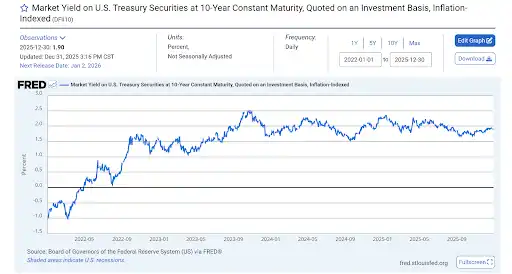
The market's focus is not on nominal interest rates, but on real interest rates. Inflation remains stubbornly high. As long as inflation persists, even if policy rates are cut, real rates struggle to break significantly lower from their elevated levels.

From the perspective of the real economy, rate cuts have not translated into easier financial conditions. Banks have not substantively loosened lending standards. Businesses remain reluctant to borrow. In other words, the intermediate link between policy and capital allocation remains blocked.

Meanwhile, the U.S. Treasury continues to issue a massive volume of new debt. In the second half of 2025, the pace of bond issuance for refinancing existing debt outpaced the liquidity released by rate cuts. The result seems counterintuitive but is crucial: overall liquidity did not expand; it actually contracted.

There simply isn't enough "available money" to push Bitcoin's price higher at the moment.
This is a Defensive Rate-Cut Cycle, Not a Growth Cycle.

This rate-cutting cycle is fundamentally different from previous ones that fueled bull markets. The Fed is cutting rates not because the economy is strong, but because unemployment is rising, corporate default rates are increasing, and the government's debt servicing costs are becoming unsustainable.

This is a defensive rate cut, driven primarily by recession fears and stagflation risks.

In this environment, capital behaves differently. Institutional investors prioritize survival over yield. Their first reaction is not to chase volatility but to reduce risk exposure and build cash buffers.

Despite its long lifecycle, Bitcoin remains one of the world's most liquid high-risk assets. When market stress increases, it is treated as a source of liquidity—a financial ATM. Risk-off flows start in crypto, not stop there.

This mirrors the logic during price expansions. Money flows into crypto last during price run-ups; it flows out of crypto first when uncertainty rises.

In contrast, as investors await a significant drop in real rates, gold is being used as a hedge against dollar devaluation.

The Deeper Issue: America's Debt Trilemma

U.S. interest payments now exceed defense spending, ranking as the federal government's third-largest expenditure after Social Security and Medicare.

Washington effectively has only three choices left.

First, roll over the debt indefinitely by issuing new bonds to pay off old ones. Given the total federal debt exceeds $38 trillion, this only exacerbates the problem.

Second, suppress long-term yields by shifting issuance towards short-term bills, lowering the average funding cost, but not addressing the fundamental imbalance.

Third, and most significantly, allow an implicit default through currency devaluation. When debt cannot be repaid in real terms, repay it with devalued dollars.

This is the structural reason behind gold's surge towards $4,500. The world is hedging against the late-stage credibility crisis of the U.S. dollar.

Rate cuts alone are insufficient. Many on Wall Street now openly state that to avoid collapse, the financial system needs continuous monetary expansion and managed inflation. This creates a vicious cycle: either print money leading to currency devaluation, or refuse to print triggering defaults.

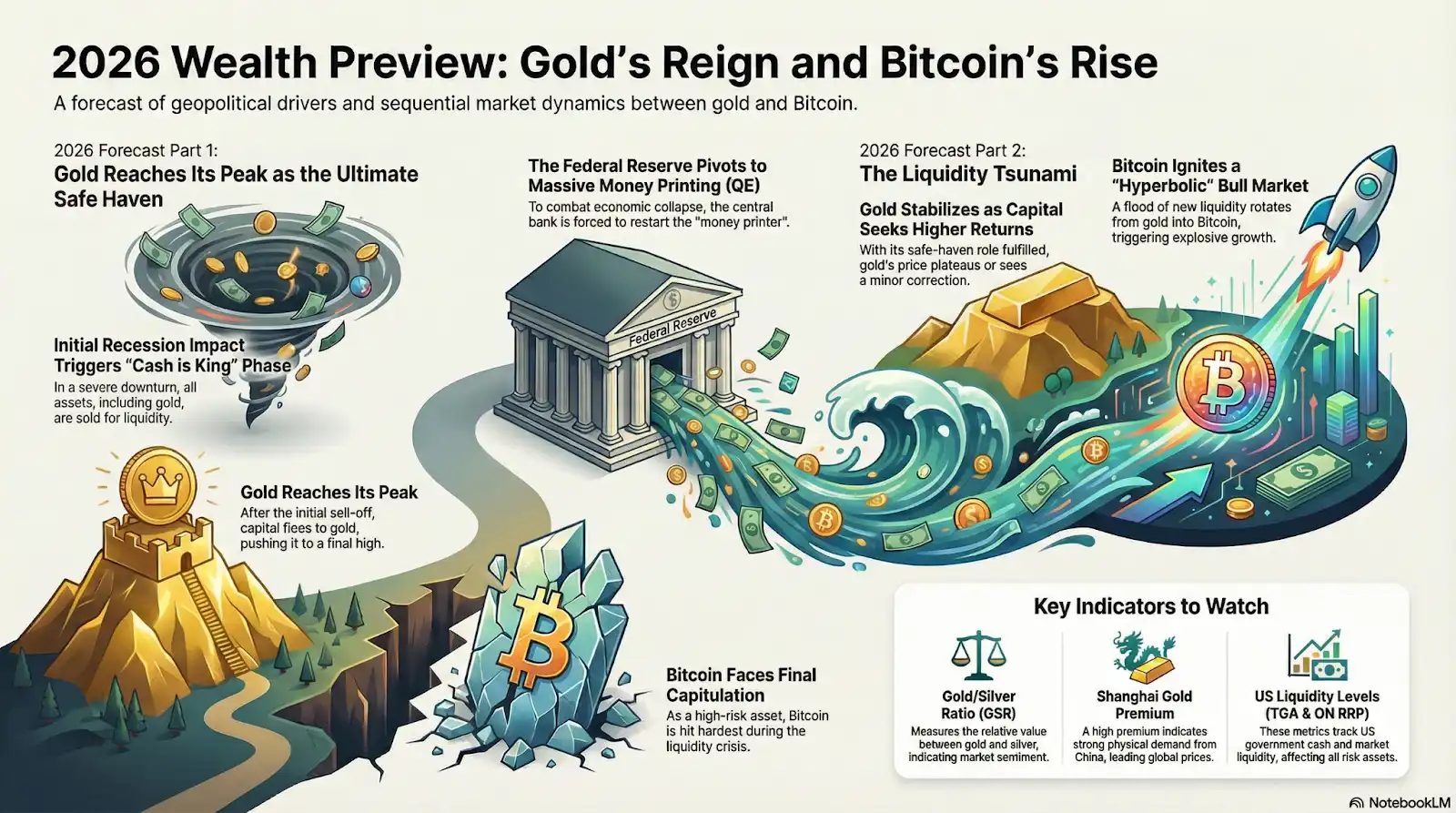
History suggests the choice is inevitable. The Fed is unlikely to tolerate systemic collapse. The reintroduction of Quantitative Easing (QE) and Yield Curve Control (YCC) now seems more a question of timing than probability.

2026 Strategic Outlook: From Liquid Darkness to Flood

Once this framework is understood, the current divergence between gold and crypto makes perfect sense. Both assets hedge against it, but timing is crucial.

Gold is anticipating the future trend of monetary expansion; Bitcoin is waiting for confirmation.

In my view, the path forward unfolds in two phases.

Act I: Recession Shock and the "Gold Peak"

When recession indicators are fully triggered—for example, U.S. unemployment rising above 5%—gold prices are likely to hold high or spike further. It will then be seen as the ultimate safe haven.

Bitcoin, however, could face a final leg down. In the initial phase of a recession, all assets are sold to raise cash. Margin calls and forced liquidations dominate market behavior.

History is clear on this. In 2008, gold fell nearly 30% before rebounding. In March 2020, gold dropped 12% in two weeks, while Bitcoin was halved.

Liquidity crises wash over all assets. The difference lies in which asset recovers first. Gold typically stabilizes and rebounds quicker; Bitcoin takes more time to rebuild market confidence.

Act II: Fed Capitulation and Bitcoin's Liquidity Explosion

Eventually, rate cuts will prove inadequate to handle the economic stress. Economic strain will force the Fed to expand its balance sheet again.

This is the moment the liquidity floodgates truly open.

Gold prices may consolidate or trade sideways. Capital will aggressively rotate into high-beta assets. Bitcoin, as the purest expression of excess liquidity, will absorb these flows.

In such scenarios, price moves are rarely gradual. Once momentum builds, Bitcoin's price can change violently within months.

A Note on Silver and the Gold-Silver Ratio

Silver's rally in 2025 was driven by two factors: its historical link to gold and its industrial demand. AI infrastructure, solar power, and electric vehicles are all heavily reliant on silver.

In 2025, inventories at major exchanges, including the Shanghai Futures Exchange and the London Bullion Market Association, fell to critical levels. In a bull market, silver typically outperforms gold, but in a bear market, it carries higher downside risk.

The gold-silver ratio remains a key metric.

Above 80, silver is historically cheap. Below 60, silver is expensive relative to gold. Below 50, speculative excess tends to dominate.

With the ratio currently around 59, the signal suggests a rotation towards gold, not aggressive accumulation of silver.

The Long View: Different Leaders, Same Destination

Setting aside the specific timing of 2026, the long-term conclusion remains unchanged. Both gold and Bitcoin are in an upward trend against fiat currencies.

The only variable is leadership. This year belongs to gold; the next phase belongs to Bitcoin.

As long as global debt expands and monetary authorities rely on currency debasement to relieve pressure, scarce assets will outperform. In the long run, fiat currency is the only consistently losing asset.

What matters now is patience, data, and discipline. The transition from gold dominance to Bitcoin dominance will not be announced—it will manifest through liquidity indicators, policy shifts, and capital rotation.

I will continue watching for these signals.

Related Questions

QWhy has Bitcoin's price remained around $80,000 despite the US entering a rate-cutting cycle, while gold continues to rise?

ABitcoin's冷淡 reaction is due to two structural factors: the 'middle-layer blockage' where actual financial conditions haven't loosened despite rate cuts, and the defensive nature of this cycle where investors prioritize risk reduction over yield chasing. Gold, however, is rising as a hedge against dollar devaluation amid recession fears and stagflation risks.

QWhat is the 'middle-layer blockage' problem mentioned in the article?

AThe 'middle-layer blockage' refers to the disconnect between policy rate cuts and actual capital allocation. Despite lower nominal rates, high inflation keeps real rates elevated, banks haven't substantially eased lending standards, and businesses remain reluctant to borrow. Concurrently, massive new debt issuance by the US Treasury absorbs liquidity faster than rate cuts can release it, leading to a contraction in overall liquidity.

QHow does a defensive rate-cutting cycle differ from a growth-driven one, and its impact on assets?

AA defensive rate-cutting cycle, driven by rising unemployment, increased corporate defaults, and unsustainable government debt costs, prioritizes economic survival over growth. In this environment, investors reduce risk exposure and build cash buffers, causing capital to flow out of high-risk assets like Bitcoin first. Conversely, growth-driven cycles encourage risk-taking and benefit assets like stocks and crypto.

QWhat are the three options the US government faces regarding its debt dilemma, according to the article?

AThe three options are: 1) Rolling over debt indefinitely by issuing new bonds to repay old ones, exacerbating the problem; 2) Shifting issuance to short-term bills to suppress long-term yields and lower financing costs, without solving the fundamental imbalance; 3) Allowing implicit default through currency devaluation, repaying debt with devalued dollars.

QWhat is the two-phase strategic outlook for 2026 regarding gold and Bitcoin?

APhase 1: Recession shock leads to a 'gold peak' where gold holds high or rises further as the safest asset, while Bitcoin faces a final sell-off due to liquidity crises and forced liquidations. Phase 2: The Fed capitulates and expands its balance sheet, unleashing massive liquidity. Gold may consolidate, and Bitcoin absorbs excess liquidity, experiencing explosive price gains as the purest expression of surplus capital.

Related Reads

20 Billion Valuation, Alibaba and Tencent Competing to Invest, Whose Money Will Liang Wenfeng Take?

DeepSeek, an AI startup founded by Liang Wenfeng, is reportedly in talks with Alibaba and Tencent for an external funding round that could value the company at over $20 billion. This marks a significant shift, as DeepSeek had previously relied solely on funding from its parent company,幻方量化 (Huanfang Quantitative), and had resisted external investment. The potential valuation would place DeepSeek among the top-tier AI model companies in China, comparable to competitors like MoonDark (valued at ~$18 billion) and ahead of recently listed firms like MiniMax and Zhipu. The funding—which could range from $600 million (for a 3% stake) to $2 billion (for 10%)—is seen as a move to secure resources for model development, retain talent, and support infrastructure needs, particularly as competition in inference models and AI agents intensifies. Both Alibaba and Tencent are eager to invest, not only for financial returns but also to integrate DeepSeek into their broader AI ecosystems. However, DeepSeek’s leadership is cautious about maintaining independence and may prefer financial investors over strategic ones to avoid being locked into a specific tech ecosystem. Alternative options, such as state-backed funds, offer longer-term capital and policy support but may come with slower decision-making and potential constraints on global expansion. With competing AI firms accelerating their IPO plans, DeepSeek’s window for securing optimal terms may be narrowing. The final decision will reflect a trade-off between capital, resources, and strategic independence.

marsbit1h ago

20 Billion Valuation, Alibaba and Tencent Competing to Invest, Whose Money Will Liang Wenfeng Take?

marsbit1h ago

After Losing 97% of Its Market Value, iQiyi Attempts to Use AI to Forcefully Extend Its Lifespan

After losing 97% of its market value since its 2018 peak, iQiyi is aggressively pivoting to AI in a desperate attempt to survive. At its 2026 World Conference, CEO Gong Yu announced an "AI Artist Library" with over 100 virtual performers and a new AIGC platform, "NaDou Pro," promising faster production and lower costs. This shift comes as the company faces severe financial distress: its market cap sits near delisting thresholds at $1.36 billion, with significant losses, declining membership revenue, and depleted cash flow. The AI strategy has sparked controversy. Top actors have issued legal threats against unauthorized digital replicas, while in Hengdian, over 134,000 background actors are seeing their already scarce job opportunities vanish as AI replaces them for background roles. iQiyi's move represents a fundamental shift from being a high-cost content buyer to a landlord" to becoming a "platform capitalist" that transfers production risk to creators. This contrasts with competitors like Douyin (TikTok's Chinese counterpart), which is investing heavily in *real* actor-led short dramas, betting that authentic human connection retains users better than AI-generated content. The article draws a parallel to the 1920s transition to "talkies," which made cinema musicians obsolete but ultimately enriched the art form. In contrast, iQiyi's AI drive is framed not as an artistic evolution but as a cost-cutting measure that could degrade storytelling, replacing genuine human emotion with algorithmically calculated stimulation and potentially numbing audiences' capacity for empathy. The core question remains: can a company focused solely on financial survival preserve the art of storytelling?

marsbit1h ago

After Losing 97% of Its Market Value, iQiyi Attempts to Use AI to Forcefully Extend Its Lifespan

marsbit1h ago

Trading

Spot
Futures

Hot Articles

What is $BITCOIN

DIGITAL GOLD ($BITCOIN): A Comprehensive Analysis Introduction to DIGITAL GOLD ($BITCOIN) DIGITAL GOLD ($BITCOIN) is a blockchain-based project operating on the Solana network, which aims to combine the characteristics of traditional precious metals with the innovation of decentralized technologies. While it shares a name with Bitcoin, often referred to as “digital gold” due to its perception as a store of value, DIGITAL GOLD is a separate token designed to create a unique ecosystem within the Web3 landscape. Its goal is to position itself as a viable alternative digital asset, although specifics regarding its applications and functionalities are still developing. What is DIGITAL GOLD ($BITCOIN)? DIGITAL GOLD ($BITCOIN) is a cryptocurrency token explicitly designed for use on the Solana blockchain. In contrast to Bitcoin, which provides a widely recognized value storage role, this token appears to focus on broader applications and characteristics. Notable aspects include: Blockchain Infrastructure: The token is built on the Solana blockchain, known for its capacity to handle high-speed and low-cost transactions. Supply Dynamics: DIGITAL GOLD has a maximum supply capped at 100 quadrillion tokens (100P $BITCOIN), although details regarding its circulating supply are currently undisclosed. Utility: While precise functionalities are not explicitly outlined, there are indications that the token could be utilized for various applications, potentially involving decentralized applications (dApps) or asset tokenization strategies. Who is the Creator of DIGITAL GOLD ($BITCOIN)? At present, the identity of the creators and development team behind DIGITAL GOLD ($BITCOIN) remains unknown. This situation is typical among many innovative projects within the blockchain space, particularly those aligning with decentralized finance and meme coin phenomena. While such anonymity may foster a community-driven culture, it intensifies concerns about governance and accountability. Who are the Investors of DIGITAL GOLD ($BITCOIN)? The available information indicates that DIGITAL GOLD ($BITCOIN) does not have any known institutional backers or prominent venture capital investments. The project seems to operate on a peer-to-peer model focused on community support and adoption rather than traditional funding routes. Its activity and liquidity are primarily situated on decentralized exchanges (DEXs), such as PumpSwap, rather than established centralized trading platforms, further highlighting its grassroots approach. How DIGITAL GOLD ($BITCOIN) Works The operational mechanics of DIGITAL GOLD ($BITCOIN) can be elaborated on based on its blockchain design and network attributes: Consensus Mechanism: By leveraging Solana’s unique proof-of-history (PoH) combined with a proof-of-stake (PoS) model, the project ensures efficient transaction validation contributing to the network's high performance. Tokenomics: While specific deflationary mechanisms have not been extensively detailed, the vast maximum token supply implies that it may cater to microtransactions or niche use cases that are still to be defined. Interoperability: There exists the potential for integration with Solana’s broader ecosystem, including various decentralized finance (DeFi) platforms. However, the details regarding specific integrations remain unspecified. Timeline of Key Events Here is a timeline that highlights significant milestones concerning DIGITAL GOLD ($BITCOIN): 2023: The initial deployment of the token occurs on the Solana blockchain, marked by its contract address. 2024: DIGITAL GOLD gains visibility as it becomes available for trading on decentralized exchanges like PumpSwap, allowing users to trade it against SOL. 2025: The project witnesses sporadic trading activity and potential interest in community-led engagements, although no noteworthy partnerships or technical advancements have been documented as of yet. Critical Analysis Strengths Scalability: The underlying Solana infrastructure supports high transaction volumes, which could enhance the utility of $BITCOIN in various transaction scenarios. Accessibility: The potential low trading price per token could attract retail investors, facilitating wider participation due to fractional ownership opportunities. Risks Lack of Transparency: The absence of publicly known backers, developers, or an audit process may yield skepticism regarding the project's sustainability and trustworthiness. Market Volatility: The trading activity is heavily reliant on speculative behavior, which can result in significant price volatility and uncertainty for investors. Conclusion DIGITAL GOLD ($BITCOIN) emerges as an intriguing yet ambiguous project within the rapidly evolving Solana ecosystem. While it attempts to leverage the “digital gold” narrative, its departure from Bitcoin's established role as a store of value underscores the need for a clearer differentiation of its intended utility and governance structure. Future acceptance and adoption will likely depend on addressing the current opacity and defining its operational and economic strategies more explicitly. Note: This report encompasses synthesised information available as of October 2023, and developments may have transpired beyond the research period.

363 Total ViewsPublished 2025.05.13Updated 2025.05.13

What is $BITCOIN

Discussions

Welcome to the HTX Community. Here, you can stay informed about the latest platform developments and gain access to professional market insights. Users' opinions on the price of BTC (BTC) are presented below.

活动图片