Gold Reaches Two-Month High, Exceeding $4,400, Amid Continued Accumulation of Reserves by China

cryptonews.ruPublished on 2026-08-11Last updated on 2026-08-11

Abstract

Gold prices soared to over $4,400, hitting a two-month high, driven primarily by a weak U.S. jobs report and sustained gold accumulation by China. The July employment data, showing a loss of 23,000 jobs against expectations of an 80,000 gain, shifted market expectations away from near-term Federal Reserve rate hikes. This pushed Treasury yields down, boosting gold's appeal as a non-yielding asset. Technically, gold broke above its 100-day moving average, attracting new buyers. China provided further support, with the People's Bank of China extending its gold-buying streak to 21 months by adding roughly 20 tons in July. This consistent central bank demand, valued for gold's sovereignty from other governments, has underpinned prices. Geopolitical tensions in the Middle East, particularly involving the U.S. and Iran near the Strait of Hormuz, added a safe-haven bid. Analysts like Peter Schiff noted gold breaking its recent negative correlation with oil, suggesting both could rise together on inflation fears amid economic weakening. The rally's sustainability hinges on upcoming U.S. inflation data. A softer CPI could fuel further gains toward $4,500, while hotter data could reverse the rally by strengthening the dollar and yields.

The price of gold rose to approximately $4,434–$4,435 before sellers finally entered the game. By 1:00 PM Eastern Time (EDT) on Tuesday, August 11, the spot price of gold was $4,382.43, putting the market in wait-and-see mode for a breakout.

Disappointing Jobs Report Overturns Fed Expectations

The spark was the U.S. July jobs report. The economy lost 23,000 jobs, while economists had expected about 80,000 new jobs, and significant downward revisions made the previous months' figures substantially weaker.

This labor market miss quickly shifted expectations regarding Federal Reserve policy. Traders scaled back bets on another near-term rate hike, which led to a decline in Treasury yields and gave gold fresh arguments against interest-bearing assets.

Holding gold does not generate income, so rising yields are one of the most reliable factors pressuring the gold price. When yields fall, this disadvantage becomes less significant, and capital has fewer reasons to stay in bonds and cash.
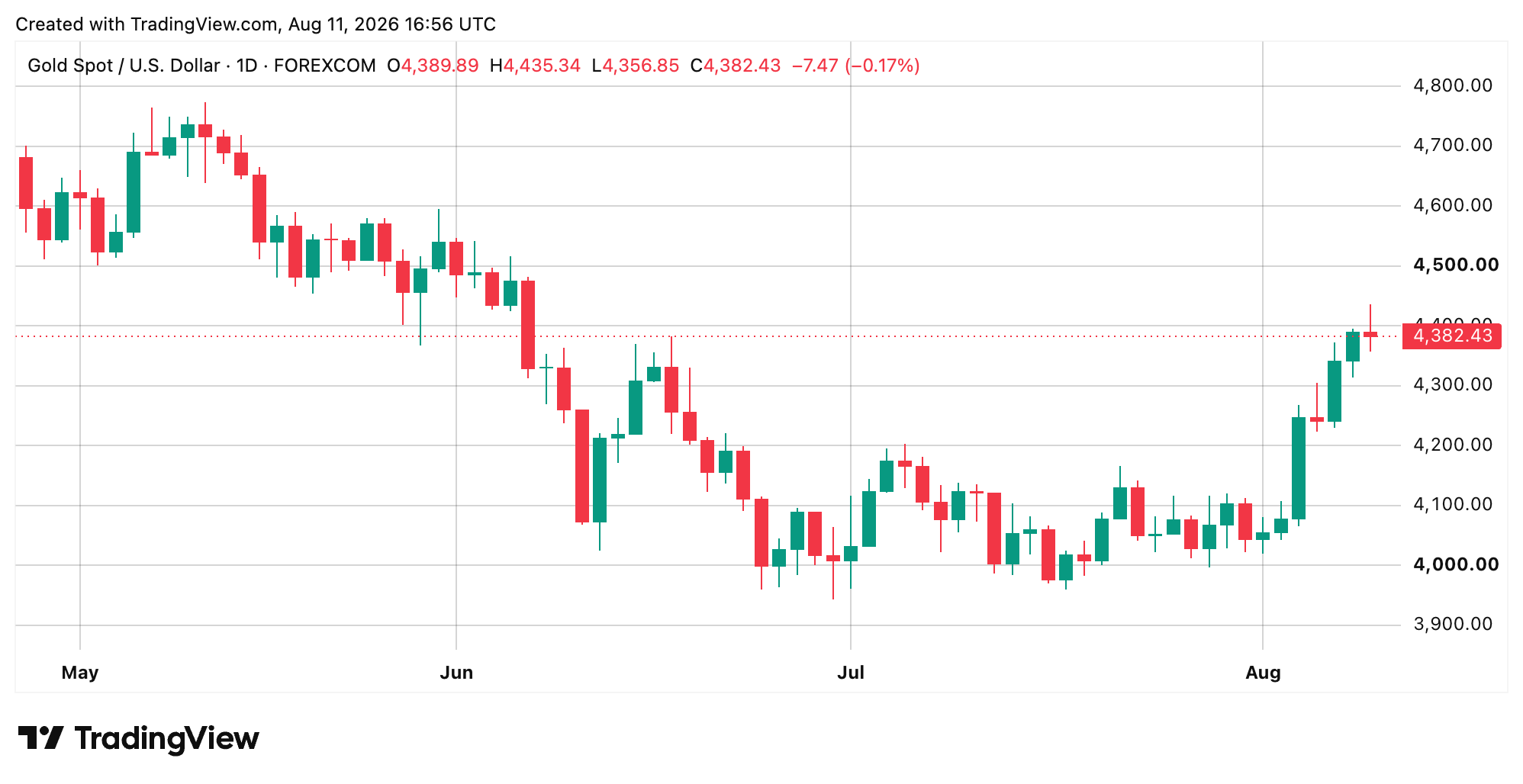
Gold Chart on August 11, 2026, at 1:00 PM Eastern Time (EDT).

The price rise also allowed gold to decisively break through the 100-day moving average—a technical indicator that traders closely watch. Breaking this barrier attracted new buyers to the market after the price of gold had tumbled to $3,966 during the summer correction.

China Continues to Accumulate Gold

Another powerful supporting factor was China. In July, the People's Bank of China extended its gold-buying campaign to 21 consecutive months, purchasing about 20 metric tons, or roughly 640,000 ounces.

By the end of July, China's official gold reserves had grown to approximately 76.08 million ounces. Chinese gold-backed exchange-traded funds also attracted new investments, leading to increased investor demand in addition to the central bank's persistent accumulation.

Central banks value gold for its independence from other governments or currency issuers. This steady institutional demand has repeatedly provided support for prices, even when a strengthening U.S. dollar should have exerted more downward pressure on gold prices.

Geopolitical Risks Keep Buyers in the Market

Ongoing tensions between the U.S. and Iran added another reason to keep gold on hand, especially since a conflict in the Strait of Hormuz could disrupt global oil supplies and rekindle inflation fears.

As a result, gold finds itself in the familiar situation of dual pressures. Expensive oil could revive inflation and lead to tighter monetary policy, which would hurt the gold price, while geopolitical instability simultaneously sends safe-haven capital rushing straight to the metal. Gold advocate and economist Peter Schiff believes this trend will continue.

"Gold and silver prices rose today alongside a 5% rise in oil prices," Schiff wrote on social media platform X. "The metals are shedding the recently established negative correlation with oil. Gold and oil should rise together as inflation pushes the consumer price index and bond yields higher, while the U.S. economy weakens as jobs are cut."

In another post on X, Schiff continued:

"Gold is now above $4,400. Silver is approaching $66. The market is signaling something to you. Are you listening?"

Inflation Data Could Either Bolster or Derail the Rally

The next decisive moment will be the U.S. inflation data. A more moderate Consumer Price Index (CPI) could further weaken the case for Fed tightening and give gold another chance to turn the recent breakout zone into sustainable support.

Higher readings could quickly unravel this situation, pushing Treasury yields and the U.S. dollar higher. Traders are now watching the $4,500 level and gold's 200-day moving average to see whether this recovery will continue or become another failed breakout after a rapid rally.

end-content

Related Questions

QWhat was the key factor that triggered the recent rise in gold prices according to the article?

AThe key trigger was the disappointing U.S. July employment report, which showed a loss of 23,000 jobs against expectations of a gain, leading traders to scale back expectations for near-term Fed rate hikes.

QHow has China's behavior contributed to the support for gold prices?

AChina's central bank has extended its gold-buying campaign for 21 consecutive months, purchasing around 20 tons in July. Official reserves have grown to approximately 76.08 million ounces, providing consistent institutional demand.

QWhat technical level did gold break through, attracting new buyers to the market?

AGold confidently broke through the 100-day moving average, a key technical indicator watched by traders, attracting new buyers after a summer correction.

QWhat geopolitical risk is mentioned as a reason for investors to hold gold?

AOngoing U.S.-Iran tensions in the Strait of Hormuz region are cited, as a potential disruption to global oil supplies could reignite inflation fears and drive safe-haven capital into gold.

QAccording to the article, what upcoming U.S. data could either reinforce or derail the gold rally?

AUpcoming U.S. inflation (CPI) data is the next critical test. A more moderate CPI could weaken the case for Fed tightening, while higher figures could push Treasury yields and the dollar up, threatening the rally.

Related Reads

A New Scaling Variable for Text-to-Image Generation, Discovered by ByteDance's Seed Team

ByteDance's SEED team investigated a crucial but often overlooked scaling variable in text-to-image diffusion models: the amount of image-grounded information in training captions. They found that simply increasing caption length with natural language does not improve model performance, as it often adds redundancy without new, usable visual supervision. The core discovery is that the final training loss of a diffusion model can be predicted by the *information content* of its text condition, measured by two complementary metrics: Grounded Perplexity Gain (GPG) and Effective Detailness (ED). This establishes a scaling relationship for text conditioning. To systematically increase information content, the team proposed **Structured Prompt (SP)**, a JSON-based representation that organizes visual variables (global scene, object attributes, spatial relationships) into clear fields, enhancing **Diffusability**—the model's ability to learn from captions. For inference, an LLM **Prompter** is trained to convert user queries into detailed SP instances, defining **Promptability**. The overall generation quality is viewed as a product of Diffusability and Promptability. A three-stage training strategy (SFT, cold-start reasoning distillation, and verifier-guided reinforcement) significantly improves the prompter's capability. The structured format also enables efficient iterative refinement through a *refine-render-judge* loop. In matched-control experiments using the same Qwen-Image backbone, data, and compute, the SP-based system substantially outperformed its natural-language counterpart, demonstrating that gains stem from the structured information interface, not just more training. The work shows that scaling text-to-image models requires scaling the *usable visual information* in conditions, not just model size or data volume.

marsbit8m ago

A New Scaling Variable for Text-to-Image Generation, Discovered by ByteDance's Seed Team

marsbit8m ago

In Just 6 Months, 4 Rounds of Funding: West Lake University Professor's Venture Takes Off

Westlake Robotics, an embodied artificial intelligence company, has completed its Series A financing round within just six months and a total of four rounds, raising a cumulative 5 billion RMB. The investor lineup includes prominent institutions such as SAIF Partners, Xiaomiao Langcheng, Henan Investment Group Huirong Fund, and Haiyuan Fund, forming a high-quality capital matrix comprising state-owned, industrial, and leading venture capital. The rapid and intensive capital injection reflects strong market confidence in the company's technological approach, product deployment capabilities, and long-term potential. The newly acquired funds will be primarily allocated to the research and development of a unified large model for humanoid robots and the establishment of a talent cultivation base for embodied AI. Founded in 2024, Westlake Robotics originated from the industrial transformation of pioneering achievements in AI and robotics at Westlake University. The founding team is led by Wang Donglin, a leading figure in China's embodied AI and robot learning field, and co-founder Zhang Yue, an expert in natural language processing. The core R&D members hail from top-tier tech companies like Alibaba, ByteDance, Tencent, and Huawei, as well as prestigious global universities. The company follows a fully self-developed strategy integrating a "universal brain + humanoid body-specific cerebellum + proprietary humanoid hardware." It is one of the few domestic enterprises capable of holistically connecting the three core areas of embodied AGI cognitive reasoning, full-body motion control, and humanoid hardware. Its proprietary technologies include the General Motion Model-GAE system for low-latency teleoperation and motion generalization, and a dual pre-trained architecture for general and body-specific processing to bridge cognitive reasoning and physical movement. In 2026, Westlake Robotics launched its self-developed humanoid robot "Westlake o1," completing the full technology chain from underlying algorithms to pre-trained models and hardware. The company has secured nearly 100 million RMB in orders, with applications in scientific research, education, data collection, and power inspection. Future targets include high-risk industrial inspection, post-disaster search and rescue, and remote precision assembly. The company has also partnered with the Longyou County government to establish a county-wide real-scenario training base for humanoid robots, aimed at collecting high-quality motion data and validating technology in authentic environments. With the latest funding, Westlake Robotics plans to further advance its core model development and talent acquisition strategy, accelerating progress toward the "GPT moment" for embodied intelligence in China.

marsbit32m ago

In Just 6 Months, 4 Rounds of Funding: West Lake University Professor's Venture Takes Off

marsbit32m ago

Volatility Plummets to Historic Lows, When Will Bitcoin's 'Summer Sideways Move' End?

Bitcoin is experiencing a classic summer of stagnant price action, trapped in a tight range between approximately $62,000 and $66,000. Analysts point to historically low implied volatility and thin summer liquidity as key characteristics of the current market. The consensus among traders is that the catalyst for a decisive breakout will come from macroeconomic factors, not internal crypto dynamics. The immediate focus is on upcoming U.S. CPI data, which could influence Federal Reserve policy expectations. A softer inflation print is seen as potentially supportive for risk assets like Bitcoin. Furthermore, the pending *Clarity Act* legislation is identified as a crucial long-term catalyst that could boost institutional participation by providing regulatory clarity. While U.S. spot Bitcoin ETFs, led by BlackRock's IBIT, have seen their strongest inflows since April, providing underlying support, this buying pressure is being offset by selling from miners and other large holders. This has resulted in continued consolidation even as global crypto trading volumes hit multi-year lows. Market participants expect the range-bound, low-volatility environment to persist for several more weeks, at least until there is clearer progress on macro policy or regulatory fronts. Any sustained break above or below the current range is likely to trigger a significant expansion in volatility. Long-term bullish narratives around adoption, institutional demand, and Bitcoin's unique attributes as collateral remain intact, but the short-term path depends on external macroeconomic catalysts.

marsbit35m ago

Volatility Plummets to Historic Lows, When Will Bitcoin's 'Summer Sideways Move' End?

marsbit35m ago

Trading

Spot
活动图片