Global Top 10 Assets Reshuffle in 2025: Why Has Bitcoin Lost Its Shine?

marsbitPublished on 2026-01-05Last updated on 2026-01-05

Abstract

In 2025, global asset markets experienced significant shifts, with traditional hard assets like gold and silver dominating while Bitcoin underperformed. Gold surged over 65% to approximately $43,100 per ounce, reaching a theoretical market cap of $30 trillion, while silver rose 150% to $72, driven by geopolitical tensions, inflation, and industrial demand from AI and solar sectors. Major AI-related tech stocks like Nvidia and TSMC saw solid gains but entered a consolidation phase. Bitcoin, despite briefly hitting $126,000 mid-year, ended 2025 around $88,000 with an 8% annual loss—marking its first negative post-halving year. Key factors included macro liquidity tightening, increased correlation with equities, large-scale selling by long-term holders, excessive leverage unwinding ($30 billion in derivatives), and slowing institutional inflows, especially from ETFs in Q4. Looking ahead to 2026, analysts remain broadly optimistic. Institutions like J.P. Morgan, Standard Chartered, and Bernstein project targets between $140,000 and $170,000, citing potential ETF-driven demand, regulatory clarity, and macro improvements. However, skeptics like Bloomberg’s Mike McGlone warn of a possible drop to $50,000 or lower due to speculative risks. Overall, 2026 is seen as a potential rebound year for Bitcoin, contingent on macro conditions and institutional adoption.

Author:zhou, ChainCatcher

2025 was a year of dramatic divergence in the global asset markets.

Geopolitical conflicts, recurring inflation,AI technology breakthroughs, and massive central bank purchases drove a strong comeback for traditional hard assets, while cryptocurrencies came under pressure in the tug-of-war between institutional expectations and macroeconomic realities.

2025 Changes in the Global Top 10 Assets: Gold Dominates, Silver Rises, Bitcoin Rallies Then Falls

According to CompaniesMarketCap data, the ranking of the global top 10 assets in2025 showed profound structural adjustments. Gold led the pack with a theoretical market cap of approximately $30 trillion, while silver's market cap approached $4 trillion, securing a spot in the top three. Tech stocks occupied the middle of the rankings, while Bitcoin's market cap was around $1.8 trillion, slipping to eighth place.
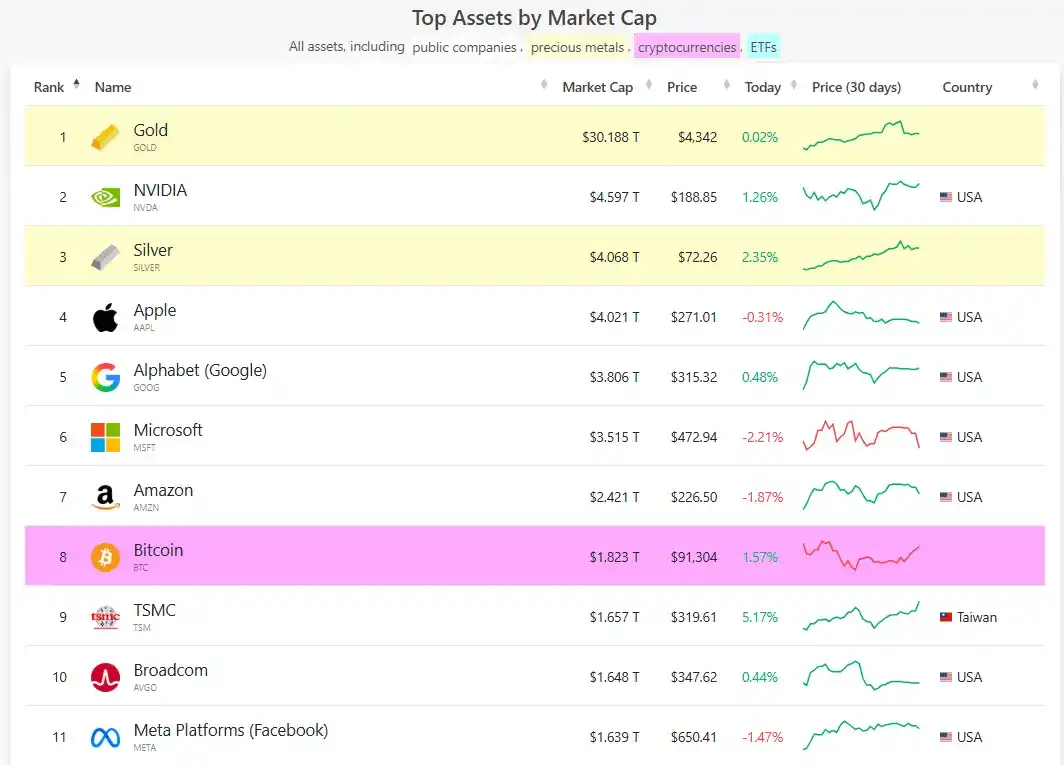

Hard Assets Gold and Silver Dominated the Year's Narrative

As the king of safe havens, the gold price soared from $2,630 at the beginning of the year to $4,310 by year-end, a gain of over65% , the largest in46 years. Driven by central bank purchases and geopolitical避险, its market cap nearly doubled and crushed the combined value of all listed companies. Silver became the year's biggest dark horse, its price surging from $29 at the start of the year to $72, a150% gain that far outpaced gold. Beyond its safe-haven属性, explosive growth in industrial demand from photovoltaics andAI computing power propelled silver from a peripheral asset强势into the global top three.

AI -Related Tech Stocks Were Strong But Entered a Digestion Phase

NVIDIA, as the chip leader, saw its market cap grow30% to $4.6 trillion, briefly surpassing the $5 trillion mark during the year. TSMC and Broadcom benefited from computing power demand, with their market caps both rising from $1 trillion to $1.6 trillion, gains of around60%. Although the AI sector overall hit record highs, the growth rate became more moderate, reflecting a more cautious market assessment of productivity realization.

Bitcoin Rallied Then Fell, Relatively Weak

Although Bitcoin briefly surged to $126,000 mid-year, with its market cap temporarily breaking into the global top five, a flash crash and volatility in the fourth quarter brought its year-end price back to around $88,000. With a negative return of approximately8% for the year, this marked the first time Bitcoin recorded a negative return in the year following a halving cycle.

Legacy Tech Giants Performed Steadily But Largely Lacked Explosiveness

Alphabet recorded a52% gain thanks to the integration of Gemini AI, its market cap rising to $3.8 trillion. The gains for Amazon, Microsoft, and Apple ranged between14% and33% . Although they maintained dominance in search, cloud computing, and consumer electronics, overall growth had significantly slowed.Meta saw its market cap increase to $1.67 trillion, driven by its Llama model and record engagement on its social platforms, fiercely competing with Broadcom for the tenth spot at year-end.

It is worth noting that in the 2025 asset ranking reshuffle, several traditional giants were squeezed out of the top ten. Among them, Eli Lilly, which had previously led due to the weight-loss drug boom, saw its gains slow due to the siphoning effect of the AI theme, falling to around 15th place. Additionally, companies like Tesla and Saudi Aramco were接近or briefly entered the top ten early in the year but fell to positions 15-20 by year-end, affected by intensified EV competition, oil price volatility, and the explosive growth of tech/precious metal assets. These changes highlight the structural shift of global capital towards AI computing infrastructure and hard asset避险demand.

Overall, the turning point in the global asset market in 2025 was the suppression of tech stocks by the market cap of hard assets. Tech stocks faced bubble concerns at historical highs, while Bitcoin experienced a shift from狂热to fatigue in its high-open, low-close performance, becoming a relative loser for the year.

Why Did Bitcoin Underperform? Narrative Shift from狂热to Fatigue

Bitcoin's performance in 2025 was typically characterized by a rise followed by a fall. At the beginning of the year, driven by pro-crypto policy expectations, massive institutionalETF inflows, and macro easing policies, its price started from the $90,000 level and reached a historical high of $126,000 in October, with its market cap briefly exceeding $2.4 trillion.

However, the situation changed急剧in the fourth quarter, with a severe flash crash pushing the price down to a low of $84,000. Bitcoin最终closed the year at around $88,000, recording a negative return of approximately8% . Compared to gold's70% and silver's over140% gains, Bitcoin's relative weakness reflected its vulnerability in a complex macro environment.

This performance was caused by multiple factors.

First, macro liquidity tightening and pressure from capital reallocation. The Fed's pace of interest rate cuts in the second half of the year fell short of expectations, coupled with the Bank of Japan maintaining its hiking stance, leading to tighter global liquidity. Capital was forced to withdraw from high-volatility assets and flow into safe-haven assets like gold and silver or productivity-oriented equity markets. Meanwhile, Bitcoin's correlation with US stocks surged from0.23 at the beginning of the year to over0.86 by year-end, gradually losing its appeal as an independent allocation asset.

Second, selling by long-term holders and leverage liquidation amplified market volatility. In 2025, the old whale group sold a record1.6 million Bitcoins, creating sustained selling pressure. The flash crash on October 10th wiped out months of gains in a very short time, triggering a chain reaction in the derivatives market.Matrixport pointed out that since the阶段性high in October 2025, nearly $30 billion in leverage corresponding to the open interest规模of BTC and ETH futures has been liquidated. Over-leveraging made it difficult for the market to quickly restore confidence after the暴跌.

Furthermore, the slowdown in institutional adoption progress further exacerbated the downward pressure. Although BitcoinETF maintained net inflows for the year, tens of billions of dollars were withdrawn in the fourth quarter. The strength of corporate acquisitions was also significantly limited. As the stock prices of some companies holding digital assets (DAT) fell, the market saw阶段性Bitcoin selling行为. The cooling of institutional sentiment directly suppressed market performance at year-end, preventing Bitcoin from continuing its past glory in 2025.

Bitcoin's Future?

Although Bitcoin recorded a negative return in 2025 and broke the traditional four-year cycle expectation, consensus at the institutional level remains optimistic. The market generally believes that this year's deep adjustment is paving the way for a more sustainable, institutionally-driven bull market in the future.

As 2026 arrives, with gradual improvement in global macro liquidity and further clarification of the regulatory environment, Bitcoin is expected to end the current period of震荡and return to a growth trajectory, potentially even challenging new historical levels.

According to summaries from various media, current public predictions show that analysts likeTom Lee, Standard Chartered, and Bernstein are generally bullish, but there are divergences.

Mainstream price targets mostly fall between $140,000 and $170,000, for example:

J.P. Morgan , based on a volatility-adjusted gold ratio model, calculated a theoretical fair value of approximately $170,000, believing Bitcoin still has significant upside potential.

Standard Chartered and Bernstein set their year-end 2026 targets at around $150,000, emphasizing structural support from ETF inflows, slowed corporate treasury adoption, and the long-term inflow of institutional capital will dominate the cycle.

Grayscale defines 2026 as the dawn of the institutional era, expecting Bitcoin to set new historical highs in the first half of the year, ending the traditional four-year cycle and shifting to a steady uptrend driven by sustained institutional demand.

Bitwise believes ETFs will absorb over 100% of the new supply, further strengthening price support, and predicts 2026 will belong to the bulls. Citi's baseline scenario is $143,000, with a bull scenario reaching $189,000.

Beyond these mainstream views, there are more激进perspectives. For example,Cardano founder Charles Hoskinson expects the Bitcoin price to reach $250,000, citing the powerful thrust from Bitcoin's fixed supply and growing institutional demand.

However, there are also significant bearish voices.Bloomberg Intelligence 's Mike McGlone is the most pessimistic, suggesting that in a deflationary macro environment, Bitcoin could fall back to $50,000 or even $10,000, particularly emphasizing the mean reversion risk faced by speculative assets.

Matrixport believes 2026 will be a year of high volatility rather than a smooth trend. Influenced by the Fed leadership transition, a疲软labor market, and election-year policy risks, the market will face密集risk event windows. The firm提醒investors to maintain flexibility and actively manage positions, precisely把握market exposure around key policy events.

Overall, although预测data shows significant divergence, mainstream institutions generally agree that 2026 will be a year of structural rebound for Bitcoin.ETF as a permanent demand engine, regulatory clarity, and accelerated corporate/institutional allocation will be the core catalysts. In the short term, the Bitcoin price may bottom out in the $80,000 to $100,000 range, but the probability of an upward breakout is significantly increasing as the macro environment turns and capital flows back.

Click to learn about open positions at ChainCatcher

Related Questions

QWhat were the top three assets by market capitalization in 2025, according to the article?

AAccording to the article, the top three assets by market capitalization in 2025 were: 1. Gold (with a theoretical market cap of approximately $30 trillion), 2. Silver (approaching $4 trillion), and 3. Nvidia (with a market cap of $4.6 trillion).

QWhy did Bitcoin underperform in 2025, recording a negative return for the year?

ABitcoin underperformed due to several factors: a tightening of global macro liquidity leading to capital outflows from high-volatility assets, record selling by long-term holders ('whales') creating supply pressure, a flash crash in Q4 that triggered massive liquidations in the derivatives market, and a slowdown in institutional adoption with net outflows from Bitcoin ETFs in the fourth quarter.

QWhat was the primary reason for the massive surge in the price and market cap of silver in 2025?

AThe massive 150% surge in silver's price was driven not only by its safe-haven属性 but also by explosive growth in demand from the photovoltaic (solar) industry and AI computing power, which are industrial uses for the metal.

QWhat is the general consensus among major institutional analysts (like J.P. Morgan, Standard Chartered) regarding Bitcoin's price target for 2026?

AThe general consensus among major institutional analysts is optimistic, with mainstream price targets for the end of 2026 falling in the range of $140,000 to $170,000. They cite reasons such as continued ETF inflows, clearer regulations, and long-term institutional capital adoption as key catalysts.

QWhich analyst provided the most pessimistic outlook for Bitcoin in 2026, and what was their prediction?

AMike McGlone from Bloomberg Intelligence provided the most pessimistic outlook. He suggested that in a deflationary macro environment, Bitcoin could fall back to $50,000 or even $10,000, emphasizing the mean reversion risk for speculative assets.

Related Reads

Kicked Out of PayPal, Musk Aims for a Comeback in the Crypto Market

Elon Musk's X (formerly Twitter) has launched its "Smart Cashtags" feature, generating approximately $1 billion in trading volume within days of its April 2026 pilot launch. The feature allows users to click on stock or crypto tickers (or even full Solana token contract addresses) in posts to view real-time price charts and discussions without leaving the app. Initially available to iPhone users in the US and Canada, with a partnership in Canada enabling direct trading via the Wealthsimple app. This move is part of Musk's broader "Everything App" vision, spearheaded by the upcoming X Money platform. Analysts, such as Mizuho's Dan Dolev, see this as a potential disruptor to the US payments market, even prompting a downgrade of PayPal's stock. X Money's beta offers services like 6% APY on deposits, cashback, and P2P transfers, with speculation it may later incorporate crypto trading and stablecoin settlements for faster transactions. However, the ambitious plan faces significant regulatory scrutiny. Senator Elizabeth Warren has questioned the sustainability of the high 6% yield and raised concerns over X's banking partner, Cross River Bank, which has a history of regulatory violations. Additional risks involve the "GENIUS Act," which may create loopholes for stablecoin issuance without full FDIC insurance coverage, potentially leaving users unprotected. The integration of social trading on a platform with over 500 million users could inject new liquidity and retail interest into the crypto market. Yet, it also amplifies risks like herd mentality and the blurring of lines between entertainment and financial speculation. Musk's return to finance, after his ouster from PayPal, hinges on balancing innovation with regulatory compliance.

marsbit1h ago

Kicked Out of PayPal, Musk Aims for a Comeback in the Crypto Market

marsbit1h ago

Trading

Spot
Futures

Hot Articles

What is $BITCOIN

DIGITAL GOLD ($BITCOIN): A Comprehensive Analysis Introduction to DIGITAL GOLD ($BITCOIN) DIGITAL GOLD ($BITCOIN) is a blockchain-based project operating on the Solana network, which aims to combine the characteristics of traditional precious metals with the innovation of decentralized technologies. While it shares a name with Bitcoin, often referred to as “digital gold” due to its perception as a store of value, DIGITAL GOLD is a separate token designed to create a unique ecosystem within the Web3 landscape. Its goal is to position itself as a viable alternative digital asset, although specifics regarding its applications and functionalities are still developing. What is DIGITAL GOLD ($BITCOIN)? DIGITAL GOLD ($BITCOIN) is a cryptocurrency token explicitly designed for use on the Solana blockchain. In contrast to Bitcoin, which provides a widely recognized value storage role, this token appears to focus on broader applications and characteristics. Notable aspects include: Blockchain Infrastructure: The token is built on the Solana blockchain, known for its capacity to handle high-speed and low-cost transactions. Supply Dynamics: DIGITAL GOLD has a maximum supply capped at 100 quadrillion tokens (100P $BITCOIN), although details regarding its circulating supply are currently undisclosed. Utility: While precise functionalities are not explicitly outlined, there are indications that the token could be utilized for various applications, potentially involving decentralized applications (dApps) or asset tokenization strategies. Who is the Creator of DIGITAL GOLD ($BITCOIN)? At present, the identity of the creators and development team behind DIGITAL GOLD ($BITCOIN) remains unknown. This situation is typical among many innovative projects within the blockchain space, particularly those aligning with decentralized finance and meme coin phenomena. While such anonymity may foster a community-driven culture, it intensifies concerns about governance and accountability. Who are the Investors of DIGITAL GOLD ($BITCOIN)? The available information indicates that DIGITAL GOLD ($BITCOIN) does not have any known institutional backers or prominent venture capital investments. The project seems to operate on a peer-to-peer model focused on community support and adoption rather than traditional funding routes. Its activity and liquidity are primarily situated on decentralized exchanges (DEXs), such as PumpSwap, rather than established centralized trading platforms, further highlighting its grassroots approach. How DIGITAL GOLD ($BITCOIN) Works The operational mechanics of DIGITAL GOLD ($BITCOIN) can be elaborated on based on its blockchain design and network attributes: Consensus Mechanism: By leveraging Solana’s unique proof-of-history (PoH) combined with a proof-of-stake (PoS) model, the project ensures efficient transaction validation contributing to the network's high performance. Tokenomics: While specific deflationary mechanisms have not been extensively detailed, the vast maximum token supply implies that it may cater to microtransactions or niche use cases that are still to be defined. Interoperability: There exists the potential for integration with Solana’s broader ecosystem, including various decentralized finance (DeFi) platforms. However, the details regarding specific integrations remain unspecified. Timeline of Key Events Here is a timeline that highlights significant milestones concerning DIGITAL GOLD ($BITCOIN): 2023: The initial deployment of the token occurs on the Solana blockchain, marked by its contract address. 2024: DIGITAL GOLD gains visibility as it becomes available for trading on decentralized exchanges like PumpSwap, allowing users to trade it against SOL. 2025: The project witnesses sporadic trading activity and potential interest in community-led engagements, although no noteworthy partnerships or technical advancements have been documented as of yet. Critical Analysis Strengths Scalability: The underlying Solana infrastructure supports high transaction volumes, which could enhance the utility of $BITCOIN in various transaction scenarios. Accessibility: The potential low trading price per token could attract retail investors, facilitating wider participation due to fractional ownership opportunities. Risks Lack of Transparency: The absence of publicly known backers, developers, or an audit process may yield skepticism regarding the project's sustainability and trustworthiness. Market Volatility: The trading activity is heavily reliant on speculative behavior, which can result in significant price volatility and uncertainty for investors. Conclusion DIGITAL GOLD ($BITCOIN) emerges as an intriguing yet ambiguous project within the rapidly evolving Solana ecosystem. While it attempts to leverage the “digital gold” narrative, its departure from Bitcoin's established role as a store of value underscores the need for a clearer differentiation of its intended utility and governance structure. Future acceptance and adoption will likely depend on addressing the current opacity and defining its operational and economic strategies more explicitly. Note: This report encompasses synthesised information available as of October 2023, and developments may have transpired beyond the research period.

363 Total ViewsPublished 2025.05.13Updated 2025.05.13

What is $BITCOIN

Discussions

Welcome to the HTX Community. Here, you can stay informed about the latest platform developments and gain access to professional market insights. Users' opinions on the price of BTC (BTC) are presented below.

活动图片















