Gemini nabs US license to offer prediction markets

cointelegraphPublished on 2025-12-11Last updated on 2025-12-11

Abstract

Crypto exchange Gemini, founded by the Winklevoss twins, has received a designated contract market license from the CFTC, allowing it to offer prediction markets in the US. Through its affiliate Gemini Titan, the company plans to let users trade event contracts and expand into crypto derivatives like futures and options. The announcement caused Gemini's stock to surge 13.7% in after-hours trading. The license marks the end of a five-year application process and could significantly boost the company, which has seen its stock decline since its public debut. President Cameron Winklevoss stated that prediction markets could potentially rival or exceed traditional capital markets in size.

Crypto exchange Gemini, founded by billionaire twins Tyler and Cameron Winklevoss, has scored a license from the Commodity Futures Trading Commission to offer prediction markets in the US.

Gemini said on Wednesday that its affiliate, Gemini Titan, received a designated contract market license from the CFTC and “plans to enter into the prediction markets space.”

The company said that “starting shortly,” its US users would be able to trade event contracts on its web platform and could expand its US derivatives offerings to include crypto futures, options, and perpetual contracts.

Gemini joins a number of crypto companies that have begun to offer prediction markets, allowing users to bet on the outcomes of a range of events, including sports and geopolitics.

Shares in Gemini (GEMI) shot up 13.7% in after-hours trading on Wednesday to $12.92 after ending the day’s trading session down 0.7%.
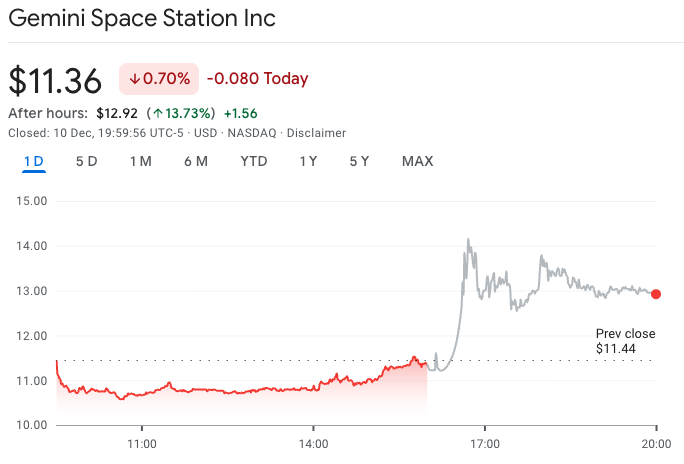
Shares in Gemini jumped on the company’s announcement that it will offer prediction markets. Source: Google Finance

The license could be a major boost for Gemini, whose stock is down 64.5% since its public debut on Sept. 12 as the crypto market has struggled to sustain a rally.

Related: ‘Elite’ traders hunt dopamine-seeking retail on prediction markets: 10x Research

“Prediction markets have the potential to be as big or bigger than traditional capital markets,” said Gemini’s president, Cameron Winklevoss.

Gemini CEO Tyler Winklevoss said it first applied for the license in March 2020, and the approval “marks the culmination of a 5-year licensing process and the beginning of a new chapter for Gemini.”

Magazine: Can Robinhood or Kraken’s tokenized stocks ever be truly decentralized?

Related Questions

QWhat license did Gemini receive and from which US regulatory body?

AGemini received a designated contract market license from the Commodity Futures Trading Commission (CFTC).

QWhich Gemini affiliate was specifically granted the license to operate prediction markets?

AGemini Titan, an affiliate of the crypto exchange Gemini, was granted the license.

QHow did the announcement of the license affect Gemini's stock price in after-hours trading?

AGemini's stock (GEMI) shot up 13.7% in after-hours trading to $12.92.

QAccording to Cameron Winklevoss, how big does he believe prediction markets can become?

ACameron Winklevoss stated that prediction markets 'have the potential to be as big or bigger than traditional capital markets.'

QWhen did Gemini first apply for this license, according to CEO Tyler Winklevoss?

ACEO Tyler Winklevoss said the company first applied for the license in March 2020.

Related Reads

Rebuttal: I Don't Regret Spending 8 Years in the Crypto Industry

Ken Chang recently wrote an article lamenting his eight years in crypto as a waste, describing the industry as inherently destructive and a system of financial nihilism that has built the world's largest casino. While many in the space dismiss such critiques, the author acknowledges that Ken’s disillusionment—shared by earlier figures like Mike Hearn—stems from a genuine idealistic disappointment. Crypto promised decentralization and a new financial system but largely delivered speculation and gambling. The author identifies five core aspirations of cryptocurrency: restoring sound money, encoding business logic via smart contracts, making digital property real, improving capital market efficiency, and expanding global financial inclusion. While progress has been made in areas like Bitcoin, stablecoins, and certain efficient financial infrastructures, many grand visions—like overthrowing fiat or revolutionizing digital ownership—remain unfulfilled. The author advocates for a "pragmatic optimism." Speculation and casino-like dynamics are seen as unfortunate but inevitable side effects of building permissionless, open financial infrastructure. The key is to focus on the real, albeit gradual, progress—such as improved financial access and inclusion—while accepting that transformative change is slow and often captured by incremental efficiency gains, not revolution. The goal remains worthy, even if the path is messier than hoped.

marsbit19m ago

Rebuttal: I Don't Regret Spending 8 Years in the Crypto Industry

marsbit19m ago

Trading

Spot
Futures
活动图片