Garlinghouse Reveals Why Ripple Really Pivoted To Its Own Stablecoin

bitcoinistPublished on 2026-03-27Last updated on 2026-03-27

Abstract

Ripple CEO Brad Garlinghouse explained that the company launched its own stablecoin, RLUSD, to internalize a role it was already playing at scale—having previously minted 20% of all USDC due to its large payment flows. The decision was driven by Ripple's substantial balance sheet strength, which positions it to offer a compliant, institutionally-focused stablecoin, especially after observing vulnerabilities like USDC's depeg during the Silicon Valley Bank collapse. Garlinghouse emphasized that trust, licensing, and transparency will differentiate stablecoins as the market matures, and he expects regulatory progress in the U.S. to continue, with further clarity anticipated by the end of May.

Ripple’s decision to launch RLUSD was not a sudden expansion beyond XRP so much as a move to internalize a business it was already helping power at scale. Speaking at FII Priority Miami 2026, Ripple CEO Brad Garlinghouse said the company’s role in stablecoin flows had grown large enough that building its own product became the logical next step.

Why Ripple Entered the Stablecoin Market

Garlinghouse said the turning point came well before RLUSD’s launch 13 months ago. “Two years ago, we were minting 20% of all USDC,” he said, tying that activity directly to Ripple’s payments business. With more than $100 billion in payment flows already processed, Ripple concluded that if it was already a major engine behind stablecoin usage, it made sense to bring that function in-house.

He also linked the decision to a moment of stress in the stablecoin market. Garlinghouse pointed to USDC’s temporary depeg during the Silicon Valley Bank collapse as a reminder that institutional users care about balance-sheet strength as much as blockchain rails.

“Circle came out and said, hey, we’ll stand in the gap. We’ll guarantee the peg. And it didn’t move because at that point, Circle didn’t have a balance sheet,” he said. “Ripple has on our balance sheet, you know, 60, 70 billion dollars of crypto. We have about four billion dollars of US dollars. And so I think we’re in a position to really have a very compliant, very institutional focused stablecoin.”

According to Garlinghouse, stablecoins are increasingly adopted not because companies want exposure to crypto branding, but because they want a better way to solve treasury, settlement and cross-border transfer problems. That broader shift, he argued, is already reshaping how the sector is perceived.

Garlinghouse compared the current state of crypto to the internet industry in the late 1990s, when companies led with the technology rather than the use case. “We don’t talk about anything as an internet company now because it’s just prevalent in the background,” he said. “And I think that’s where some of the blockchain and crypto based solutions are heading”. Companies, he added, “just want to solve a payments problem. They want to solve a custody problem.”

On market structure, Garlinghouse expects the stablecoin field to get more crowded before it gets smaller. He said the biggest banks are already evaluating whether they should issue their own stablecoins, but questioned whether the market benefits from too many dollar-backed instruments that ultimately serve the same economic function. “We don’t need, you know, 50 US dollar stablecoins. Like, why? Like, they’re all, it’s still, at the end of the day, a U.S. dollar,” he said.

That does not mean he sees no room for differentiation. Instead, he argued that trust, licensing and reserve transparency will become the real competitive variables as the market matures. Ripple, he said, has deliberately taken a compliance-first route, pursuing not just a New York Department of Financial Services license but also an OCC license.

He added that the sector as a whole needs more regulatory verification and disclosure, pointing even to Tether’s renewed push for an audit as evidence that transparency is becoming harder to avoid.

Garlinghouse was similarly upbeat on the US policy backdrop. He described passage of the Genius Act as a major unlock for demand and said corporate executives are now actively asking whether stablecoins should be part of their operations. While he said follow-on legislation around asset classification has been slower, he argued the tone in Washington has already shifted sharply, citing recent coordination between the SEC and CFTC and predicting further progress by the end of May.

“So I think we already have made huge progress in this administration to provide some of that structure and Clarity [Act]. I think clarity will still pass. I was in Washington two days ago, and I think we’ll still get something. [...] I’ll predict by the end of May we’ll get something across,” Garlinghouse said.

At press time, XRP traded at $1.36.
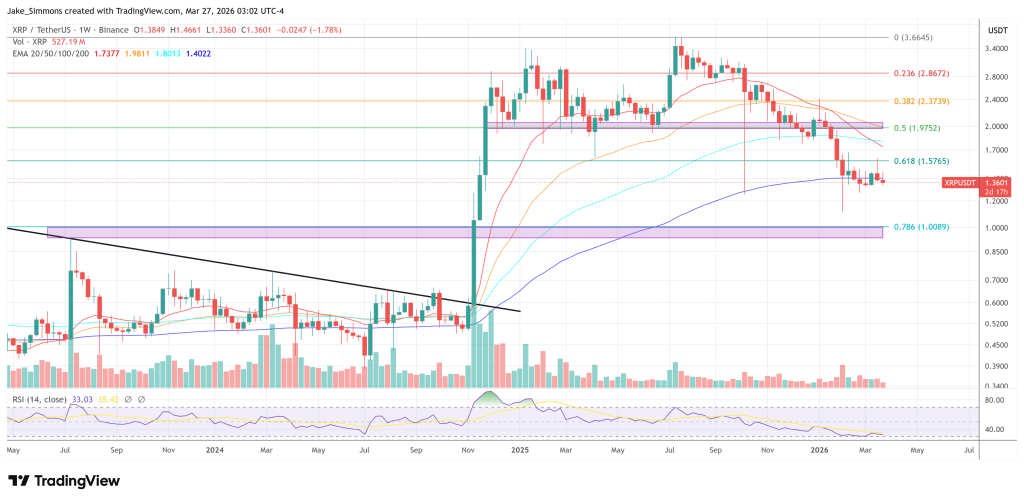
XRP drops below the 200-week EMA again, 1-week chart | Source: XRPUSDT on TradingView.com

Related Questions

QWhat was the main reason Ripple decided to launch its own stablecoin, RLUSD?

ARipple decided to launch RLUSD because its role in stablecoin flows had grown so large that building its own product became the logical next step. The company was already minting 20% of all USDC and processing over $100 billion in payment flows, making it a major engine behind stablecoin usage.

QAccording to Brad Garlinghouse, what event in the stablecoin market highlighted the importance of a strong balance sheet for institutional users?

AGarlinghouse pointed to USDC's temporary depeg during the Silicon Valley Bank collapse as the event that highlighted the importance of balance-sheet strength for institutional users, noting that Circle lacked the balance sheet to guarantee the peg at that time.

QHow does Garlinghouse compare the current state of the crypto industry to the internet in the 1990s?

AGarlinghouse compared the current state of crypto to the internet industry in the late 1990s, where companies led with the technology rather than the use case. He stated that just as we no longer talk about 'internet companies' because the technology is now prevalent in the background, blockchain and crypto-based solutions are heading in the same direction.

QWhat does Garlinghouse believe will be the key competitive differentiators in the mature stablecoin market?

AGarlinghouse believes that trust, licensing, and reserve transparency will become the real competitive variables as the stablecoin market matures.

QWhat positive developments in US policy and regulation did Garlinghouse highlight?

AGarlinghouse was upbeat on US policy, citing the passage of the Genius Act as a major unlock for demand. He also mentioned improved coordination between the SEC and CFTC and predicted that further legislative clarity would be achieved by the end of May.

Related Reads

After 50x Storage Surge, Justin Sun Always Looks to the Next Decade

Sun Yuchen, known for his controversial stunts like a $30 million lunch with Warren Buffett (canceled due to a kidney stone) and eating a $6.2 million duct-taped banana, is often overshadowed by a significant fact: his decade-long track record of spotting major investment trends. In 2016, he famously advised young people to invest in Bitcoin, Nvidia, Tesla, and Tencent instead of buying property. A hypothetical $20,000 investment in Nvidia and Tesla from that list would now be worth over 50 million RMB. His latest major call was on November 6, 2025, predicting a "50x storage opportunity" tied to the AI boom, which materialized with Sandisk's stock surging nearly 50-fold by 2026. Looking ahead, Sun now focuses on the next frontier: Physical AI. He identifies four key areas: 1. **Embodied AI/Robotics**: He sees this reaching its "iPhone moment," with companies like UBTech and Galaxy General leading in commercialization. 2. **Drones**: Viewed as the first commercially viable form of Physical AI, revolutionizing sectors from warfare (e.g., AeroVironment's Switchblade) to logistics. 3. **Spatial Computing**: Beyond VR, it's about AI understanding physical space, a foundational technology for robotics and autonomous systems, exemplified by Apple's Vision Pro. 4. **Space Exploration**: After a 2025 suborbital flight with Blue Origin, Sun advocates for space as the ultimate frontier, discussing blockchain's potential role in space asset management and data transactions. His investment philosophy involves betting on entire, inevitable trends rather than single companies. For robotics, he sees Tesla (the body/manufacturer) and Nvidia (the brain/AI platform) as complementary plays. In defense drones, he highlights companies making tanks obsolete (AeroVironment) and those augmenting fighter jets (Kratos). For space, he participated in Blue Origin's flight and anticipates SpaceX's potential IPO to redefine the sector's valuation. Sun Yuchen's vision frames the next two decades not as a revolution in information flow (like the internet), but in the fundamental operation of the physical world through AI-powered robots, autonomous systems, and spatial intelligence, ultimately extending human and AI activity into space. While many still focus on conventional assets, he continues to look toward the next technological horizon.

marsbit53m ago

After 50x Storage Surge, Justin Sun Always Looks to the Next Decade

marsbit53m ago

The Billionaires Behind the Most Expensive Midterm Election in History

"The Most Expensive Midterm Elections and Their Billionaire Backers" This analysis details the unprecedented scale of spending in the 2026 midterm elections, highlighting the key billionaire donors shaping the political landscape. Jeff Yass, founder of Susquehanna International Group, has contributed over $81 million, ranking third among individual donors behind George Soros ($102.6M) and Elon Musk ($84.8M). Yass is a major donor to Trump's MAGA Inc. and supports school choice and various candidates. Overall, federal committees have raised over $4.7 billion this cycle, with political ad spending projected to reach $10.8 billion. Republican-aligned groups are significantly out-raising their Democratic counterparts. "Dark money" from undisclosed sources continues to grow. The core stakes involve control of Congress and policy direction for Trump's final term. Donors are also motivated by specific issues: Sergey Brin and Chris Larsen are funding opposition to a proposed California wealth tax and supporting crypto-friendly policies. Other top donors include OpenAI's Greg Brockman and his wife Anna ($50M total to MAGA Inc. and an AI-focused PAC), Richard Uihlein ($45.3M to conservative causes), venture capitalists Marc Andreessen and Ben Horowitz (each over $44M to crypto/AI PACs and MAGA Inc.), Miriam Adelson ($42.6M to GOP leadership PACs), Paul Singer ($33.9M), and Diane Hendricks ($25.8M to MAGA Inc.). The article notes that the peak fundraising period is still ahead, with major primaries approaching.

marsbit55m ago

The Billionaires Behind the Most Expensive Midterm Election in History

marsbit55m ago

The Largest IPO in History Is Approaching, Surpassing SpaceX, 28 Years of AI Self-Iteration, Countdown to Intelligence Explosion

"Anthropic Nears Trillion-Dollar IPO, Fueled by Explosive Growth and 2028 'Intelligence Explosion' Warning Anthropic is considering a deal valuing the AI company near $1 trillion, potentially leading to one of the largest IPOs ever and surpassing SpaceX. Its revenue has skyrocketed, with Annual Recurring Revenue (ARR) reaching $45 billion in May 2026—a 500% increase in just five months. This vertical growth curve is attributed to its key products, Claude Code and Cowork, dominating AI coding and enterprise collaboration. Beyond commercial success, co-founder Jack Clark issued a pivotal warning in an interview: there is a greater than 50% chance that by the end of 2028, AI systems will achieve recursive self-improvement—the ability to autonomously build a 'better version' of themselves, initiating an 'intelligence explosion.' This prophecy underpins the company's astronomical valuation, as the market prices in the potential for transformative and disruptive AI. Further signaling its ambition, Anthropic formed a $1.5 billion joint venture with Goldman Sachs and Blackstone, aiming to disrupt traditional consulting firms like McKinsey by deploying Claude AI for complex strategic work. This move tests AI's capacity to replace high-level cognitive labor, a precursor to its predicted autonomous evolution. The narrative presents a dual future: unprecedented economic opportunity alongside significant risks like economic restructuring and security threats. Anthropic's meteoric rise and Clark's 2028 prediction frame the coming years as a countdown to a potential technological singularity."

marsbit1h ago

The Largest IPO in History Is Approaching, Surpassing SpaceX, 28 Years of AI Self-Iteration, Countdown to Intelligence Explosion

marsbit1h ago

Trading

Spot
Futures
活动图片





