Full Text of the Fed Decision: 25 Basis Point Rate Cut, $40 Billion Treasury Bill Purchases Within 30 Days

比推Published on 2025-12-10Last updated on 2025-12-10

Abstract

The Federal Reserve lowered the target range for the federal funds rate by 25 basis points to 3.50%-3.75% on December 10, 2025, marking the third consecutive rate cut. The decision was approved by a 9-3 vote. The policy statement removed the description of unemployment as "low," and the latest dot plot maintained the projection of an additional 25 basis point rate cut in 2026. Additionally, the Fed will purchase $40 billion in Treasury bills over 30 days starting December 12 to maintain ample reserve levels. The policy stance reflects concerns over moderating economic activity, a rise in unemployment, and inflation that remains elevated. The committee emphasized its commitment to achieving maximum employment and a 2% inflation target, noting increased downside risks to employment. Voting against the decision were Stephen Miran, who preferred a 50 basis point cut, and Austan Goolsbee and Jeffrey Schmid, who favored no change. The Board also unanimously approved a reduction in the primary credit rate to 3.75%.

On December 10, 2025, local time, the Federal Reserve lowered the benchmark interest rate by 25 basis points to 3.50%-3.75% in a 9-3 vote, marking the third consecutive meeting with a rate cut. The policy statement removed the description of the unemployment rate as "low." The latest dot plot maintains the forecast of a 25 basis point rate cut in 2026.

Additionally, the Federal Reserve will purchase $40 billion in Treasury bills within 30 days starting December 12 to maintain ample reserve supply.

Full Text of the Interest Rate Decision

Available data indicate that economic activity is expanding at a moderate pace. Job growth has slowed this year, and the unemployment rate has risen as of September. More recent indicators are consistent with this situation. Inflation has increased compared to the beginning of the year and remains elevated.

The Committee's long-term goals are to achieve maximum employment and 2% inflation. Uncertainty about the economic outlook remains high. The Committee is closely monitoring risks on both sides of its dual mandate and believes that downside risks in employment have increased in recent months.

To support these goals and considering changes in the risk balance, the Committee decided to lower the target range for the federal funds rate by 25 basis points to 3.50% to 3.75%. In assessing the appropriate timing and magnitude of any further adjustments to the target range for the federal funds rate, the Committee will carefully evaluate incoming data, the evolving economic outlook, and the balance of risks. The Committee is strongly committed to supporting maximum employment and returning inflation to its 2% target.

In evaluating the appropriate monetary policy stance, the Committee will continue to monitor the implications of incoming information for the economic outlook. The Committee would be prepared to adjust the stance of monetary policy as appropriate if risks emerge that could impede the attainment of the Committee's goals. The Committee's assessments will take into account a wide range of information, including labor market conditions, inflationary pressures and inflation expectations, and financial and international developments.

The Committee believes that reserve balances have declined to ample levels and will initiate purchases of short-term U.S. Treasury securities as needed to maintain ample reserve supply on an ongoing basis.

Voting in favor of this monetary policy action were: Chair Jerome H. Powell, Vice Chair John C. Williams, Michael S. Barr, Michelle W. Bowman, Susan M. Collins, Lisa D. Cook, Philip N. Jefferson, Alberto G. Musalem, and Christopher J. Waller. Voting against were Stephen I. Miran, who preferred to lower the target range for the federal funds rate by 1/2 percentage point at this meeting; and Austan D. Goolsbee and Jeffrey R. Schmid, who preferred to maintain the target range for the federal funds rate unchanged at this meeting.
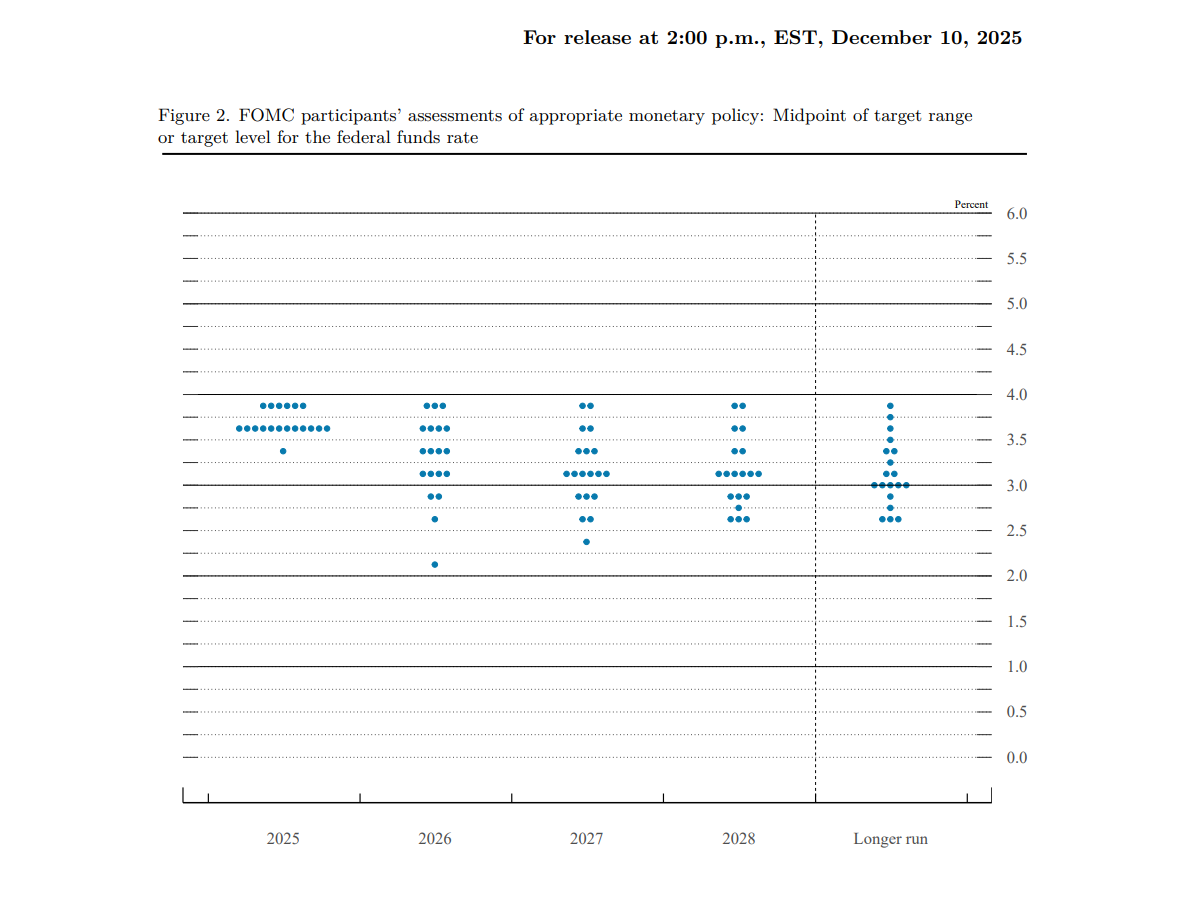
Median Fed Dot Plot: Cumulative 25 Basis Point Rate Cut in 2026

Decisions Regarding Monetary Policy Operations

To implement the monetary policy stance announced in the Federal Open Market Committee's statement on December 10, 2025, the Federal Reserve makes the following decisions:

The Board of Governors of the Federal Reserve System unanimously voted to lower the interest rate on reserve balances to 3.65%, effective December 11, 2025.

As part of the policy decision, the Federal Open Market Committee voted to direct the Open Market Trading Desk at the Federal Reserve Bank of New York, until further notice, to execute transactions in the System Open Market Account in accordance with the following domestic policy directive:

"Effective December 11, 2025, the Federal Open Market Committee directs the Desk:

To conduct open market operations as necessary to maintain the federal funds rate in a target range of 3.50% to 3.75%.

To conduct standing overnight repurchase agreement operations at an offering rate of 3.75%.

To conduct standing overnight reverse repurchase agreement operations at an offering rate of 3.50%, with a per-counterparty limit of $160 billion per day.

To increase the System Open Market Account's holdings of securities by purchasing Treasury bills and, if necessary, other U.S. Treasury securities with remaining maturities of three years or less, to maintain ample levels of reserves.

To reinvest all principal payments from the Federal Reserve's holdings of U.S. Treasury securities at auction. To roll over all principal payments from the Federal Reserve's holdings of agency securities into Treasury bills."

In related actions, the Board of Governors of the Federal Reserve System unanimously voted to approve a 25 basis point reduction in the primary credit rate to 3.75%, effective December 11, 2025. In taking this action, the Board approved requests submitted by the Boards of Directors of the Federal Reserve Banks of New York, Philadelphia, St. Louis, and San Francisco to set this rate.


Twitter:https://twitter.com/BitpushNewsCN

Bitpush TG Discussion Group:https://t.me/BitPushCommunity

Bitpush TG Subscription: https://t.me/bitpush

Original link:https://www.bitpush.news/articles/7594706

Related Questions

QWhat was the new target range for the Federal Funds Rate after the December 10, 2025, Fed decision?

AThe new target range for the Federal Funds Rate is 3.50% to 3.75%.

QHow many members of the Federal Open Market Committee (FOMC) voted against the policy action, and what were their preferred actions?

AThree members voted against the policy action. Stephen I. Miran preferred to lower the target range by 1/2 percentage point, while Austan D. Goolsbee and Jeffrey R. Schmid preferred to maintain the target range unchanged.

QWhat specific action did the Fed announce regarding its balance sheet and Treasury securities?

AThe Fed announced it will purchase $40 billion in Treasury bills over 30 days starting December 12 to maintain ample reserve supplies. It will also reinvest principal payments from its holdings of U.S. Treasury securities and agency securities into Treasury bills.

QAccording to the latest dot plot, what is the median projection for interest rate changes in 2026?

AThe median projection from the latest dot plot is for a cumulative 25 basis point rate cut in 2026.

QWhat changes were made to the policy statement regarding the description of the labor market?

AThe policy statement removed the description of the unemployment rate as 'low'.

Related Reads

OpenAI Post-Training Engineer Weng Jiayi Proposes a New Paradigm Hypothesis for Agentic AI

OpenAI engineer Weng Jiayi's "Heuristic Learning" experiments propose a new paradigm for Agentic AI, suggesting that intelligent agents can improve not just by training neural networks, but also by autonomously writing and refining code based on environmental feedback. In the experiment, a coding agent (powered by Codex) was tasked with developing and maintaining a programmatic strategy for the Atari game Breakout. Starting from a basic prompt, the agent iteratively wrote code, ran the game, analyzed logs and video replays to identify failures, and then modified the code. Through this engineering loop of "code-run-debug-update," it evolved a pure Python heuristic strategy that achieved a perfect score of 864 in Breakout and performed competitively with deep reinforcement learning (RL) algorithms in MuJoCo control tasks like Ant and HalfCheetah. This approach, termed Heuristic Learning (HL), contrasts with Deep RL. In HL, experience is captured in readable, modifiable code, tests, logs, and configurations—a software system—rather than being encoded solely into opaque neural network weights. This offers potential advantages in explainability, auditability for safety-critical applications, easier integration of regression tests to combat catastrophic forgetting, and more efficient sample use in early learning stages, as demonstrated in broader tests on 57 Atari games. However, the blog acknowledges clear limitations. Programmatic strategies struggle with tasks requiring long-horizon planning or complex perception (e.g., Montezuma's Revenge), areas where neural networks excel. The future vision is a hybrid architecture: specialized neural networks for fast perception (System 1), HL systems for rules, safety, and local recovery (also System 1), and LLM agents providing high-level feedback and learning from the HL system's data (System 2). The core proposition is that in the era of capable coding agents, a significant portion of an AI's learned experience could be maintained as an auditable, evolving software system.

marsbit53m ago

OpenAI Post-Training Engineer Weng Jiayi Proposes a New Paradigm Hypothesis for Agentic AI

marsbit53m ago

Your Claude Will Dream Tonight, Don't Disturb It

This article explores the recent phenomenon of AI companies increasingly using anthropomorphic language—like "thinking," "memory," "hallucination," and now "dreaming"—to describe machine learning processes. Focusing on Anthropic's newly announced "Dreaming" feature for its Claude Agent platform, the piece explains that this function is essentially an automated, offline batch processing of an agent's operational logs. It analyzes past task sessions to identify patterns, optimize future actions, and consolidate learnings into a persistent memory system, akin to a form of reinforcement learning and self-correction. The article draws parallels to similar features in other AI agent systems like Hermes Agent and OpenClaw, which also implement mechanisms for reviewing historical data, extracting reusable "skills," and strengthening long-term memory. It notes a key difference from human dreaming: these AI "dreams" still consume computational resources and user tokens. Further context is provided by discussing the technical challenges of managing AI "memory" or context, highlighting the computational expense of large context windows and innovations like Subquadratic's new model claiming drastically longer contexts. The core critique argues that this strategic use of human-centric vocabulary does more than market products; it subtly reshapes user perception. By framing algorithms with terms associated with consciousness, companies blur the line between tool and autonomous entity. This linguistic shift can influence user expectations, tolerance for errors, and even perceptions of responsibility when systems fail, potentially diverting scrutiny from the companies and engineers behind the technology. The article concludes by speculating that terms like "daydreaming" for predictive task simulation might be next, continuing this trend of embedding the idea of an "inner life" into computational processes.

marsbit55m ago

Your Claude Will Dream Tonight, Don't Disturb It

marsbit55m ago

Trading

Spot
Futures
活动图片