The start after the rate cut hasn't been promising.
Bitcoin fell back to around $85,600, Ethereum lost the $3,000 mark; crypto-related stocks also faced pressure, with Strategy and Circle both falling nearly 7% intraday, Coinbase down over 5%, while mining companies CLSK, HUT, and WULF saw declines exceeding 10%.
From expectations of a Bank of Japan rate hike to uncertainties about the Federal Reserve's future rate cut path, and the systematic de-risking by long-term holders, miners, and market makers, the reasons for this decline lean more towards the macro level.
Yen Rate Hike: The Underestimated First 'Domino'
The Japanese rate hike is the biggest factor in this decline, potentially the last major event in the financial industry this year.
Historical data shows that when Japan hikes rates, Bitcoin holders tend to suffer.
After the past three Bank of Japan rate hikes, Bitcoin fell 20%–30% within 4–6 weeks. As analyst Quinten detailed: Bitcoin fell about 27% after the March 2024 Yen rate hike, 30% after the July hike, and another 30% after the January 2025 hike.
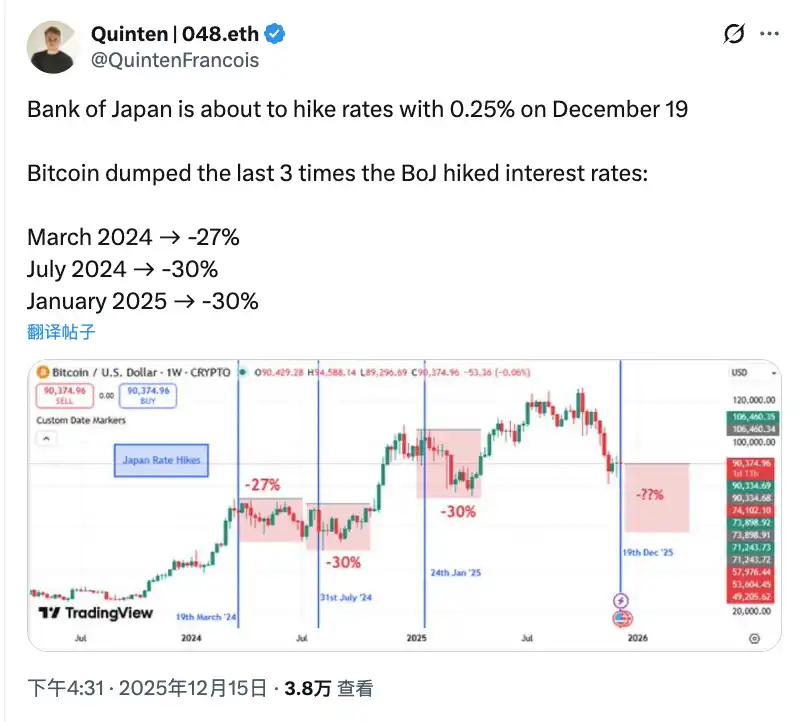
This time, it's Japan's first rate hike since January 2025, potentially reaching a 30-year high. Prediction markets currently indicate a 97% probability of a 25 basis point hike, almost certain. The meeting that day might just be a formality, as the market has already reacted with a decline.
Analyst Hanzo stated that the crypto market's neglect of the Bank of Japan's动向 was a major mistake. He pointed out that Japan, as the largest overseas holder of U.S. Treasury bonds (holdings exceeding $1.1 trillion), its central bank policy changes could affect global dollar supply, Treasury yields, and risk assets like Bitcoin.
Several Twitter users focused on macro analysis also noted that the Yen is the second largest player in the foreign exchange market after the U.S. dollar, potentially having a greater impact on capital markets than the Euro. The nearly thirty-year bull market in U.S. stocks has been significantly related to Yen carry trades. For years, investors borrowed low-interest Yen loans to invest in U.S. stocks, bonds, or high-yield assets like cryptocurrencies. When Japanese interest rates rise, these positions can be quickly unwound, leading to forced liquidations and deleveraging across all markets.
Furthermore, the current market backdrop is: most major central banks are cutting rates, while the Bank of Japan is hiking. This contrast will trigger the unwinding of carry trades, meaning such hikes could lead to renewed turmoil in the cryptocurrency market.
More importantly, the Yen hike itself might not be the key risk; the signal sent by the Bank of Japan's policy guidance for 2026 is more critical. The Bank of Japan has already confirmed it will sell approximately $550 billion worth of ETF holdings starting January 2026. If the Bank of Japan hikes rates again or multiple times in 2026, it would mean more hikes and accelerated bond sales, further unwinding Yen carry trades, triggering a sell-off in risk assets and a回流 of Yen, potentially causing sustained冲击 to stocks and cryptocurrencies.
But if we're lucky, if the Bank of Japan pauses further rate hikes after this one in future meetings, the market flash crash might end, followed by a period of反弹行情.
Uncertainty Over Future U.S. Rate Cut Expectations
Of course, any decline is never due to a single factor or variable. During this period of the Bank of Japan hike and Bitcoin's暴跌, the following conditions also coexisted: leverage reaching peak levels; U.S. dollar liquidity tightening; extreme positioning levels; the impact of global liquidity and leverage, etc.
Let's turn our attention back to the United States.
In the first week after the rate cut靴子落地, Bitcoin began to weaken. Because the market's focus has shifted to "how many more times can rates be cut in 2026, and will the pace be forced to slow down?". Two data points to be released this week: the U.S. macro data Non-Farm Payrolls report and CPI data, are core variables in repricing this expectation.
With the U.S. government ending its long shutdown, the Bureau of Labor Statistics (BLS) will release October and November employment data this week, with the most watched being the Non-Farm Payrolls report released tonight at 21:30. The current expectation is: +55k new non-farm jobs, significantly lower than the previous +110k.
On the surface, this is a typical data structure "beneficial for rate cuts," but the problem lies precisely in: if employment cools too quickly, will the Fed worry about the economy stalling and choose to adjust policy more cautiously? Once employment data shows a "cliff-like cooling" or structural deterioration, the Fed might choose to wait and see instead of accelerating easing.
Then there's the CPI data. Compared to employment data, the point repeatedly discussed by the market regarding the CPI data released on December 18th is: will CPI give the Fed a reason to "also accelerate QT (quantitative tightening)" to offset the Bank of Japan's tightening?
If inflation data rebounds or shows increased stickiness, even if the Fed maintains its rate cut stance, it might accelerate QT to回收流动性, thus balancing between "nominal easing" and "actual liquidity tightening."
The next truly certain rate cut is earliest at the January 2026 FOMC window, and the time span is still relatively far. Currently, Polymarket predicts a 78% probability of unchanged rates on January 28th, with the probability of a rate cut only 22%. The uncertainty of rate cut expectations is too high.
Additionally, the Bank of England and the European Central Bank will also hold their respective monetary policy meetings this week to discuss their stances. With Japan率先转向, the U.S. hesitating, and Europe and the U.K.观望, global monetary policy is in a highly fragmented stage,难以形成合力.
For Bitcoin, this "non-unified liquidity environment" is often more damaging than clear tightening.
Mining Farms Shutting Down, 'Old Money' Continues Exiting
Another common analytical view is: long-term holders are still持续抛售, and the pace of减持 accelerated this week.
First is the selling by ETF institutions. On that day, Bitcoin spot ETFs saw a net outflow of approximately $350 million (about 4,000 BTC), primarily from Fidelity's FBTC and Grayscale's GBTC/ETHE; for Ethereum ETFs, the cumulative net outflow was about $65 million (about 21,000 ETH).
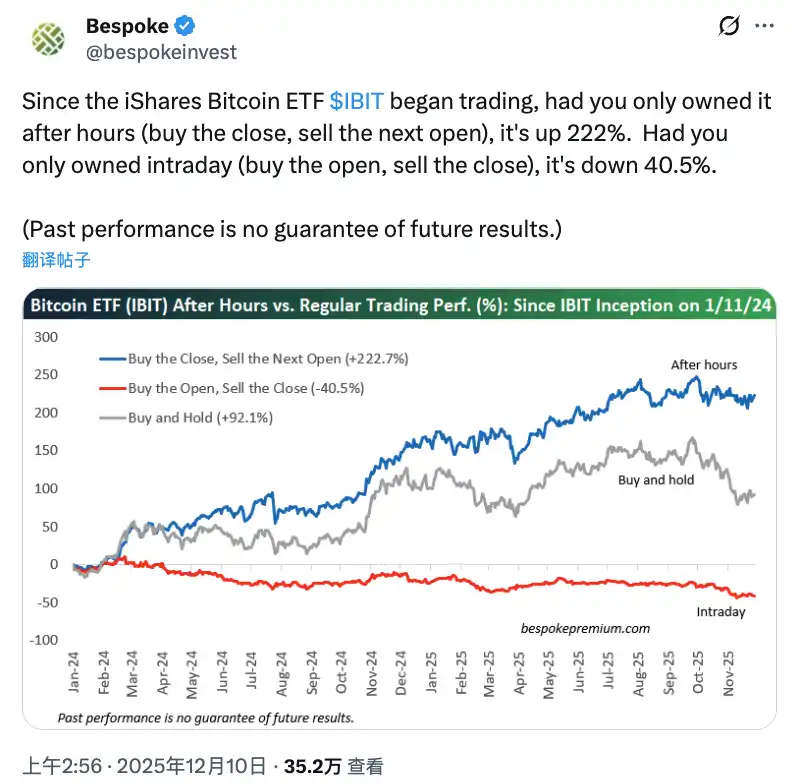
For example, a very interesting point is that Bitcoin's performance during U.S. trading hours was relatively weaker. Data from Bespoke Investment stated: "Since BlackRock's IBIT Bitcoin ETF began trading, holding it after hours yielded 222%, but holding it only during market hours resulted in a 40.5% loss."
Following this, a more direct selling signal appeared on the链上层面.
On December 15th, Bitcoin exchange net inflows reached 3,764 BTC (approx. $340 million), hitting a阶段性高点. Among them, Binance alone had a net inflow of 2,285 BTC,放大 about 8 times compared to the previous period, clearly indicating large holders集中充值, preparing to sell.
Furthermore, changes in market makers' positions also构成重要的背景因素. Taking Wintermute as an example, between late November and early December, it transferred over $1.5 billion in assets to trading platforms. Although between December 10th and 16th, its BTC holdings saw a net increase of 271 BTC, the market was still somewhat panicked about its large transfer behavior.
On the other hand, selling by long-term holders and miners has also attracted significant attention.
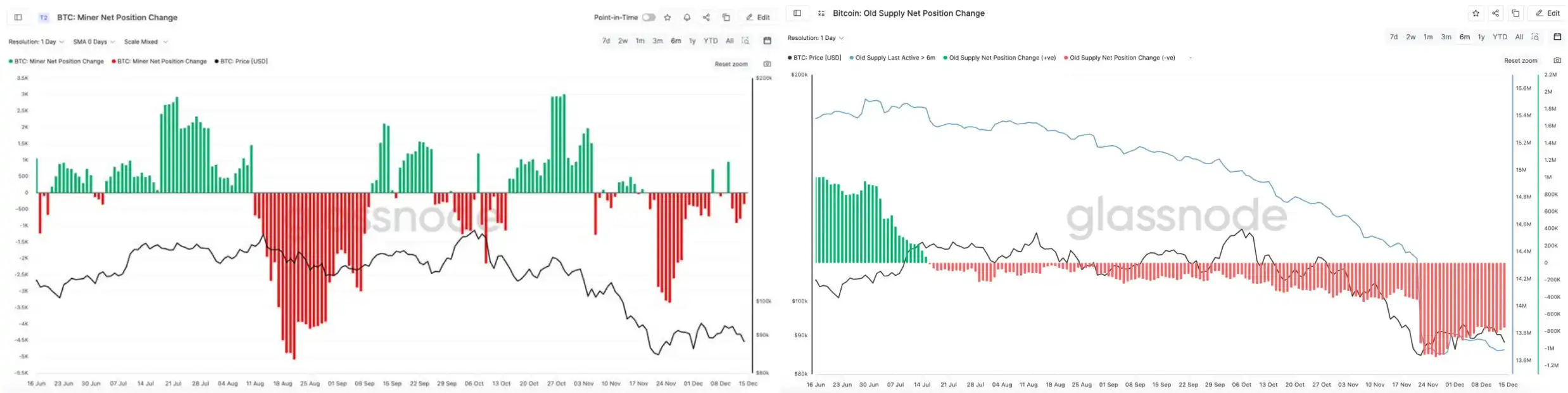
On-chain monitoring platform CheckOnChain detected a rotation in Bitcoin's hashrate, a phenomenon often associated with periods of miner pressure and liquidity tightening. On-chain analyst CryptoCondom pointed out: "A friend asked me if miners and OGs are really selling their BTC. The objective answer is yes, check Glassnode's data on miner net position changes and OG long-term BTC holdings."
Glassnode data shows that OGs (coins not moved for over 6 months) selling Bitcoin has been ongoing for months, with a noticeable acceleration from late November to mid-February.
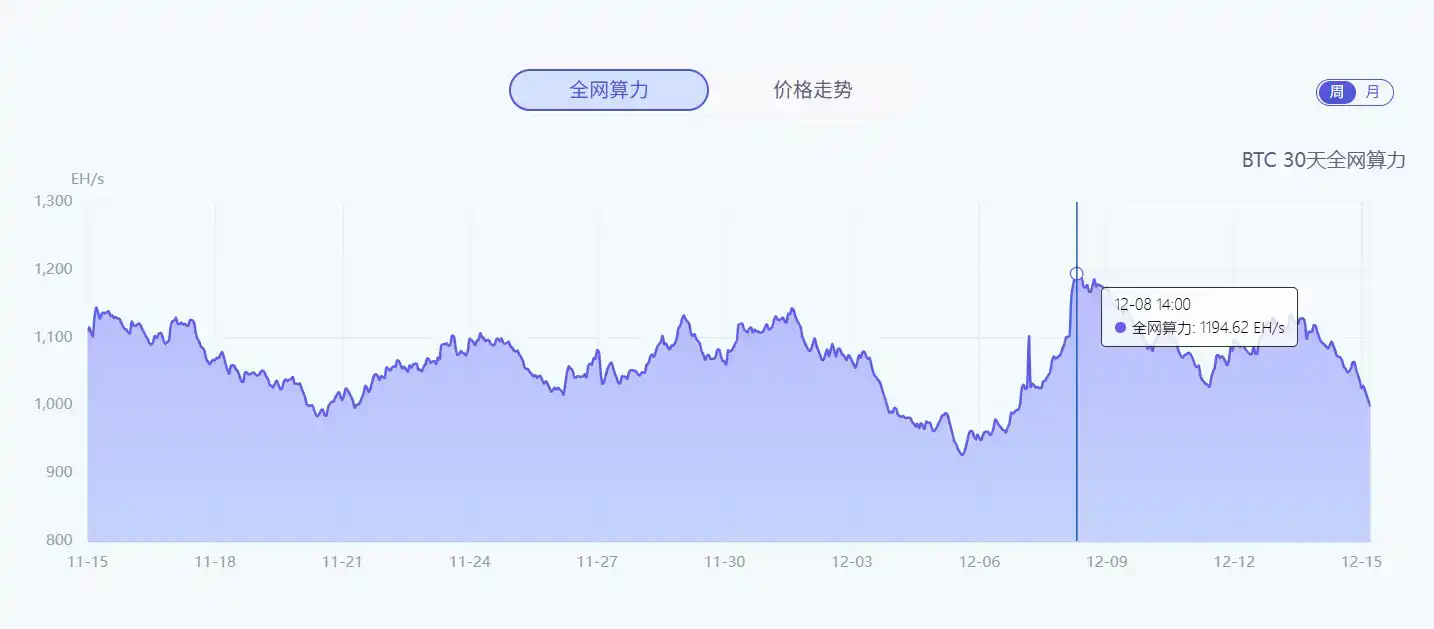
Coupled with the drop in Bitcoin's global hashrate, as of December 15th, according to F2pool data, Bitcoin's global hashrate was temporarily reported at 988.49 EH/s, down 17.25% from the same time last week.
This data also aligns with the current rumors of "Bitcoin mining farms in Xinjiang陆续关机." Kong Jianping, founder and chairman of Nano Labs, also commented on the recent drop in Bitcoin's hashrate, stating that based on an average of 250T per machine, at least 400,000 Bitcoin miners have recently shut down.
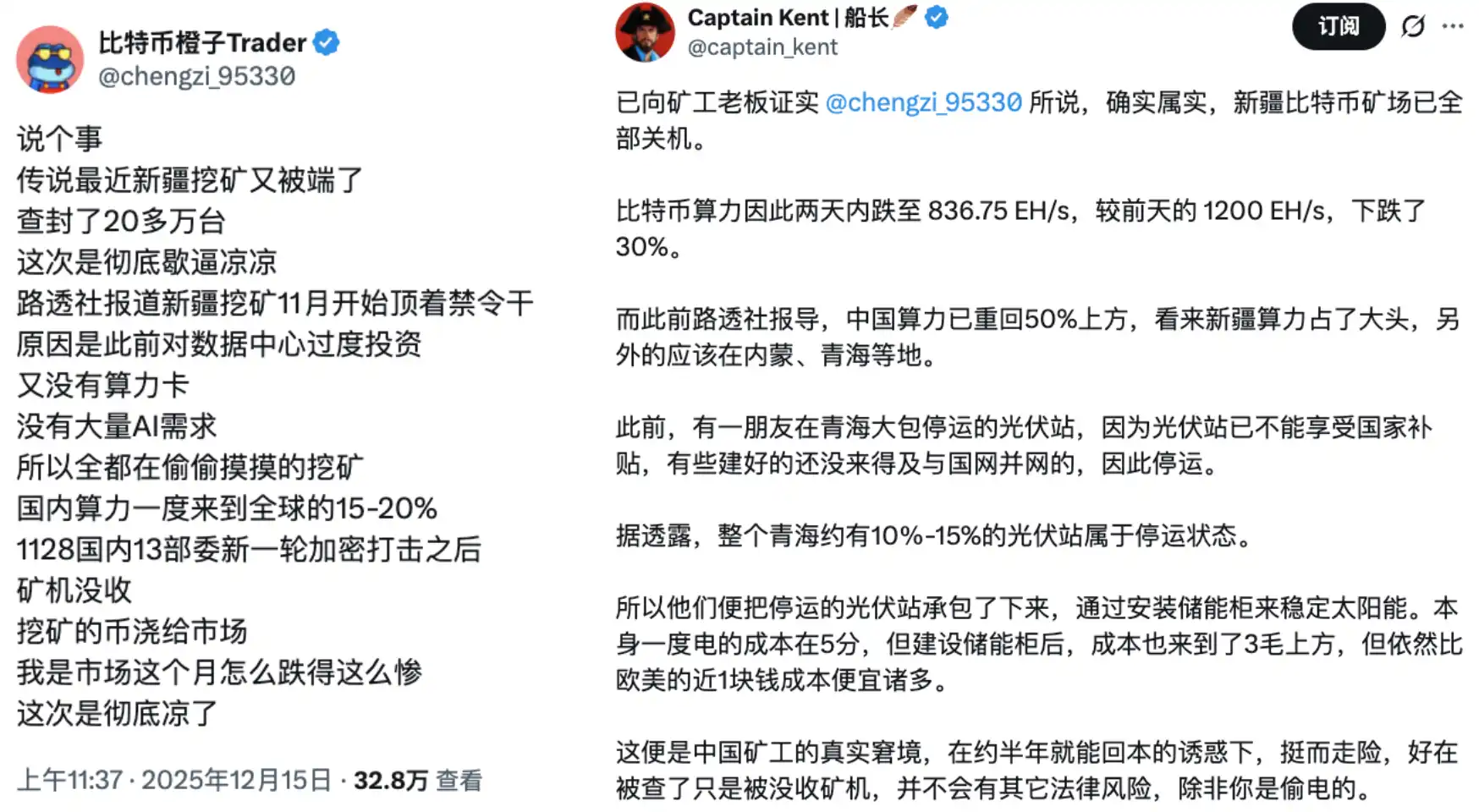
In summary, the factors in this round of decline include: the Bank of Japan率先转向紧缩, loosening Yen carry trades; the Federal Reserve, after completing the first rate cut, failing to provide a clear subsequent path, leading the market to actively lower expectations for 2026 liquidity; and on the链上层面, the behavior of long-term holders, miners, and market makers further amplified the price's sensitivity to liquidity changes.