From the Fringes to the Mainstream: A Review of the Milestone Events Defining the 2025 Crypto Market Landscape

marsbitPublished on 2025-12-29Last updated on 2025-12-29

Abstract

The year 2025 marked a pivotal "Sovereign Fusion Year" for crypto, transitioning it from a speculative asset to a geopolitical strategic reserve. The US, under the Trump administration, established a Strategic Bitcoin Reserve, repurposing seized coins and shifting from seller to long-term holder. The GENIUS Act created a federal regulatory framework for stablecoins, effectively ending the wild west era. Trump's personal memecoin $TRUMP and the controversial World Liberty Financial (WLFI) project blurred the lines between politics and DeFi. Solana and XRP ETFs were approved, signaling institutional adoption beyond Bitcoin and Ethereum. Major infrastructure upgrades occurred with Solana's Firedancer and Ethereum's Pectra & Fusaka. Circle's IPO and HashKey's Hong Kong listing showcased corporate maturity. Visa's integration of USDC on Solana and the rise of tokenized real-world assets (RWA) revolutionized payments. A catastrophic $15B hack on Bybit and the extreme market volatility of the "10.11" crash, which wiped out $150B in leverage, served as severe security and risk warnings. The year concluded with symbolic pardons for Silk Road's Ross Ulbricht and Binance's CZ, signaling a reconciliation between the crypto industry's past and its new, institutionalized future.

The year 2025 is destined to leave a profound mark on global financial history, hailed as the "Sovereign Integration Year" for the crypto asset industry. If 2024 was the "Wall Street Moment" brought by Bitcoin ETFs, then 2025 marks the year digital assets officially leaped from mere financial speculation tools to becoming geopolitical strategic chips and national reserve assets. The core driver of this transformation stems from a dramatic shift in the U.S. executive branch—the Trump administration's historic move to establish a "Bitcoin Strategic Reserve" upon taking office, fundamentally rewriting the underlying logic of global monetary competition.

This year witnessed frequent watershed events in regulation: the signing of the GENIUS Act granted stablecoins legitimate dollar status; the World Liberty Financial (WLFI) project, directly involving the Trump family, blurred the lines between politics and DeFi; and the pardons of Ross Ulbricht and CZ signaled the resolution of the crypto "wild west era" and the dawn of a new order.

This article will review what the author considers the 10 most milestone events in the crypto industry in 2025.

These events constitute the "points of no return" for the industry's development in 2025—decisive moments that irrevocably altered market structure, regulatory environment, or technological paradigms.

1. The Geopolitical Pivot: Establishment of the U.S. Bitcoin Strategic Reserve
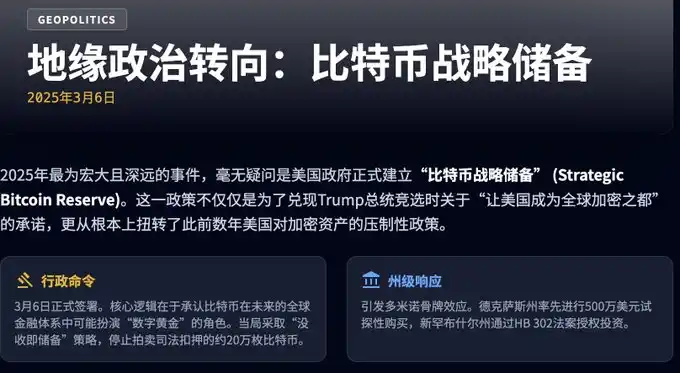
The most monumental and far-reaching event of 2025 was undoubtedly the U.S. government's formal establishment of the "Bitcoin Strategic Reserve." This policy was not only about fulfilling President Trump's campaign promise to "make America the crypto capital of the world," but it also fundamentally reversed years of suppressive U.S. policies towards crypto assets, elevating them to the status of a national strategic resource on par with gold and oil.

1.1 Policy Origin and Execution Mechanism

President Trump signed an executive order shortly after taking office and formally issued the directive to establish the reserve on March 6. Its core logic was to acknowledge Bitcoin's potential role as "digital gold" in the future global financial system.

On the execution front, the administration adopted a "confiscation as reserve" strategy—halting the auction of approximately 200,000 bitcoins previously seized by judicial authorities (e.g., the Silk Road case, Bitfinex case) and transferring them to a newly created "Digital Asset Reserve" for permanent holding. Furthermore, the executive order directed the Treasury and Commerce Departments to devise a "budget-neutral" accumulation strategy, meaning the U.S. government effectively transformed from the largest potential seller into a long-term holder of this asset class.

1.2 The "Lummis Plan" and Legislative Gambit

Senator Cynthia Lummis resubmitted the "Bitcoin Strategic Reserve Act," proposing the use of Federal Reserve surplus funds to purchase 1 million bitcoins (about 5% of total supply) over five years and hold them for at least 20 years. While somewhat fanciful and sparking fierce debate in Congress, the prior enactment of the executive order at least set a positive precedent.

1.3 Domino Effect at the State Level

The federal government's shift in attitude triggered a "digital arms race" among states. As of December 2025, 16 states had either tabled relevant legislation for discussion or moved it forward.

  • Texas: Pioneered a "tentative" purchase of $5 million through the Comptroller's office.
  • New Hampshire: Passed HB 302, authorizing the state Treasury to invest reserve funds in digital assets, marking a major breakthrough in state government treasury management观念.

2. The Regulatory Endgame: The GENIUS Act and the "Dollarization" of Stablecoins, The Arrival of MiCA
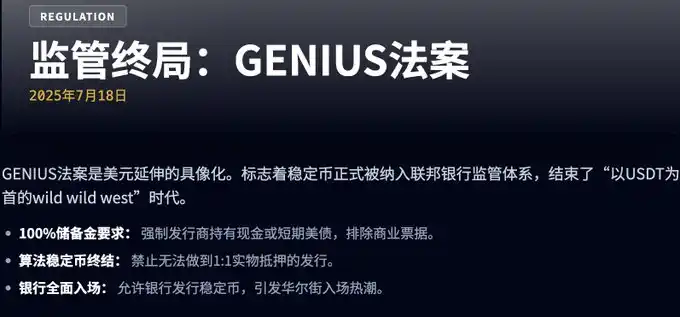
The GENIUS Act, signed into law on July 18, 2025, is the embodiment of the dollar's extension. This act marked the formal incorporation of stablecoins into the federal banking regulatory system, ending the "wild wild west era led by USDT."

2.1 Ending the Regulatory Vacuum

The GENIUS Act essentially established a unified regulatory framework at the federal level:

100% Reserve Requirement: Mandated issuers to hold 100% "high-quality liquid assets" (cash, short-term U.S. Treasuries) as reserves, directly excluded commercial paper, and enhanced credit quality.

End of Algorithmic Stablecoins: Effectively banned the issuance of algorithmic stablecoins that could not achieve 1:1 physical collateralization.

2.2 Full-Scale Bank Entry

The act allowed banks and their subsidiaries to issue stablecoins, triggering a wave of Wall Street entry.

Visa's Strategic Move: Visa quickly announced the U.S. launch of USDC settlement services on the Solana blockchain, leveraging the legal certainty provided by the act to massively integrate stablecoin settlement.

JPMorgan's On-Chain Fund: Launched a tokenized money market fund (MONY) on Ethereum, serving as a prelude to the bank's exploration of compliant stablecoin issuance.

2.3 Europe's MiCA Finally Arrives

The EU's Markets in Crypto-Assets (MiCA) regulation came into full effect in early 2025, becoming the world's first comprehensive regulatory framework covering 27 countries with unified standards. Its "passport" system eliminated regulatory fragmentation, forced non-compliant stablecoins out of the European market, and established a new global benchmark for compliant operations.

3. The President's Token: TRUMP and the Rise of World Liberty Financial (WLFI)
On January 17, just three days before Trump's presidential inauguration, he launched his own memecoin $TRUMP. Setting aside the potential profits for the Trump family, this move not only strained the already shaky Solana meme liquidity but also directly ignited the "celebrity coin" effect. A private dinner in April pushed this spectacle to its peak.

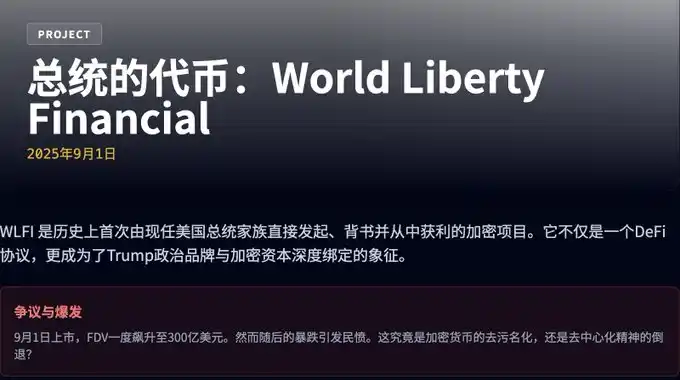
But that wasn't the end. World Liberty Financial (WLFI) became another major weapon for the Trump family. Bearing the "presidential halo," it was not just a DeFi protocol but a symbol of the deep entanglement between the Trump political brand and crypto capital.

Led by the Trump family, WLFI aimed to "democratize finance." After multiple rounds of financing, it even set up a corresponding DAT before listing. WLFI officially went public on September 1, 2025.

Its fully diluted valuation (FDV) briefly soared above $30 billion at opening before sharply retreating. Beyond the public outrage caused by the price crash, the project sparked massive controversy, particularly regarding质疑 that foreign capital (like Justin Sun and Aqua 1) might be making disguised political contributions by purchasing tokens. Some saw WLFI's emergence as marking the complete de-stigmatization of cryptocurrency and introducing millions of MAGA supporters to DeFi wallets for the first time; others argued it made the supposedly decentralized crypto industry more "centralized," pushing the entire market backward.

4. Institutional Explosion: Approval of Solana and XRP ETFs, The Rampancy of Altcoin DATs
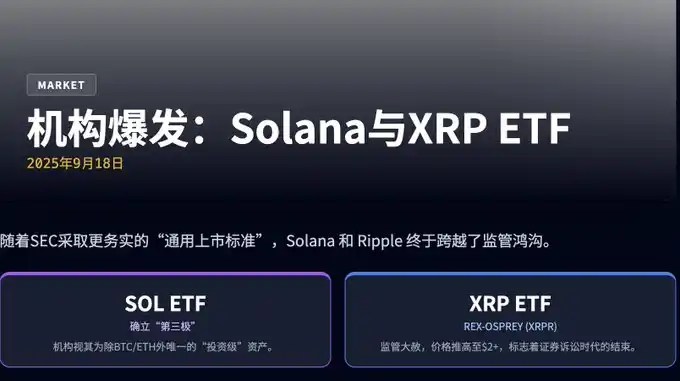
2025 was the year altcoin ETFs fully blossomed, even if altcoin performance was "notable but mixed." With the SEC adopting a more pragmatic "universal listing standard," Solana and Ripple finally crossed the regulatory chasm. The U.S. Securities and Exchange Commission (SEC) passed new standard listing rules, shortening the crypto ETF approval window from the original 240-270 days to just 75 days. This institutional change directly ushered in the "altcoin ETF era," with spot ETFs for assets like Solana, XRP, and Litecoin quickly approved thereafter, marking the institutionalized transition of crypto assets from a single asset class to diversified investment portfolios.

4.1 Solana ETF: Establishing the "Third Pole"

Solana ETF applications saw light in the second half of 2025, with market expectations for approval extremely high. This became the core driver keeping SOL prices strong throughout 2025, as institutional investors began to see it as the only "investment-grade" public chain asset besides BTC and ETH.

4.2 Ripple ETF: From "Security" to "Commodity"

With the resolution of Ripple's lawsuit with the SEC, the listing of an XRP ETF became 2025's biggest reversal. The REX-Osprey XRP ETF (XRPR) listed on September 18. This symbolized a regulatory "amnesty" for historical遗留 issues, pushing XRP prices above $2 and signaling to the market that compliance整改 could lead to entry into the mainstream system.

4.3 The Altcoin DAT Carnival

The frenzy around [presumably a specific fund or strategy] in the first half made the market see another possibility, so imitators emerged one after another. From well-known names like ETH, HYPE, BNB, AVAX to smaller-cap altcoins, everyone was eager to catch this wave. Their purposes varied: some sought larger capital inflows, others merely for marketing effect. With nav < 1 today, one wonders if this will lead to their own liquidation? But it undoubtedly brought them onto traditional capital's radar and unprecedentedly normalized "coin-token linkage" operations.

This opens up more possibilities for tokens and their extensions like DeFi, NFTs, ve-tokens, staking, and buybacks.

5. Infrastructure's Rapid Evolution: Firedancer, Pectra, and Fusaka Upgrades
5.1 Solana Firedancer

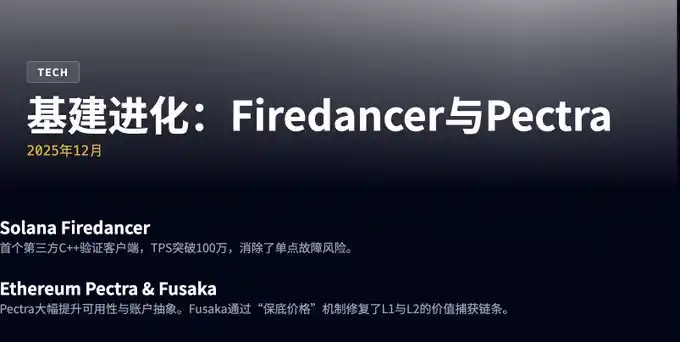
In December 2025, the Firedancer validator client, developed by Jump Crypto, launched on the Solana mainnet. This was the first validator node software rewritten in C++ by a third party, achieving over 1 million TPS in test environments. It brought crucial client diversity to Solana, eliminating single-point-of-failure risks and laying the groundwork for the entry of giants like Visa.

5.2 Ethereum Pectra and Fusaka Upgrades

The Pectra upgrade, executed in May 2025, significantly enhanced Ethereum's usability.

  • Staking Threshold Optimization: Increased the maximum effective stake balance for validators to 2048 ETH, reducing operational costs for large institutions.
  • Account Abstraction: Introduced "programmable wallet" functionality, allowing regular accounts to possess smart contract capabilities, greatly lowering the user entry barrier.

The Fusaka upgrade, executed in December 2025, primarily "fixed" the value capture chain between L1 and L2—essentially, L2s must pay tribute to L1. EIP-7918 introduced a "floor price" mechanism—a price hike. It stipulated that the base fee for Blobs would no longer be allowed to drop indefinitely to 1 wei. Instead, the minimum price for Blobs would be pegged to the Gas price of L1's execution layer. If implemented as planned, this could generate significant revenue for ETH.

6. Maturation of Corporate Equity: Circle, Kraken, and HashKey IPOs
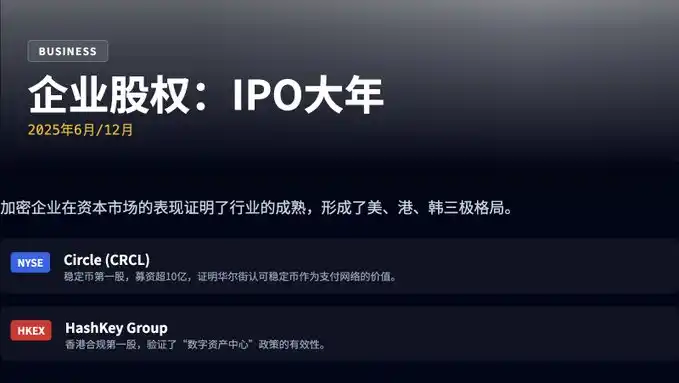
In 2025, the performance of crypto enterprises in capital markets demonstrated the industry's maturity, forming a tri-polar listing landscape across the U.S., Hong Kong, and South Korea.

6.1 Circle IPO: The Stablecoin Pioneer

USDC issuer Circle successfully IPOed on the NYSE on June 5, 2025, under the ticker CRCL. It raised over $1 billion with a valuation of approximately $8 billion. Its success proved Wall Street's recognition of the long-term value of "stablecoins as payment networks," making it the most significant industry IPO since Coinbase. (This article skips Bullish)

6.2 Kraken: Valuation Repair and Transformation

Although Kraken did not complete its IPO in 2025, it secured $800 million in Pre-IPO funding, reaching a valuation of $20 billion. After settling with the SEC, Kraken successfully transformed into a full-service institutional broker, planning to list in 2026 to challenge Coinbase's position.

6.3 HashKey Group IPO: Hong Kong's Compliance Pioneer

In the East, HashKey Group officially listed on the main board of the Hong Kong Stock Exchange (HKEX) on December 17, 2025. HashKey's IPO raised approximately HK$1.67 billion (about $215 million), giving it a market capitalization of around $2.5 billion.

Milestone Significance: This marked the first listed licensed crypto asset exchange group in Hong Kong and Asia. HashKey's successful listing validated the effectiveness of Hong Kong's "digital asset hub" policy, paving the way for Asian crypto enterprises to raise capital in local markets.

6.4 Bithumb Seeks U.S. IPO; Upbit Fully Acquired by Naver

South Korea's crypto market also saw its capital exit moment this year, with the top 2 exchanges announcing their respective listing plans.

7. The Settlement Layer Revolution: Visa, USDC, and the RWA Explosion
2025 saw the large-scale implementation of RWA tokenization and the on-chain migration of payment settlements.

7.1 Visa Chooses Solana

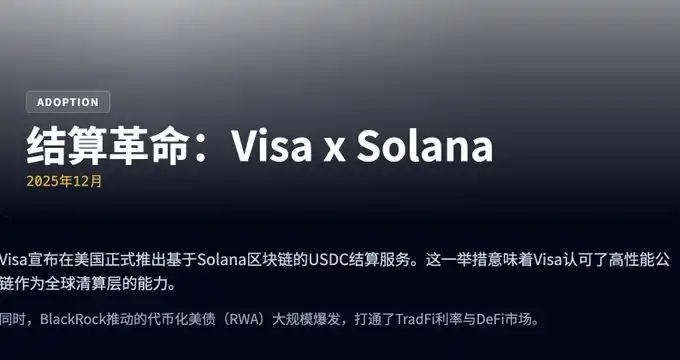
In December 2025, Visa announced the formal U.S. launch of USDC settlement services based on the Solana blockchain. This move signified Visa's recognition of high-performance public chains as capable global clearing layers, integrating blockchain into the core global payment network.

7.2 Scaling Tokenized U.S. Treasuries

Tokenized U.S. Treasuries promoted by giants like BlackRock (e.g., the BUIDL fund) exploded in 2025 and gradually became collateral for DeFi protocols. This connected TradFi interest rates with the DeFi market, vastly improving capital efficiency.

8. The Security Alarm: Bybit's $1.5 Billion Hack
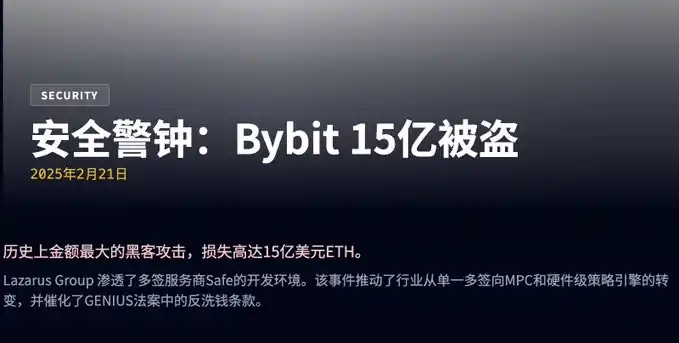
On February 21, 2025, Bybit exchange suffered the largest hack in history by value, losing $1.5 billion worth of ETH.

The Lazarus Group infiltrated the computer of a developer at the multi-signature service provider Safe, implanting malicious code that altered the frontend UI. The Bybit team, unaware, signed transactions transferring funds to the hackers.

The incident shocked the entire industry, prompting a shift from单一 multi-sig towards MPC and hardware-level policy engines, and served as a key catalyst for the anti-money laundering条款 in the U.S.'s push for the GENIUS Act.

This hack also revealed the invisible hand of "alliances" among exchanges, showing that the competitive relationship on the surface was just a misunderstanding.

9. Market Cycle Extremes: The "10.11 Event" and The Great Leverage Purge
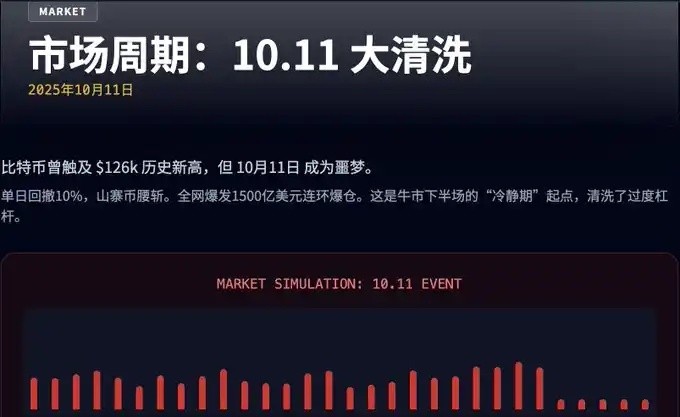
The market in 2025 experienced a rollercoaster from extreme狂热 to brutal清算, with the "10.11 Event" becoming the watershed moment for the year's行情.

Driven by the Trump election victory effect and the establishment of the strategic reserve, Bitcoin hit an all-time high of around $126,000 on October 6. However, the market then underwent a violent reversal.

October 11 became the most terrifying day in the 2025 secondary market. On this day, BTC and ETH pulled back 10%, some altcoins almost dropped to zero, the entire market was a sea of red, suffering a bloodbath. Binance even conducted the largest compensation payout in history for this.

With "smart money" buried, market makers "frequently reported爆雷消息," and order books showing only tiny buy orders, panic quickly spread. In the following days, a series of liquidations totaling approximately $150 billion occurred across the network, and the Bitcoin price rapidly retreated to the $85,000 range. The "10.11 Event" was seen as the starting "cooling-off period" for the second half of the 2025 bull market, brutally purging speculative capital overly reliant on leverage. The situation was extremely惨烈.

10. The Century Pardon: The Return of Ross Ulbricht and CZ
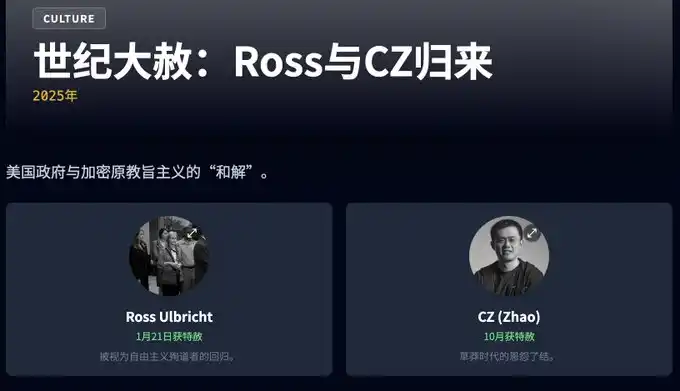
2025 witnessed fateful turns for two iconic figures in the crypto industry, seen as symbolic of a某种 "reconciliation" between the U.S. government and crypto libertarianism及 the early exchange era.

10.1 Ross Ulbricht's Pardon

On January 21, 2025, the day after his inauguration, President Trump signed a pardon, announcing the unconditional release of Silk Road founder Ross Ulbricht. Ulbricht had been sentenced to double life imprisonment plus 40 years for creating the dark web market Silk Road and had served 12 years. In the eyes of the crypto community, he was seen as a martyr for libertarianism.

This pardon fulfilled a Trump campaign promise and was viewed as a huge victory by libertarians and early Bitcoin adopters, symbolizing that the government would no longer treat code writers as "drug lords," but rather acknowledge the historical limitations and contributions of early internet explorers.

10.2 CZ's Liberation

In October 2025, CZ also had his moment of pardon. CZ's return (though likely not as CEO) and Ross's freedom marked the definitive turning of the page on the crypto industry's "wild west era."

These two pardons were not just changes in personal fate; they also hinted that, within the new geopolitical and capital landscape, former "outlaws" could be re-accepted by "mainstream" society through the运作 of capital, public opinion, and politics.

Conclusion: From Speculation to Cornerstone

Looking back at 2025, from Bitcoin becoming a (prospective) national reserve, to the listings of HashKey and Circle, and the pardons of Ross and CZ, all events point in the same direction: the comprehensive institutionalization of crypto assets.

Former rebels were co-opted, former fringe assets became national wealth. 2025 is not the end of the cycle, but the starting point of "crypto realism." In this new era, code is still law, but the law has finally learned how to coexist with code—and even utilize it.

Postscript

If there's anything truly exciting, it's probably

11. The Establishment of the Global Trend of Corporate Balance Sheet "Bitcoinization"

By the end of 2025, over 200 listed companies and funds held approximately 5.1% of Bitcoin's total supply. Beyond MicroStrategy (holding over 670,000 BTC), "Digital Asset Treasury" (DAT) companies, including several fintech firms, collectively attracted $92 billion in capital inflows. Bitcoin has evolved from the gamble of个别 companies into a standardized tool for corporations to hedge against inflation and optimize capital structure.


Related Questions

QWhat was the most significant geopolitical event in the crypto market in 2025 according to the article, and what was its core purpose?

AThe most significant geopolitical event was the establishment of the U.S. Strategic Bitcoin Reserve. Its core purpose was to elevate Bitcoin to the status of a national strategic resource, akin to gold and oil, and to fundamentally shift U.S. policy from suppression to adoption, fulfilling a campaign promise and positioning the U.S. as a leader in the crypto space.

QWhich key piece of U.S. legislation in 2025 brought stablecoins under federal banking regulation, and what were two of its main provisions?

AThe key legislation was the GENIUS Act. Two of its main provisions were: 1) A 100% reserve requirement, mandating issuers to hold high-quality liquid assets like cash and short-term U.S. Treasuries, and 2) Effectively banning algorithmic stablecoins that were not 1:1 backed by real collateral.

QWhat major infrastructure upgrade for the Solana network occurred in December 2025, and why was it important?

AThe Firedancer validator client, developed by Jump Crypto, launched on the Solana mainnet in December 2025. It was critically important because it was the first third-party client written in C++, achieving over 1 million TPS in testing and providing essential client diversity to eliminate single points of failure on the network.

QWhat was the '10.11 Event' in the 2025 crypto market, and what was its consequence?

AThe '10.11 Event' was a massive market crash on October 11, 2025, where Bitcoin and Ethereum prices plummeted (10%+) and many altcoins crashed to near zero. It triggered a chain reaction of approximately $150 billion in liquidations, washing out over-leveraged speculative capital and marking the start of a 'cooling-off' period for the bull market.

QWhich two iconic figures from crypto's early history were granted clemency in 2025, and what did their pardons symbolize?

ARoss Ulbricht, founder of Silk Road, and Changpeng Zhao (CZ), former CEO of Binance, were granted clemency. Their pardons symbolized a reconciliation between the U.S. government and crypto's foundational era, marking the end of the industry's 'outlaw' period and its acceptance into the mainstream.

Related Reads

Winter for Crypto IPOs: Consensys and Ledger Withdraw Applications

The crypto IPO window is tightening significantly in 2026, marked by prominent companies delaying or pausing their public listing plans. Following a successful 2025 "harvest year" that saw Circle, Bullish, and Gemini go public amidst a bull market, the tide has turned. Consensys, developer of MetaMask, recently postponed its IPO until at least fall 2026. Hardware wallet leader Ledger also suspended its planned US listing due to unfavorable market conditions, with Kraken having previously delayed its own plans. This shift is driven by a cooling market in 2026, characterized by a significant Bitcoin price correction, declining trading volumes, and reduced investor risk appetite for crypto stocks. The poor post-IPO performance of 2025 listings like Circle and Bullish, which saw major share price declines, has heightened investor caution. This contrasts sharply with the current AI sector, where companies like SpaceX, OpenAI, and Anthropic are commanding massive valuations and investor enthusiasm based on narratives of stable, exponential growth. Crypto companies now face pressure to transition from hype-driven models to demonstrating reliable cash flows and robust compliance. While the paused IPO plans may lead to valuation resets and affect ecosystem liquidity, they also accelerate industry consolidation toward stronger, more compliant infrastructure players. A potential recovery in Bitcoin's price and clearer regulations could reopen the IPO window in the latter half of 2026.

marsbit57m ago

Winter for Crypto IPOs: Consensys and Ledger Withdraw Applications

marsbit57m ago

ChatGPT Can Manage Your Money for You. Would You Trust It with Your Bank Account?

OpenAI has launched a personal finance tool for ChatGPT, currently in preview for US-based ChatGPT Pro users. This feature allows users to connect their bank and investment accounts (via Plaid, supporting over 12,000 institutions) directly to ChatGPT. It analyzes transactions, generates visual dashboards, and offers conversational financial advice—such as budgeting or planning for major purchases—based on the user's actual data. This move follows OpenAI's acquisitions of fintech startups Roi and Hiro Finance, signaling a strategic push into vertical "super assistant" applications, similar to its earlier health-focused feature. However, the launch has sparked significant privacy concerns. Critics question the safety of granting such sensitive financial access to an AI, especially amid ongoing lawsuits alleging OpenAI shared user chat data with third parties like Meta and Google. OpenAI emphasizes that ChatGPT only reads data (no transaction capabilities), deletes it within 30 days if disconnected, and offers opt-out options for model training. Yet, trust remains a major hurdle. The trend reflects a broader industry shift: AI companies like Anthropic and Perplexity are also targeting high-value, data-rich domains like finance and health. While technically promising, the tool operates in a regulatory gray area—it provides personalized guidance but disclaims formal financial advice or liability. Ultimately, OpenAI's challenge is convincing users to trust an AI with their most private financial information.

marsbit58m ago

ChatGPT Can Manage Your Money for You. Would You Trust It with Your Bank Account?

marsbit58m ago

Trading

Spot
Futures

Hot Articles

What is LINON

Linde plc Tokenized Stock (Ondo): Revolutionizing Traditional Equity Access Through Blockchain Innovation The emergence of Linde plc Tokenized Stock (Ondo), represented by the ticker $LINON, signifies a monumental shift in the fusion of traditional financial structures and decentralized finance (DeFi). This innovative financial instrument showcases the tremendous potential of blockchain technology to democratize access to traditional equity markets while ensuring the security and regulatory compliance necessary for institutional-grade financial products. Through Ondo Finance's pioneering tokenization platform, $LINON provides a seamless pathway for global investors to engage with one of the world's leading industrial gas companies, Linde plc, creating a blockchain-native representation of the underlying equity. Introduction to Linde plc Tokenized Stock The landscape of financial markets is witnessing a groundbreaking transformation through the tokenization of real-world assets. Linde plc Tokenized Stock (Ondo) epitomizes this revolutionary approach by bridging the gap between conventional stock ownership and blockchain-enabled financial infrastructure. The $LINON token allows investors to gain exposure to one of the prominent industrial companies worldwide through decentralized technology. Operating within Ondo Finance's comprehensive ecosystem, $LINON symbolizes a practical application of tokenization technology that enhances accessibility, efficiency, and global connectivity in traditional financial markets. By leveraging blockchain infrastructure, this tokenized stock enables international investors to participate in U.S. equity markets, overcoming traditional barriers associated with cross-border investing. The significance of $LINON goes beyond technological innovation; it represents a fundamental shift in asset structuring, distribution, and trading in the digital age. This tokenized stock maintains all the economic benefits associated with traditional Linde plc shares while offering improved liquidity, programmable compliance features, and seamless integration with decentralized finance protocols. The development of $LINON indicates a growing acceptance of blockchain technology as a viable means for traditional finance, exemplifying how even well-established assets like Linde plc can integrate into blockchain systems. This approach preserves the core attributes that appeal to investors while introducing advanced capabilities that enhance the overall investment proposition. Project Overview and Objectives Linde plc Tokenized Stock (Ondo) encapsulates a strategic effort to democratize access to traditional equity markets through advanced blockchain technologies. The primary objective of $LINON is to provide approved global investors seamless access to the economic exposure associated with Linde plc shares, furthering an effort to create a more inclusive financial ecosystem. Beyond the digital representation of traditional assets, $LINON endeavors to eliminate barriers of geography and time zones that limit investor participation. Its design ensures that blockchain technology can elevate traditional investment vehicles without undermining the security or compliance requirements expected by investors. Key goals of the project include enhanced liquidity provision, programmable compliance mechanisms, and interoperability with other blockchain networks. Each $LINON token is fortified by actual Linde plc securities housed at U.S.-registered broker-dealers, allowing holders to reap economic advantages akin to traditional stockholders, such as dividend reinvestment. Furthermore, $LINON aims to establish new industry standards for institutional-grade tokenized securities, paving the way for traditional assets to embrace blockchain technology while remaining compliant with regulatory frameworks. By associating itself with a company as reputable as Linde plc, the project opens avenues for exploring tokenized equities catering to both conservative institutional players and daring retail investors. Project Creator and Development Team The vision for Linde plc Tokenized Stock (Ondo) comes from Nathan Allman, founder and CEO of Ondo Finance. His background in traditional finance coupled with expertise in blockchain technology positions him uniquely to navigate the complexities of asset tokenization. Allman's academic journey began at Brown University, focusing on Economics and Biology, equipping him with valuable analytical skills. His time at Goldman Sachs in the Digital Assets division strengthened his understanding of the interplay between financial institutions and emerging technologies, laying the groundwork for his later endeavors in alternative investment strategies. Under Allman's guidance, Ondo Finance has emerged as a leader in asset tokenization, launching $LINON as a flagship example of the company's larger mission towards revolutionizing traditional financial systems using blockchain technology. His commitment to leveraging blockchain for creating institutional-grade financial products has shaped the landscape of real-world asset tokenization. Investment and Funding Structure The growth of Ondo Finance, the platform powering Linde plc Tokenized Stock (Ondo), is bolstered by robust financial backing from prestigious venture capital firms and strategic investors. This strong investment foundation underpins the development of the key infrastructure essential for compliant tokenized securities like $LINON. In August 2021, Ondo Finance secured $4 million in seed funding led by a major venture capital firm, which enabled the company to commence platform development and establish the necessary regulatory processes for tokenizing real-world assets. This early investment cemented Ondo Finance's credibility within the industry. The Series A funding round followed, garnering $20 million with participation from renowned firms committed to transformative technology companies. This backing demonstrated substantial institutional confidence in Ondo Finance's vision, allowing it to hone its approach to asset tokenization through mechanisms that ensure compliance and accessibility. Noteworthy contributors, including institutional investors and experienced partners, have added significant value to Ondo Finance’s development efforts. Their involvement underscores the confidence across sectors in Ondo Finance's approach to bridging traditional finance with blockchain innovations. Technical Infrastructure and Innovation The technical architecture that underpins Linde plc Tokenized Stock (Ondo) represents a sophisticated melding of traditional finance systems and cutting-edge blockchain technology. The architecture's foundation is built on the Ethereum network, renowned for its security and programmability—both critical for intricate financial instruments. The $LINON tokenization process comprises creating a blockchain-native representation of Linde plc shares that preserves economic benefits while augmenting investor capabilities. Each token corresponds to actual shares held at U.S.-registered broker-dealers, creating a compliant custody structure that legitimizes the asset's existence and value. Automated compliance systems are integrated into the tokenization process, managing critical components such as know-your-customer (KYC) verification and anti-money laundering (AML) protocols. This incorporation of programmable compliance empowers $LINON to uphold regulatory standards essential for institutional proliferation. Cross-chain interoperability characterizes the advanced technical features of $LINON. While initially deployed on Ethereum, the framework is designed for expansion to other networks such as Solana and BNB Chain. This adaptability enhances liquidity and accessibility, allowing investors to select their preferred blockchain ecosystems. Historical Timeline and Development Crafting the history of Linde plc Tokenized Stock (Ondo) unfolds in parallel with the evolution of Ondo Finance's tokenization platform. The timeline's inception dates back to March 2021 when Nathan Allman laid the foundations for creating institutional-grade financial products on blockchain infrastructure. The initial funding round in August 2021 provided crucial resources for developing the platform and establishing partnerships necessary for effective tokenization. By January 2023, Ondo Finance launched its tokenized treasury products, establishing mechanisms that would facilitate future tokenized equities such as $LINON. A pivotal milestone arose in February 2025 when Ondo Chain—a Layer 1 blockchain designed specifically for asset tokenization—was introduced. This infrastructure enhances capabilities vital for institutional markets, demonstrating Ondo Finance's long-term commitment to tokenization. Subsequently, the launch of Ondo Global Markets in September 2025 marked the official debut of $LINON. This milestone showcased the successful transition from development to active trading, enabling investors around the world to access American financial markets seamlessly. Ongoing development plans include a targeted expansion of available tokenized assets to over 1,000 by the end of 2025, pointing to a bright future for Ondo Finance's ecosystem and its mission to broaden tokenized equity accessibility. Regulatory Compliance and Legal Framework The legal architecture governing Linde plc Tokenized Stock (Ondo) emphasizes a sophisticated approach to regulatory compliance, allowing tokenized securities to be implemented within a blockchain-based framework. The legal structure governing $LINON spans multiple jurisdictions while maintaining a robust legal footing. Compliance systems ensure that only eligible investors can access the token, enforced through automated verification that aligns with international regulations. This innovative regulatory technology promises real-time enforcement of complex requirements, considerably enhancing efficiency in operating within the regulatory landscape. The custody framework undergirding $LINON ensures that the underlying shares are securely held at U.S.-registered broker-dealers, complying with necessary regulations while delivering blockchain-driven access to investors. The token maintains its economic equivalency and security through this carefully structured custody arrangement. KYC and AML compliance systems are embedded within the smart contract architecture, ensuring integrity and adherence to regulatory practices while fostering transparency for investors. The jurisdictional restrictions mark a commitment to navigating the evolving landscape of international securities laws. Market Impact and Industry Significance The advent of Linde plc Tokenized Stock (Ondo) holds profound implications for the broader financial landscape, symbolizing a clear shift towards blockchain-enabled markets. $LINON serves as a proof-of-concept for integrating traditional companies into blockchain ecosystems, showcasing the potential benefits such as broader accessibility and improved efficiency. The market's response to $LINON indicates a growing acceptance of tokenization among institutional investors, contributing to the emergence of an expanding sector wherein traditional assets can be interconnected with blockchain innovations. The success of $LINON further solidifies market confidence, indicating an overarching shift towards recognizing asset tokenization as a transformative force in finance. Future Development and Expansion Plans The future trajectory for Linde plc Tokenized Stock (Ondo) centers around the expansion of the tokenization ecosystem and enhanced infrastructure supporting blockchain-enabled financial services. Plans for cross-chain integration usher in new opportunities for liquidity and flexibility within the investment framework, with existing capabilities poised for continuous enhancement. With the introduction of Ondo Chain, Ondo Finance aims to transition $LINON to an optimized blockchain environment specifically designed for asset tokenization. This new infrastructure heralds exciting prospects for the development of institutional-grade financial products, ensuring ongoing compatibility with contemporary investment strategies. Further integration with decentralized finance protocols signifies a commitment to empowering $LINON holders through advanced financial strategies. The anticipated expansion of available tokenized assets promises to broaden investor access, enhancing the utility and appeal of the platform. In alignment with ambitions for regulatory expansion, ongoing efforts to secure approvals for new jurisdictions will enhance investor access, further positioning $LINON at the forefront of the burgeoning tokenization market. Conclusion Linde plc Tokenized Stock (Ondo), as represented by the $LINON token, stands at the intersection of traditional finance and blockchain innovation. It embodies a transformative milestone in how financial assets are structured, distributed, and engaged within modern investment ecosystems. The technical sophistication behind $LINON, combined with its regulatory compliance framework, illustrates that asset tokenization can improve financial infrastructure rather than simply digitizing existing products. This pioneering effort not only enhances investor access to U.S. equity markets but also signifies an evolution of how traditional financial services can integrate blockchain technology. As the asset tokenization market grows exponentially, with prospects suggesting significant valuation increases, $LINON paves the way for a future where tokenized securities become standard fixtures in the financial landscape. The trajectory of $LINON will undoubtedly influence how traditional finance adapts to a transformed, blockchain-powered world.

2.8k Total ViewsPublished 2025.12.05Updated 2025.12.05

What is LINON

What is CRMON

Salesforce Tokenized Stock (Ondo): Revolutionising Traditional Equity Access Through Blockchain Innovation The emergence of Salesforce Tokenized Stock (CRMON) marks a pivotal advancement in integrating traditional financial markets with blockchain technology. This innovative approach offers investors unprecedented access to equity exposure through tokenisation. Developed by Ondo Finance, CRMON provides tokenholders with economic exposure equivalent to holding Salesforce stock (CRM) while automatically reinvesting dividends. This effectively bridges the gap between conventional equity markets and decentralised finance (DeFi). Introduction and Comprehensive Overview of Salesforce Tokenized Stock In recent years, the financial landscape has dramatically transformed due to blockchain technology, fundamentally altering how investors access and interact with traditional assets. The development of Salesforce Tokenized Stock (CRMON) is a prime example of this evolution, representing a sophisticated fusion of conventional equity markets with cutting-edge distributed ledger technology. CRMON is a tokenised version of Salesforce stock, emerging from the innovative work of Ondo Finance, a leading platform in the real-world asset tokenisation sector that positions itself as a bridge between traditional finance and decentralised systems. Designed to provide tokenholders with economic exposure that mirrors the performance of the underlying Salesforce stock, CRMON incorporates automatic dividend reinvestment mechanisms. This eliminates many traditional barriers associated with international equity investment, such as complex brokerage relationships, currency conversion challenges, and restricted trading hours. The tokenisation process reimagines stock ownership as a blockchain-native asset while maintaining its economic equivalence with the underlying security, offering enhanced portability and integration capabilities within decentralised finance ecosystems. CRMON transcends its individual utility as an investment instrument to represent a fundamental shift in how financial markets can operate in an increasingly digital world. By maintaining full backing through U.S.-registered broker-dealers and implementing robust compliance frameworks, CRMON demonstrates that tokenised securities can achieve the regulatory standards necessary for institutional adoption while delivering the technological advantages of blockchain infrastructure. Understanding Tokenized Real-World Assets and CRMON's Strategic Position Tokenised real-world assets signify one of the most significant innovations in modern finance, fundamentally reimagining how traditional securities are represented, traded, and utilised within digital ecosystems. CRMON operates as a tokenised equity instrument correlating directly with Salesforce stock while optimising accessibility and efficiency. This aligns with Ondo Finance's broader mission to democratise access to institutional-grade financial products through innovative tokenisation strategies. The tokenisation process guarantees complete economic equivalence with the underlying Salesforce equity. Each CRMON token represents a proportional claim on Salesforce stock held by qualified custodians, with dividend payments automatically reinvested to maintain continuous exposure to total return performance. This structure simplifies dividend management and ensures that tokenholders receive the full economic benefit of their equity exposure, encompassing both capital appreciation and income generation. Ondo Finance's strategy in tokenising Salesforce stock demonstrates its expertise in creating compliant, institutional-grade products that meet traditional financial markets' stringent requirements. The platform’s focus on merging regulatory compliance with blockchain benefits positions it at the forefront of decentralised finance, captivating both institutional and retail investors seeking blockchain-native solutions. The Technology and Innovation Framework Behind CRMON The technological infrastructure supporting CRMON integrates blockchain technology with traditional financial mechanisms, delivering institutional-grade security and compliance while maintaining the operational advantages of decentralised systems. Built on the Ethereum blockchain, CRMON utilises robust smart contract capabilities to ensure transparent, secure operations. The smart contract architecture incorporates layered security and compliance mechanisms, enabling automated compliance checks and real-time asset backing verification. Integration with oracle services maintains accurate pricing and dividend information, ensuring CRMON reflects the underlying Salesforce stock's accurate performance. This architecture delivers automated dividend reinvestments and other corporate actions, eliminating manual processing requirements and directly enhancing tokenholder benefits. Ondo Finance ensures CRMON's security structure includes daily third-party verification of holdings, independent collateral agents, and a multiple-layer custody system through partnerships with established financial institutions. This framework safeguards tokenholder interests against operational risks while providing robust asset backing. The user interface enhances integration capabilities, allowing seamless interaction between CRMON and various decentralised finance protocols, as well as cryptocurrency exchanges. This interoperability enables users to leverage their tokenised equity across multiple platforms, creating sophisticated investment strategies that marry traditional equity characteristics with blockchain-native innovation. Leadership and Corporate Structure of Ondo Finance The leadership team behind CRMON and Ondo Finance blends expertise from traditional finance and blockchain technology, presenting a robust combination of skills essential for successfully bridging conventional markets with decentralised finance. Nathan Allman, the founder and CEO, emerged from a distinguished financial background before establishing Ondo Finance in 2021. Allman's experience includes notable roles at major financial institutions, including significant contributions to developing cryptocurrency market services. His insights into regulatory compliance were paramount in developing products like CRMON that successfully unify traditional securities with blockchain technology. With a team of professionals boasting substantial experience in both conventional finance and blockchain sectors, Ondo Finance's leadership comprises diverse expertise that covers every aspect of tokenised asset development. Justin Schmidt serves as President and COO, contributing unique operational expertise, while Chris Tyrell brings essential compliance knowledge. Investment Landscape and Funding History The investment landscape surrounding Ondo Finance reflects significant institutional confidence in its mission to tokenise real-world assets. The company has raised substantial funds through various investment rounds, attracting leading venture capital firms and strategic investors that recognise the transformative potential of tokenised securities like CRMON. Notably, Ondo Finance completed a successful Series A funding round in 2022, led by well-known venture capital firms. This funding success validates Ondo Finance's innovative approach to creating compliant, institutional-grade tokenised products. In total, Ondo Finance has successfully secured substantial funding, raising significant capital for product development and market expansion, including a noteworthy token sale that reinforced its governance structure through the establishment of the ONDO token. The diverse composition of investors reflects broad market confidence in Ondo Finance's business model, demonstrating support from both traditional and blockchain-native organisations. Operational Mechanics and Technical Implementation The operational framework supporting CRMON exemplifies sophisticated integration of traditional financial mechanisms with blockchain technology. The technical implementation introduces multiple layers of security, compliance, and operational efficiency to meet institutional standards while enhancing accessibility. The tokenisation process begins by acquiring actual Salesforce stock through U.S.-registered broker-dealers, ensuring each CRMON token maintains direct correlation with the underlying equity performance. Smart contracts automate operational processes, including dividend reinvestment and corporate action processing, facilitating a streamlined user experience. The Minting and redemption processes allow authorised participants to manage CRMON tokens effectively. During U.S. trading hours, institutions can mint new tokens by depositing stablecoins that are used to purchase corresponding Salesforce equity. This structure maintains a tight correlation with underlying assets, enhancing liquidity and price discovery. Additionally, the infrastructure supports twenty-four-hour token transfer capabilities, providing CRMON holders with operations outside traditional market hours. This represents a significant advantage over conventional securities ownership, thus promoting integration with decentralised finance applications. Plans for cross-chain compatibility through partnerships signal further ambitions for CRMON's market reach. By expanding to other blockchain networks, Ondo Finance aims to enhance accessibility and user engagement with tokenised equity products. Timeline and Historical Development of Tokenized Equity Innovation The timeline of CRMON's development and Ondo Finance's broader tokenised capabilities demonstrates a systematic innovation process beginning with the company's founding in 2021. 2021: Ondo Finance is founded by Nathan Allman and co-founders, launching initial products focused on structured vault offerings on the Ethereum blockchain. 2022: The company completes substantial funding rounds—both equity and token sales—totaling significant capital and launching initial tokenised U.S. Treasury products. 2023-2024: Ondo Finance experiences substantial growth, establishing partnerships with major financial institutions while expanding its product offerings beyond fixed-income securities. February 2025: Ondo Global Markets is announced, marking the transition into equity tokenisation with plans for accessing over one hundred U.S. stocks and ETFs. September 2025: The official launch of Ondo Global Markets includes CRMON alongside other tokenised equity offerings, marking a significant evolution in Ondo Finance's product ecosystem. This timeline highlights the organisation's rapid growth and its capability to adapt its technological and compliance frameworks to accommodate different asset classes effectively while maintaining security and regulatory integrity. Regulatory Framework and Compliance Approach Ondo Finance's regulatory framework showcases a sophisticated compliance strategy, essential for achieving institutional adoption in the tokenised securities market. The company's strong partnerships with U.S.-registered broker-dealers promote adherence to Securities and Exchange Commission regulations and apply robust investor protections. Acquisitions, such as Oasis Pro—a registered broker-dealer—significantly enhance Ondo Finance's compliance capabilities, ensuring thorough alignment with existing regulatory structures. The company employs independent verification procedures that foster transparency, aiming for a solid performance standards reputation. Furthermore, Ondo Finance's commitment extends to international regulatory compliance, ensuring token access remains restricted to eligible investors while adhering to pertinent cross-border securities regulations. Comprehensive attention to tax implications and reporting requirements fortifies the security and compliance landscape of CRMON, ensuring that investor obligations remain manageable. Future Prospects and Market Positioning The forward-looking landscape for CRMON and Ondo Finance illustrates substantial growth opportunities driven by institutional adoption of blockchain technology and escalating demand for efficient alternatives to conventional securities ownership. Market projections indicate the tokenised asset sector could value multiple trillion dollars by 2030. With plans to scale CRMON offerings significantly and integrate it with a dedicated blockchain infrastructure—Ondo Chain—Ondo Finance aims to elevate its institutional-grade tokenised asset operations. Additionally, the development of strategic partnerships enhances distribution capabilities while establishing the company's credibility in the financial market. Furthermore, the integration of tokenised equity with decentralised finance protocols offers new potential for innovative financial products and strategies previously impossible with traditional securities. These factors underscore CRMON's positioning to effectively capture increased market share and deliver innovative solutions for international investment exposure. Conclusion Salesforce Tokenized Stock (CRMON) symbolises a transformative development within financial markets, successfully bridging traditional equity ownership with blockchain technology to create unprecedented accessibility for global investors. Through Ondo Finance's sophisticated tokenisation framework, CRMON provides complete economic exposure to Salesforce equity performance while enhancing operational advantages that exceed traditional ownership. The launch of CRMON reflects the broader evolution of financial markets towards blockchain infrastructures that maintain regulatory compliance while delivering increased efficiency. Ondo Finance's extensive approach to regulatory adherence, institutional-grade security, and technological innovation solidifies CRMON as a model for future tokenised securities, delivering access previously unattainable in conventional brokerage structures. As the tokenised asset sector continues to develop, CRMON is well-positioned to address historical inefficiencies in capital markets while providing investors with innovative solutions for accessing traditional securities. The outlook for CRMON looks exceptionally promising, supported by ambitious expansion plans, technological innovations, and strategic partnerships, thereby representing a pioneering model of modern financial infrastructure evolving through blockchain integration.

2.9k Total ViewsPublished 2025.12.05Updated 2025.12.05

What is CRMON

What is SHOPON

Shopify Tokenized Stock (Ondo): A Comprehensive Analysis of Real-World Asset Tokenization in Web3 This article delves into the Shopify Tokenized Stock (Ondo), recognised by its ticker symbol $SHOPON, exploring its implications at the intersection of traditional finance and blockchain technology. As a part of Ondo Finance's tokenized securities platform, Shopify’s tokenized stock exemplifies advancements in democratizing access to global capital markets through innovative digital assets. Introduction and Overview of Shopify Tokenized Stock (Ondo) Shopify Tokenized Stock (Ondo), or $SHOPON, portrays a pivotal innovation in the realm of tokenized securities, allowing investors to gain economic exposure akin to directly owning shares of Shopify Inc. This token, developed under the umbrella of Ondo Finance, not only provides investors with the ability to hold digital representations of the company’s stock but also integrates features such as automatic reinvestment of dividends. This advancement represents a substantial shift in the landscape of decentralized finance (DeFi), linking conventional equity markets with blockchain solutions designed to enhance accessibility, transparency, and liquidity. By eliminating geographical barriers and enabling 24/7 trading capabilities, $SHOPON is positioned as a bridge connecting traditional financial instruments and the emerging Web3 ecosystem. What is Shopify Tokenized Stock (Ondo), $SHOPON? The $SHOPON token serves as a digital manifestation of Shopify Inc.'s shares, engineered to provide a direct correlation to the underlying asset's performance. Through the utilization of blockchain technology, the token gives holders a mechanism to participate in the economic benefits associated with equity ownership, including capital appreciation and dividend distribution. The unique aspect of $SHOPON lies in its automatic dividend reinvestment mechanism, which allows returns to compound without necessitating active management by the investor. This feature inherently enhances its attractiveness as an investment vehicle, particularly for individuals seeking passive income growth alongside exposure to high-performing equities. The tokenization process is facilitated by the custody of actual Shopify shares through regulated intermediaries, ensuring that every $SHOPON token is verifiably backed by real equity. This structure empowers investors with the dual advantages of both traditional financial characteristics and the innovative benefits tied to blockchain technology. Who is the Creator of Shopify Tokenized Stock (Ondo)? The creator of Shopify Tokenized Stock (Ondo), Nathan Allman, is an experienced figure in the finance sector, formerly associated with Goldman Sachs. His rich background includes significant expertise in digital asset development, bridging the gap between traditional finance and cryptocurrencies. Allman’s educational journey, marked by studies at Brown University, provided him with a deep understanding of economics and biology, equipping him with analytical skills that inform his strategic vision. In 2021, he founded Ondo Finance, committing to developing tokenized securities that meet institutional-grade standards while leveraging blockchain's transformative capabilities. Under Allman's leadership, Ondo Finance has focused on creating compliant and innovative financial products that empower a diverse investor base. Who are the Investors of Shopify Tokenized Stock (Ondo)? The investment landscape surrounding Shopify Tokenized Stock (Ondo) is notably robust, underpinned by significant institutional support. Primarily, Pantera Capital stands out as a strategic partner through the Ondo Catalyst initiative, a $250 million commitment aimed at accelerating the development of on-chain capital markets. This partnership not only signifies institutional confidence in the potential of tokenized assets but also reinforces Ondo Finance's operational capabilities and market positioning. The funding pathways have included earlier rounds that amassed millions in seed funding and further structural investments, solidifying relationships with both venture capital firms and private investors. Moreover, the financial framework is complemented by strategic partnerships with established financial institutions and technology companies, enhancing Ondo’s infrastructure and operational expertise. How Does Shopify Tokenized Stock (Ondo), $SHOPON Work? At the core of $SHOPON's operational framework is a sophisticated system integrating traditional finance mechanisms with blockchain technology. The custody of actual Shopify shares ensures that token holders retain authentic economic exposure, safeguarding their investments in line with recognized legal structures. The smart contracts employed in managing $SHOPON handle various functions, including automatic dividend reinvestment and ownership transfer, offering instant settlement and increased liquidity, marking a significant departure from conventional trading systems plagued by multi-day settlement delays. By providing interoperability with other decentralized finance applications, $SHOPON empowers holders with potentially lucrative opportunities for advanced investment strategies, including lending and automated market making. This complex integration presents a unique value proposition, catering to both traditional and crypto-native investors. The innovative structure of $SHOPON also allows for real-time settlements and transactions documented on the blockchain, delivering unparalleled transparency and security—a major advancement over standard equity trading practices. Timeline of Shopify Tokenized Stock (Ondo) March 2021: Nathan Allman establishes Ondo Finance, initially focusing on decentralized finance yield optimization. August 2021: Completion of a $4 million seed funding round led by Pantera Capital. January 2023: Launch of initial tokenized treasury security products, laying the groundwork for future equity tokenization. July 2025: Announcement of the Ondo Catalyst initiative, a strategic investment program valued at $250 million, aimed at propelling the development of tokenization in capital markets. September 3, 2025: Launch of Ondo Global Markets featuring over 100 tokenized U.S. stocks and ETFs, including $SHOPON. Technical Implementation and Blockchain Infrastructure Shopify Tokenized Stock (Ondo) operates on a technical architectural framework that marries blockchain protocols with traditional financial custody arrangements. The ecosystem leverages Ethereum's smart contract capabilities, providing seamless transaction management while ensuring compliance with regulatory standards through established financial custodians. Central to this architecture are security measures and transparent transaction records that affirm the legitimacy of each tokenholder's economic stake. With automated features managed by intricate smart contracts, $SHOPON not only streamlines ownership transfers but also allows for the tactical reinvestment of dividends—a hallmark of modern investment strategies. Moreover, the incorporation of LayerZero technology facilitates cross-chain interoperability, making $SHOPON accessible across multiple blockchain environments while preserving its functional robustness. This forward-thinking technical design positions $SHOPON as an adaptable asset within the larger DeFi milieu. Regulatory Framework and Compliance Architecture $SHOPON's regulatory framework is built upon the meticulous navigation of existing financial regulations that govern securities. The custody arrangements for the underlying Shopify shares are managed by U.S.-regulated broker-dealers, ensuring compliance and protection for investors. By maintaining a separation between the blockchain tokenization process and traditional custody, $SHOPON adheres to legal requirements while offering innovative functionalities that challenge conventional constraints. This dual-layered compliance approach enhances investor confidence and underscores Ondo Finance's commitment to regulatory integrity. Notably, the availability of $SHOPON is tailored to international investors from regions such as Asia-Pacific, Europe, and Africa, as regulatory parameters in the U.S. and U.K. present challenges in accessing tokenized securities. Market Access and Global Distribution Strategy The distribution strategy of $SHOPON is keenly designed to optimize global access while conforming to regulatory standards. The platform aims to establish comprehensive coverage for eligible investors across multiple regions, effectively dismantling traditional barriers through the implementation of blockchain technology. Integration with various cryptocurrency wallets and exchanges also promotes user-friendliness and accessibility, establishing a streamlined experience for investors to manage their holdings. Moreover, the 24/7 trading capabilities afforded by the tokenized model allow participants to react promptly to market shifts, fundamentally transforming how global equities are accessed and traded. Technology Integration and Cross-Chain Functionality The remarkable technological underpinnings of $SHOPON propagate its multi-chain functionality, set to expand its reach beyond Ethereum to networks such as Solana and BNB Chain. Such cross-chain capabilities allow users flexibility when navigating between blockchains, concurrently leveraging distinct network attributes to optimize their trading experience. LayerZero serves as the backbone for ensuring decentralized transfers between networks while providing the requisite security and speed, quintessential for maintaining investor trust. This comprehensive interoperability illustrates $SHOPON's commitment to being a versatile, user-centric asset in the evolving investment landscape. Ecosystem Integration and DeFi Compatibility Incorporating $SHOPON into broader DeFi protocols signifies its potential beyond traditional stock ownership. Token holders can leverage their holdings for various sophisticated strategies and applications, enhancing investment returns and liquidity management. By establishing a presence in lending protocols and automated trading systems, $SHOPON effectively democratizes access to advanced financial strategies previously limited to institutional investors. Such integration contributes to a more competitive and dynamic financial landscape, where individual investors can capitalize on tools typically reserved for larger entities. Risk Management and Security Framework Security remains paramount in the operational infrastructure of $SHOPON. The tokenization framework employs multiple layers of protection—beginning with regulated custody of the underlying Shopify shares. The operational protocols establish rigorous auditing, key management, and transaction monitoring standards, thus safeguarding against potential vulnerabilities. Moreover, meticulous adherence to evolving regulatory requirements provides an extra layer of security, fortifying investor protections and institutional compliance. Market Impact and Industry Implications The introduction of Shopify Tokenized Stock (Ondo) heralds a transformative shift in how financial markets operate, emphasizing the potential of tokenized securities to reshape traditional investment paradigms. The successful integration of $SHOPON encapsulates the efficiencies inherent in blockchain technology and opens avenues for new user demographics previously barred from extensive market participation. The impact extends beyond the immediate benefits to token holders, indicating broader trends that may challenge the status quo of investment services, particularly in addressing geographic restrictions and operational costs typically associated with traditional brokerage platforms. Undeniably, $SHOPON encapsulates the potential for traditional institutions to innovate further, leveraging the increasing demand for seamless blockchain access to complement existing financial infrastructure. Future Development Roadmap and Strategic Vision As Ondo Finance looks forward, the trajectory of $SHOPON rests on ambitious goals aimed at broadening the spectrum of available tokenized assets significantly. Over the next few years, plans are in place to expand to more than 1,000 tokenized securities, further enhancing market participation and investment options for individuals worldwide. Continued integration with traditional financial actors, development of specialized institutional products, and enhancements in automated trading capabilities will ensure that $SHOPON maintains its position at the forefront of financial innovation. Regulatory collaboration will also remain a focal point, establishing a framework that not only supports the compliance requirements but also promotes a healthy environment for tokenized asset proliferation. Conclusion and Market Significance In summary, Shopify Tokenized Stock (Ondo), represented by the ticker $SHOPON, is more than merely a tokenized equity offering; it embodies the innovation possible when traditional finance collides with modern blockchain applications. With a robust technical architecture, a commitment to compliance, and a clear strategic vision, $SHOPON exemplifies the potential for tokenized assets to enhance liquidity, accessibility, and functionality in capital markets. As the global investment landscape evolves, the transformative implications of $SHOPON extend beyond individual investors to revolutionize how financial instruments are perceived, traded, and utilized within both traditional and decentralized frameworks.

2.9k Total ViewsPublished 2025.12.05Updated 2025.12.05

What is SHOPON

Discussions

Welcome to the HTX Community. Here, you can stay informed about the latest platform developments and gain access to professional market insights. Users' opinions on the price of A (A) are presented below.

活动图片












