Original | Odaily Planet Daily(@OdailyChina)
Author | Asher(@Asher_ 0210)
Since the World Cup began, trading demand in prediction markets has surged rapidly. As of June 24th, the cumulative trading volume for the World Cup winner market alone on Polymarket has exceeded $30 billion.
But honestly, what percentage of these are trial-type newcomers?
The night before a match, you're scrolling through your phone and see Spain's win probability suddenly plummet. The group chat is buzzing with 'get in!' Your heart races, and you follow the crowd, rushing in. You wake up the next day, staring blankly at your zeroed-out account. This is the daily routine for 90% of new users on Polymarket—emotional trading.
Seasoned players, apart from late-night market watching and frequent position adjustments, also maintain a vast knowledge base of team form, injury updates, fixture pressures, odds fluctuations, and market sentiment.
What about rookies? Most decide on a whim after seeing a hot market, lacking a stable strategy or reliable trading signals to reference, ultimately falling into emotional trading—blindly buying strength, following trends, and adding positions impulsively. Once judgment falters and emotions run high, losses are often amplified.
Prediction Position Platform (Tool link:https://t.me/PredictPP_Bot), abbreviated as PPP, targets exactly this demand. As a strategy discovery and copy trading execution tool for Polymarket users, PPP helps users filter for noteworthy strategy accounts on Polymarket, continuously pushes potentially valuable trading opportunities, and supports automated copy trading and position management, making the process from signal discovery to trade execution smoother and more efficient.
Simply put, PPP solves the problems users face when participating in Polymarket: "incomplete view, inability to keep up, and slow execution."
A Tool Focused on Prediction Market Strategy Discovery and Copy Trading Execution
PPP uses a Telegram Bot as its primary interaction interface, focusing on the Polymarket trading scene, providing a full-chain prediction market tool: helping users discover addresses worth watching, receiving timely market changes, and executing trades and subsequent management according to preset parameters.
It adopts a subscription-based service (monthly fee of 59 USDC), which can be directly deducted from the user's securely hosted wallet balance. Currently, a limited-time discount offering it for only 1.99 USDC is ongoing.
After subscribing, users have access to PPP's full functionality, including round-the-clock trade signal monitoring, one-click trading for hot events, exclusive strategies and leaderboard copy trading address recommendations, AI address analysis, smart copy trading management, and more.
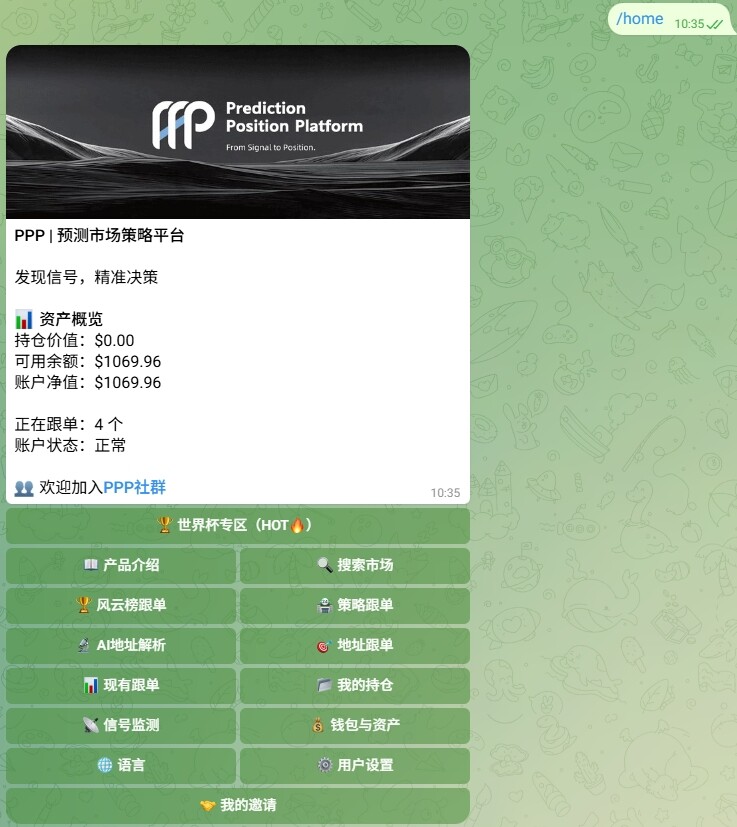
Currently, catering to World Cup trading demand, PPP has set up a "World Cup Zone." This zone displays upcoming matches and hot information, allowing users to directly view related prediction markets and quickly participate in relevant predictions via "Trade Now."
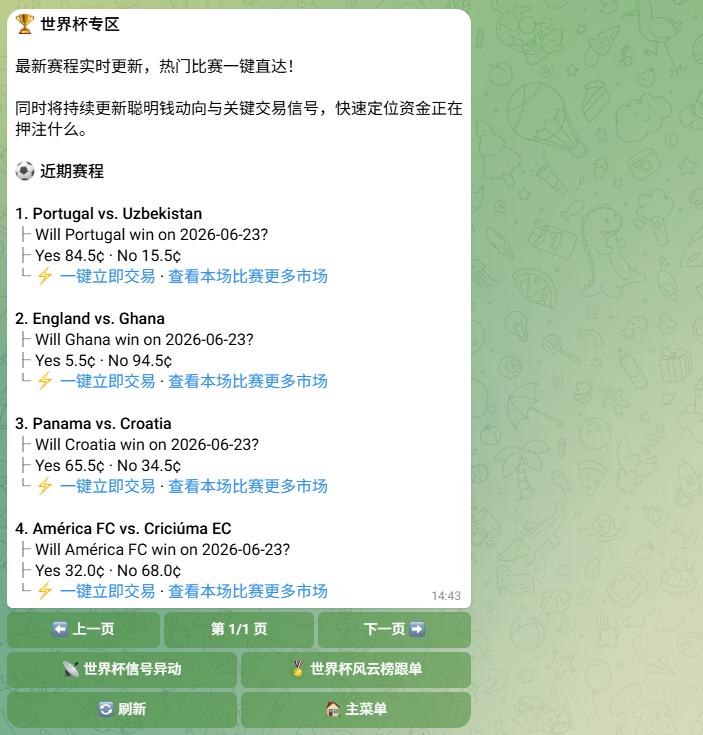
Beyond World Cup-related markets, PPP also supports broader event searches, covering Politics, Sports, Crypto, Finance, Technology, Weather, Hot, and Latest Events across 8 modules.
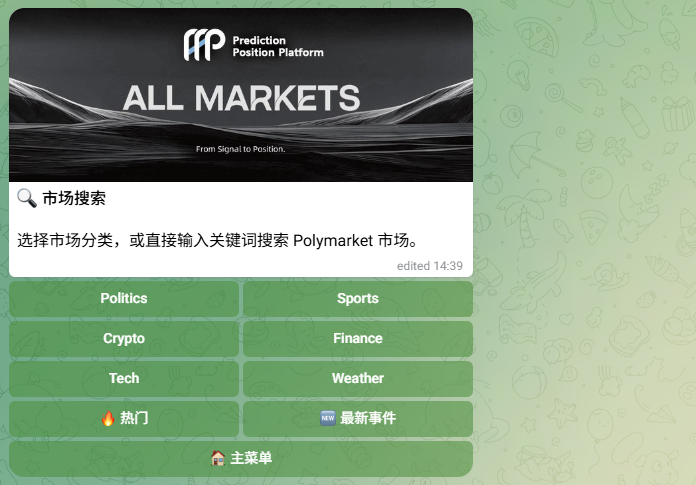
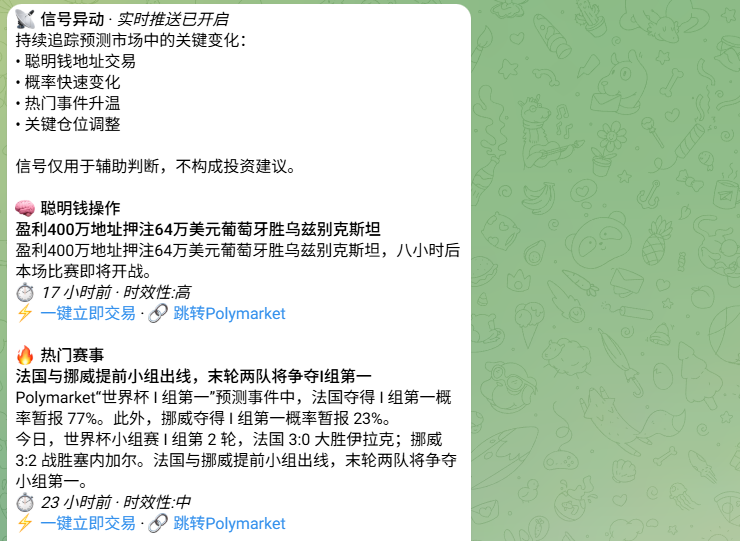
In "Signal Monitoring," PPP continuously tracks key changes in prediction markets and pushes more noteworthy trading signals to users. These signals include smart money address trades, significant short-term probability swings in prediction events, rising discussion heat around hot events, etc.
Compared to users repeatedly refreshing market pages on Polymarket, "Signal Monitoring" helps users discover potential trading opportunities faster and participate directly.
For users already tracking certain smart money addresses, PPP also offers an "AI Address Analysis" feature.
Users can manually input an address, and through PPP's model algorithm, get a one-click analysis of that address's historical trading performance, such as total P&L, win rate, profit/loss ratio, Sharpe ratio, maximum drawdown, and other analytical metrics. Simultaneously, manually entered addresses are compared against PPP's internal smart money database, providing users with more dimensional references.
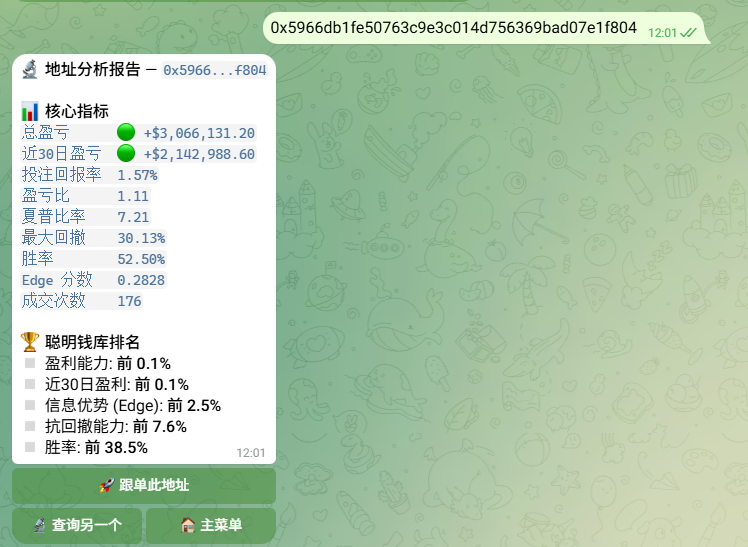
These features primarily solve two problems: helping users search and discover new trading opportunities faster; helping users make more comprehensive judgments about known addresses.
However, in prediction markets, not all profitable addresses are worth copying. Some addresses' gains might come from special information, extreme positions, a single favorable market move, or capital scale advantages. If users only look at profit rankings, they can easily overlook drawdowns, liquidity, holding style, and actual copy-ability.
Therefore, PPP's more prominent capabilities lie in its self-built address database and the derivative "Strategy Plaza" and "Trading Leaderboard."
Using the Strategy Plaza to Locate Prediction Masters Better Suited for Long-Term Tracking
On Polymarket, seeing that a single address is profitable isn't difficult. The hard part is judging whether that address is worth long-term tracking. Some addresses have high profits, perhaps from hitting a few high-odds events; others have decent win rates, but the drawdowns and position risks they take each time aren't suitable for ordinary users to replicate; still others rely on special information, capital scale, or extreme holding methods, appearing strong on the surface but offering limited actual copy-trading value.
Therefore, the accounts showcased in PPP's "Strategy Plaza" module are those that have undergone multi-dimensional filtering of traders on Polymarket, helping users find strategy accounts more suitable for long-term observation and tracking.
In its filtering logic, PPP synthesizes metrics like profit, win rate, drawdown, activity level, holding period, quality of market participation, and capital behavior to model and analyze addresses, combined with manual review. This aims to exclude as much as possible those with incidental profits, anomalous samples, and non-replicable extreme trading behaviors, and remains updated.
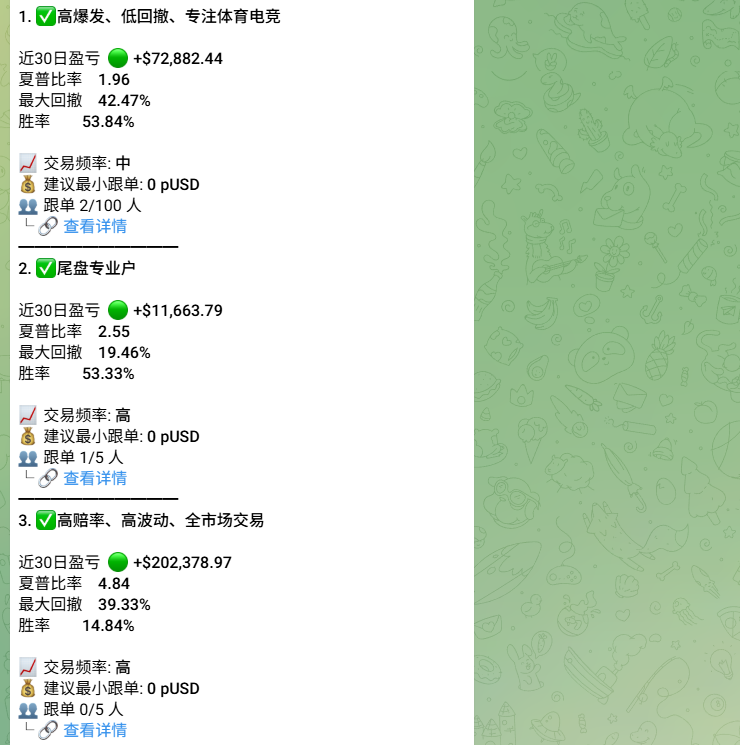
As shown in the figure above, if a user selects the second address in the Strategy Plaza, say "Closing Specialist," and clicks "View Details," they can see more dimensional data analysis for that address, including parameters like its trading frequency and current number of copy traders.
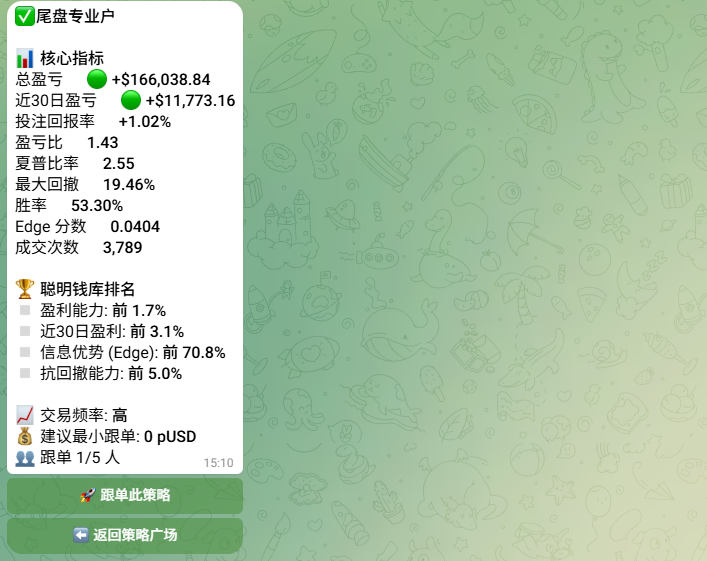
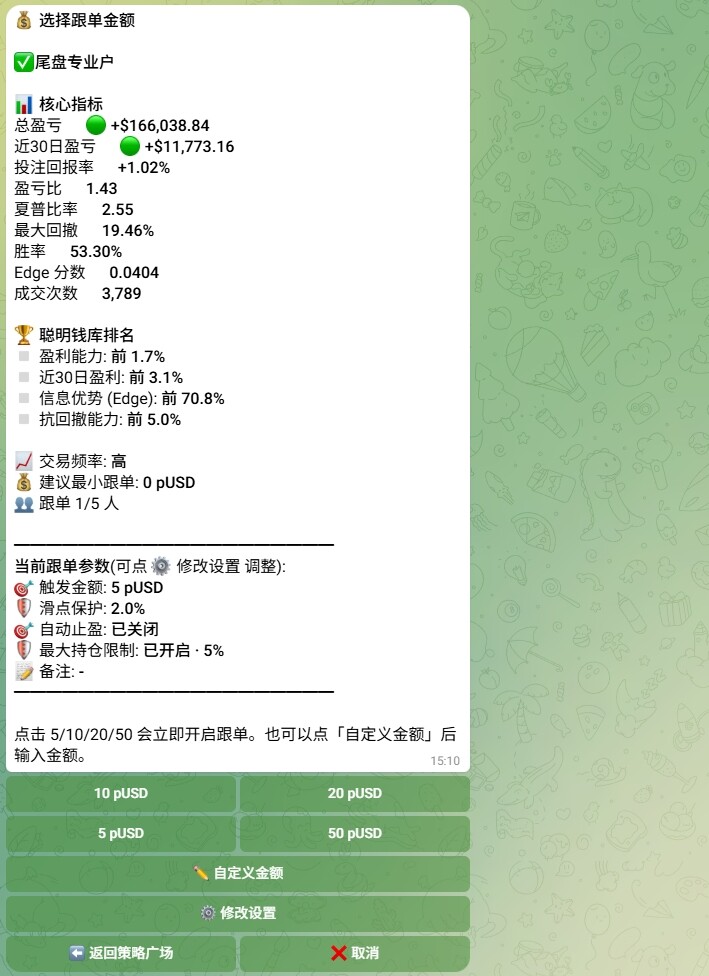
Clicking "Copy This Strategy" allows the user to set parameters like copy amount, maximum position percentage, automatic take-profit, etc.
Using the Trading Leaderboard to Recommend Addresses with Outstanding Recent Performance
If the Strategy Plaza leans more towards long-term observation, then the Trading Leaderboard is more suitable for users to capture recent opportunities.
The pace of prediction markets changes rapidly. Especially during events like the World Cup, major political events, crypto market movements, and macroeconomic data releases, certain traders might hit multiple markets consecutively in a short period or demonstrate stronger judgment in hot events. For users, such addresses might not be suitable for long-term following but are worth close observation in the short term.
PPP filters traders currently standing out on Polymarket based on metrics like recent profit, win rate, activity level, quality of market participation, and capital behavior, helping users quickly discover addresses with stronger recent profitability and more active trading actions.
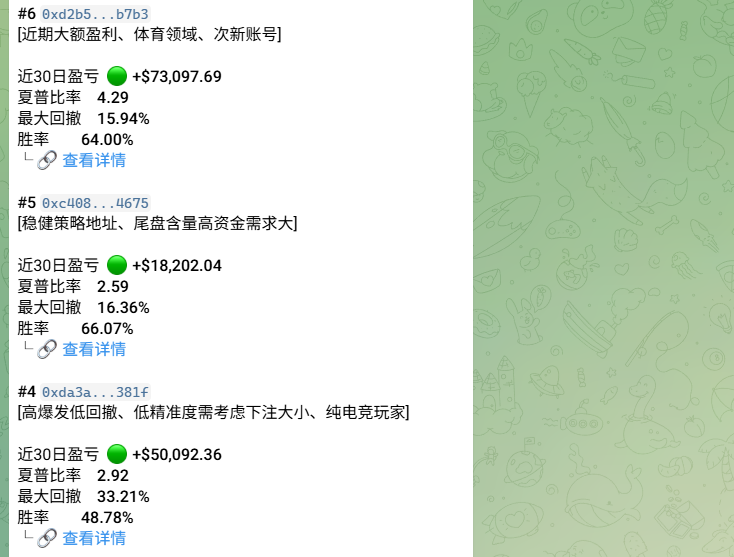
Specifically, PPP defines a label for each address on the Trading Leaderboard and provides data such as P&L for the last 30 days, Sharpe ratio, maximum drawdown, win rate, etc. Users can see not only how much an address recently made but also further judge if its profits are stable, if its drawdown is acceptable, and if its trading style suits their own copy trading.
Beyond addresses filtered through the Strategy Plaza and Trading Leaderboard, PPP also supports users adding custom copy trading addresses.
Overall, the Strategy Plaza is for discovering accounts worth following long-term, the Trading Leaderboard is for capturing addresses with outstanding recent performance, custom address copy trading preserves users' own judgment space, and the exclusive AI model address analysis can assist users in making copy trading decisions.
Position Query and Management, Making Copy Trading Results More Controllable
Automatic copy trading doesn't mean users can't make adjustments after setup.
PPP provides position query and management features after copy trading execution. In most cases, users don't copy just one address. Without a unified holdings interface, users can easily lose track of which positions come from where or whether the copy logic is still suitable. For addresses already being copied, PPP consolidates them into "Current Copy Trades" for management, allowing adjustments to copy amount, risk parameters, or stopping the copy trade as needed.
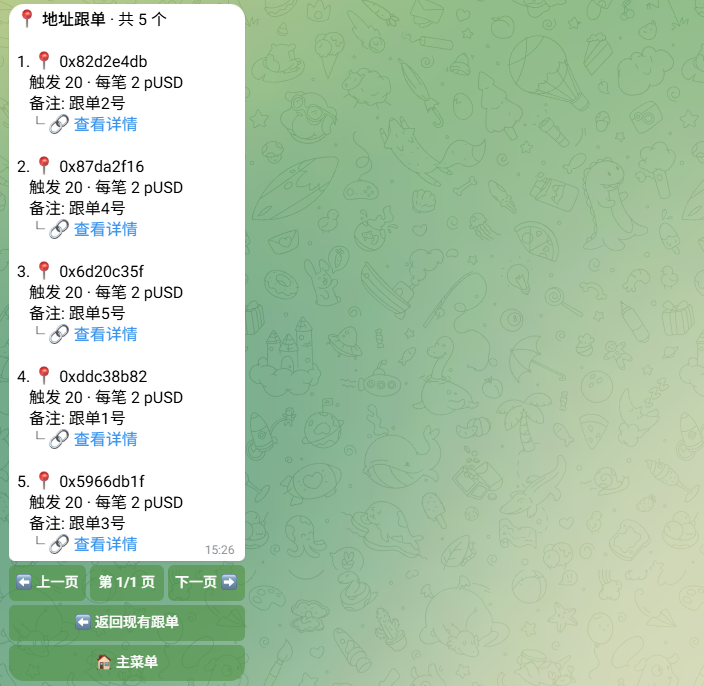
Simultaneously, PPP supports viewing historical positions and P&L data. Through these records, users can further observe the actual performance of different copied addresses, such as which ones brought sustained profits, which had larger drawdowns, and which strategies are no longer suitable to follow.
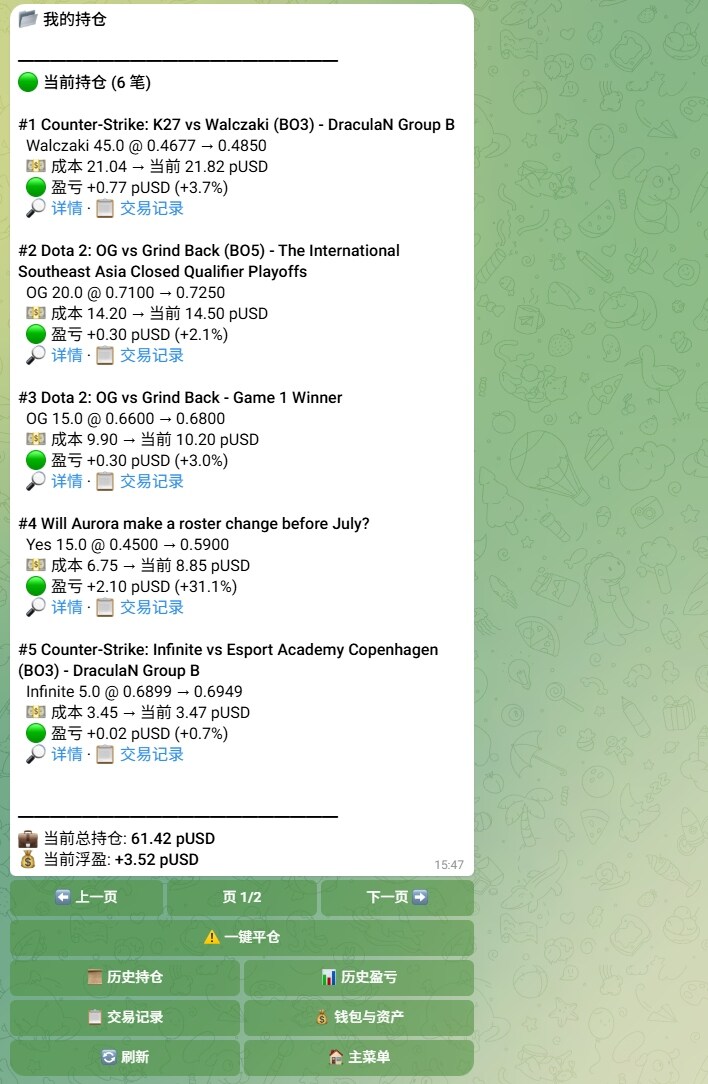
It can be said that PPP's copy trading process is not merely "automated trading after discovering an address" but forms a more complete closed loop—screening addresses worth watching, pushing trading signals, then completing copy execution, and finally continuously adjusting positions through holdings and copy management. For users looking to improve their long-term profitability odds on Polymarket, this process—viewable, adjustable, manageable—is more important than simple automatic copy trading.
Non-Custodial Wallet is PPP's Trust Foundation
For copy trading tools, beyond trading efficiency, user concern centers on fund security.
PPP adopts a non-custodial wallet model. User assets remain in their own on-chain wallets; the platform does not custody user assets and will not request private keys or seed phrases. Users can export the wallet autonomously and manage their private keys, login accounts, and device security themselves. PPP only undertakes services like address monitoring, signal aggregation, copy trade execution, and notification push; trading funds are not handed over to the platform for custody.
When a copy trading tool approaches trade execution, the key trust factor shifts from signal speed to whether asset control rights are clear. PPP's choice of a non-custodial wallet model draws a clearer line between efficiency and security, also laying a foundation of trust for subsequent automated copy trading and position management.
From Address Screening to Signal Push, PPP is Lowering the Trial-and-Error Cost of Copy Trading
Hot matches and market prices change daily, and active addresses quickly switch between different events. Ordinary users find it difficult to track a large number of accounts long-term and also struggle to judge whether an address's profit stems from a stable strategy or short-term luck, extreme positioning, or chance events.
PPP continuously screens traders on Polymarket based on metrics like profit, win rate, maximum drawdown, activity level, holding period, quality of market participation, and capital behavior, helping users quickly discover addresses with relatively stable performance and potential value for further research and tracking.
Building on this, PPP continuously monitors address trading behavior and hot market changes, filtering from these worthwhile signals like smart money movements and rapid market probability shifts, and promptly pushes them to users.
Users don't need to stay up all night watching the market or constantly switch between group chats, browsers, and trading pages to grasp potential market opportunities more efficiently.
Using tools effectively and leveraging the expertise of forecasters across various fields might be the evolutionary path for Polymarket newcomers that incurs the least tuition fees.