From Scrolling Tweets to Buying Tokens: Will 'Smart Asset Tags' Turn X into a Crypto 'Trading Terminal'?

Odaily星球日报Published on 2026-01-12Last updated on 2026-01-12

Abstract

X, the platform formerly known as Twitter, is developing a new feature called "Smart Cashtags," according to product lead and Solana advisor Nikita Bier. This tool will allow users to tag specific assets (like stocks, BTC, or meme coins) in their posts. Clicking these tags will display the asset's real-time price and aggregate all related information. The feature, planned for a public release next month, is seen as a major step toward Elon Musk's vision of transforming X into a "super app." Market reactions are mixed. Solana and BNB Chain ecosystems expressed strong support, with some assets from these chains featured in early mockups. Some view this as a potential competitor to major CEXs like Binance, while others are skeptical, citing X's history of delayed product launches (like the long-promised X Money payments) and poor handling of crypto-related content and spam. The move is analyzed as a potential "dimensional attack" by a Web2 giant on the crypto space, leveraging X's massive user base (400-600 million MAUs) to bridge the gap between social media and financial transactions. It is compared to the evolution of China's WeChat, which integrated payments and financial services to become an all-in-one platform. However, whether X can successfully execute this vision and improve its technical implementation remains to be tested.

Original | Odaily Planet Daily (@OdailyChina)

Author | Wenser (@wenser 2010)

A major earthquake affecting 600 million crypto users and a $3 trillion crypto market is here!

Just yesterday, X (Twitter) platform product lead and Solana advisor Nikita Bier posted that X is the best source for financial news and is currently developing Smart Asset Tags (Smart Cashtags). This feature will allow users to specify specific assets or smart contracts when posting market-related content on X; users can click on these tags in their timeline to view real-time prices of the related assets and all information mentioning that asset. The feature is planned to be iterated and feedback collected before its public release next month.

The news caused a market stir. Some believe this move means the X platform is implementing the grand vision of a "super app" previously outlined by Musk; others think that, thanks to its massive user base and crypto community, X will become a direct competitor to many CEXs;还有人结合配图认为 X 将引导海量流动性与注意力到 Solana 等链上生态。(Others,结合配图, believe X will channel massive liquidity and attention to on-chain ecosystems like Solana.)

When a Web2 giant platform sets its sights on the crypto market, is it a new "paradigm shift in internet finance" or just another "future promise" like the long-pending payment gateway? Odaily Planet Daily will explore this matter from product analysis and ecosystem layout perspectives in this article.

When X Transforms into a "Smart Asset Window": Web2 Product's Dimensional Strike on the Crypto Sphere

Based on available information, let's first discuss the specific details of this X platform feature update.

According to Nikita Bier's post and accompanying image, the so-called Smart Asset Tags (Smart Cashtags) primarily aim to "provide real-time financial data based on the user's timeline," with information about mentioned assets being aggregated and displayed; when posting a tweet, users can specify specific assets (such as stocks, BTC, Meme coins, etc.) by their ticker symbol (Ticker); clicking on the corresponding ticker allows direct access to its real-time price, and may potentially offer trading support (Buy & Sell interface).
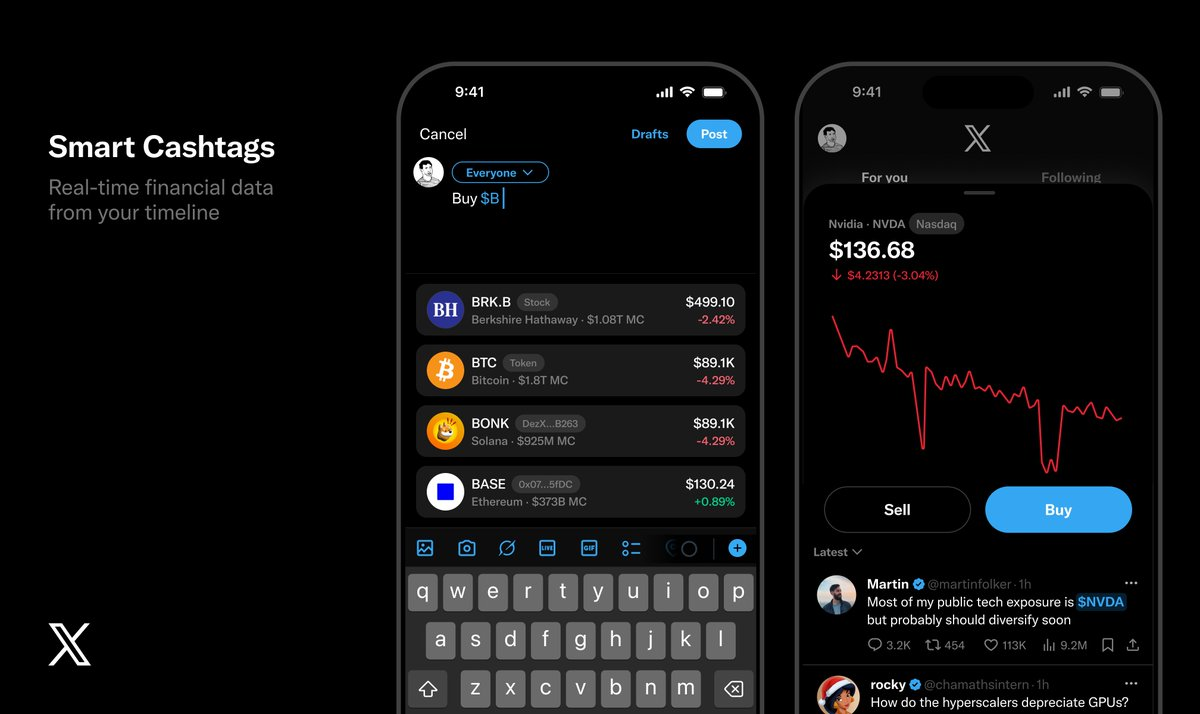
Furthermore, what sparks imagination in the accompanying image is not just the feature display, but also the mentioned corresponding targets – besides major assets like BRKB (Berkshire Hathaway stock) and BTC, Solana ecosystem Meme coin BONK and the Base ecosystem's yet-to-launch ecosystem token BASE are also listed, leading to external guesses that this might be evidence that the X platform's "Smart Asset Tags" feature will initially only support the Solana and Base ecosystems.

In the comments section, Nikita Bier also responded to (or hinted at) several hot questions from netizens:

  • When asked "Does this mean we will be able to trade on X in the future using self-custody wallets or even CEX widgets?", they responded "👀" (hinting watch this space);
  • When asked "Which backend will this feature connect to to find assets?", they responded "The API we use is almost for assets minted on-chain in real-time".

Market Reactions Show Diverse Opinions: Some Applaud, Some Scoff

It is worth mentioning that the news quickly received enthusiastic responses from Solana official, BNB Chain team members, Solana ecosystem projects, Base ecosystem projects, and the CT (Crypto Twitter) circle, although the反响并不总是一边倒的喝彩 (reaction wasn't always one-sided cheers), some are not optimistic about the launch of this feature.

Solana official directly posted to "hitch a ride" – "Look, BONK is in the picture!", meaning "the X platform will allow users to post Solana tokens and view charts and news". Subsequently, after Nikita Bier posted in response to someone else "My investments are in my bio," Solana official posted again saying "Same here,"可以说趁机好好涨了一波圈外热度。(可以说 they took the opportunity to gain a lot of heat outside their circle).

With Solana leading the way, BSC naturally didn't hold back. First, early this morning Beijing time, when community users discussed whether the X platform feature update would integrate BNB Chain, Binance founder CZ responded: "Minor shareholder, we'll see then. 😆" And when someone suggested that X platform's move might mean a war for public chain liquidity, CZ commented again: "No need for exclusivity, right? Can support multiple chains. Coexist." He also later posted the corresponding tweet where Musk expressed thanks for CZ's support during the Twitter acquisition. This morning, BNB Chain Growth Executive Director Nina Rong posted that she had sent a direct message to X platform product lead and Solana ecosystem advisor Nikita Bier, offering BSC's support for the Smart Asset Tags project.

Solana ecosystem infrastructure project Helius CEO mert also appeared in the comments shouting: "Any Solana-centric infrastructure? Contact me!"

Base ecosystem project Limitless and Base ecosystem information account Base Posting also "showed their faces" in the comments, expressing curiosity about the BASE token on one hand, and anticipation for X platform's new feature on the other. Bitget's official account also posted expressing curiosity. Binance.US said "Sounds useful". Unchained crypto journalist Laura Shin posted, "(Is this X) a step towards an all-in-one app?"

Opinions within the crypto circle were more diverse: Sentient APAC head Anita believes "X platform will become a killer for CEXs like Binance"; crypto KOL 加密韦陀 commented: "A complete copy of Binance", and later posted that based on past poor experiences with X platform's group chat功能 (features), they are not optimistic about X platform making wallets or trading apps. Others stated that X has almost ruined cryptocurrency, even worse than LinkedIn;还有人 said, as soon as you mention cryptocurrency in a tweet, the post will be nuked by spam.

CryptoQuant founder Ki Young Ju expressed a similar view – he stated that the X platform is suppressing the reach of cryptocurrency-related posts while failing to curb the surge in automated spam, punishing legitimate users. Data shows a surge in automated activity related to the "crypto" keyword, generating over 7.7 million posts in a single day. Ki Young Ju pointed out that the X platform cannot distinguish between automated accounts and real human accounts, and the paid verification system has become a mass-posting tool for bots.

In the摇摆不定 (wavering) between promoting cryptocurrency asset普及化 (popularization) and restricting cryptocurrency content dissemination, the X platform is also seeking its own way to balance both.

Web2 Product vs. Crypto App: Dimensional Strike Under Network Effects

It must be said that the news brought by Nikita Bier, who joined X in mid-2025 to负责产品 (be responsible for product), may not meet everyone's expectations, but this change确实从产品层面上构成了对加密货币应用的“降维打击” (indeed constitutes a "dimensional strike" against cryptocurrency applications from a product level), specifically体现在以下 3 方面 (manifested in the following 3 aspects):

First, the network effect of Web2 giant products based on massive users. Currently, the X platform has about 400-600 million monthly active users, which is already equivalent to the total size of the cryptocurrency market (2025 data is about 600 million people). If in the traditional internet field, user numbers represent traffic data like reads, likes, comments, etc., X's Smart Asset Tags feature, like crypto apps, becomes an entry channel and corresponding window for the funds, capital, and liquidity that users possess, and this is precisely the weakness of crypto applications.

Second, an important step for the X platform in practicing the "super app" vision. In the past, overseas markets believed more in "segmentation is king," with one app focusing on one细分垂类市场 (niche vertical market), which is also an important reason why paid SaaS and niche markets can develop on a large scale overseas; the success of domestic internet giants like WeChat, Alipay, Douyin (Tiktok) in application products has provided new ideas for the development of Western internet platforms – an "ALL IN ONE"一站式平台 (one-stop platform) that can cover users' needs from life to work, from payment to shopping, from entertainment to socializing, etc. Musk has said more than once that he "wants to transform the X platform into a super app like WeChat," and based on previous actions like X platform planning to open payments, integrate with Visa, and provide creator incentives, starting with assets like crypto and stocks might be a masterstroke. After all, who wouldn't want to buy or sell assets they are bullish or bearish on while browsing news on X?

Third, this move may become the starting point for "new finance" in the Western internet field. As is well known, due to the高度完善 (highly developed) banking system and credit card system overseas, overseas internet users are often accustomed to credit card payments for超前消费 (advance consumption); firstly, they have not experienced the impact of热潮冲击 (waves) like P2P, internet finance, micro-loans; secondly, they prefer shopping at offline physical stores rather than online e-commerce; thirdly, they have no direct motivation to use cryptocurrency payments, let alone things like stablecoin payments, PayFi yields which are unheard of by many. The launch of the X platform's Smart Asset Tags feature might bridge these numerous information gaps in one step, quickly meeting the diverse needs of X platform users for online financial loan needs, online e-commerce shopping needs, cryptocurrency payment needs, stablecoin storage yield needs, etc.

Don't rush to deny X's future development possibilities. Looking at the current state of WeChat's product, the X platform is not without转型可能 (transformation potential).

Product Analysis Comparison Between X Platform and WeChat: Public Social Media VS Half-Social Platform

Currently, WeChat's product components mainly include the following 3 major parts:

First, the熟人社交与半熟人社交板块 (close friend social and semi-close friend social section). This part mainly includes functions like adding friends, creating WeChat groups, Moments (朋友圈), etc.;

Second, the original content publishing and distribution platform section. This part mainly includes the Official Account platform (公众号平台), Video Channels (视频号平台), and other functional sections;

Third, the internet financial application and life services section. This part mainly includes WeChat Stores (微信小店), WeChat Red Packets (微信红包), WeChat Wallet (零钱通), and life services and other functional sections.

Correspondingly, as a public social media platform, X's current main product functions are concentrated in 2 major parts:

First, the user account, follow list, and corresponding timeline section. This is the main component of public social media. Users are both content producers and content consumers. Meanwhile,包括特朗普、美国政府部门以及资本机构等 (including Trump, US government departments, and capital institutions) all use the X platform as one of the mainstream channels for对外发声、公关传播 (external communication, PR dissemination).

Second, the "Community功能" (Community features), "群聊功能" (group chat features), and other sections that users complain about year-round. This part consists of the social attribute functions of social media, but the current technical setup and product experience of the X platform are hardly satisfactory.

Therefore, the launch of "Smart Asset Tags" might, like "WeChat Red Packets (Wallet) building the closed loop of the WeChat ecosystem's economic system," become an important step in building the "X platform ecosystem economic system": on one hand, this feature is closely integrated with content publishing, content dissemination, and content discussion; on the other hand, this feature will become an infrastructure project for the X platform to complete links like capital inflow, investment consumption, and e-commerce引流 (diversion), meeting users' diverse usage needs.

Of course, the actual functional implementation effect and user experience remain to be verified by time.

Additionally, it is worth mentioning that the proposal of this feature comes right after Musk's previous announcement of "即将开源新的 X 平台算法" (impending open-sourcing of the new X platform algorithm). Its impact on the subsequent传播度 (reach) of cryptocurrency-related content, the quality of spam control, and other aspects is far broader than most people imagine, and the duration of impact might also be more lasting.

However, some are pessimistic about this. After all, the concept of an asset display window is not new. Whether it was the Blinks function previously launched by Solana, the token ticker price display built into the OKX wallet, or the trading入口 (entry points) provided by numerous browser extensions, none have achieved high-frequency use or widespread adoption in the crypto market. Whether the X platform, as a news and information distribution center, can change this现状 (status quo) from the platform functionality end remains unknown.

Let's not forget, the big饼 (promise) painted by former X platform CEO Linda Yaccarino in early January 2025 – "X platform payment功能 (feature) X Money will be launched within the year" – we haven't even gotten to eat yet!

And it's been over 2 years since Musk first revealed in 2023 that "payment features will be launched by mid-2024"!

It must be said, in terms of application product iteration and updates, Western internet platforms lag far behind domestic internet companies!


Related Questions

QWhat is the 'Smart Cashtags' feature being developed by X (Twitter) according to the article?

AThe 'Smart Cashtags' feature allows users to specify specific assets or smart contracts when posting financial content on X. Users can click these tags in their timeline to view real-time prices of the related assets and all information mentioning that asset.

QHow might the 'Smart Cashtags' feature impact the crypto market and existing exchanges like CEXs?

AIt is believed that due to X's massive user base and crypto community, this feature could position X as a direct competitor to many Centralized Exchanges (CEXs), potentially redirecting significant liquidity and attention to on-chain ecosystems like Solana.

QWhich blockchain ecosystems are speculated to be initially supported by X's 'Smart Cashtags' feature based on the provided image?

ABased on the image in the article, it is speculated that the Solana ecosystem (e.g., meme coin BONK) and the Base ecosystem (e.g., its unreleased BASE token) might be among the first supported by the 'Smart Cashtags' feature.

QWhat are some of the criticisms or concerns raised about X platform's move into crypto asset integration?

ACritics point out that X has previously suppressed the reach of crypto-related posts while failing to curb automated spam, potentially punishing legitimate users. Others doubt the platform's ability to execute well, citing past poor experiences with features like group chats, and some view it as mere imitation of existing crypto exchange features.

QHow does the article compare X's development strategy to WeChat (Weixin), and what is the significance of 'Smart Cashtags' in this context?

AThe article compares X's strategy to WeChat's 'super app' model, suggesting that 'Smart Cashtags' could be a key step in building an economic ecosystem within X, similar to how WeChat's integrated wallet and payment services created a closed loop, combining content with financial transactions and services.

Related Reads

If the AI Bubble Is Already Bursting, Who Will Truly Survive?

If the AI Bubble is Bursting, Who Will Remain? The debate over an AI bubble is intensifying, with figures like Ray Dalio warning of high levels and Jensen Huang seeing immense, early-stage opportunity. Both views hold truth: a speculative bubble in capital markets likely exists, mirroring the dot-com era, but the underlying technological shift is real and transformative. History shows that while bubbles burst—wiping out overvalued companies and speculative capital—they often leave behind critical physical and digital infrastructure. The dot-com bust, for instance, eliminated many firms but left the global fiber optic networks and data centers that enabled the rise of Amazon, Netflix, and cloud computing. Today's massive AI infrastructure investments (projected at trillions by 2030) in data centers, power, cooling, and GPUs may follow a similar path, creating the foundation for future applications. A key divergence from past bubbles is the "Jevons Paradox" effect in AI. As the cost of AI inference has plummeted by over 99.7% since 2023, enterprise spending on AI has skyrocketed. Cheap "tokens" have unlocked vast, previously uneconomical use cases, moving AI from simple chatbots into core business workflows—code generation, legal document review, scientific simulation, and financial analysis. The market is now in a phase of self-correction, weeding out superficial "API-wrapper" startups, but this cleansing process strengthens the ecosystem. The long-term trajectory is clear. The value is gradually shifting from capital expenditure (CapEx) on hardware to operational expenditure (OpEx) on transformative applications. As AI becomes a utility, the winners will be firms that deeply integrate it to solve vertical industry problems in law, healthcare, finance, and manufacturing. The泡沫 will recede, but the foundational shift towards an AI-powered era across all sectors is irreversible. The underlying productive force of AI contains no bubble.

marsbit25m ago

If the AI Bubble Is Already Bursting, Who Will Truly Survive?

marsbit25m ago

If the AI Bubble Is Already Bursting, Who Will Truly Remain?

**Summary: If the AI Bubble is Bursting, What Will Remain?** The debate around an AI bubble is intensifying, with figures like Ray Dalio warning of high valuations while Jensen Huang sees immense opportunity. This echoes the dot-com bubble, which saw massive wealth destruction but ultimately left behind critical infrastructure like undersea cables and broadband, enabling future giants like Amazon and Netflix. Similarly, today's AI boom involves trillions invested in data centers, power, cooling, and GPUs, while application-layer revenue remains comparatively modest. This investment-disparity signals a bubble. However, the core technological progress is real and accelerating. AI inference costs have plummeted by over 99.7% since 2023, making intelligence increasingly cheap and accessible. This cost collapse is unlocking vast new demand. Instead of reducing spending, enterprises are tripling their AI cloud expenditure. Cheap "tokens" enable AI to move beyond simple chatbots into complex workflows—automating code writing, legal document review, financial analysis, and scientific research. This follows "Jevons's paradox": improved efficiency leads to greater total consumption. The market is now undergoing a necessary purification, weeding out "API-wrapper" startups with no real moat. The deeper evolution involves a shift from capital expenditure (CapEx) on infrastructure to operational expenditure (OpEx) on value-creation in applications. While hardware vendors currently profit most, long-term value will migrate to AI-native firms solving vertical industry problems. Ultimately, a market correction will cleanse speculative excess but will not reverse the AI+ trend. The massive physical and algorithmic infrastructure being built will endure, becoming a cheap, utility-like foundation. Just as the internet became indispensable to all industries post-2000, AI is poised to empower and redefine every sector, moving society irreversibly toward an intelligence-augmented era. The bubble may burst, but the underlying productive momentum is solid.

链捕手32m ago

If the AI Bubble Is Already Bursting, Who Will Truly Remain?

链捕手32m ago

Microsoft CEO: In the AI Era, How Do You Define a Company's Moat?

Microsoft CEO Satya Nadella argues that in the AI era, a company's true competitive edge, or "moat," is not determined by choosing the single most powerful model, but by its ability to build a continuous "learning loop." This system integrates and evolves by connecting human workflows, domain expertise, organizational judgment, and employee experience. He posits that future companies will accumulate two types of capital: Human Capital (employee knowledge, judgment, creativity) and "Token Capital" (a firm's own built and owned AI capabilities). Importantly, AI amplifies rather than devalues human capital. Human direction is essential to guide progress, as computational power alone is aimless. The core opportunity lies in creating a closed-loop system where human and token capital reinforce each other in a compound, self-improving cycle. A company must be able to preserve its unique institutional knowledge—its "company veteran" expertise—even if it switches underlying general-purpose AI models. This requires private evaluation benchmarks, reinforcement learning environments based on internal data, and queryable knowledge bases. Nadella warns against a future where economic value is concentrated by a few dominant models that commoditize entire industries' knowledge. Instead, the priority should be building a broad "frontier ecosystem" where every company, industry, and nation can own its learning loop. This allows organizations to retain control of their intellectual property, amplify employee capabilities, and ensure the economic value created by AI is captured within their own businesses and communities. True corporate sovereignty in the AI age comes from turning organizational knowledge into a compounding system that creates enduring, defensible value.

marsbit1h ago

Microsoft CEO: In the AI Era, How Do You Define a Company's Moat?

marsbit1h ago

ETFs Are Just the Ticket: The True Institutionalization of Bitcoin Is Happening Where You Can't See It

Beyond the Bitcoin ETF spotlight, a deeper institutionalization is underway, leveraging Bitcoin as a foundational financial primitive. Institutions are using Bitcoin for purposes long reserved for assets like U.S. Treasuries and gold: as collateral for loans, insurance reserves, and the backbone of rated bonds. Examples include a Barbados-based insurer capitalizing with $40M in Bitcoin reserves and Ledn's $188M securitization of Bitcoin-backed loans, which received the first-ever investment-grade rating (BBB-) from S&P for a digital asset-backed security. This structure was stress-tested during a 27% price drop in early 2026, triggering automatic liquidations that functioned as designed but revealed the systemic risk of synchronized selling across leveraged positions. Infrastructure is evolving to support this, with platforms like Anchorage Digital's Atlas network enabling secure, institutional-grade settlement and collateral management. Strategies like basis trades and corporate treasuries (exemplified by companies like MicroStrategy issuing billions in equity and debt to fund Bitcoin acquisitions) further integrate Bitcoin into financial mechanics. While ETFs solved "how to own" Bitcoin, these developments answer "what to do with it," embedding the asset into the working machinery of finance—as collateral upon which loans, derivatives, and structured products are built. The real, enduring institutional shift is happening in these largely invisible plumbing and financing systems.

marsbit1h ago

ETFs Are Just the Ticket: The True Institutionalization of Bitcoin Is Happening Where You Can't See It

marsbit1h ago

ZEC Co-Founder Responds to Orchard Vulnerability: No Signs of Theft, Orchard Pool to Be Sealed

ZEC Co-Founder Addresses Orchard Vulnerability: No Signs of Theft, Plans to Sunset Orchard Pool A security vulnerability was recently discovered in Zcash's Orchard shielded pool, raising key concerns. The primary questions are whether the flaw was exploited, if user funds are safe, whether users can verify the total ZEC supply, and if other similar vulnerabilities exist. Analysis suggests the vulnerability was likely not exploited prior to its discovery. It was found proactively by a researcher using specialized tools, not due to an active breach. The development team and mining pools acted quickly to contain the issue. Typical financially-motivated attacks would likely have left visible on-chain evidence, which has not been observed. User funds in Orchard are considered safe and should be recoverable, assuming no prior exploitation. If the flaw was never used, all legitimate funds can be withdrawn. The article outlines risks associated with moving funds to transparent addresses or other pools, but concludes that leaving assets in place is a reasonable option. Currently, users cannot independently verify that the total ZEC supply hasn't been inflated due to this bug. However, the planned Ironwood network upgrade is designed to resolve this. It will permanently close the Orchard pool to new deposits and internal transfers, allowing only withdrawals. This mechanism will cap total withdrawals at the amount of legitimately deposited funds, enabling anyone to cryptographically verify the supply post-upgrade. Multiple teams, including Shielded Labs, have conducted extensive audits focused on counterfeiting vulnerabilities, assisted by advanced AI tools. No additional flaws of this type have been found so far, increasing confidence that no other similar undisclosed vulnerabilities exist. In summary, evidence indicates the Orchard bug was probably not used, user funds are secure, and no other counterfeiting flaws are currently known. The upcoming Ironwood upgrade will restore users' ability to independently verify the total ZEC supply, closing this chapter.

Foresight News1h ago

ZEC Co-Founder Responds to Orchard Vulnerability: No Signs of Theft, Orchard Pool to Be Sealed

Foresight News1h ago

Trading

Spot
Futures
活动图片




