From Mining Pool to Mars: Why Is Wang Chun in the SpaceX Cockpit?

marsbitPublished on 2026-05-26Last updated on 2026-05-26

Abstract

Title: From Mining Pool to Mars: Why Wang Chun is in the SpaceX Cockpit? When SpaceX announced that Wang Chun, co-founder of F2Pool, would command the first commercial crewed interplanetary mission, many were shocked. Why would a Bitcoin mining pool founder be on a Mars mission roster? However, understanding Wang Chun's journey over the past decade and the deepening ties between the crypto industry and SpaceX reveals this is not accidental, but an inevitable result of a new era taking shape. Today's Mars plan is no longer just a space engineering project; it is evolving into a civilization-upgrading experiment driven by global tech capital, AI, computing power, energy, and the crypto economy. Wang Chun stands precisely at the intersection of these forces. Part 1: From F2Pool to SpaceX – Wang Chun's Leap F2Pool, founded when Bitcoin was still niche, is one of the earliest large-scale mining pools and once held a significant share of global Bitcoin hash rate. Wang Chun belongs to the first generation of Chinese Bitcoin advocates and infrastructure builders—idealists and engineers who believed in a new value network independent of traditional finance. Miners like him built the hardware, energy, and computing power foundational to decentralized networks. This aligns with the long-term, high-engineering, future-oriented vision required for space civilization. Elon Musk’s space endeavors value such long-term builders over mere capital players, which explains Wang Chun's entry int...

Author: Winnie, CryptoPulse

When SpaceX announced that Wang Chun, co-founder of F2Pool, would serve as the commander of the first commercial manned interstellar flight mission, many people's initial reaction was shock. Why would a Bitcoin mining pool founder make it onto the Mars mission roster?

However, if one truly understands Wang Chun's experiences over the past decade and the deepening ties between the crypto industry and SpaceX today, it becomes clear that this event is not accidental, but rather an inevitable result as a new era gradually takes shape.

Because today's Mars plan is no longer just an aerospace engineering project; it has begun to transform into a civilization-upgrading experiment driven by global tech capital, AI, computing power, energy, and the crypto economy. And Wang Chun happens to stand at the convergence point of these forces.

I. From F2Pool to SpaceX: Wang Chun's Leapfrog Journey

In today's crypto world, F2Pool is almost a living fossil. It was founded during an era when Bitcoin was still very marginal, was one of the earliest large-scale mining pools globally, and also long held a significant share of the world's Bitcoin hashrate.
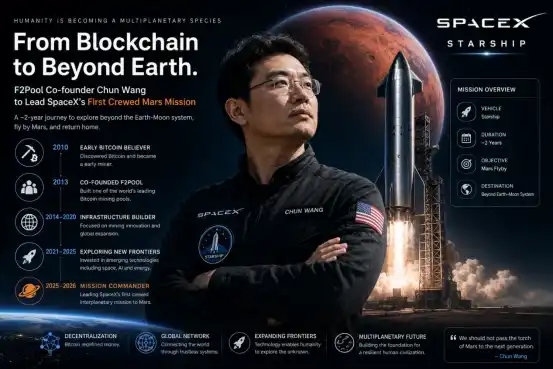
And Wang Chun is one of China's earliest true Bitcoin evangelists and infrastructure builders.

Many people's current understanding of the crypto space revolves around memes, trading, speculation, and KOLs. But in the crypto world around 2011, the core players weren't financial speculators; they were a group of geeks, engineers, and idealists.

They believed the future of the internet needed a new type of value network independent of the traditional financial system. Thus, the earliest miners began building rigs, studying algorithms, maintaining nodes, and constructing hashpower networks. Wang Chun was one of the most typical figures of that era.

The most important significance of F2Pool wasn't just about mining for profit, but that it helped the Bitcoin network truly form a global-scale infrastructure. Because any decentralized network ultimately requires hardware, energy, and computing power support in the real world. In other words, miners are essentially the energy workers of the digital world.

This is also a key reason why Wang Chun later gradually began focusing on aerospace, deep space exploration, and even Mars plans.

Because, looking at the underlying logic, both the Bitcoin network and space civilization belong to the category of infrastructure civilization. They both require long-termism, extremely high engineering capabilities, and imagination for the future world.

Therefore, Wang Chun is not like a traditional financial player; he is more like a builder from the era of technological utopia. This is also why he was later able to gradually enter Elon Musk's aerospace ecosystem.

Because the people Musk truly respects are never merely capital players, but those willing to invest long-term and genuinely believe in the narrative of future civilization.

II. Why Are the Crypto Circle and SpaceX Getting Closer?

Over the past few years, a very clear trend is that the connection between the crypto industry and frontier tech fields like SpaceX, AI, and robotics is rapidly strengthening. Many people find it strange—what exactly is the relationship between rockets and Bitcoin?

But in reality, the connection between them is deepening.

Because the core of today's global tech competition has gradually evolved from internet application competition to infrastructure competition. And the crypto industry and SpaceX are essentially part of the next generation of infrastructure.
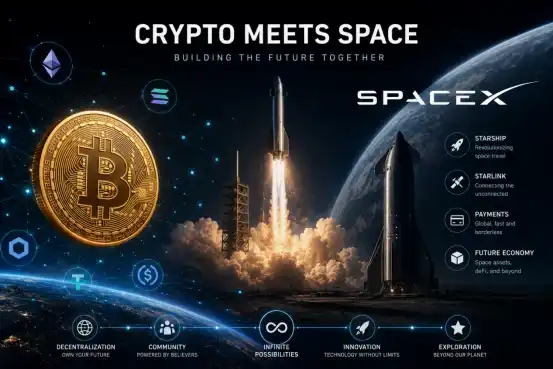
First, what is SpaceX's core mission?

It is to reduce the cost of human access to space. In the past, sending one kilogram of cargo into space cost tens of thousands of dollars. The goal of Starship is to compress that cost to tens of dollars. Once achieved, the entire economic model of human society will be transformed.

Because with low-cost access to space, orbital servers could emerge, space energy could explode, global satellite internet will further proliferate, and even future Mars bases begin to possess practical feasibility.

And these new worlds will require new payment systems, new value networks, and new globalized financial systems.

Thus, cryptocurrency naturally gains an opportunity to enter the space economy.

Because the traditional financial system is fundamentally built on national sovereignty and geographical boundaries. But if an interplanetary economy emerges in the future, traditional banking systems will struggle to cover it.

Blockchain is inherently suited for globalized, cross-regional, trustless value circulation. This is also why more and more tech geeks believe cryptocurrency is likely to become an important component of the future space economy.

Beyond that, there is a deeper reason. That is, the crypto circle and SpaceX essentially share the same spiritual core.

They both belong to high-risk long-termism.

Early Bitcoin was considered impossible to succeed; SpaceX also faced bankruptcy multiple times. But whether Bitcoin believers or Mars plan supporters, they are willing to believe in a goal that seems utterly crazy in the short term but could change the world in the long run.

So today, you'll find more and more people in the crypto industry starting to pay attention to SpaceX, Starlink, AI, robotics, brain-computer interfaces, space energy, supercomputing power... because these things are gradually forming the next generation of civilization systems.

What mattered most in the past internet era were traffic platforms, while what may matter most in the future era are energy, computing power, AI, and space infrastructure.

And the crypto economy could become the value layer within this system.

III. Human Spaceflight History Is Entering the Era of Commercial Civilization

Many interpret this event as a Chinese entrepreneur about to fly by Mars. But in reality, the truly significant aspect of this event far exceeds a piece of commercial space news. Because behind it lies the implication that the power structure of human spaceflight history is changing.

For decades, space exploration has been a state activity—the US, the former Soviet Union, China—relying on state finances, military-industrial systems, and political will.

But today, commercial spaceflight is fundamentally altering this model. SpaceX has proven that private companies can also lead a space revolution.

And Wang Chun's entry into an interstellar mission further indicates that future participants in deep space exploration may no longer be limited to professional astronauts.

Entrepreneurs, engineers, AI researchers, owners of tech capital, and even future robotics experts could all enter space.

This is actually very similar to the Age of Discovery in the 15th century.

Initially, oceanic exploration relied on national fleets. But what truly drove global expansion later was commercial capital. The British East India Company and the Dutch East India Company were essentially tools of commercial civilization expansion.

And today's SpaceX is beginning to possess similar attributes. The difference is that what was crossed in the past were oceans, while what is being crossed now is interstellar space.

More crucially, Wang Chun also made a very important statement this time: "We should not leave the landing plan to the next generation." This statement essentially reminds SpaceX not to deviate from the original intention of a multi-planetary civilization due to commercialization and real-world pressures.

Because over the past year, with the AI explosion, data center construction, and NASA's lunar plan advancement, part of SpaceX's focus has clearly begun shifting toward the Moon.

Compared to Mars, the Moon is easier to commercialize. But Mars is the true key to determining whether humanity can become a multi-planetary civilization.

So today's Mars plan is no longer merely a tech project. It is more like a civilization faith.

And Wang Chun's appearance means that the new capital forces, new tech communities, and new idealists accumulated from the past crypto world are now formally entering the interstellar era.

Conclusion

To summarize, the most shocking aspect of this event is not that an individual is about to fly by Mars, but that the dominant force behind human civilization expansion is gradually shifting from state machinery to tech companies, AI systems, and globalized technology capital.

From mining pool to Mars, from the Bitcoin network to starships, Wang Chun's experience might be an early preview of the direction of technological civilization evolution over the next few decades.

Related Questions

QWhy was Wang Chun's appointment as mission commander for SpaceX's first commercial interplanetary flight surprising to many?

AMany were shocked because Wang Chun is primarily known as a co-founder of F2Pool, a Bitcoin mining pool. People questioned why a figure from the cryptocurrency industry would be selected to lead a deep-space mission, viewing the fields as unrelated.

QAccording to the article, what is the deeper connection between the cryptocurrency industry and companies like SpaceX?

AThe article states that both the crypto industry and SpaceX represent a shift towards next-generation infrastructure. They share a core ethos of high-risk, long-termism aimed at fundamentally changing systems. Furthermore, cryptocurrencies are seen as a potential value layer for a future multi-planet economy that traditional finance cannot easily support.

QHow does the article describe the evolution of human space exploration's driving forces?

AThe article describes a shift from space exploration being a state-driven endeavor (by nations like the USA, USSR, and China) to an era dominated by commercial civilization. It draws a parallel to the Age of Discovery, where commercial entities like the East India Companies eventually drove expansion, similar to how private companies like SpaceX are now leading space exploration.

QWhat significant concern did Wang Chun express regarding SpaceX's plans, according to the text?

AWang Chun cautioned that the plan 'should not be left to the next generation,' implicitly reminding SpaceX not to lose sight of its original multi-planetary civilization goal by focusing too much on commercially easier targets like the Moon, instead of the more critical objective of reaching Mars.

QWhat does the article suggest Wang Chun's journey from F2Pool to SpaceX symbolizes?

AIt symbolizes a broader evolution in technological civilization, where the driving forces for human expansion are shifting from state mechanisms to technology companies, AI systems, and globalized technical capital. His path is presented as a preview of this future direction.

Related Reads

Why Sam Altman's 'Water and Electricity Theory' Sparks Copyright Controversy

OpenAI CEO Sam Altman's recent statement that "intelligence will become a utility like electricity or water" has sparked significant controversy, primarily around copyright issues and the nature of AI development. While positioning AI as a utility serves as a compelling narrative for infrastructure investors, critics argue the analogy is flawed in three key areas. First, there's a fundamental "property gap." Traditional utilities like water and power create new, physical infrastructure from scratch. In contrast, major AI models are trained by reorganizing vast amounts of existing human-created content—books, articles, code, etc.—often scraped from the web without explicit permission or compensation to creators. This "free acquisition, paid resale" model is seen by many as ethically problematic. Second, there's a "pricing gap." True public utilities are typically regulated to ensure universal service with non-discriminatory, cost-plus pricing. AI's token-based pricing, however, involves significant price discrimination (e.g., output tokens costing much more than input tokens) and is designed for revenue maximization, not equitable access. Third, a "governance gap" exists. Utilities operate under public oversight, while AI pricing and development are currently controlled by a few private companies. Furthermore, the industry's own shift toward buying licensed training data (e.g., deals with Reddit or news publishers) undermines its previous legal reliance on "fair use" for freely scraped data. In conclusion, while AI is indeed becoming a foundational technology, calling it a public utility remains contentious. The title requires not just scale and a pay-per-use model, but also credible solutions for data provenance, equitable pricing, and public governance.

marsbit8m ago

Why Sam Altman's 'Water and Electricity Theory' Sparks Copyright Controversy

marsbit8m ago

From ZEC's Surge to Vitalik's Support: Will the Privacy Narrative Resurface?

From ZEC's surge to Vitalik's endorsement, is privacy making a comeback? The recent rally in ZEC has refocused attention on the crypto privacy sector. This resurgence stems from a growing market realization: while blockchain transparency builds trust, full exposure of user balances, trading strategies, and risk positions can become a vulnerability, especially for large traders and institutions on platforms like Hyperliquid. The privacy landscape has evolved beyond classic anonymity coins like ZEC, XMR, and DASH. It now encompasses privacy infrastructure projects such as Railgun (bringing privacy to DeFi) and Aztec (a privacy-focused L2), as well as newer entrants like Genius Terminal, SilentSwap, and 0xBow that emphasize transaction privacy while attempting to balance compliance. Industry trends confirm privacy is becoming integrated, not a niche feature. Perp DEX Aster has introduced a "Shield Mode," and Vitalik has discussed the need for native privacy at the Ethereum protocol level, including proposals like EIP-8182 for standardized private transfers. In conclusion, this revival is more than a simple sector rotation. It reflects a critical reassessment of transparency's limits. As on-chain finance matures, the challenge is finding a sustainable balance between necessary transparency for trust and essential privacy for protecting assets and strategies, making privacy a potential cornerstone of next-generation infrastructure.

marsbit18m ago

From ZEC's Surge to Vitalik's Support: Will the Privacy Narrative Resurface?

marsbit18m ago

Trump, the "Stock Market Manipulator" in U.S. Stocks, Lifts Up the Entire Quantum Computing Sector

"Trump, the 'U.S. Stock Market Mastermind,' Boosts the Entire Quantum Computing Sector" This article details how former U.S. President Donald Trump's policies and public statements have significantly influenced the stock market, particularly in the quantum computing sector. A key example is the U.S. government's direct investment in Intel stock in August 2025, which yielded over $45 billion in gains within seven months. Trump publicly credited himself for this profit. Recently, the Trump administration announced a new $2 billion initiative. Through the Department of Commerce, funding from the CHIPS and Science Act will be provided to nine quantum computing companies in exchange for minority, non-controlling equity stakes. The recipients include IBM ($1B for its subsidiary Anderon), GlobalFoundries ($375M), and listed companies like D-Wave, Infleqtion, and Rigetti ($100M each). Private firms such as Atom Computing and PsiQuantum also received $100M. This "investment-for-equity" strategy marks a shift from pure subsidies to an "active investor" model under the CHIPS Act. The announcement immediately boosted quantum computing stocks. The article frames this as part of Trump's "America First" industrial policy, aimed at securing U.S. technological leadership, similar to past investments in semiconductors, rare earths, and lithium. The author suggests this pattern of government-backed market intervention, alongside Trump's personal stock endorsements, is a hallmark of his approach to driving market gains and may continue in sectors like defense and advanced energy.

marsbit57m ago

Trump, the "Stock Market Manipulator" in U.S. Stocks, Lifts Up the Entire Quantum Computing Sector

marsbit57m ago

Trading

Spot
Futures
活动图片