Former Hack VC Partner Publicly Accuses Firm: Forced to Work While Sick, Retaliated Against After Resignation

marsbitPublished on 2026-08-24Last updated on 2026-08-24

Abstract

Former Hack VC partner Hsin-Ju Chuang has publicly accused the firm of forcing her to work extreme hours while seriously ill and threatening to blacklist her in the industry when she tried to leave. In a detailed post on X, she stated she worked 13-14 hours per day, 6 days a week, despite being diagnosed with Graves' disease and suffering severe insomnia. She alleges that Hack VC co-founder Alex Pack threatened her with reputational damage if she departed before completing major events like Hack Summit and Korea Blockchain Week commitments. This pressure, she claims, led to a severe deterioration in her mental health. After leaving, she also faced nearly four months of issues with her COBRA health insurance continuation, which she views as retaliation. Hsin-Ju has dismissed her lawyer and rejected any settlement requiring confidentiality, vowing to release all evidence. Hack VC responded that it is aware of the post and concerned for her health, but noted significant disagreements over the events, declining further public comment for privacy reasons. The case highlights power dynamics and the potential for coercion within the tightly-knit crypto VC network.

Author: Xiaobing

On August 24th, former Hack VC partner and Platform Lead, Hsin-Ju Chuang, published a lengthy post on X, accusing the firm of demanding she work 13 to 14 hours a day, 6 days a week while suffering from a serious illness and chronic insomnia; when she expressed her intention to leave, senior management allegedly threatened her with "industry blacklisting" to compel her to complete a major conference and a series of events during Korea Blockchain Week.
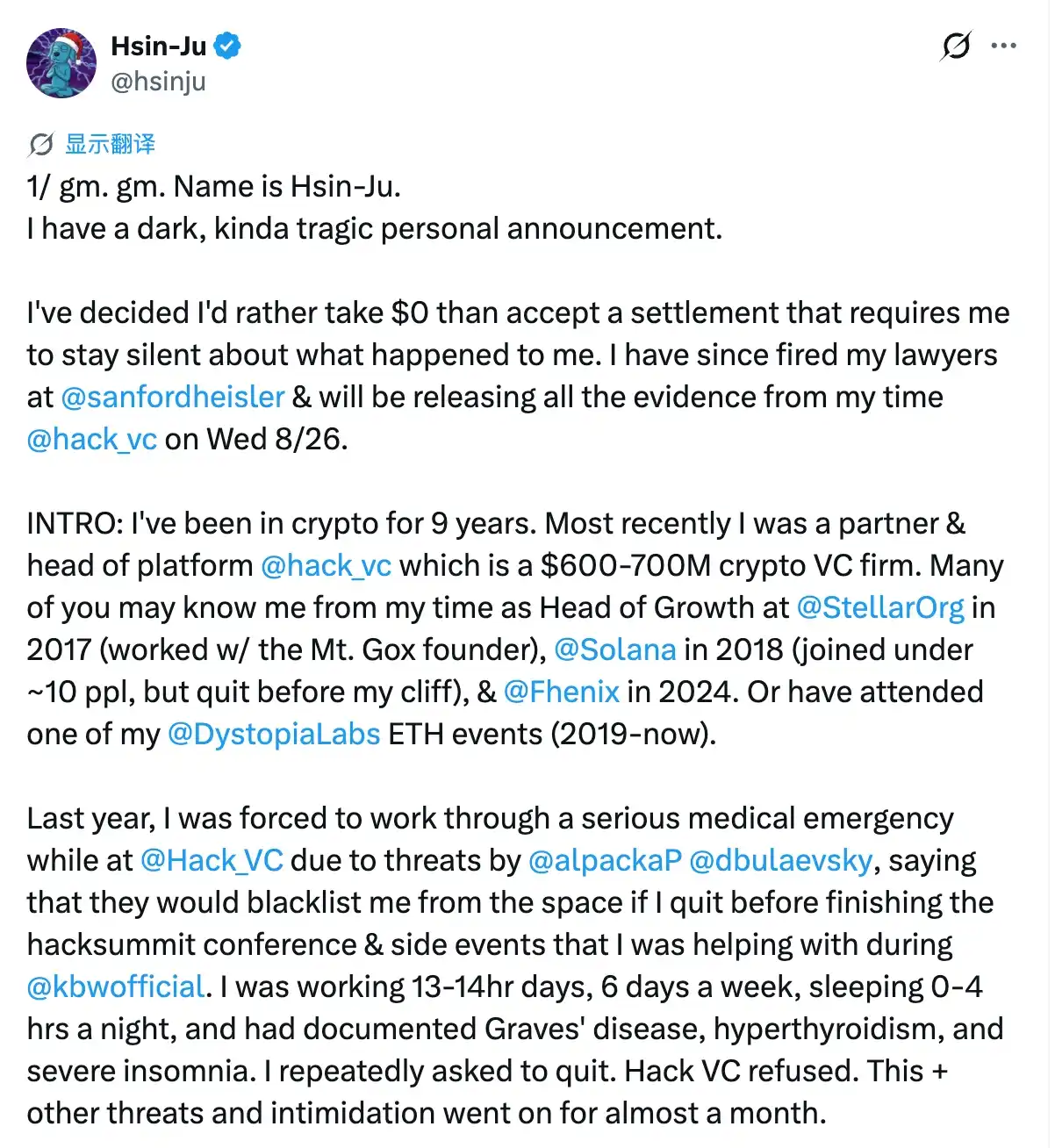
According to the numbers she provided, this equates to 78 to 84 hours of work per week.

She also announced she had fired her legal counsel, rejected any settlement agreements containing non-disclosure clauses, and previewed the full release of evidence on August 26th.

From Early Solana Employee to Hack VC Partner

Hsin-Ju is not an ordinary newcomer to the crypto industry.

She previously handled growth at Stellar, joined the then-small Solana team in 2018 as Head of Growth. A team introduction published by Solana that year also listed her position, proving she was indeed a very early member of Solana.

Thereafter, she founded Dystopia Labs, long organizing Ethereum developer events, and once managed growth operations for Fhenix. Starting in 2021, she participated part-time at Hack VC, becoming a full-time partner and Platform Lead in 2025.

In the lengthy post published on August 24th, she stated she had worked full-time at Hack VC for only 7 months, but had previously collaborated part-time for several years. Before resigning, her annual salary had just been raised from $250,000 to $300,000, and she received a $30,000 bonus, an additional carry promise, and an opportunity to join the GP entity.

She proactively disclosed these compensation details, seemingly to preempt an almost inevitable question: does a partner earning a $300,000 annual salary, plus fund profit-sharing, have the right to complain about work intensity?

Her answer is that this is not a "wage complaint" stemming from dissatisfaction with compensation, but a public accusation following damage to her health and personal boundaries.

What Allegations Has Hsin-Ju Made?

So far, her account can be summarized into five parts.

One: Demanded to Work High-Intensity Hours While Seriously Ill

Hsin-Ju stated that at the time, she had been diagnosed with Graves' disease, hyperthyroidism, and suffered from severe insomnia. She worked 13 to 14 hours a day, 6 days a week, sleeping only 0 to 4 hours per night.

Her responsibilities included the Hack Summit and related events during Korea Blockchain Week. According to her account, she repeatedly requested to withdraw from the project and even leave the company, but was unsuccessful.

Two: Threatened with "Industry Blacklisting" to Prevent Her Departure

She named and accused Hack VC co-founder Alex Pack and partner Daniel Bulaevsky, alleging they used industry connections to pressure her.

Hsin-Ju stated that Alex Pack told her he knew most managing partners of VC firms, had nearly a decade of industry relationships, and could have her blacklisted within the industry.

Both the VC and crypto industries heavily rely on reputation, referrals, and personal networks. A significant number of job opportunities are not created through public recruitment but through endorsements among funds, founders, and core community members. The so-called "blacklisting" doesn't necessarily require a formal list; just a few phone calls or negative comments could potentially cause someone to lose financing, employment, and collaboration opportunities.

Three: Deteriorating Work and Mental State, Ultimately Leading to Suicidal Behavior

Hsin-Ju claimed that nearly a month of sustained high pressure, threats, and sleep deprivation severely deteriorated her mental state, ultimately leading to suicidal behavior.

Even after this incident, she reportedly informed Hack VC in writing that she had no plans to sue the company. Her condition was that the company would not retaliate or defame her within the industry.

Four: COBRA Health Insurance Issues Persisted for Nearly 4 Months After Resignation

Hsin-Ju stated that one month after her resignation, problems arose with her COBRA continuation health coverage. Hack VC allegedly did not resolve the issue promptly but repeatedly instructed her to contact third-party customer service. The problem persisted for nearly 4 months until she hired a lawyer to intervene, after which it was handled.

COBRA is a U.S. continuation health coverage system, allowing eligible employees to temporarily continue participating in their former employer's group health insurance plan after leaving, typically bearing most or all of the premium themselves.

The U.S. Department of Labor's employer guidelines clearly state that even if a company hires a third-party administrator for group insurance, employers subject to ERISA and COBRA regulations still bear corresponding compliance responsibilities. However, whether Hack VC's specific insurance plan is applicable, and whether the problem originated with the company or the third-party administrator, still requires awaiting more documents.

For someone who had just experienced a severe health crisis, health insurance is not ordinary post-resignation paperwork but a lifeline for continuing treatment. This is also why Hsin-Ju views this as "retaliation."

Five: Refused Settlement Money in Exchange for Silence

According to Hsin-Ju's description, the parties' lawyers had been in contact for nearly a year and were preparing to enter private mediation and settlement stages. However, she ultimately decided to dismiss her own lawyer and reject any compensation conditioned on confidentiality.

She wrote that she would rather receive $0 than accept settlement money in exchange for silence, and plans to publicly release case evidence on August 26th.

Hack VC responded, stating they have noted the post and are concerned about Hsin-Ju's health, but there are significant disagreements about the sequence of events; for privacy reasons, they will not provide a detailed public response at this time.

Awaiting a Response

The crypto industry likes to talk about permissionlessness, censorship resistance, personal sovereignty, and freedom to exit. But in reality, crypto VCs and project teams still rely on an extremely small network of relationships:

  • A few funds control financing;
  • A few conferences control exposure;
  • A few partners control industry endorsements;
  • A few exchanges and KOLs control liquidity and narratives.

For ordinary practitioners, on-chain assets can be freely withdrawn, but professional relationships may not be so easily exited.

One can transfer tokens out of a wallet at any time, but may not dare to easily resign from a fund that controls industry resources.

The ultimate categorization of this matter awaits the evidence she promised to release, and also requires giving Hack VC the opportunity to provide a complete response.

Perhaps most interestingly, after the exposure and accusation, many people's first reaction in the comments was:

That's it? In China, this wouldn't even be considered excessive.

The truly frightening thing is not that someone publicly accuses themselves of working 80 hours a week, but that more people see this number and no longer feel it's worth complaining about.


Related Questions

QWhat are the main allegations made by Hsin-Ju Chuang against Hack VC?

AHsin-Ju Chuang's main allegations against Hack VC include: 1) Being forced to work 13-14 hour days, 6 days a week while suffering from a serious illness (Graves' disease, hyperthyroidism) and severe insomnia. 2) Being threatened with 'industry blacklisting' by co-founder Alex Pack to prevent her from leaving before a major conference. 3) Her mental state deteriorating to the point of a suicide attempt. 4) The company mishandling her COBRA health insurance continuation for nearly four months after her departure. 5) Refusing a settlement with a non-disclosure agreement.

QWhat is Hsin-Ju Chuang's professional background in the crypto industry?

AHsin-Ju Chuang is not a newcomer to crypto. She previously worked on growth at Stellar and was the Head of Growth for Solana in its early days in 2018. She later founded Dystopia Labs, organized Ethereum developer events, and handled growth for Fhenix. She began a part-time role with Hack VC in 2021 and became a full-time Partner and Head of Platform in 2025.

QAccording to the article, how did Hack VC respond to the public allegations?

AHack VC responded by stating they had seen the post and were concerned for Hsin-Ju's health. However, they claimed there are 'significant differences' in the accounts of what happened. Citing privacy reasons, they said they would not provide a detailed public response at that time.

QWhat is COBRA insurance and why was its mishandling a significant part of the complaint?

ACOBRA is a U.S. law that allows eligible employees to temporarily continue their employer-sponsored group health insurance after leaving a job, though they typically pay the full premium. Its mishandling was significant because Hsin-Ju Chuang had just experienced a severe health crisis. Reliable insurance was crucial for her continued treatment, making the nearly 4-month delay in resolving the issue not just an administrative problem but a critical threat to her well-being, which she viewed as retaliation.

QWhat broader industry issue does the article suggest this case highlights?

AThe article suggests this case highlights a contradiction in the crypto industry, which champions ideals like permissionless access and individual sovereignty. In reality, career mobility for professionals can be heavily restricted by a small, powerful network of VC funds, conferences, and influential partners who control funding, exposure, and reputation. The threat of 'blacklisting' shows that while digital assets can be exited freely, professional relationships often cannot, creating a potential power imbalance.

Related Reads

Phantom Discontinues Support for Sui as Network Struggles to Recover

On September 24, Phantom wallet will discontinue support for the Sui blockchain, giving users a few weeks to migrate their assets. This marks the end of a partnership that began with much fanfare in January 2025, when Sui became the fourth Layer 1 network supported by the then-15-million-user wallet. Phantom is also dropping support for Monad in August, indicating a broader streamlining of its multi-chain offerings rather than a move specific to Sui. The announcement coincides with a significant downturn for the Sui network. Its Total Value Locked (TVL) in DeFi has plummeted from approximately $2 billion in early 2026 to under $1 billion by July. The price of SUI has also fallen sharply from its all-time high of $5.36 in January 2025 to around $0.83 at the time of reporting. Phantom provided users with two main migration paths: converting SUI to a wrapped version on Solana directly within the wallet (with no proprietary Phantom fee until the cutoff date), or exporting their seed phrase to another Sui-compatible wallet like Sui Foundation's preferred wallet, Sui Wallet. The company emphasized that assets remain on the blockchain, not in the wallet, and warned users against potential migration scams. While both parties describe the split as mutual and leave open the possibility of future collaboration, the loss of a major wallet's support highlights the ongoing fragmentation in the blockchain industry. This poses a challenge for Sui's retail accessibility, even as the network maintains other infrastructure support, such as from Circle for its stablecoins. The future will reveal whether other wallets follow Phantom's lead or seek to attract the displaced Sui user base.

cryptonews.ru6m ago

Phantom Discontinues Support for Sui as Network Struggles to Recover

cryptonews.ru6m ago

Strategy Conducts $25 Million Buyback of Its Own Shares from Investors

MicroStrategy, the largest public company by Bitcoin holdings, conducted a $25 million buyback of its Series A Preferred Stock (STRC) from investors. This move coincided with the company reporting a significant increase in its dollar liquidity, which grew by $525 million to reach $3.75 billion, primarily from selling common stock (MSTR). Management stated this reserve is sufficient to cover preferred stock dividends for two years. The article explains that share buybacks are typically used by mature companies to support share prices, signal undervaluation, or return capital to shareholders. For MicroStrategy, this action follows its latest Bitcoin purchase in mid-June and precedes recent market speculation, fueled by CEO Michael Saylor's social media post, about a potential new Bitcoin acquisition. The company's strategy allows for selling Bitcoin to fund preferred share obligations and authorizes buybacks of up to $1 billion. While STRC shares saw a modest pre-market increase after the buyback news, they continue to trade below their $100 par value. The report details how buybacks can boost earnings per share (EPS) and affect capital structure, differentiating them from dividend payments. It also notes the regulatory and tax implications of such transactions. Despite the buyback, the company reaffirmed its long-term commitment to holding Bitcoin, which remains its core balance sheet asset with 843,775 BTC valued at approximately $55 billion.

cryptonews.ru11m ago

Strategy Conducts $25 Million Buyback of Its Own Shares from Investors

cryptonews.ru11m ago

Trading

Spot
活动图片