Strategy Conducts $25 Million Buyback of Its Own Shares from Investors

cryptonews.ruPublished on 2026-08-24Last updated on 2026-08-24

Abstract

MicroStrategy, the largest public company by Bitcoin holdings, conducted a $25 million buyback of its Series A Preferred Stock (STRC) from investors. This move coincided with the company reporting a significant increase in its dollar liquidity, which grew by $525 million to reach $3.75 billion, primarily from selling common stock (MSTR). Management stated this reserve is sufficient to cover preferred stock dividends for two years. The article explains that share buybacks are typically used by mature companies to support share prices, signal undervaluation, or return capital to shareholders. For MicroStrategy, this action follows its latest Bitcoin purchase in mid-June and precedes recent market speculation, fueled by CEO Michael Saylor's social media post, about a potential new Bitcoin acquisition. The company's strategy allows for selling Bitcoin to fund preferred share obligations and authorizes buybacks of up to $1 billion. While STRC shares saw a modest pre-market increase after the buyback news, they continue to trade below their $100 par value. The report details how buybacks can boost earnings per share (EPS) and affect capital structure, differentiating them from dividend payments. It also notes the regulatory and tax implications of such transactions. Despite the buyback, the company reaffirmed its long-term commitment to holding Bitcoin, which remains its core balance sheet asset with 843,775 BTC valued at approximately $55 billion.

Strategy, the largest public company by the volume of bitcoin on its balance sheet, has conducted a buyback of its own shares: the repurchase involved preferred securities, STRC, which were acquired from investors for a total of $25 million.

In a recent report for the U.S. Securities and Exchange Commission (SEC), the company also disclosed growth in its dollar liquidity. The cash reserve increased by $525 million, reaching $3.75 billion. The main source of replenishment was the additional issuance and sale of ordinary MSTR shares.

Strategy assured that the current dollar reserve is sufficient to pay dividends on STRC for the next two years. For shareholders, this is an important signal: the company shows that it maintains control not only over its cryptocurrency assets but also over its obligations related to securities.

Why Companies Conduct Buybacks

A share buyback, or buyback, is when a company purchases its already issued shares from investors. Companies use this tool when they want to support stock prices, redistribute excess liquidity, change their capital structure, or signal to the market that they believe their shares are undervalued.

For investors, buybacks are significant because they can alter the balance of power among shareholders. If the repurchased shares are subsequently cancelled, the stake of the remaining owners in the company increases. If the shares are kept on the balance sheet, they can be used later—for example, for corporate programs or reissuance.

Buybacks are most common among mature companies with stable cash flows: in the technology, finance, energy, telecommunications, and consumer sectors. For such businesses, this is one way to return capital to shareholders, alongside dividends.

What Happened to Strategy's Balance Sheet

The buyback of STRC took place approximately one month after the last disclosed bitcoin purchase. Between June 15 and 21, Strategy bought 520 $BTC for $34.9 million. Subsequent reports to the SEC on June 29, July 6, 13, and 20 showed no new purchases of the first cryptocurrency.

Strategy's balance sheet still holds 843,775 $BTC. Their market value is estimated at approximately $55 billion. This volume makes bitcoin the key asset on the company's balance sheet: in accounting terms, it is an asset that directly influences how investors and the securities market perceive the business.

Considering Strategy as a joint-stock company, its decisions affect several financial indicators at once: equity, net assets, share capital structure, and potential net profit in future reporting periods. However, accounting for such transactions can depend on the approaches applied in financial reporting, including International Financial Reporting Standards (IFRS).

How a Buyback Affects Key Metrics

After a buyback, the number of shares outstanding may decrease. In such cases, earnings per share (EPS) typically appears stronger, even if the company's total profit remains unchanged. For the market, this can be a reason to reassess the valuation of the shares, although a buyback program itself does not guarantee a price increase.

A buyback also affects market capitalization and capital structure. The company spends cash, and its equity may decrease by the cost of the repurchased shares. In financial statements, such transactions are reflected in the balance sheet and the statement of changes in equity, and the accounting entries depend on the applicable accounting standards.

For shareholders, the effect depends on the company's subsequent actions. Cancelling the repurchased shares increases the relative stake of the remaining owners. Keeping the shares on the balance sheet gives the company more flexibility, but it does not always translate to immediate benefits for investors.

A Signal from Michael Saylor

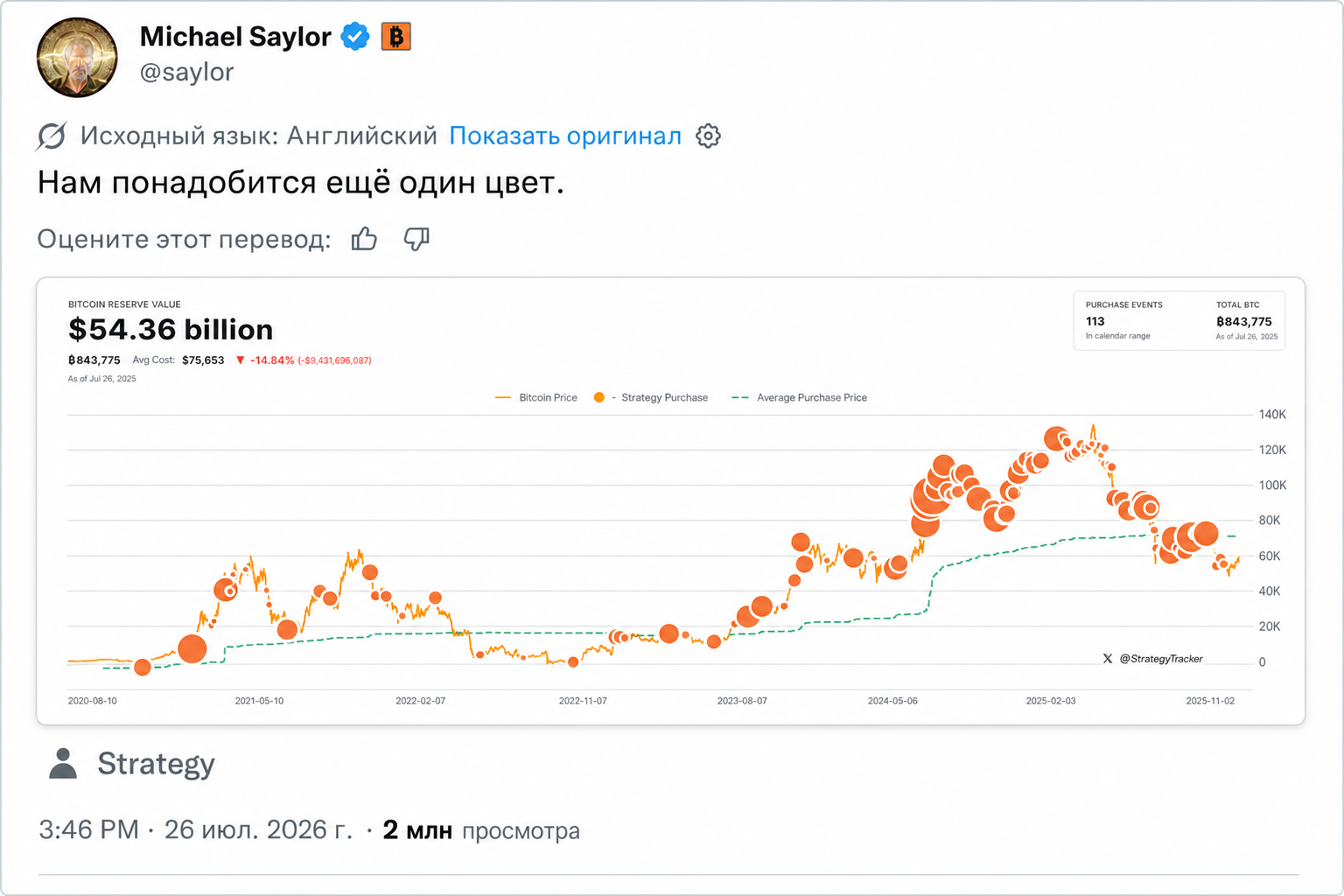
On Sunday, July 26, Strategy's head, Michael Saylor, published a chart from StrategyTracker on social media platform X, showing the history of bitcoin purchases. He wrote that the company might need "another color." The market interpreted this as a possible hint at a new purchase of $BTC.

Previously, Michael Saylor used different colors on charts to distinguish bitcoin transactions from replenishments of fiat reserves. Orange was used to mark cryptocurrency purchases, green to indicate growth in the dollar reserve. Recently, the chart has remained only green.
How STRC Shares Reacted

Following the news of the buyback, STRC quotes added about 1.7% in pre-market trading. However, the security is still trading significantly below its $100 par value—at around $88.35.

For STRC holders, such a deal is important not only because of the short-term price reaction. The buyback can support investor confidence, especially if the board of directors continues to balance between bitcoin purchases, payments on preferred shares, and liquidity management.

At the end of June, Strategy approved a new strategy. It allows the company to sell bitcoins for payments on preferred shares and conduct share buybacks of up to $1 billion. On July 5, Strategy sold 3,588 $BTC for $215 million. In mid-July, Strategy's CEO, Fong Le, stated that the company would continue to buy bitcoin and did not plan to abandon long-term ownership of the first cryptocurrency.

Procedure, Taxes, and Differences from Dividends

A buyback program usually begins with a decision by the board of directors or a shareholders' meeting, after which the company discloses the deal's parameters: volume, timing, price or price range. The buyback itself can be conducted through the open market, a tender offer to investors, or over-the-counter deals with individual shareholders.

In Russia, such operations are regulated by corporate law. Companies face restrictions on the volume of buybacks, rules for public companies, and requirements for information disclosure. The role of the board of directors and the shareholders' meeting is particularly important, as these bodies determine the conditions and permissibility of the transaction.

Tax consequences depend on the jurisdiction and the participant's status. For the company, a share buyback is usually related to capital movements, not ordinary operating revenue. For a shareholder, selling shares back to the company can lead to taxable income if the selling price is higher than the purchase price.

A buyback differs from dividends in that dividends provide a direct cash payment to owners, while a buyback works by changing the number of shares outstanding and the demand for the shares. Dividends are convenient for those seeking regular cash flow. Buybacks can benefit those who remain invested and expect an increase in their stake and share value, but their effect depends more on the buyback price and the company's subsequent decisions.

Sometimes buybacks are also used as a defense against hostile takeovers. When a company reduces the free float of shares on the market, it becomes more difficult for a potential buyer to accumulate a large stake. Simultaneously, the influence of the remaining shareholders may increase if the repurchased shares are cancelled or kept out of free circulation for a long time.

Related Questions

QWhat did the company Strategy do with its preferred shares STRC, and what was the amount?

AStrategy conducted a buyback (repurchase) of its own preferred shares STRC from investors for a total of $25 million.

QAccording to the article, what is the main purpose for a company to conduct a share buyback?

ACompanies conduct share buybacks (or "buybacks") to support share prices, redistribute excess liquidity, change their capital structure, or signal to the market that they believe their shares are undervalued.

QHow did the company Strategy significantly increase its dollar liquidity, as reported to the SEC?

AStrategy increased its dollar liquidity by $525 million, reaching $3.75 billion, primarily through the issuance and sale of additional common MSTR shares.

QWhat did Michael Saylor's post on social media platform X, mentioning "another color" on the StrategyTracker chart, imply to the market?

AThe market interpreted Michael Saylor's post about needing "another color" as a possible hint that the company might be preparing for a new purchase of Bitcoin ($BTC).

QWhat is one key difference between a share buyback and paying dividends for investors?

AA key difference is that dividends provide a direct cash payment to shareholders, while a buyback works by changing the number of shares outstanding and the demand for those shares. Buybacks can benefit remaining shareholders through increased ownership percentage and potential share price appreciation, depending on the buyback price and the company's subsequent actions.

Related Reads

Crypto Bull Is Back, Which Assets Bounced the Hardest?

The cryptocurrency market experienced a significant surge last week, with Bitcoin rallying over 26% to nearly $79,500, its strongest weekly gain since March 2023, fueling discussions of a renewed bull market. This rebound highlighted several key market dynamics. First, short-term directional shifts are increasingly tied to U.S. policy cycles. The rally was driven by two major catalysts: the U.S. Treasury's announcement to increase long-term bond buybacks, easing macro liquidity pressures, and former President Trump's push for clearer crypto legislation, boosting regulatory certainty and risk appetite. Second, Bitcoin spot ETFs solidified their role as a leading market indicator. In the week ending August 21, U.S. Bitcoin and Ethereum spot ETFs saw a combined net inflow of $2.6 billion, the highest since October 2025, signaling strong institutional re-entry. Third, the rally followed a clear capital rotation pattern: Bitcoin's breakout ignited broader gains, with Ethereum (up nearly 30%), major altcoins, and meme coins sequentially posting larger percentage increases. Analysis of the top performers among the top 50 altcoins by market cap revealed the week's biggest gainers: ENA (Ethena) led with a 100.75% surge, fueled by a Coinbase partnership. It was followed by PUMP (Pump.fun, up 88-99%), STX (Stacks, up 82-94%), TRUMP (Official Trump, up 79-91%), and ZEC (Zcash, up 75.15%), which uniquely reached a new all-time high. Meme coins like BOME on Solana also saw explosive gains, exemplifying the high-risk, high-reward sentiment. The rally illustrated a clear path: Bitcoin set the stage, major coins like Ethereum led the charge, and altcoins/meme coins delivered the most explosive returns, mapping the gradient of returning market enthusiasm.

marsbit6m ago

Crypto Bull Is Back, Which Assets Bounced the Hardest?

marsbit6m ago

Wuhan is About to Witness Its Largest IPO in History

Wuhan is poised for its largest-ever IPO as Yangtze Memory Technologies Co., Ltd. (YMTC) has officially applied for a listing on the Shanghai Stock Exchange's STAR Market, seeking to raise 33 billion yuan. The domestic leader in 3D NAND flash memory chips completed its IPO辅导 (tutoring) process in a record three months, with market expectations valuing the company at 300 billion yuan or higher. YMTC's roots trace back to 2006 with the founding of Wuhan Xinxin. After surviving the global financial crisis and periods of operational difficulty, the company was formally established in 2016 through a joint investment involving Tsinghua Unigroup, the National Integrated Circuit Industry Investment Fund (the "Big Fund"), and local Hubei government funds. With a distinct "national team" background, its major shareholders include provincial and municipal state-owned assets committees and the Big Fund. Based in Wuhan's Optics Valley (East Lake High-tech Development Zone), YMTC's potential listing highlights the region's rise as a tech hub. Optics Valley is already home to 72 listed companies and has ambitious plans to exceed 100 by 2030. The zone recently established four industry-focused母基金 (mother funds) totaling 18 billion yuan to further boost sectors like integrated circuits and optoelectronics. YMTC's IPO would complete the "Optics Valley Seven Stars," a group of leading local optoelectronic and communication giants.

marsbit6m ago

Wuhan is About to Witness Its Largest IPO in History

marsbit6m ago

Banks and Regulators Join Pilot Project to Test Quantum-Resistant Crypto Transfers

Banks and financial regulators from Europe, the Middle East, and Asia have joined a pilot project to test quantum-resistant crypto infrastructure for digital asset wallets and on-chain transactions. The initiative, announced by the Responsible Fintech Institute and infrastructure provider Safeheron, will use NEAR's quantum-resistant testnet. It will employ the ML-DSA-65 post-quantum digital signature standard, recently finalized by the U.S. National Institute of Standards and Technology (NIST). Participating regulators include the Abu Dhabi Global Market, Bhutan's Gelphu Financial Services Authority, and Malta's Financial Services Authority. Financial institutions involved are Bison Bank and DK Bank. In the pilot, banks will test wallet creation and transactions in a unified application environment, while regulators will initially observe and later contribute to governance mechanisms. The organizers plan to publish a technical paper detailing the research, protocol design, and test results, eventually open-sourcing the core technology. This effort comes as financial authorities prepare for the advent of quantum computers, which threaten current public-key cryptography. For instance, the Hong Kong Monetary Authority aims for the territory's banking sector to be fully prepared for quantum-related security risks by 2030. The Bank for International Settlements (BIS) also recommended in a 2025 document that financial institutions begin a coordinated, phased transition to post-quantum systems.

cryptonews.ru8m ago

Banks and Regulators Join Pilot Project to Test Quantum-Resistant Crypto Transfers

cryptonews.ru8m ago

Trading

Spot
活动图片