Fidelity 2026 Crypto Market Outlook: We May Be Entering a Supercycle, Bull Market to Last for Years

marsbitPublished on 2026-01-06Last updated on 2026-01-06

Abstract

Fidelity's 2026 crypto market outlook suggests the traditional four-year cycle may be ending as institutional adoption of digital assets accelerates. Key trends include growing national crypto reserves, exemplified by the US and Kyrgyzstan establishing strategic holdings, and increasing corporate adoption, with over 100 public companies now holding significant amounts. While short-term investors should remain cautious due to recent volatility, long-term holders may still benefit. The report speculates whether the market is entering a multi-year "super cycle" rather than facing an immediate bear market, though confirmation may come by mid-2026. Ultimately, Bitcoin's long-term proposition as a non-inflationary store of value remains compelling for patient investors.

Author: Fidelity Investments

Compiled by: Nicky, Foresight News

TL;DR:

Investors looking to enter the market for short-term gains should perhaps be cautious. However, those planning to hold for the long term may not have missed the opportunity yet. This year, more governments and corporations worldwide have incorporated digital assets into their balance sheets. Due to this new demand, some investors believe the traditional four-year cycle of cryptocurrency may have come to an end.

In March, President Trump signed an executive order establishing a strategic Bitcoin reserve for the U.S. government. The order formally designated all Bitcoin currently held by the government, along with several other cryptocurrencies, as reserve assets.

While the full impact of this executive order remains to be seen, 2025 made one thing clear: cryptocurrency is gaining mainstream acceptance. It is no longer viewed merely as a volatile form of speculation by "degens" (an abbreviation for "degenerate," a term cryptocurrency traders use to describe themselves due to the market's wild nature and the mindset required to survive it), but is now recognized by the U.S. government as a store of value.

What does this mean for the cryptocurrency market as we head into 2026? Does the significant price correction we are currently witnessing mean the bull market is over? Is it too late to invest in cryptocurrency now? Here are several key trends to watch.

Will More Countries Adopt Crypto Reserves?

Many countries around the world currently hold some amount of cryptocurrency, but few have formally established crypto reserves—designating their holdings as financial assets serving a strategic national interest.

This began to change in 2025 (most notably with President Trump's executive order in March) and is likely to continue progressing into 2026.

For example, in September, Kyrgyzstan passed a bill to establish its own cryptocurrency reserve. Elsewhere, more countries are beginning to explore this possibility. Brazil's Congress recently advanced a bill that would allow up to 5% of the country's international reserves to be held in Bitcoin (though it remains to be seen if the bill will become law).

"Fidelity Digital Assets believes that more countries may purchase Bitcoin in the future, driven by game theory," said Chris Kuiper, Vice President of Research at Fidelity Digital Assets. "If more countries hold Bitcoin as part of their foreign exchange reserves, other nations may feel competitive pressure, increasing the impetus for them to do the same."

What does this mean for prices? "From a simple supply and demand economics perspective, any additional demand for Bitcoin could push prices higher," Kuiper said. "Of course, the key is how large the incremental demand is and whether other investors are selling or holding."

Will Corporations Continue Buying Cryptocurrency?

Governments are not the only potential source of new demand in 2026. Corporations are likely to participate increasingly—some of which began adding Bitcoin and other cryptocurrencies to their balance sheets in 2025. To date, the most prominent example is software and analytics company Strategy (formerly MicroStrategy, stock ticker MSTR), which has been steadily purchasing Bitcoin since 2020. However, this year more companies adopted this practice, turning it into a trend. As of November, well over 100 publicly traded companies (both domestic and international) hold cryptocurrency. About 50 of these companies currently hold over 1 million Bitcoins.

"There is clearly an arbitrage opportunity where some companies can leverage their market position or financing channels to raise funds for purchasing Bitcoin," Kuiper said. "Part of this stems from investment mandates, as well as geographic and regulatory issues. For example, investors who cannot buy Bitcoin directly might choose to gain exposure through these companies or the securities they issue."

On the surface, corporate purchases of cryptocurrency add to market demand, which helps drive up asset prices. But investors should also be aware of the risks. "If these companies choose or are forced to sell some of their digital assets—for instance, during a bear market—this could certainly create downward pressure on the price of the Bitcoin or other digital assets they hold," Kuiper noted.
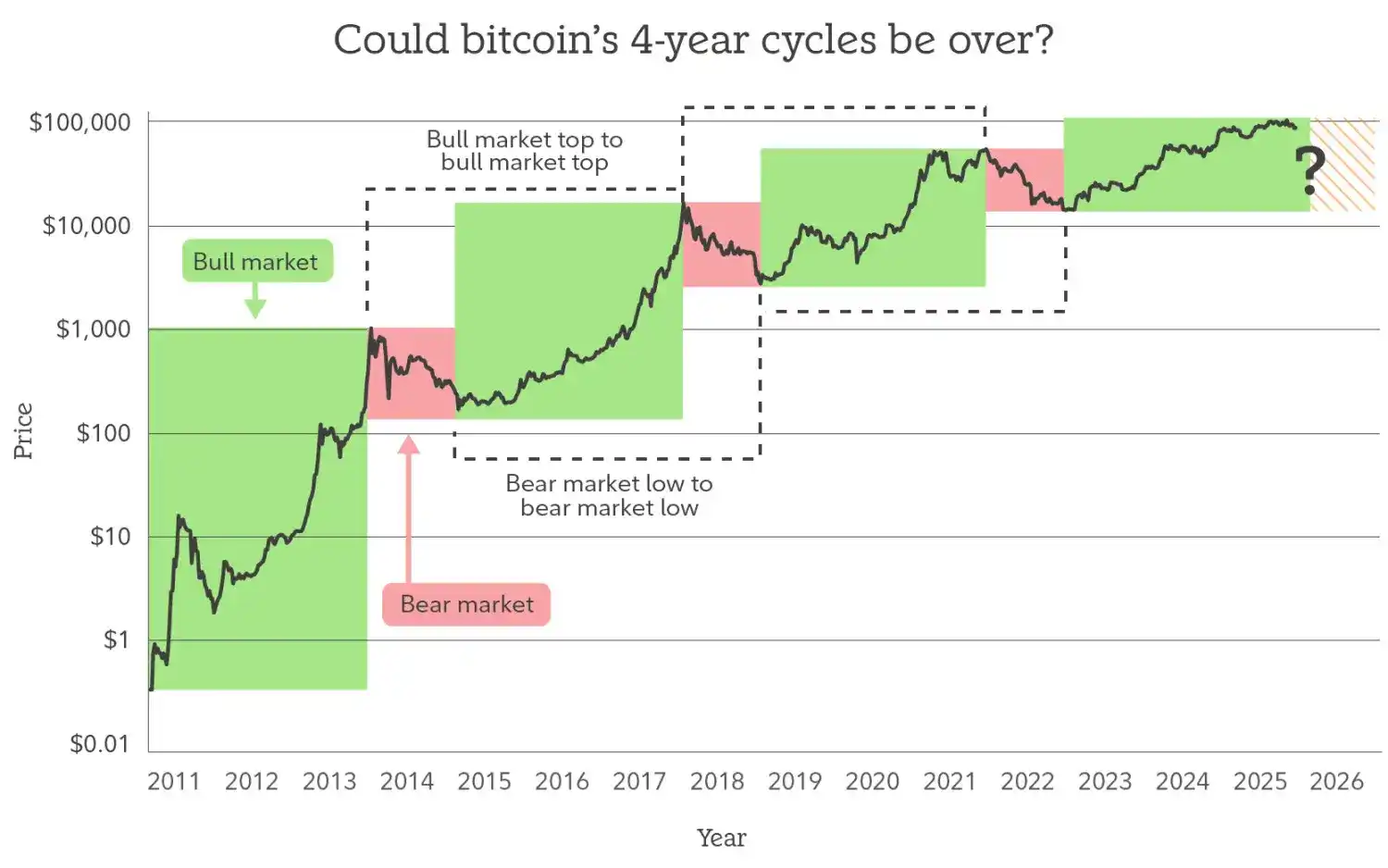
Source: Fidelity Investments. Past performance is not a reliable indicator of future results.

Will the Four-Year Cycle End?

Compared to traditional investments like stocks and bonds, Bitcoin's history is relatively short, but its price has roughly followed a four-year cycle (from bull market peak to peak, or bear market trough to trough). It reached bull market peaks in November 2013, December 2017, and November 2021, and formed bear market bottoms in January 2015, December 2018, and November 2022. These cycles were accompanied by significant price volatility: the first cycle dropped from $1,150 to $152, the second from $19,800 to $3,200, and the third from $69,000 to $15,500.

Bitcoin's movements often lead the entire cryptocurrency market to follow—in many cases, with even more volatility.

Currently, we are around the four-year mark of the current cycle, as the last bull market peaked in November 2021. And over the past month, cryptocurrency prices have continued to fall. So, has this bull market already peaked?

If the four-year cycle repeats, we might be at or near the end of Bitcoin's current bull run. However, some cryptocurrency investors believe this historical trend is about to end, and the current price pullback is merely a temporary retreat before the market resumes its upward trend.

What does this mean specifically? Some investors believe that while price pullbacks will still occur, the volatility of any decline will be much lower than in the past, and the magnitude may be so small that it doesn't feel like a full bear market. Others think we may be entering a supercycle where the bull market lasts for years. For reference, the supercycle in commodities during the 2000s lasted nearly a decade.

Kuiper doesn't believe these cycles will disappear entirely, as the fear and greed that drive them haven't magically vanished. But he points out that if the four-year cycle were to repeat, we should have already set the cycle's all-time high and entered a full bear market. Although the pullback since November has been quite severe so far, he says we might not know for sure until 2026 whether a four-year cycle has truly formed. The current price drop could be the start of a new bear market, or it could just be a correction within a bull market that will go on to set new all-time highs in the future—as we've already seen several times in this cycle.

Whether these predictions will come true remains to be seen, and we might not know until mid-2026.

Is It Too Late to Buy Bitcoin Now?

Despite the many unknowns still present in the cryptocurrency market, one thing has become clearer: the crypto market is entering a new paradigm. "We are seeing a fundamental shift in the structure and categories of investors, and I believe this will continue into 2026," Kuiper said. "Traditional fund managers and investors have started buying Bitcoin and other digital assets, but in terms of the amount of capital they could bring into this space, I think we've only scratched the surface."

In light of this, investors who haven't yet entered the market might ask: Is it still a good time to buy Bitcoin?

For Kuiper, it depends on your investment horizon. If you are looking for gains in the short or medium term (four to five years or less), you might be late, especially if this cycle ultimately follows historical patterns.

"However, from a very long-term perspective, I personally believe that if you view Bitcoin as a store of value, you are never fundamentally 'too late'," Kuiper said. "As long as its hard supply cap remains, I believe every purchase of Bitcoin is putting your labor or savings into something that won't be devalued by government monetary policy and inflation."


Related Questions

QAccording to Fidelity's 2026 crypto market outlook, what new source of demand could potentially end the traditional four-year cycle?

AThe new sources of demand from more national governments and corporations adding digital assets to their balance sheets could potentially end the traditional four-year cycle.

QWhat significant action did the US government take regarding Bitcoin in March 2025, as mentioned in the article?

AIn March 2025, President Trump signed an executive order to establish a strategic Bitcoin reserve for the US government, formally designating all currently held Bitcoin and other cryptocurrencies as reserve assets.

QWhat is the 'super cycle' that some investors believe the crypto market might be entering?

AA 'super cycle' refers to a bull market that could last for many years, with the article citing the nearly decade-long super cycle in commodities during the 2000s as a reference.

QAccording to Fidelity Digital Assets Research VP Chris Kuiper, is it ever fundamentally 'too late' to buy Bitcoin for long-term investors?

ANo, Chris Kuiper states that from a very long-term perspective, if you view Bitcoin as a store of value, you are never fundamentally 'too late' to buy, as long as its hard supply cap remains.

QWhat risk does Chris Kuiper highlight regarding corporations holding cryptocurrencies on their balance sheets?

AHe highlights the risk that if these companies choose or are forced to sell their digital assets, such as during a bear market, it could create downward pressure on the price of those assets.

Related Reads

ETFs Are Just the Ticket: The True Institutionalization of Bitcoin Is Happening Where You Can't See It

Beyond the Bitcoin ETF spotlight, a deeper institutionalization is underway, leveraging Bitcoin as a foundational financial primitive. Institutions are using Bitcoin for purposes long reserved for assets like U.S. Treasuries and gold: as collateral for loans, insurance reserves, and the backbone of rated bonds. Examples include a Barbados-based insurer capitalizing with $40M in Bitcoin reserves and Ledn's $188M securitization of Bitcoin-backed loans, which received the first-ever investment-grade rating (BBB-) from S&P for a digital asset-backed security. This structure was stress-tested during a 27% price drop in early 2026, triggering automatic liquidations that functioned as designed but revealed the systemic risk of synchronized selling across leveraged positions. Infrastructure is evolving to support this, with platforms like Anchorage Digital's Atlas network enabling secure, institutional-grade settlement and collateral management. Strategies like basis trades and corporate treasuries (exemplified by companies like MicroStrategy issuing billions in equity and debt to fund Bitcoin acquisitions) further integrate Bitcoin into financial mechanics. While ETFs solved "how to own" Bitcoin, these developments answer "what to do with it," embedding the asset into the working machinery of finance—as collateral upon which loans, derivatives, and structured products are built. The real, enduring institutional shift is happening in these largely invisible plumbing and financing systems.

marsbit6m ago

ETFs Are Just the Ticket: The True Institutionalization of Bitcoin Is Happening Where You Can't See It

marsbit6m ago

ZEC Co-Founder Responds to Orchard Vulnerability: No Signs of Theft, Orchard Pool to Be Sealed

ZEC Co-Founder Addresses Orchard Vulnerability: No Signs of Theft, Plans to Sunset Orchard Pool A security vulnerability was recently discovered in Zcash's Orchard shielded pool, raising key concerns. The primary questions are whether the flaw was exploited, if user funds are safe, whether users can verify the total ZEC supply, and if other similar vulnerabilities exist. Analysis suggests the vulnerability was likely not exploited prior to its discovery. It was found proactively by a researcher using specialized tools, not due to an active breach. The development team and mining pools acted quickly to contain the issue. Typical financially-motivated attacks would likely have left visible on-chain evidence, which has not been observed. User funds in Orchard are considered safe and should be recoverable, assuming no prior exploitation. If the flaw was never used, all legitimate funds can be withdrawn. The article outlines risks associated with moving funds to transparent addresses or other pools, but concludes that leaving assets in place is a reasonable option. Currently, users cannot independently verify that the total ZEC supply hasn't been inflated due to this bug. However, the planned Ironwood network upgrade is designed to resolve this. It will permanently close the Orchard pool to new deposits and internal transfers, allowing only withdrawals. This mechanism will cap total withdrawals at the amount of legitimately deposited funds, enabling anyone to cryptographically verify the supply post-upgrade. Multiple teams, including Shielded Labs, have conducted extensive audits focused on counterfeiting vulnerabilities, assisted by advanced AI tools. No additional flaws of this type have been found so far, increasing confidence that no other similar undisclosed vulnerabilities exist. In summary, evidence indicates the Orchard bug was probably not used, user funds are secure, and no other counterfeiting flaws are currently known. The upcoming Ironwood upgrade will restore users' ability to independently verify the total ZEC supply, closing this chapter.

Foresight News11m ago

ZEC Co-Founder Responds to Orchard Vulnerability: No Signs of Theft, Orchard Pool to Be Sealed

Foresight News11m ago

Microsoft Announces Commercial-Grade Quantum Computer to be Completed in Three Years: Will the Boots Land?

Microsoft announces plans to build a commercially viable quantum computer by 2029, a significant acceleration from the previous industry consensus of a decade. The breakthrough is fueled by their new Majorana 2 quantum chip, which boasts a record-breaking average qubit lifetime of 20 seconds—a 1,000-fold reliability improvement over its predecessor. This leap was achieved by leveraging topological qubits, a theoretically more stable technology using Majorana zero modes, and switching the core superconducting material from aluminum to lead. Crucially, Microsoft's "Discovery" agentic AI platform accelerated the R&D process. AI agents autonomously analyzed vast experimental data, optimized manufacturing parameters (like the lead alloy composition), and solved issues like "ghost noise," dramatically speeding up experimentation. While the 20-second coherence time is a landmark, challenges remain: scaling from 12 qubits to the millions needed for practical applications, managing compilation costs, and verifying quantum results. Skeptics call for peer-reviewed data, and questions persist about whether even 20 seconds is sufficient for complex algorithms like breaking RSA encryption. The race is on with other approaches (superconducting, trapped ions), but Microsoft's confidence in its topological roadmap signals a potential shortcut to a scalable quantum future.

marsbit29m ago

Microsoft Announces Commercial-Grade Quantum Computer to be Completed in Three Years: Will the Boots Land?

marsbit29m ago

Trading

Spot
Futures
活动图片




