Fed Governor Calls For Strong Stablecoin Oversight As CLARITY Act’s Final Text Gets Delayed

bitcoinistPublished on 2026-04-02Last updated on 2026-04-02

Abstract

In a speech, Federal Reserve Governor Michael Barr called for strong regulatory oversight of stablecoins, citing potential risks to financial stability. He acknowledged that the proposed GENIUS Act provides needed clarity but emphasized that implementation by regulators is crucial. Barr highlighted stablecoins' use cases in crypto trading, remittances, and treasury management but warned of risks like insufficient reserve safeguards and illicit finance. He urged measures including tight control of reserves, capital requirements, and anti-money laundering controls. This comes as the final text of the related CLARITY Act, a major crypto market structure bill, faces a delay. A compromise text is no longer expected this week, with a markup anticipated later in the month. The delay is attributed to concerns that early release could give opponents time to stall the bill. A key point of contention has been a proposed prohibition on offering yield on stablecoin balances, a measure aimed at addressing banking industry worries but facing strong opposition from crypto firms like Coinbase.

US Federal Reserve (Fed) Governor has warned about the potential risks that stablecoin may pose to financial stability and urged for strong oversight, as the industry awaits the final text of the highly anticipated crypto market structure bill.

Fed Governor Calls For Stablecoin Clarity

On Tuesday, Fed Governor Michael Barr discussed the importance of stablecoin regulations, noting that landmark legislation, the Guiding and Establishing Innovation for US Stablecoins (GENIUS) Act, provides “some needed clarity” to issuers about how they can fit into the regulatory framework.

During a Federalist Society event, Barr listed main use cases for tokens pegged to the US dollar, including facilitating crypto trading and as a store of value in some foreign jurisdictions. He also highlighted that they can be used to offer reduced remittance costs, expedite trade finance processing, and assist firms in managing their treasury functions.

However, the Fed Governor emphasized that “a great deal” of the clarity will “depend on how federal and state regulators implement the statute.” Therefore, regulators still need to address multiple risks, he warned, explaining that caution is warranted due to “a long and painful history of private money created with insufficient safeguards.”

Key issues include regulation of reserve assets, the potential for regulatory arbitrage, the scope of permissible activities for stablecoin issuers beyond issuance, appropriate capital and liquidity requirements, anti-money-laundering controls, and consumer protection requirements.

The federal regulator called for regulatory and technological measures to ensure that stablecoins are not used for illicit activity, affirming that “tight control over reserve assets, coupled with supervision, capital and liquidity requirements, and other measures, could enhance the stability of stablecoins and make them more viable payment instruments.”

His remarks come as the US Treasury Department seeks public feedback on the GENIUS Act Notice of Proposed Rulemaking (NPRM) concerning state-level regulatory regimes, issued on April 1.

Final Text On Yield Compromise Delayed

Barr’s warning also follows the clash between the crypto and banking industries over stablecoin-related language that is set to be included in the crypto market structure bill, also known as the CLARITY Act, which was expected to be released as soon as this week but might be delayed until later in the month.

In a shift from last week’s guidance, the bill’s final text of the compromise between industry stakeholders and the Senate Banking Committee is no longer expected to be published this week, a spokesperson for Senator Thom Tillis’s office told Crypto In America on Wednesday.

A source familiar with the matter stated that the delay reflects concerns that releasing the text ahead of a markup, now expected in the back half of the month, could give opponents an opening to slow the bill’s progress.

Notably, the two parties have been fighting over the potential prohibition of yield and rewards on stablecoin balances, stalling the crypto bill for over two months. Last week, the crypto industry got its first look at the latest version of the CLARITY Act, set to address the long-standing dispute.

As reported by Bitconinist, the proposal seemingly prohibited platforms from offering yield, directly or indirectly, for holding a stablecoin, or in a manner that resembles a bank deposit. This restriction would broadly apply to digital asset service providers, including exchanges and brokers, as well as their affiliates.

The text aimed to limit workarounds and prohibit any activity “economically or functionally equivalent” to interest, addressing concerns from the banking industry side, but facing renewed backlash from crypto players like Coinbase.

According to the Wednesday report, the update follows ongoing talks between crypto and banking groups due to dissatisfaction with the earlier draft agreed upon by Tillis, Senator Angela Alsobrooks, and the White House.
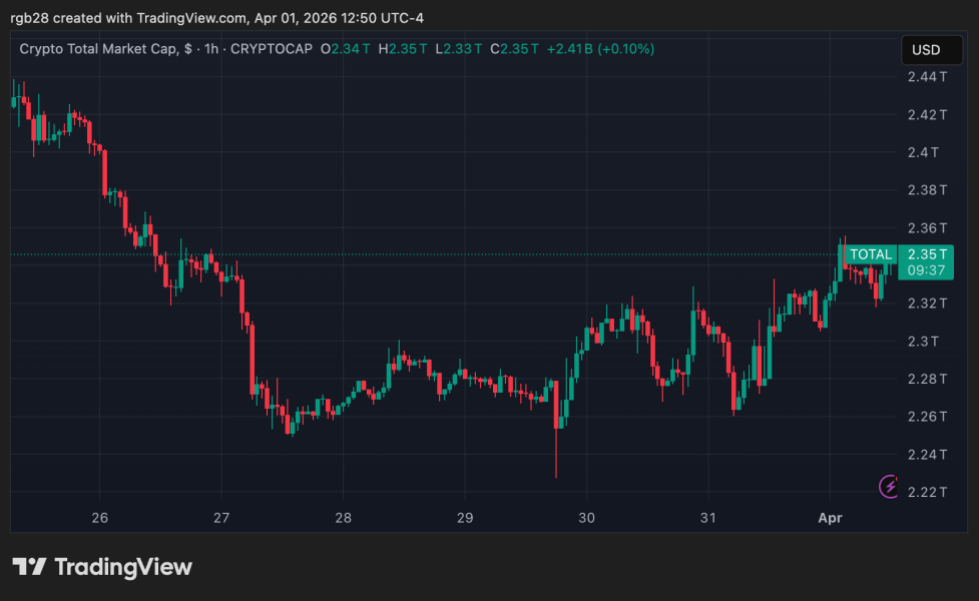
The total crypto market capitalization is at $2.35 trillion in the one-week chart. Source: TOTAL on TradingView


Related Questions

QWhat are the main risks associated with stablecoins that Fed Governor Michael Barr highlighted?

AFed Governor Michael Barr highlighted risks including the need for regulation of reserve assets, the potential for regulatory arbitrage, the scope of permissible activities for stablecoin issuers, appropriate capital and liquidity requirements, anti-money-laundering controls, and consumer protection requirements.

QWhat is the name of the landmark stablecoin legislation discussed in the article?

AThe landmark stablecoin legislation discussed is called the Guiding and Establishing Innovation for US Stablecoins (GENIUS) Act.

QWhy has the final text of the CLARITY Act been delayed according to the article?

AThe final text of the CLARITY Act has been delayed because releasing it ahead of a markup, now expected later in the month, could give opponents an opening to slow the bill's progress.

QWhat specific provision in the CLARITY Act proposal is causing a clash between the crypto and banking industries?

AThe clash is over the potential prohibition of yield and rewards on stablecoin balances, which would restrict platforms from offering anything economically or functionally equivalent to interest.

QWhat event did Fed Governor Michael Barr speak at when he called for stablecoin clarity?

AHe spoke at a Federalist Society event.

Related Reads

Anthropic's IPO Launch: Commercial Miracle or Valuation Bubble?

Anthropic has confidentially filed for an IPO, led by Morgan Stanley and Goldman Sachs, potentially going public by October. Following its latest $650 billion funding round, its pre-IPO valuation stands at $965 billion, with projections reaching up to $2 trillion at listing, which would make it the highest-valued private company ever. The article, written by Fu Sheng, addresses skepticism that this represents an AI bubble akin to the 2000 dot-com crash. It argues the current situation differs fundamentally. Unlike the internet bubble era, which relied on speculative narratives with little revenue, Anthropic's valuation is backed by unprecedented, measurable financial performance. Key data points include: * **Revenue Growth:** ARR skyrocketed from $10 billion in early 2025 to $470 billion by May 2026, targeting $100 billion by year-end—a growth curve unmatched in business history. * **Profitability:** It achieved operating profitability in Q2 2026 with an estimated $5.6 billion profit. * **Efficiency:** With ~3,000 employees and ~$470 billion ARR, its revenue per employee exceeds $10 million. Products like Claude Code, launched less than a year ago, already generate $25 billion in annualized revenue. * **Enterprise Adoption:** It boasts a strong enterprise client base, with 8 of the Fortune 10 and over 1,000 large firms spending over $1 million annually on Claude. The valuation is framed using a traditional SaaS model (e.g., a 10x Price-to-Sales multiple on $100 billion revenue). The author contends the core question for analysts has shifted from "How big could this be?" to "How much is it earning and will earn next quarter?" The discussion extends beyond Anthropic to a broader paradigm shift: the transition from a "carbon-based" to a "silicon-based" economy. Companies are increasingly prioritizing investment in compute and AI capabilities over human resources, as these directly scale productivity and competitive advantage. Anthropic's IPO is thus positioned not just as a corporate milestone, but as a price anchor for this new economic era.

链捕手3h ago

Anthropic's IPO Launch: Commercial Miracle or Valuation Bubble?

链捕手3h ago

Near Returns to the AI Stage: Transformation into a Public Chain Due to 'Payroll Difficulties,' Agent and Privacy Emerge as New Growth Narratives

NEAR Returns to AI Origins: From Payroll Struggles to Blockchain, Now Focusing on AI Agents and Privacy NEAR Protocol's journey began not with grand blockchain ambitions, but from a practical hurdle: its AI startup founders, including Transformer paper co-author Illia Polosukhin, couldn't efficiently pay international developers in 2017. This led them to pivot and build a high-performance, scalable blockchain. After years navigating various crypto narratives like sharding and cross-chain interoperability, NEAR is now leveraging its AI roots to re-enter the AI arena. A key driver is its "NEAR Intents" layer, which abstracts complex cross-chain transactions. Users simply state their goal (e.g., swap BTC for ETH), and a solver network finds the optimal route. This system has processed over $20B in cross-chain volume, generating significant fee revenue. A major growth area is private transactions via "Confidential Intents/Swaps," which hide trade details until settlement to protect against MEV and front-running. Remarkably, private swaps recently accounted for over 40% of NEAR's transaction volume, highlighting strong demand but also potential regulatory scrutiny. With its AI-founder pedigree, NEAR is positioning itself at the intersection of blockchain, AI agents, and privacy, aiming to become infrastructure for the emerging agent economy while navigating the challenges of its rapid adoption.

marsbit5h ago

Near Returns to the AI Stage: Transformation into a Public Chain Due to 'Payroll Difficulties,' Agent and Privacy Emerge as New Growth Narratives

marsbit5h ago

Trading

Spot
Futures
活动图片




