Farewell to the 'Correspondent Bank' Era? Five Crypto Institutions Get the Key to Direct Access to the Fed's Payment System

Odaily星球日报Published on 2025-12-18Last updated on 2025-12-18

Abstract

The U.S. Office of the Comptroller of the Currency (OCC) has conditionally approved five digital asset firms—Ripple, Circle, Paxos, BitGo, and Fidelity Digital Assets—to become federally chartered national trust banks. This marks a significant shift, integrating crypto businesses directly into the federal banking regulatory framework and reducing their historical reliance on intermediary banks. These institutions, now operating under federal oversight, gain regulatory uniformity and nationwide operational rights but are prohibited from taking FDIC-insured deposits or issuing loans. A key advantage is eligibility to apply for direct access to the Federal Reserve’s payment systems (like Fedwire), which could lower transaction costs by 30–50%, enhance settlement efficiency, and mitigate "debanking" risks. This move, enabled by the 2025 GENIUS Act under the Trump administration, reflects a strategic pivot toward recognizing stablecoins as extensions of the dollar system and reinforces requirements for 100% reserve backing and asset segregation. However, traditional banking groups (like BPI) oppose the decision, citing regulatory arbitrage and systemic risks. Final access to Fed accounts remains subject to approval, representing the next phase of industry-regulator negotiation.

Original | Odaily Planet Daily (@OdailyChina)

Author | Ethan (@ethanzhang_web3)

December 12, 2025, Washington D.C. - The Office of the Comptroller of the Currency (OCC) announced that it has conditionally approved five digital asset institutions - Ripple, Circle, Paxos, BitGo, and Fidelity Digital Assets - to convert into federally chartered national trust banks.

This decision was not accompanied by dramatic market fluctuations but is widely regarded as a watershed moment by regulators and financial circles. Crypto businesses, long operating on the fringes of the traditional financial system and frequently facing banking service disruptions, have for the first time been formally incorporated into the US federal banking regulatory framework with a "bank" identity.

The change did not come suddenly, but it is thorough. Ripple plans to establish "Ripple National Trust Bank," and Circle will operate "First National Digital Currency Bank." These names themselves clearly convey the signal released by regulators: digital asset-related businesses are no longer just "high-risk exceptions" passively undergoing scrutiny but are allowed to enter the core layer of the federal financial system under clear rules.

This shift stands in stark contrast to the regulatory environment of a few years ago. Especially during the banking turmoil of 2023, the crypto industry was once deeply mired in the so-called "de-banking" dilemma, systematically cut off from the US dollar settlement system. With President Trump signing the GENIUS Act in July 2025, stablecoins and related institutions obtained a clear legal definition at the federal level for the first time, also providing the institutional premise for the OCC's concentrated licensing.

This article will analyze the institutional logic and practical impact behind this approval from four perspectives: "What is a Federal Trust Bank," "Why is this license so important," "The Regulatory Shift in the Trump Era," and "Traditional Finance's Response and Challenges." The core judgment is: The crypto industry is transitioning from being an "external user" dependent on the banking system to becoming part of the financial infrastructure. This not only changes the cost structure of payments and clearing but is also reshaping the definition of a "bank" in the digital economy.

What is a "Federal Trust Bank"?

To understand the true weight of this OCC approval, one must first clarify a easily misunderstood point: This is not these five crypto firms obtaining a traditional "commercial bank charter."

The OCC approved "National Trust Bank" status. This is a type of bank charter that has long existed in the US banking system but was primarily used for businesses like estate management and institutional custody. Its core value lies not in "how much business it can do" but in its regulatory level and infrastructure status.

What does Federal Chartering mean?

Under the US dual banking system, financial institutions can choose to be regulated by state governments or the federal government. The two are not simply parallel in terms of compliance intensity but have a clear hierarchy of authority. A federal charter bank license issued by the OCC means the institution is directly regulated by the Treasury system and enjoys "federal preemption," no longer needing to adapt to the regulatory rules of each individual state for compliance and operations.

The legal basis for this can be traced back to the National Bank Act of 1864. Over the following century and a half, this system has been a key institutional tool for forming a unified financial market in the US. This is particularly critical for crypto companies.

Prior to this approval, whether it was Circle, Ripple, or Paxos, to operate compliantly nationwide in the US, they had to apply for Money Transmitter Licenses (MTLs) in all 50 states, facing a "patchwork" system with different regulatory stances, compliance requirements, and enforcement standards. This was not only costly but also severely limited business expansion efficiency.

After converting to a federal trust bank, the regulatory body shifts from various state financial regulators to the unified oversight of the OCC. For the companies, this means a unified compliance path, a nationwide business passport, and a structural elevation of regulatory credibility.

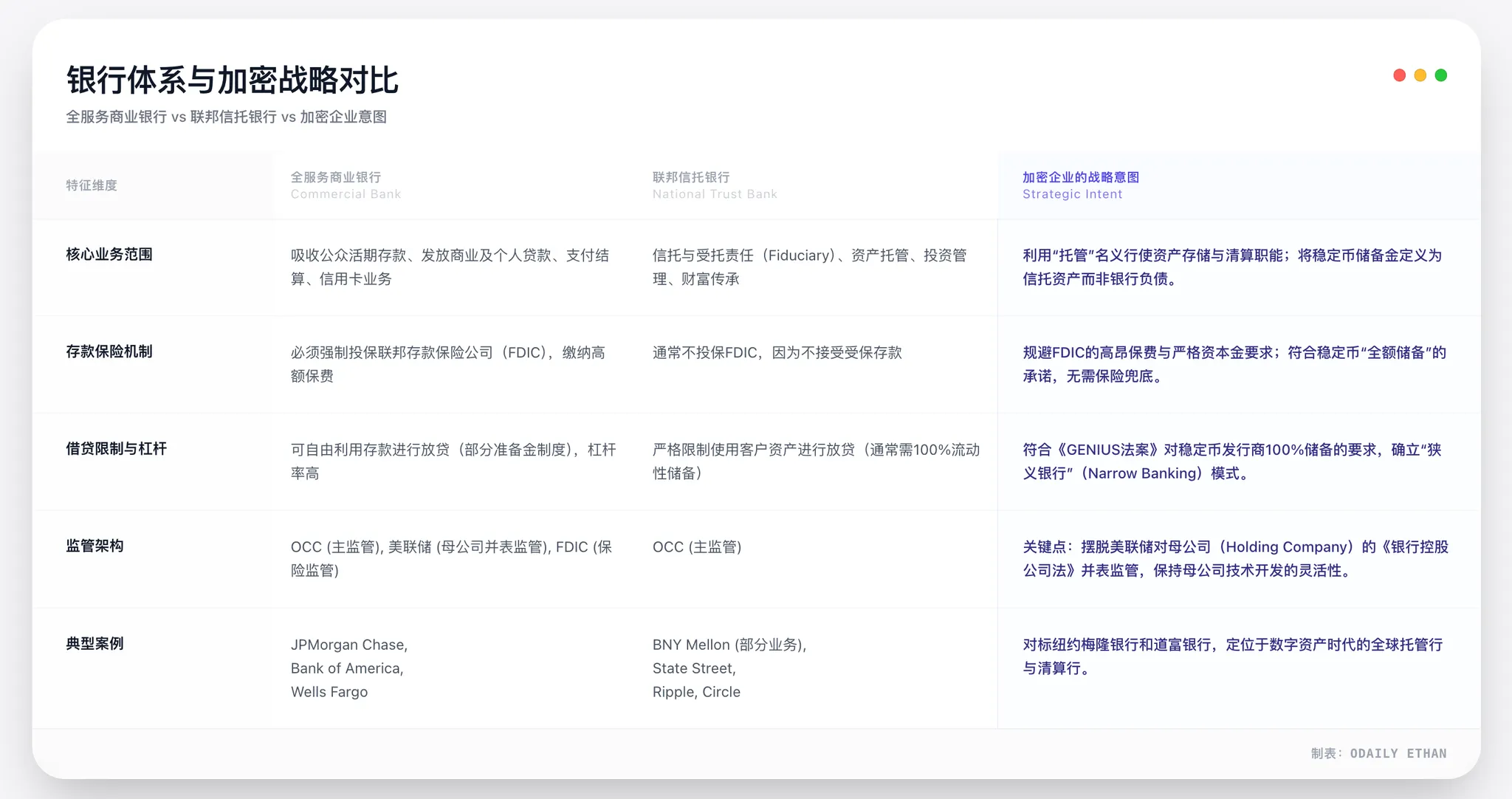
Trust Bank, not a "Mini Commercial Bank"

It is crucial to emphasize that a federal trust bank is not equivalent to a "full-service commercial bank." The five approved institutions are not permitted to accept FDIC-insured public deposits, nor can they make commercial loans. This is also a core reason for criticism from traditional banking organizations (like the Bank Policy Institute), which argue this is an admission with "unequal rights and obligations."

However, from the perspective of the crypto firms' own business structures, this restriction is highly compatible. Taking stablecoin issuers as an example, whether it's USDC or Ripple's RLUSD, their business logic is inherently built on 100% reserve asset backing. Stablecoins do not engage in credit expansion nor rely on a fractional reserve lending model, thus they do not carry the systemic risk associated with the "maturity mismatch" of traditional banks. Under this premise, introducing FDIC deposit insurance is unnecessary and would significantly increase the compliance burden.

More importantly, the core of a trust bank charter lies in fiduciary duty. This means licensed institutions are legally required to strictly segregate client assets from their own funds and prioritize client interests. This has strong practical significance for the entire crypto industry post the FTX client asset misappropriation scandal. Asset segregation is no longer a company promise but a mandatory obligation under federal law.
From "Custodian" to "Payment Node"

Another profound implication of this change is a key shift in the regulatory interpretation of the "trust bank" business scope. OCC head Jonathan Gould explicitly stated that the new federal bank access "provides consumers with new products, services, and sources of credit, and ensures the banking system is vibrant, competitive, and diverse." This laid the policy foundation for accepting crypto institutions.

Under this framework, the strategic value of Paxos and BitGo's "conversion" from state trust to federal trust bank status far exceeds a mere change in title. The core lies in the fact that the OCC system grants federal trust banks a key right: the eligibility to apply for access to the Federal Reserve's payment systems. Therefore, their real target is not the "bank" title, but competing for direct access to the central bank's core settlement system.

Taking Paxos as an example, although it had already become a compliance benchmark under the strict supervision of the New York State Department of Financial Services (NYDFS), state charters have inherent limitations: they cannot directly connect to the federal payment network. The OCC's approval document clearly states that the converted new entities can continue to engage in businesses like stablecoins, asset tokenization, and digital asset custody. This is equivalent to officially acknowledging at the institutional level: stablecoin and asset tokenization issuance have become legitimate "banking activities." This is not a breakthrough for individual companies but a substantive expansion of the "banking" function.

Once fully implemented, these institutions are expected to directly connect to central bank payment systems like Fedwire or CHIPS, no longer necessarily relying on traditional commercial banks as intermediaries. The leap from "custodied asset manager" to "direct node in the payment network" is the most structurally significant breakthrough in this regulatory shift.

Why This License is Priceless

The true value of the federal trust bank license lies not in the "bank" identity itself, but in the fact that it potentially opens a door to direct access to the Federal Reserve's clearing system.

This is also why Ripple CEO Brad Garlinghouse called this approval a "huge step forward," while traditional banking lobby groups (BPI) appeared very uneasy. For the former, it means efficiency and certainty; for the latter, it means the long-monopolized financial infrastructure is being redistributed.

What does Direct Fed Connection mean?

Prior to this, crypto companies were always in the "peripheral layer" of the dollar system. Whether Circle issuing USDC or Ripple providing cross-border payments, any final settlement involving US dollars had to be completed through commercial banks as intermediaries. This model is known in financial terms as the "correspondent banking system." Superficially, it's just a longer process, but in essence, it has caused three long-term problems plaguing the industry.

First is the uncertainty of the right to exist. In recent years, the crypto industry has repeatedly faced situations where banks unilaterally terminated services. Once a correspondent bank withdraws, the fiat channels of crypto companies can be cut off in a very short time, bringing business to a halt. This is the so-called "de-banking" risk.

Second is the cost and efficiency issue. The correspondent model means every fund flow must go through multiple layers of bank clearing, each layer accompanied by fees and time delays. This structure is inherently unfriendly to high-frequency payments and stablecoin settlements.

Third is settlement risk. The traditional banking system generally adopts T+1 or T+2 settlement cycles. Funds in transit not only tie up liquidity but are also exposed to bank credit risk. When Silicon Valley Bank collapsed in 2023, Circle had approximately $3.3 billion in USDC reserves temporarily stranded in the banking system, an event still seen as a cautionary tale for the industry.

The federal trust bank status changes this very structure. At the institutional level, licensed institutions are eligible to apply for a Federal Reserve "master account." Once approved, they can directly access federal-level clearing networks like Fedwire, achieving real-time, irrevocable final settlement within the dollar system, no longer relying on any commercial bank intermediary.

This means that in the critical环节 of fund clearing, institutions like Circle and Ripple, for the first time, stand at the same "system level" as JPMorgan Chase and Citibank.

Ultimate Cost Advantage, Not Marginal Optimization

The reduction in payment costs from obtaining a master account is structural, not marginal. The core principle is that a direct connection to the Federal Reserve's payment system (like Fedwire) completely bypasses the multiple intermediaries of the traditional correspondent banking system, thereby removing the corresponding middleman fees and markups.

Based on industry practices and the Fed's public fee structure for 2026, projections indicate that in high-frequency, large-volume scenarios like stablecoin issuance and institutional payments, this direct connection model could reduce overall settlement costs by approximately 30%-50%. Cost reduction primarily comes from two levels:

  1. Direct Fee Advantage: The Fed's per-transaction fee for large-value Fedwire payments is significantly lower than commercial banks' wire transfer quotes.
  2. Structural Simplification: Eliminates various handling fees, account maintenance fees, and liquidity management costs associated with the correspondent bank环节.
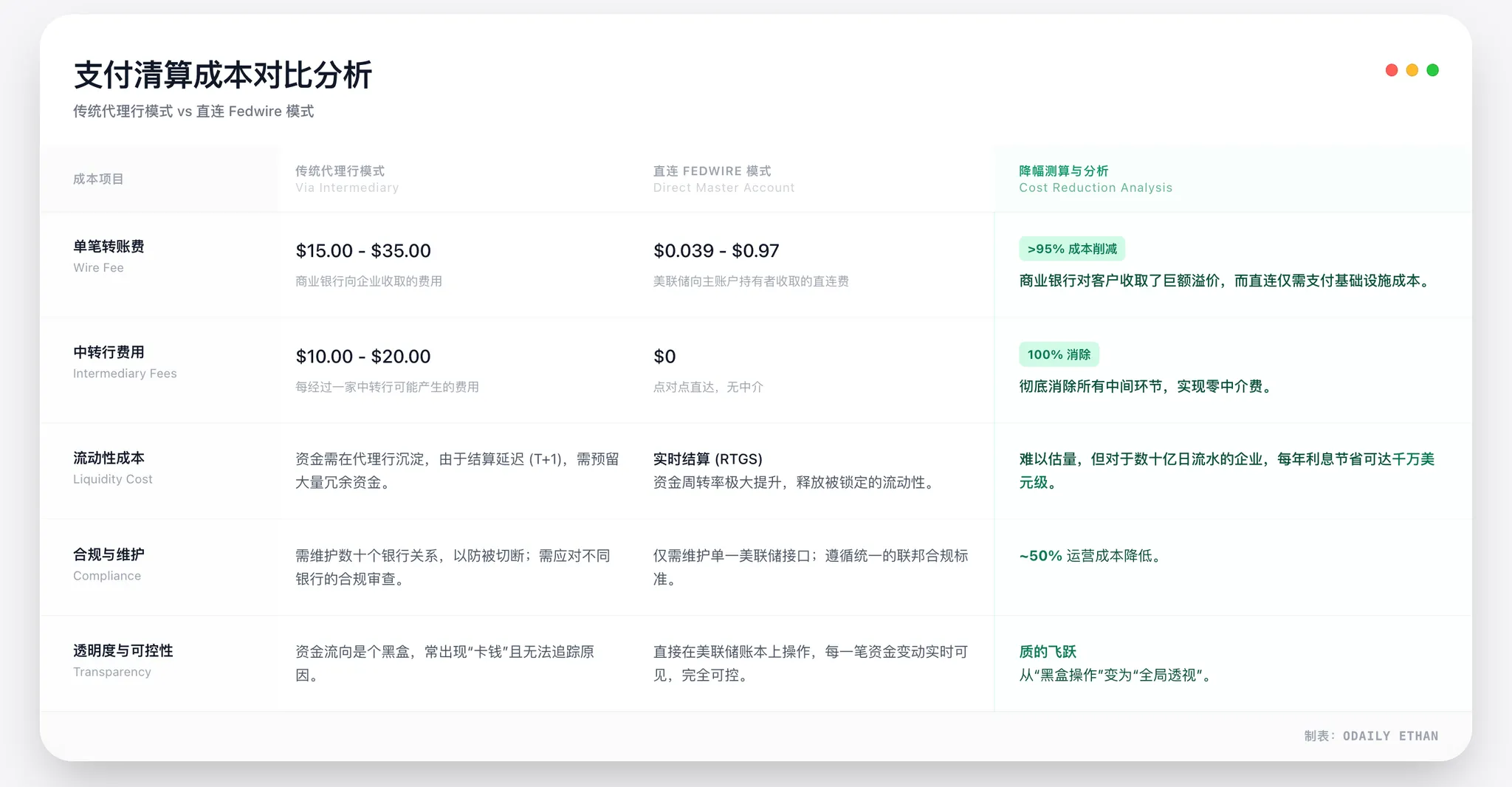
Taking Circle as an example, its nearly $80 billion USDC reserves face huge daily fund flows. If direct connection is achieved, the savings on payment channel fees alone could amount to hundreds of millions of dollars annually. This is not a minor optimization but a fundamental cost restructuring at the business model level.

Therefore, the cost advantage brought by master account eligibility is certain and substantial, directly translating into a core moat for stablecoin issuers in terms of fee competition and operational efficiency.

The Legal and Financial Attributes of Stablecoins are Changing

When stablecoin issuers operate as federal trust banks, the attributes of their products also change. In the old model, USDC or RLUSD were closer to "digital vouchers issued by tech companies," their security highly dependent on the issuer's governance and the soundness of partner banks. In the new structure, stablecoin reserves will be placed within a federally regulated OCC fiduciary system and achieve legal mandatory segregation from the issuer's own assets.

This is not equivalent to a central bank digital currency (CBDC), nor does it involve FDIC insurance, but under the combination of "100% full reserve + federal-level regulation + fiduciary duty," its credit rating is significantly higher than most offshore stablecoin products.

A more practical impact lies in payments. Taking Ripple as an example, its ODL (On-Demand Liquidity) product has long been constrained by bank operating hours and fiat channel availability. Once integrated into the federal clearing system, the切换 between fiat and on-chain assets will no longer be limited by time windows, significantly enhancing the continuity and certainty of cross-border settlements.

Market Reaction is More Rational

Although this development is seen as a milestone within the industry, the market reaction did not show剧烈波动. Whether XRP or USDC-related assets, price changes were relatively limited. But this does not mean the license value is underestimated; it更可能表明: the market already views it as a long-term institutional change, not a short-term trading theme.

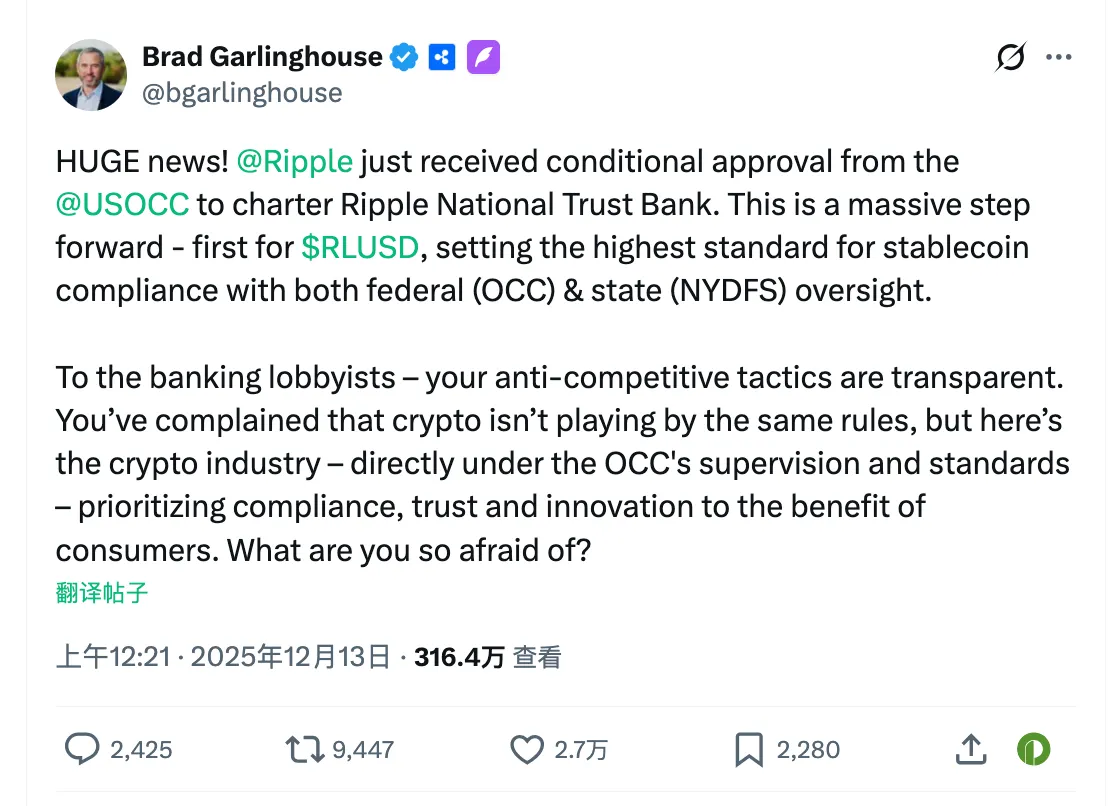
Ripple CEO Brad Garlinghouse defined this progress as "the highest standard on the stablecoin compliance path." He not only emphasized that RLUSD is now under dual regulation (OCC federal and NYDFS state) but also directly targeted traditional banking lobbies: "Your anti-competitive tactics have been seen through. You complain that the crypto industry doesn't follow the rules, but now we are under the OCC's direct regulatory standards. What are you really afraid of?"
Meanwhile, Circle also stated in related announcements that the national trust bank charter will fundamentally reshape institutional trust, enabling issuers to provide digital asset custody services with greater fiduciary responsibility to institutional clients.

The statements from both converge: From "being served by banks" to "becoming part of the bank," crypto finance is entering a全新的 stage. And the federal trust bank license is not just a permit; it paves a safe通道 for institutional capital, which has been观望 due to compliance uncertainty, to enter the crypto market.

The Trump Era's "Golden Period" and the GENIUS Act

Rolling back the clock three or four years, it was hard to imagine crypto companies gaining federal recognition as "banks" by the end of 2025. What facilitated this转变 was not technological breakthrough but a fundamental shift in the political and regulatory environment.

The return of the Trump administration and the enactment of the GENIUS Act together paved the way for crypto finance to access the federal system.

From "De-banking" to Institutional Acceptance

During the Biden administration, the crypto industry long remained in an environment of strong regulation and high uncertainty. Especially after the FTX collapse in 2022, the regulatory基调 shifted to "risk isolation," with the banking system being urged to stay away from crypto business.

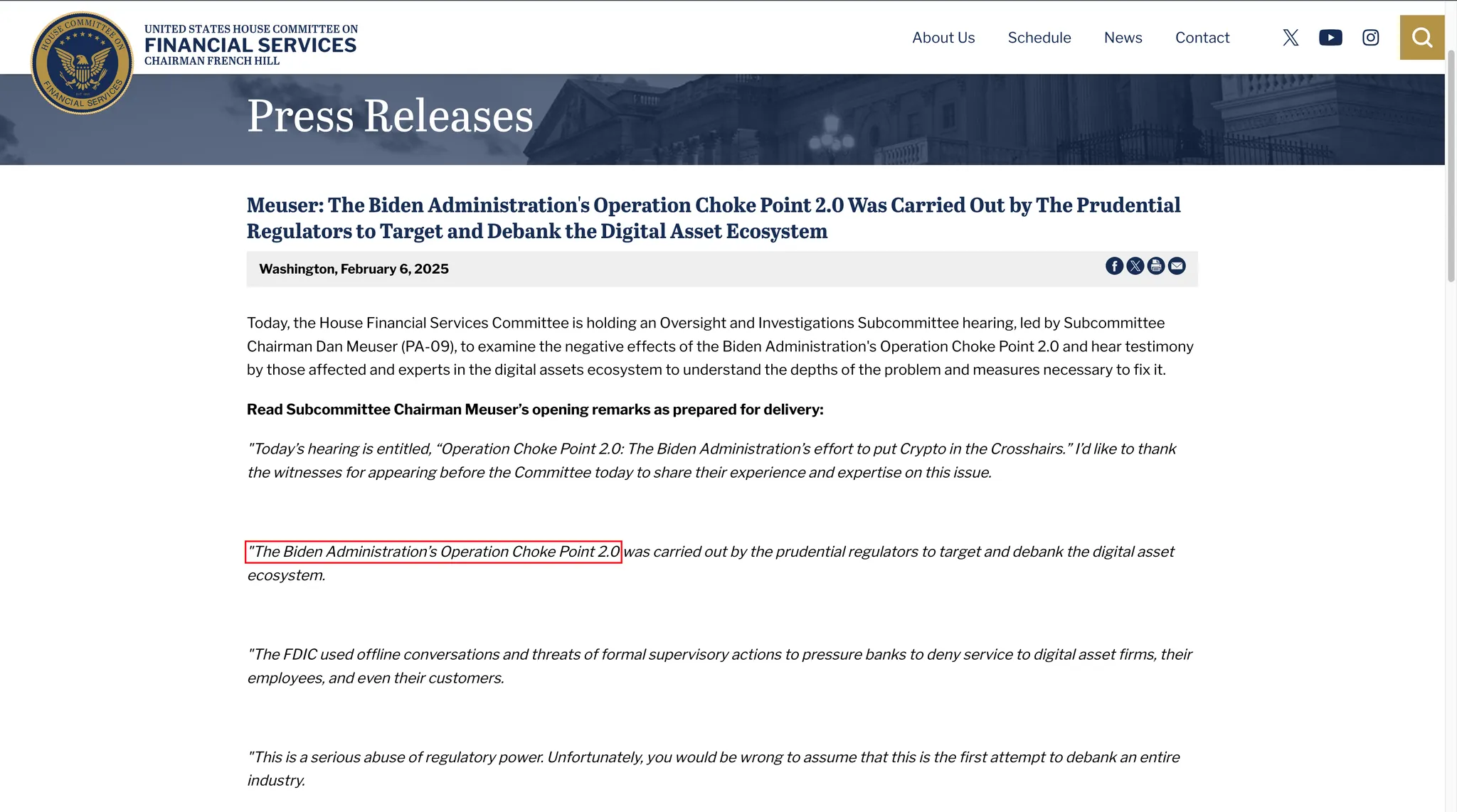
This phase was called "de-banking" within the industry and described by some lawmakers as "Operation Choke Point 2.0." According to subsequent investigations by the House Financial Services Committee, multiple banks cut ties with crypto firms under informal regulatory pressure. The successive exits of Silvergate Bank and Signature Bank were a集中体现 of this trend.

The regulatory logic then was clear: Rather than painstakingly regulating crypto risks, isolate them outside the banking system.
This logic was fundamentally reversed in 2025.

Trump repeatedly expressed support for the crypto industry during his campaign, emphasizing making the US the "global center for crypto innovation." Upon returning to office, crypto assets were no longer单纯 viewed as a risk source but incorporated into broader financial and strategic considerations.

The key shift was that stablecoins began to be seen as an extension tool of the dollar system. On the day the GENIUS Act was signed, the White House explanation明确指出 that regulated dollar stablecoins help expand the demand for US Treasury bonds and consolidate the international status of the US dollar in the digital age. This实质上 redefined the role of stablecoin issuers in US finance.

The Institutional Role of the GENIUS Act

In July 2025, Trump signed the GENIUS Act. The significance of this act lies in首次 establishing a clear legal identity for stablecoins and related institutions at the federal level. The act explicitly allows non-bank institutions, upon meeting conditions, to be regulated federally as "qualified payment stablecoin issuers." This provided an institutional entry point into the federal framework for companies like Circle and Paxos, which were originally outside the banking system.

More importantly, the act imposes hard requirements on reserve assets: stablecoins must be 100% backed by highly liquid assets such as US dollar cash or short-term US Treasury bonds. This实质上 excludes algorithmic stablecoins and high-risk allocations, also高度契合 the trust bank model of "not taking deposits, not making loans."

Furthermore, the act establishes the priority claim right of stablecoin holders. Even if the issuing institution goes bankrupt, the relevant reserve assets must be prioritized to redeem the stablecoins. This clause significantly reduces regulatory concerns about "moral hazard" and enhances the credibility of stablecoins at the institutional level.

Under this framework, the OCC's issuance of federal trust bank licenses to crypto companies became a顺理成章的 institutional implementation according to regulations.

Traditional Finance's Defense and Future Challenges

For the crypto industry, this is a long-awaited institutional breakthrough; but for Wall Street incumbents, it更像是一次必须反击的 invasion of territory. The OCC's approval for five crypto institutions to convert into federal trust banks did not garner unanimous applause but quickly triggered a猛烈的防御 from traditional banking coalitions represented by the Bank Policy Institute (BPI). This war between "old and new banks" has just begun.

BPI's Fierce Counterattack: Three Core Accusations

BPI represents the interests of giants like JPMorgan Chase, Bank of America, and Citigroup. Immediately after the OCC announced its decision, its leadership issued sharp质疑, with core arguments targeting deep-seated conflicts in regulatory philosophy.

First, is the accusation of "regulatory arbitrage" - "calling a deer a horse" (挂羊头卖狗肉). BPI pointed out that these crypto institutions applying for "trust" charters is a form of self-deception, as their actual activities are core banking businesses like payments and clearing, with systemic importance even exceeding that of many medium-sized commercial banks.

However, through the trust charter, their parent companies (e.g., Circle Internet Financial) cleverly avoid the consolidated supervision by the Federal Reserve that is mandatory for "bank holding companies." This means regulators have no authority to review the parent company's software development or external investments—if code vulnerabilities in the parent company lead to bank asset losses, this would create a huge risk exposure in a regulatory blind spot.

Second, is the破坏 of the sacred principle of "separation of banking and commerce". BPI warned that allowing tech companies like Ripple and Circle to own banks实质上 breaks the firewall preventing industrial and commercial giants from using bank funds for输血 (funneling). What makes traditional banks even more dissatisfied is unfair competition: tech companies can use their monopolistic advantages in social networks and data flows to squeeze out banks, without having to fulfill the Community Reinvestment Act (CRA) obligations mandatory for traditional banks.

Finally, is the fear regarding systemic risk and the lack of a safety net. Since these new trust banks have no FDIC insurance backstop, once panic about stablecoin depegging occurs, traditional deposit insurance cannot act as a buffer. BPI argues that this kind of unprotected liquidity crunch would quickly spread, evolving into a systemic crisis similar to 2008.

The Fed's "Final Checkpoint"

The OCC issuing a license does not mean everything is settled. For these five newly minted "federal trust banks," the final and most critical checkpoint to the federal payment system—the right to open a master account—remains tightly held by the Federal Reserve.

Although the OCC认可 their bank status, under the US dual banking system, the Fed has independent discretion. Previously, the crypto bank Custodia Bank in Wyoming initiated lengthy litigation after being denied a master account by the Fed. This precedent shows that there is still a huge gap between obtaining a license and真正接入 Fedwire.

This is also the next main battlefield for traditional banking (BPI) lobbying. Since阻止 the OCC from issuing licenses is impossible, traditional banking forces will势必 pressure the Fed to set extremely high thresholds when approving master accounts—for example, requiring these institutions to prove their anti-money laundering (AML) capabilities are on par with universal banks like JPMorgan Chase, or requiring their parent companies to provide additional capital guarantees.

For Ripple and Circle, this game has just entered the second half: if they get the license but cannot open a Fed master account, they will still have to operate through the correspondent banking model, greatly diminishing the gold content of this "national-level bank"招牌.

Conclusion: The Future is More Than Just Regulatory Games

It can be expected that the future game surrounding crypto banks will显然 not stop at the licensing level.

On one hand, the attitude of state regulators remains uncertain. Powerful state regulators represented by the New York State Department of Financial Services (NYDFS) have long played a leading role in crypto regulation. As federal preemption expands, whether state regulatory power is weakened may trigger new legal disputes.

On the other hand, although the GENIUS Act has taken effect, numerous implementation details still need to be formulated by regulatory agencies. Specific rules including capital requirements, risk isolation, and cybersecurity standards will become the focus of policy in the coming period. Games between different interest groups will likely play out in these technical provisions.

Furthermore, changes at the market level are also worth noting. As crypto institutions obtain bank status, they could become either合作对象 for traditional financial institutions or potential acquisition targets. Whether traditional banks acquire crypto institutions to补齐技术能力, or crypto companies move反向 into banking, the financial landscape could undergo structural adjustments accordingly.

One thing is certain: this OCC approval is not the end of the controversy, but a new starting point. Crypto finance has entered the institutional interior, but how to find a balance between innovation, stability, and competition will remain a question that US financial regulation must answer in the coming years.


Related Questions

QWhat is the significance of the OCC granting federal trust bank charters to the five crypto firms (Ripple, Circle, Paxos, BitGo, Fidelity Digital Assets)?

AThe OCC's approval allows these five digital asset firms to operate as federally chartered national trust banks, marking a pivotal shift where crypto businesses are formally integrated into the U.S. federal banking regulatory framework. It grants them federal preemption, unifying compliance under the OCC instead of navigating disparate state-level regulations, and provides a pathway to potentially access the Federal Reserve's payment systems (like Fedwire), reducing reliance on intermediary banks and lowering settlement costs.

QWhat are the key limitations of a federal trust bank charter compared to a full commercial bank charter?

AA federal trust bank charter does not permit the institution to accept FDIC-insured public deposits or to make commercial loans. This structure is highly aligned with the business models of stablecoin issuers (like Circle and Ripple), which operate on a 100% reserve asset model and do not engage in credit creation or fractional reserve lending, thus avoiding the systemic risks associated with traditional banking.

QHow does direct access to the Federal Reserve's payment systems (like Fedwire) benefit these newly chartered crypto banks?

ADirect access to Fedwire allows these institutions to become direct nodes in the core U.S. payment infrastructure, eliminating the need for intermediary 'correspondent' banks. This reduces settlement fees by an estimated 30-50%, removes 'de-banking' risk (sudden loss of banking services), enables real-time final settlement, and significantly improves efficiency and cost structure for high-volume operations like stablecoin issuance and cross-border payments.

QWhat role did the GENIUS Act play in enabling this regulatory shift for crypto firms?

AThe GENIUS Act, signed into law in July 2025, provided the crucial federal legal framework by defining and legitimizing 'qualified payment stablecoin issuers.' It established requirements for 100% reserve backing with high-liquid assets (cash and short-term Treasuries), granted stablecoin holders priority claim in bankruptcy, and explicitly allowed non-bank entities to become federally regulated stablecoin issuers, which paved the way for the OCC to grant them federal trust bank charters.

QWhat are the main objections raised by traditional banking groups like the Bank Policy Institute (BPI) against this move?

AThe Bank Policy Institute (BPI) argues that this constitutes regulatory arbitrage, allowing crypto firms to perform bank-like functions (payments, clearing) without being subject to the full scrutiny of a bank holding company (e.g., consolidated supervision by the Fed). They also claim it violates the long-standing principle of 'separation of banking and commerce,' creates an unfair competitive advantage (as tech firms avoid community reinvestment obligations), and introduces systemic risk due to the lack of FDIC insurance, which could lead to instability in a crisis.

Related Reads

Trading

Spot
Futures

Hot Articles

What is SONIC

Sonic: Pioneering the Future of Gaming in Web3 Introduction to Sonic In the ever-evolving landscape of Web3, the gaming industry stands out as one of the most dynamic and promising sectors. At the forefront of this revolution is Sonic, a project designed to amplify the gaming ecosystem on the Solana blockchain. Leveraging cutting-edge technology, Sonic aims to deliver an unparalleled gaming experience by efficiently processing millions of requests per second, ensuring that players enjoy seamless gameplay while maintaining low transaction costs. This article delves into the intricate details of Sonic, exploring its creators, funding sources, operational mechanics, and the timeline of significant events that have shaped its journey. What is Sonic? Sonic is an innovative layer-2 network that operates atop the Solana blockchain, specifically tailored to enhance the existing Solana gaming ecosystem. It accomplishes this through a customised, VM-agnostic game engine paired with a HyperGrid interpreter, facilitating sovereign game economies that roll up back to the Solana platform. The primary goals of Sonic include: Enhanced Gaming Experiences: Sonic is committed to offering lightning-fast on-chain gameplay, allowing players and developers to engage with games at previously unattainable speeds. Atomic Interoperability: This feature enables transactions to be executed within Sonic without the need to redeploy Solana programmes and accounts. This makes the process more efficient and directly benefits from Solana Layer1 services and liquidity. Seamless Deployment: Sonic allows developers to write for Ethereum Virtual Machine (EVM) based systems and execute them on Solana’s SVM infrastructure. This interoperability is crucial for attracting a broader range of dApps and decentralised applications to the platform. Support for Developers: By offering native composable gaming primitives and extensible data types - dining within the Entity-Component-System (ECS) framework - game creators can craft intricate business logic with ease. Overall, Sonic's unique approach not only caters to players but also provides an accessible and low-cost environment for developers to innovate and thrive. Creator of Sonic The information regarding the creator of Sonic is somewhat ambiguous. However, it is known that Sonic's SVM is owned by the company Mirror World. The absence of detailed information about the individuals behind Sonic reflects a common trend in several Web3 projects, where collective efforts and partnerships often overshadow individual contributions. Investors of Sonic Sonic has garnered considerable attention and support from various investors within the crypto and gaming sectors. Notably, the project raised an impressive $12 million during its Series A funding round. The round was led by BITKRAFT Ventures, with other notable investors including Galaxy, Okx Ventures, Interactive, Big Brain Holdings, and Mirana. This financial backing signifies the confidence that investment foundations have in Sonic’s potential to revolutionise the Web3 gaming landscape, further validating its innovative approaches and technologies. How Does Sonic Work? Sonic utilises the HyperGrid framework, a sophisticated parallel processing mechanism that enhances its scalability and customisability. Here are the core features that set Sonic apart: Lightning Speed at Low Costs: Sonic offers one of the fastest on-chain gaming experiences compared to other Layer-1 solutions, powered by the scalability of Solana’s virtual machine (SVM). Atomic Interoperability: Sonic enables transaction execution without redeployment of Solana programmes and accounts, effectively streamlining the interaction between users and the blockchain. EVM Compatibility: Developers can effortlessly migrate decentralised applications from EVM chains to the Solana environment using Sonic’s HyperGrid interpreter, increasing the accessibility and integration of various dApps. Ecosystem Support for Developers: By exposing native composable gaming primitives, Sonic facilitates a sandbox-like environment where developers can experiment and implement business logic, greatly enhancing the overall development experience. Monetisation Infrastructure: Sonic natively supports growth and monetisation efforts, providing frameworks for traffic generation, payments, and settlements, thereby ensuring that gaming projects are not only viable but also sustainable financially. Timeline of Sonic The evolution of Sonic has been marked by several key milestones. Below is a brief timeline highlighting critical events in the project's history: 2022: The Sonic cryptocurrency was officially launched, marking the beginning of its journey in the Web3 gaming arena. 2024: June: Sonic SVM successfully raised $12 million in a Series A funding round. This investment allowed Sonic to further develop its platform and expand its offerings. August: The launch of the Sonic Odyssey testnet provided users with the first opportunity to engage with the platform, offering interactive activities such as collecting rings—a nod to gaming nostalgia. October: SonicX, an innovative crypto game integrated with Solana, made its debut on TikTok, capturing the attention of over 120,000 users within a short span. This integration illustrated Sonic’s commitment to reaching a broader, global audience and showcased the potential of blockchain gaming. Key Points Sonic SVM is a revolutionary layer-2 network on Solana explicitly designed to enhance the GameFi landscape, demonstrating great potential for future development. HyperGrid Framework empowers Sonic by introducing horizontal scaling capabilities, ensuring that the network can handle the demands of Web3 gaming. Integration with Social Platforms: The successful launch of SonicX on TikTok displays Sonic’s strategy to leverage social media platforms to engage users, exponentially increasing the exposure and reach of its projects. Investment Confidence: The substantial funding from BITKRAFT Ventures, among others, emphasizes the robust backing Sonic has, paving the way for its ambitious future. In conclusion, Sonic encapsulates the essence of Web3 gaming innovation, striking a balance between cutting-edge technology, developer-centric tools, and community engagement. As the project continues to evolve, it is poised to redefine the gaming landscape, making it a notable entity for gamers and developers alike. As Sonic moves forward, it will undoubtedly attract greater interest and participation, solidifying its place within the broader narrative of blockchain gaming.

1.3k Total ViewsPublished 2024.04.04Updated 2024.12.03

What is SONIC

What is $S$

Understanding SPERO: A Comprehensive Overview Introduction to SPERO As the landscape of innovation continues to evolve, the emergence of web3 technologies and cryptocurrency projects plays a pivotal role in shaping the digital future. One project that has garnered attention in this dynamic field is SPERO, denoted as SPERO,$$s$. This article aims to gather and present detailed information about SPERO, to help enthusiasts and investors understand its foundations, objectives, and innovations within the web3 and crypto domains. What is SPERO,$$s$? SPERO,$$s$ is a unique project within the crypto space that seeks to leverage the principles of decentralisation and blockchain technology to create an ecosystem that promotes engagement, utility, and financial inclusion. The project is tailored to facilitate peer-to-peer interactions in new ways, providing users with innovative financial solutions and services. At its core, SPERO,$$s$ aims to empower individuals by providing tools and platforms that enhance user experience in the cryptocurrency space. This includes enabling more flexible transaction methods, fostering community-driven initiatives, and creating pathways for financial opportunities through decentralised applications (dApps). The underlying vision of SPERO,$$s$ revolves around inclusiveness, aiming to bridge gaps within traditional finance while harnessing the benefits of blockchain technology. Who is the Creator of SPERO,$$s$? The identity of the creator of SPERO,$$s$ remains somewhat obscure, as there are limited publicly available resources providing detailed background information on its founder(s). This lack of transparency can stem from the project's commitment to decentralisation—an ethos that many web3 projects share, prioritising collective contributions over individual recognition. By centring discussions around the community and its collective goals, SPERO,$$s$ embodies the essence of empowerment without singling out specific individuals. As such, understanding the ethos and mission of SPERO remains more important than identifying a singular creator. Who are the Investors of SPERO,$$s$? SPERO,$$s$ is supported by a diverse array of investors ranging from venture capitalists to angel investors dedicated to fostering innovation in the crypto sector. The focus of these investors generally aligns with SPERO's mission—prioritising projects that promise societal technological advancement, financial inclusivity, and decentralised governance. These investor foundations are typically interested in projects that not only offer innovative products but also contribute positively to the blockchain community and its ecosystems. The backing from these investors reinforces SPERO,$$s$ as a noteworthy contender in the rapidly evolving domain of crypto projects. How Does SPERO,$$s$ Work? SPERO,$$s$ employs a multi-faceted framework that distinguishes it from conventional cryptocurrency projects. Here are some of the key features that underline its uniqueness and innovation: Decentralised Governance: SPERO,$$s$ integrates decentralised governance models, empowering users to participate actively in decision-making processes regarding the project’s future. This approach fosters a sense of ownership and accountability among community members. Token Utility: SPERO,$$s$ utilises its own cryptocurrency token, designed to serve various functions within the ecosystem. These tokens enable transactions, rewards, and the facilitation of services offered on the platform, enhancing overall engagement and utility. Layered Architecture: The technical architecture of SPERO,$$s$ supports modularity and scalability, allowing for seamless integration of additional features and applications as the project evolves. This adaptability is paramount for sustaining relevance in the ever-changing crypto landscape. Community Engagement: The project emphasises community-driven initiatives, employing mechanisms that incentivise collaboration and feedback. By nurturing a strong community, SPERO,$$s$ can better address user needs and adapt to market trends. Focus on Inclusion: By offering low transaction fees and user-friendly interfaces, SPERO,$$s$ aims to attract a diverse user base, including individuals who may not previously have engaged in the crypto space. This commitment to inclusion aligns with its overarching mission of empowerment through accessibility. Timeline of SPERO,$$s$ Understanding a project's history provides crucial insights into its development trajectory and milestones. Below is a suggested timeline mapping significant events in the evolution of SPERO,$$s$: Conceptualisation and Ideation Phase: The initial ideas forming the basis of SPERO,$$s$ were conceived, aligning closely with the principles of decentralisation and community focus within the blockchain industry. Launch of Project Whitepaper: Following the conceptual phase, a comprehensive whitepaper detailing the vision, goals, and technological infrastructure of SPERO,$$s$ was released to garner community interest and feedback. Community Building and Early Engagements: Active outreach efforts were made to build a community of early adopters and potential investors, facilitating discussions around the project’s goals and garnering support. Token Generation Event: SPERO,$$s$ conducted a token generation event (TGE) to distribute its native tokens to early supporters and establish initial liquidity within the ecosystem. Launch of Initial dApp: The first decentralised application (dApp) associated with SPERO,$$s$ went live, allowing users to engage with the platform's core functionalities. Ongoing Development and Partnerships: Continuous updates and enhancements to the project's offerings, including strategic partnerships with other players in the blockchain space, have shaped SPERO,$$s$ into a competitive and evolving player in the crypto market. Conclusion SPERO,$$s$ stands as a testament to the potential of web3 and cryptocurrency to revolutionise financial systems and empower individuals. With a commitment to decentralised governance, community engagement, and innovatively designed functionalities, it paves the way toward a more inclusive financial landscape. As with any investment in the rapidly evolving crypto space, potential investors and users are encouraged to research thoroughly and engage thoughtfully with the ongoing developments within SPERO,$$s$. The project showcases the innovative spirit of the crypto industry, inviting further exploration into its myriad possibilities. While the journey of SPERO,$$s$ is still unfolding, its foundational principles may indeed influence the future of how we interact with technology, finance, and each other in interconnected digital ecosystems.

54 Total ViewsPublished 2024.12.17Updated 2024.12.17

What is $S$

What is AGENT S

Agent S: The Future of Autonomous Interaction in Web3 Introduction In the ever-evolving landscape of Web3 and cryptocurrency, innovations are constantly redefining how individuals interact with digital platforms. One such pioneering project, Agent S, promises to revolutionise human-computer interaction through its open agentic framework. By paving the way for autonomous interactions, Agent S aims to simplify complex tasks, offering transformative applications in artificial intelligence (AI). This detailed exploration will delve into the project's intricacies, its unique features, and the implications for the cryptocurrency domain. What is Agent S? Agent S stands as a groundbreaking open agentic framework, specifically designed to tackle three fundamental challenges in the automation of computer tasks: Acquiring Domain-Specific Knowledge: The framework intelligently learns from various external knowledge sources and internal experiences. This dual approach empowers it to build a rich repository of domain-specific knowledge, enhancing its performance in task execution. Planning Over Long Task Horizons: Agent S employs experience-augmented hierarchical planning, a strategic approach that facilitates efficient breakdown and execution of intricate tasks. This feature significantly enhances its ability to manage multiple subtasks efficiently and effectively. Handling Dynamic, Non-Uniform Interfaces: The project introduces the Agent-Computer Interface (ACI), an innovative solution that enhances the interaction between agents and users. Utilizing Multimodal Large Language Models (MLLMs), Agent S can navigate and manipulate diverse graphical user interfaces seamlessly. Through these pioneering features, Agent S provides a robust framework that addresses the complexities involved in automating human interaction with machines, setting the stage for myriad applications in AI and beyond. Who is the Creator of Agent S? While the concept of Agent S is fundamentally innovative, specific information about its creator remains elusive. The creator is currently unknown, which highlights either the nascent stage of the project or the strategic choice to keep founding members under wraps. Regardless of anonymity, the focus remains on the framework's capabilities and potential. Who are the Investors of Agent S? As Agent S is relatively new in the cryptographic ecosystem, detailed information regarding its investors and financial backers is not explicitly documented. The lack of publicly available insights into the investment foundations or organisations supporting the project raises questions about its funding structure and development roadmap. Understanding the backing is crucial for gauging the project's sustainability and potential market impact. How Does Agent S Work? At the core of Agent S lies cutting-edge technology that enables it to function effectively in diverse settings. Its operational model is built around several key features: Human-like Computer Interaction: The framework offers advanced AI planning, striving to make interactions with computers more intuitive. By mimicking human behaviour in tasks execution, it promises to elevate user experiences. Narrative Memory: Employed to leverage high-level experiences, Agent S utilises narrative memory to keep track of task histories, thereby enhancing its decision-making processes. Episodic Memory: This feature provides users with step-by-step guidance, allowing the framework to offer contextual support as tasks unfold. Support for OpenACI: With the ability to run locally, Agent S allows users to maintain control over their interactions and workflows, aligning with the decentralised ethos of Web3. Easy Integration with External APIs: Its versatility and compatibility with various AI platforms ensure that Agent S can fit seamlessly into existing technological ecosystems, making it an appealing choice for developers and organisations. These functionalities collectively contribute to Agent S's unique position within the crypto space, as it automates complex, multi-step tasks with minimal human intervention. As the project evolves, its potential applications in Web3 could redefine how digital interactions unfold. Timeline of Agent S The development and milestones of Agent S can be encapsulated in a timeline that highlights its significant events: September 27, 2024: The concept of Agent S was launched in a comprehensive research paper titled “An Open Agentic Framework that Uses Computers Like a Human,” showcasing the groundwork for the project. October 10, 2024: The research paper was made publicly available on arXiv, offering an in-depth exploration of the framework and its performance evaluation based on the OSWorld benchmark. October 12, 2024: A video presentation was released, providing a visual insight into the capabilities and features of Agent S, further engaging potential users and investors. These markers in the timeline not only illustrate the progress of Agent S but also indicate its commitment to transparency and community engagement. Key Points About Agent S As the Agent S framework continues to evolve, several key attributes stand out, underscoring its innovative nature and potential: Innovative Framework: Designed to provide an intuitive use of computers akin to human interaction, Agent S brings a novel approach to task automation. Autonomous Interaction: The ability to interact autonomously with computers through GUI signifies a leap towards more intelligent and efficient computing solutions. Complex Task Automation: With its robust methodology, it can automate complex, multi-step tasks, making processes faster and less error-prone. Continuous Improvement: The learning mechanisms enable Agent S to improve from past experiences, continually enhancing its performance and efficacy. Versatility: Its adaptability across different operating environments like OSWorld and WindowsAgentArena ensures that it can serve a broad range of applications. As Agent S positions itself in the Web3 and crypto landscape, its potential to enhance interaction capabilities and automate processes signifies a significant advancement in AI technologies. Through its innovative framework, Agent S exemplifies the future of digital interactions, promising a more seamless and efficient experience for users across various industries. Conclusion Agent S represents a bold leap forward in the marriage of AI and Web3, with the capacity to redefine how we interact with technology. While still in its early stages, the possibilities for its application are vast and compelling. Through its comprehensive framework addressing critical challenges, Agent S aims to bring autonomous interactions to the forefront of the digital experience. As we move deeper into the realms of cryptocurrency and decentralisation, projects like Agent S will undoubtedly play a crucial role in shaping the future of technology and human-computer collaboration.

574 Total ViewsPublished 2025.01.14Updated 2025.01.14

What is AGENT S

Discussions

Welcome to the HTX Community. Here, you can stay informed about the latest platform developments and gain access to professional market insights. Users' opinions on the price of S (S) are presented below.

活动图片












